
Fast Withdrawal Casino Australia: The 2026 Reality Behind the Marketing
Every Australian-facing “fast withdrawal” casino is an offshore operation breaking the Interactive Gambling Act 2001 — there is no licensed online casino in this country. The speed claims are real, the sites are real, the Australian licence that would back them does not exist. This guide lays out what players actually face in 2026: which operators clear cashouts fastest, what each payment method really takes, and what disappears when the regulator that would normally police the operator is on the other side of the world.

Current as of 12 November 2026 · Verified against the Australian Communications and Media Authority register and operator T&Cs.
Table of Contents
- Why every “fast withdrawal” casino in Australia is an offshore operation
- The operators Australian players turn to for fast payouts in 2026
- The Interactive Gambling Act: why online casino is illegal in Australia
- What you lose when an offshore casino is not connected to BetStop
- Which withdrawal method actually clears your money fastest
- Crypto withdrawals: the speed ceiling for Australian players
- Why your 2026 bonus is smaller than it looks once wagering hits
- No-ID casinos: what you trade for a faster payout
- Online pokies that pay out fast: what the RTP numbers mean for your cashout
- Live dealer and new casinos: do fresh sites pay out any quicker?
- How we selected and ranked these operators
- Your money, your call: what to do before you deposit at an offshore casino
- Frequently asked questions about fast withdrawal casinos in Australia
Why every “fast withdrawal” casino in Australia is an offshore operation
The single fact this page keeps returning to is the most basic one: online casino games, online pokies and in-play sports betting are prohibited in Australia under the Interactive Gambling Act 2001, and no licence exists for them federally or in any state or territory. The Australian Communications and Media Authority, ACMA, is the regulator that enforces the prohibition, and its enforcement record now runs to more than 1,560 websites blocked since November 2019. Every Australian-facing online casino in this guide operates from outside the country. None of them is licensed here. None of them can be.
That is the baseline, not a footnote. A casino offering “fast withdrawal” to an Australian player is making two simultaneous claims: that the cashout pipeline will be fast, and that the operation is trustworthy enough to send your money to. The pipeline can be fast. The trust has nowhere local to anchor. The Australian regulator that investigates complaints, the dispute resolution scheme that arbitrates disputes, and the self-exclusion register that covers problem gambling all sit outside the relationship — by design, because the operator has placed itself outside the Australian regulatory perimeter.
The ACMA’s enforcement has been quiet but relentless. The agency has had 1,564 illegal gambling and affiliate websites blocked by Australian ISPs since November 2019, and more than 225 illegal services have voluntarily withdrawn from the Australian market since 2017. That is the practical enforcement ceiling: ISPs block sites at ACMA’s request, and operators occasionally pull out when the legal pressure exceeds the marketing value of the Australian market. The IGA does not prosecute individual players — it targets the provider — which is why millions of Australians continue to use these sites without legal consequence, and why the practical risk is a different one: a blocked site with a balance still on it, no Australian complaints channel, and no way to compel a withdrawal.
What “fast withdrawal” actually means at an offshore casino
The marketing says instant. The mechanics say something else. No casino site is truly instant — every legitimate operator runs account verification before your first withdrawal, and the biggest cause of a slow payout is your own KYC, not the casino’s payment processing. A “fast withdrawal” claim is therefore the operator’s promise that, once KYC has cleared, the cashout pipeline itself — internal review, then payment method, then banking rail — will move quickly. That is a narrower promise than the headline suggests.
The pipeline has three stages. First, internal review: the casino’s payments team approves the withdrawal, which on a clean account can take minutes but on a flagged account can take days. Second, payment method clearance: the operator hands the funds off to the chosen rail — PayID, crypto, e-wallet, card or bank transfer — each of which has its own median and worst-case timeline. Third, the banking rail itself: the time the money takes to actually arrive, which can be the fastest step or the slowest depending on the method.
For Australian players, the published medians at tested casinos sit at 42 minutes for crypto, 2 hours for PayID, 6 hours for e-wallets, 2 working days for Visa and Mastercard, and 3 working days for bank transfer. Worst-case recorded times are roughly 4 hours for crypto, 8 hours for PayID, 18 hours for e-wallets, 5 working days for cards, and 7 working days for bank transfer. Those numbers are not abstractions — they describe the difference between a withdrawal that lands before lunch and one that takes most of a working week. Crypto is the fastest method overall, and PayID is the quickest AUD-native option.
The Australian online casino landscape: all offshore, all unregulated
There is no licensed online casino in Australia. None. The category that competitors present as a list of operators is, from a regulatory perspective, a list of brands that have positioned themselves on the wrong side of a federal prohibition. The Interactive Gambling Act 2001 bans interactive gambling services that offer casino-style games, pokies and in-play betting to customers physically present in Australia; the Interactive Gambling Amendment Act 2017 strengthened enforcement; and the Interactive Gambling Amendment (Gambling Reform) Bill 2026, which passed Parliament on 19 August 2026 and commences 1 January 2027, layers further restrictions on top.
The “offshore” label is doing more work than it looks. An offshore casino can be licensed in Curacao, Malta, Anjouan or one of several smaller jurisdictions, and that licence may be verifiable — Bizzo Casino’s Curacao licence, Antillephone N.V. 8048/JAZ2017-067, is one — but it is not an Australian licence and confers none of the Australian protections. Offshore casinos are not connected to BetStop, the National Self-Exclusion Register that binds every Australian-licensed wagering service. They are not within ACMA’s complaint jurisdiction. They are not subject to the Australian consumer law that governs licensed wagering providers. The site can be blocked at any time by ACMA request, and the player has no local recourse.
That is the shape of the market this guide operates inside. The rest of the page ranks within that shape, but it does not soften it. Crown still stands as a state-licensed land-based casino, distinct from everything in the offshore casino segment.
The operators Australian players turn to for fast payouts in 2026
Ten operators appear in this comparison. Nine are offshore casinos. One is a licensed Australian wagering operator included as a contrast, not a casino option. Every offshore entry below operates without an Australian licence because no such licence exists. The table summarises status, best documented withdrawal speed and licence position; the operator write-ups that follow give the detail.
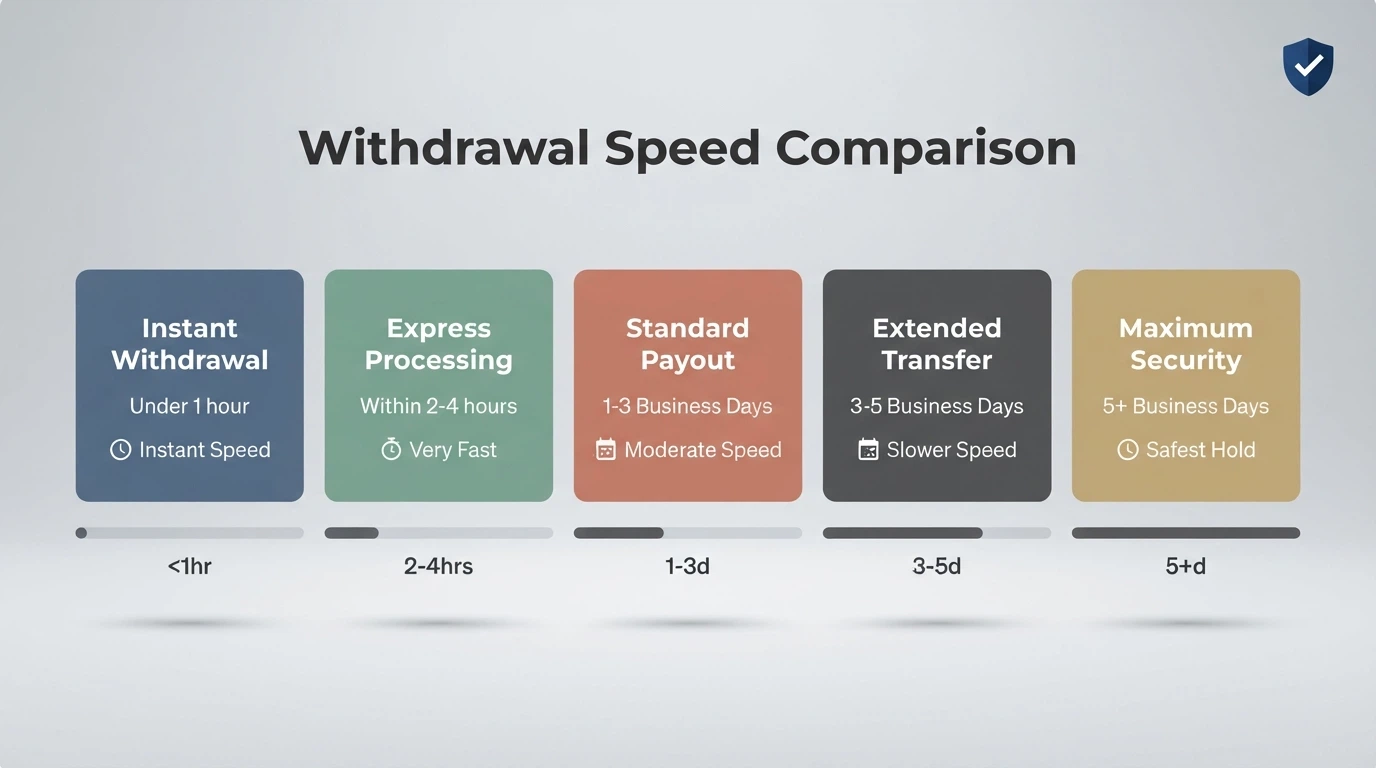
| Operator | Status | Best withdrawal speed | Licence |
|---|---|---|---|
| RocketPlay | Offshore casino | PayID under 1 hour | Curacao (register not confirmed) |
| SkyCrown | Offshore casino | ~10 min advertised; crypto under 1 hr, PayID same day | Curacao (register not confirmed) |
| Royal Reels | Offshore casino | — | Curacao (register not confirmed) |
| WinSpirit | Offshore casino | E-wallets 0–24 hrs; crypto under 2 hrs | Curacao (register not confirmed) |
| Bizzo Casino | Offshore casino | Crypto minutes to hours | Curacao (Antillephone N.V. 8048/JAZ2017-067) |
| Stake | Offshore casino | — | Curacao (register not confirmed) |
| Fair Go Casino | Offshore casino | — | Curacao (register not confirmed) |
| Scream Casino | Offshore casino | — | Not confirmed |
| Rainbet | Offshore casino | — | Not confirmed |
| Neds | Licensed AU wagering | — | NT Racing and Wagering Commission |
The five filled speed cells in the middle column are the operators with independently confirmed data for at least one payment method. The four em dashes sit where independent performance data was not available this review cycle — a separate gap from the marketing claims those operators publish on their own sites. Treat any operator’s advertised speed as a starting point, not a verified figure, until the data behind it can be checked.
RocketPlay
RocketPlay sits at the practical end of the speed range for Australian players. Its PayID withdrawals clear in under an hour for most Australian banks — among the fastest audited times in the offshore segment — and the A$5,000 daily PayID limit sits well above the A$10,000 weekly cap that constrains some peers. The broader withdrawal ceiling is fee-free up to A$15,000 per week and A$30,000 per month, which matters for a player whose balance has grown large enough for withdrawal friction to become its own cost.
Welcome wagering sits in the industry-standard 30x–40x band, with no obvious small-print that changes the math. The exact bonus shape was not confirmed in this review cycle, but the wagering multiplier carries through to the turnover required and the time the player needs to clear it. The PayID-specific speed is the standout data point, and it is independently tested rather than operator-stated. For a player who values PayID speed above all else and wants headroom to withdraw larger balances, RocketPlay earns its position at the top of this ranking on a verified number rather than a marketing promise.
SkyCrown
SkyCrown is the aggressive-marketing end of the offshore segment. The four-tier welcome package adds up to A$8,000 plus 400 free spins — eye-catching by any standard — but the 40x wagering applies to every stage, the free-spin payout is capped at A$300 per part, and the minimum qualifying deposit rises from A$30 to A$50 by the fourth deposit. On withdrawals, the operator advertises a 10-minute average, with crypto clearing inside an hour and PayID settling the same day once internal review approves the cashout. Daily limits are A$5,000; weekly A$10,000; monthly A$15,000.
The 10-minute advertised figure is the marketing claim, not an audited result, and the published withdrawal limits are tighter than RocketPlay’s on a daily and weekly basis. SkyCrown suits the reader who wants the biggest bonus headline and accepts the wagering attached to it. The reading: treat the 10 minutes as an upper bound on the speed ceiling, not a guarantee, and read the wagering terms before the deposit button.
Royal Reels
Royal Reels pitches itself on catalogue breadth: 5,400+ pokies across 40+ providers, which is the largest pokies library in the featured set by a clear margin. The welcome offer is a three-deposit package totalling up to A$2,500 across 100%, 75% and 100% matches, with 35x wagering applied to the bonus portion only — a friendlier structure than the 40x-on-bonus-plus-deposit deals elsewhere, and the kind of detail that matters when working out what a bonus really costs. The A$5 per-spin cap during bonus clearance is the standard ceiling; an A$10 no-deposit bonus is offered after phone verification, which functions as a soft KYC gate.
On withdrawals, the operator describes its crypto and PayID cashouts as instant, but no independently audited time was available this review cycle. That is the gap a Royal Reels player cannot close without testing the pipeline themselves. Royal Reels fits the player who values pokies variety first and reads the bonus clearing fine print before they start. The size of the library is real; the speed claim sits in the gap between marketing and verification.
WinSpirit
WinSpirit runs a tightly defined welcome offer — 100% up to A$300 plus 100 free spins on five named BGaming titles — with the kind of small print most operators prefer not to print at all: 40x wagering, a 7-day bonus validity window, an A$5 maximum bet during clear-down, a 31-day window to activate the bonus at all, and an A$50 maximum cashout from any no-deposit offer. For a player who reads the bonus terms before they accept them, that transparency is worth something; for someone chasing headline numbers, it reads as fussy.
On withdrawals, e-wallets clear in 0–24 hours and crypto in under two hours; cards and bank transfers take one to three business days. Daily limits are A$5,000 with a minimum withdrawal of A$20–A$30 depending on the method. WinSpirit suits the player who plans their bonus clearing the way they plan a session — with a stopwatch — over the player who wants the biggest match. Compared with Royal Reels’ three-deposit structure, WinSpirit offers less headline value but tighter rules and a verified withdrawal timeline.
Bizzo Casino
Bizzo is one of the few operators in this segment with a verifiable Curacao licence number — Antillephone N.V. 8048/JAZ2017-067 — which at least lets a player confirm what the regulator in question has actually issued. Minimum deposits and withdrawals are both A$10, the lowest in the featured set, and crypto withdrawals clear in minutes to hours against the three-to-five business days a bank transfer takes. The catch is RTP: the same pokie can run at a lower return rate on the Bizzo platform than the provider’s published default — research gives the concrete example of a familiar game at 94.5% on Bizzo versus 96.5% elsewhere. That two-point gap compounds across thousands of spins and quietly shrinks any payout edge a player thought they had.
Bizzo suits the small-stake player who values low minimums and a verifiable licence, and who checks the RTP of the games they actually play. The licence number is the rarest thing on the page. The RTP setting is the most consequential.
Stake
Stake is the brand Australian crypto-first players tend to encounter first, and it runs the model the rest of the segment borrows from: a Curacao-registered operation built around cryptocurrency deposits and withdrawals rather than card or bank rails. Independent data on its current bonus terms, withdrawal speeds and limits was not confirmed in this review cycle, so any speed claim for Stake here would be fabricated. Treat the brand as a known name in the offshore segment rather than a verified performer against the figures cited for the operators above. The general crypto-speed pattern — minutes for the popular altcoins, an hour for Bitcoin — is what the segment looks like, but Stake’s own numbers were not in this run’s verified set.
Fair Go Casino
Fair Go Casino leans on its .com.au domain to signal an Australian focus, and the A$20 minimum deposit sits at the lower end of the segment. The relevant detail is what happens at withdrawal: KYC is triggered before any serious cashout, which inverts the speed advantage the AU-branded domain was meant to suggest. Independent data on its bonus structure and current payout speeds was not confirmed in this review cycle. Fair Go suits a player who has decided they want an Australian-facing brand and accepts that the speed story ends at the KYC wall. The domain name is not a regulator.
Scream Casino
Scream Casino is one of several newer names Australian players encounter on affiliate lists, with a name that does more work than the public data behind it. Independent data on its licence, bonus terms and withdrawal speeds was not confirmed in this review cycle. The page lists it because it is part of the market Australian players meet; it does not include it in the speed comparison because no verified number supports an entry. Treat it as a known name with no verified performance against the figures cited elsewhere in this guide.
Rainbet
Rainbet is another operator with visible Australian-facing traffic but minimal independently confirmed data on licence, bonus structure or withdrawal speed. Where it sits in this list is a market-presence call rather than a performance call. The honest position: Rainbet exists, players use it, and nothing in this guide can speak to how its payouts actually compare. The em dash in the table is the right cell for now.
Neds
Neds belongs on this list as the licensed Australian contrast — and that contrast does most of the work. Neds is licensed by the Northern Territory Racing and Wagering Commission, takes bets on sports and racing only, and offers no online casino games, no pokies, no table games. It is connected to BetStop, accepts AUD through PayID and bank transfer, and falls under Australian consumer-protection law. Anyone reading this guide for casino games will find nothing here to play; anyone reading it for the licensed wagering alternative has found it. Neds makes the legal shape of the market visible by what it does not offer.
The Interactive Gambling Act: why online casino is illegal in Australia
The Interactive Gambling Act 2001 is the federal law that prohibits the supply of interactive gambling services to customers physically present in Australia. Online casino games, online pokies and in-play sports betting sit inside the prohibited category; the licensing regime that covers wagering on races and pre-event sport is a separate, permitted category administered by state and territory regulators. The shape of the prohibition has been stable for a quarter-century, but the perimeter around it has tightened significantly through the 2017 and 2026 amendments.

What the Interactive Gambling Act 2001 actually bans
The IGA 2001 prohibits the supply of interactive gambling services to people in Australia where those services involve casino-style games, gaming machines or in-play sports betting. Lotteries, keno (until 1 January 2027), and wagering on sporting events and races placed before the event begins are not covered by the prohibition and are licensed at state and territory level. The Northern Territory Racing and Wagering Commission, operating through Licensing NT, is the de facto national licensor for online wagering, with licences running for up to 20 years.
There is no online casino licence anywhere in Australia — not federally, not in any state or territory. Land-based casinos (Crown Melbourne, The Star Sydney and the smaller state operators) are state-licensed and exist as valid points of contrast for an online page, but their licences cover their physical premises and the related online services they may run under separate approvals, not the broader interactive casino market. A reader confusing a land-based casino licence with an offshore online casino’s Curacao registration is making exactly the comparison the prohibition was designed to make impossible.
The 2026 reform: what changes on 1 January 2027
The Interactive Gambling Amendment (Gambling Reform) Bill 2026 passed Parliament on 19 August 2026 and its measures commence on 1 January 2027. It is the largest gambling reform package in Australian history, and several of its provisions directly affect the offshore casino market this guide describes. Wagering advertising is banned during live sporting event coverage from 15 minutes before the event starts to 5 minutes after it ends, between 5:00 am and 8:30 pm. Television wagering advertising is capped at three ads per hour between 5:00 am and 8:30 pm. Broadcasting of sporting odds is banned outright. No wagering promotion from athletes, celebrities or influencers is permitted.
A national wagering advertising opt-out register known as AdStop will be administered by ACMA, giving individuals a single mechanism to opt out of wagering advertising across online platforms — though AdStop is not expected to be operational by 1 January 2027 and is likely to commence on a later day fixed by proclamation. Online wagering ads may be shown only to users who are logged in, confirmed over 18 and offered an opt-out. Direct marketing of inducements is prohibited for 14 days after a customer signs up, for 90 days after a person deregisters from BetStop, and indefinitely for customers identified as at risk of gambling-related harm. Banks and payment providers gain express authority to block transactions to illegal gambling operators — the most consequential single change for offshore users. Online keno (“pocket pokies”) and foreign-matched lotteries are prohibited under the reform.
The payment-blocking power is the provision that lands hardest on the offshore market. A bank deciding to act on the new authority could decline a transaction to an illegal operator regardless of the customer’s preference, and the operator’s payment processor sits in the same enforcement perimeter. The reform does not change the legality of the offshore casino itself — that prohibition has been in force since 2001 — but it adds a new tool to the existing enforcement machinery, and the offshore segment’s payment options are exactly the kind of friction that creates.
What ACMA enforcement means for the player
The ACMA enforces the prohibition at the provider end. Since its first blocking request in November 2019, the agency has had 1,564 illegal gambling and affiliate websites blocked by Australian ISPs, and more than 225 illegal services have withdrawn from the Australian market since 2017. The blocking mechanism works at the ISP layer: when ACMA requests a block, the major Australian ISPs implement it, and the domain stops resolving inside Australia. The mechanism is reliable and rapid for the affected site.
The IGA targets the provider, not the player. No Australian has been prosecuted for using an offshore casino. The practical risk for a player is not a fine or a criminal record; it is the cumulative consequence of using a service that sits outside the Australian regulatory perimeter. A site can be blocked with a balance still on it. A withdrawal can be refused or delayed with no Australian complaints channel to escalate. A win can be voided with no dispute resolution scheme to adjudicate. The site can simply stop operating, and the funds on it stop with it. None of these risks are theoretical — each is the kind of failure mode that recurs across offshore consumer disputes in every market where the regulator is offshore.
What you lose when an offshore casino is not connected to BetStop
BetStop is Australia’s most effective single harm-reduction tool, and it does not reach a single casino in this guide. The National Self-Exclusion Register launched on 21 August 2023 and runs as a federal register administered by ACMA; one registration excludes a person from every Australian-licensed online and phone wagering provider in the country. To the end of Q3 FY 2025–2026, 59,830 people had registered, and 37,247 had active exclusions as of 31 March 2026.
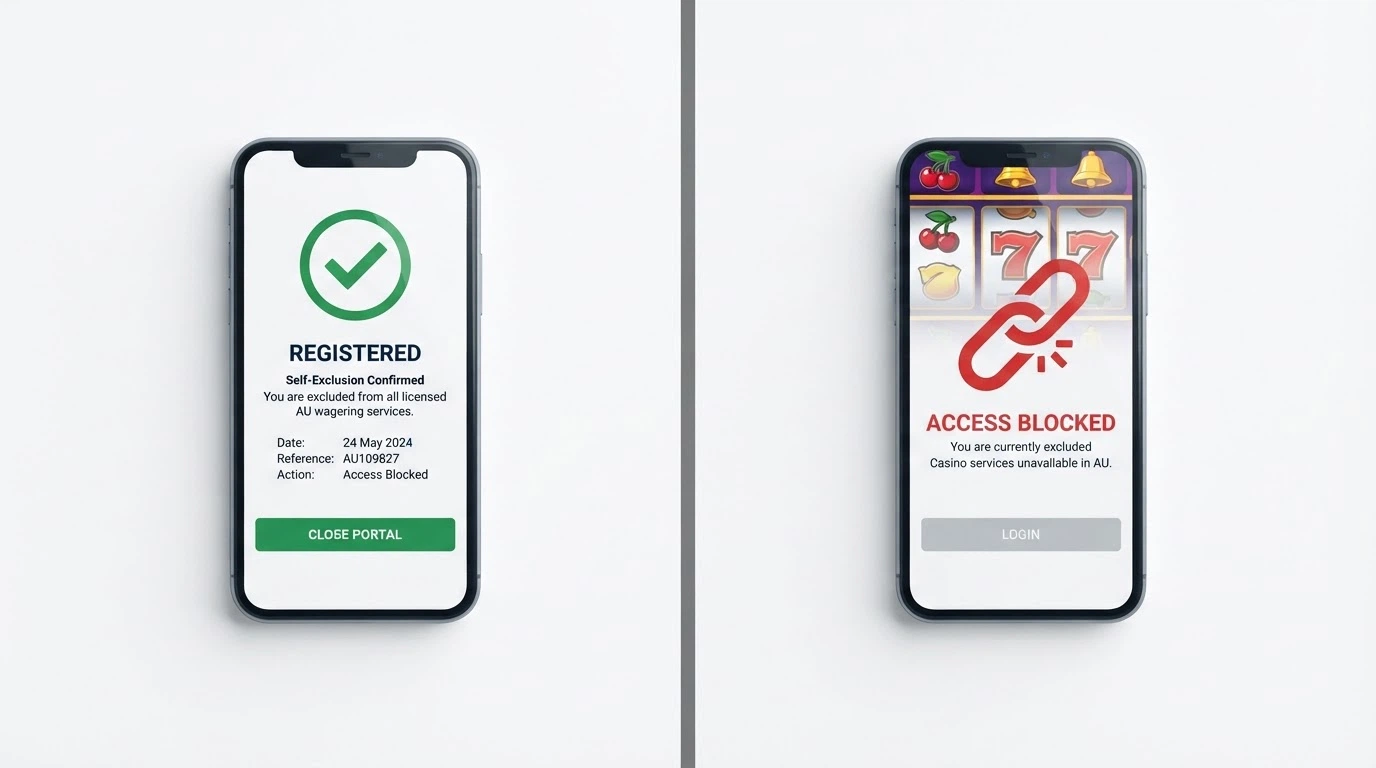
The constraint is the licence. BetStop binds Australian-licensed wagering services — the roughly 190 providers that operate under state and territory wagering licences. An offshore casino is not licensed here, is not connected to the register, and will keep taking a self-excluded person’s money. The same exclusion that closes every Australian wagering account a person holds does nothing to a Curacao-registered offshore casino that has not signed up to the register and has no obligation to honour it. For a player who has self-excluded because they recognise a problem, that gap is the entire point of the offshore route and the entire reason to be cautious about it.
The harm numbers: 3.29 million Australians affected
Gambling harm in Australia is not marginal — it touches millions, and the offshore route carries none of the licensed market’s safeguards. Approximately 3.29 million Australians aged 5 and over are affected annually by their own or another person’s gambling, including approximately 1.97 million adults classified as having at-risk or problem gambling. Risky gambling in Australia increased from 13.7% in 2024 to 19.4% in 2025, almost doubling since the COVID-19 lockdowns of 2020–2021. In the 12 months to March 2026, Australians lost A$36.0 billion to gambling, an increase of A$1.3 billion on the A$34.3 billion lost in the 12 months to March 2025. Some 15.1% of the Australian adult population, an estimated 3.32 million people, are experiencing some level of gambling harm from their own or others’ gambling behaviours.
Those figures are not a forecast. They are the measured cost of the market Australians use every year, across licensed wagering and offshore casinos alike. The BetStop coverage gap means the self-exclusion tool designed to address that harm does not extend to roughly 90% of the offshore-facing market where some of those affected are playing.
The effectiveness numbers from BetStop registrants are striking. 77 per cent of BetStop registrants experienced a better overall quality of life after registering, 79 per cent improved mental health, and 96 per cent had either completely stopped betting (81%) or decreased their betting (15%). 78 per cent of BetStop registrants were under 40, and 38 per cent chose lifetime exclusion. The tool works. Its perimeter stops at the offshore boundary.
Where to get help: 1800 858 858 and Gambling Help Online
Concrete help is available right now, regardless of where the reader sits in this guide. The National Gambling Helpline on 1800 858 858 is free, confidential and staffed 24/7. Online support is available through Gambling Help Online, which offers live chat and counselling. Self-exclusion from Australian-licensed wagering providers is available through BetStop, which covers all roughly 190 licensed wagering services in Australia — and does not cover offshore casinos.
For an Australian playing at an offshore casino, the helpline and the online counselling service are reachable today; BetStop will close the licensed wagering accounts but will not close the offshore accounts. A reader who needs to step back from offshore play needs both: the licensed-wagering side covered by BetStop, and the offshore side covered by the practical decision not to deposit. The gap is real and it is the gap this section of the guide is built around.
Which withdrawal method actually clears your money fastest
Method matters more than the casino. The same operator can take 10 minutes via crypto and 5 working days via bank transfer, and the choice between those rails is the player’s, not the operator’s. The table below summarises the published medians and worst-case recorded times at tested AU-facing casinos in 2026.

| Withdrawal method | Median payout time | Worst case recorded |
|---|---|---|
| Cryptocurrency | 42 minutes | 4 hours |
| PayID | 2 hours | 8 hours |
| E-wallets | 6 hours | 18 hours |
| Visa / Mastercard | 2 working days | 5 working days |
| Bank transfer | 3 working days | 7 working days |
The table is a guide to the speed ceiling, not a guarantee for any operator. Crypto is the fastest method overall, clearing in 2 to 60 minutes once the casino has approved the withdrawal. PayID is the quickest AUD-native option, with personally tested times as low as 25 minutes at the leading operators. E-wallets sit in the middle at a 6-hour median. Cards and bank transfers are the slower tier, and a player who chooses them should plan for the timeline rather than the marketing.
PayID: the fastest AUD method — when it is actually available for withdrawals
PayID is the headline fiat method at Australian-facing casinos, but the headline overstates what most players actually get. Personally tested PayID withdrawal times at AU-facing operators in 2026 run from 25 minutes (Hell Spin) to 28 minutes (Goldenbet) to 35 minutes (Lucky7), which puts the leading operators well inside the published 2-hour median for the segment. The faster operators include RocketPlay (PayID under one hour for most Australian banks) and SkyCrown (PayID same day once internally approved).
The catch is that a true PayID-out — an NPP payout that lands in the recipient’s account in real time — is rare. The more common pattern is that casinos accept PayID for deposits only and pay withdrawals via standard bank transfer, which takes 1 to 3 business days. That is the deposit-only trap: the operator markets PayID as a feature, and the player discovers at withdrawal time that the AUD-native instant rail only ran in one direction. A player choosing an operator on PayID speed should confirm that PayID is supported for withdrawals, not just for deposits, before depositing.
Crypto: faster than PayID but only at crypto-friendly casinos
Crypto is the speed ceiling for Australian players: 2 to 60 minutes once the casino has approved the withdrawal, with the popular altcoins at the fast end of that band and Bitcoin at the slower end. Bitcoin takes 30 to 60 minutes due to block confirmation times; Litecoin and USDT TRC-20 settle under 10 minutes; Solana clears most withdrawals in under 5 minutes. The casino’s internal approval is still the gate — crypto is not a workaround for a flagged account — but on a clean account, crypto is the fastest method available.
The availability gap matters. Not every featured operator accepts crypto. Research confirms crypto support at Bizzo Casino (minutes to hours), SkyCrown (under an hour) and WinSpirit (under two hours), and identifies Stake as a crypto-native platform. Other operators in the set either do not support crypto at all or did not have their crypto policies confirmed in this review cycle. A player choosing crypto for speed should verify the operator supports the specific coin and network they intend to use; USDT TRC-20 is the most commonly supported stablecoin network in this segment.
E-wallets and bank transfers: the slower tier
E-wallets sit at the middle of the table: 6-hour median, 18-hour worst case. The e-wallet brands AU-facing casinos use include Skrill, Neteller, MiFinity and eZeeWallet, and the speed advantage over cards and bank transfers comes from the e-wallet acting as an intermediary between the casino and the player’s bank account — the e-wallet is paid quickly, and the player can withdraw from the e-wallet to a bank account on their own schedule.
Cards and bank transfers are the slower tier for the same reason: intermediary banks, currency conversion where the operator settles in a non-AUD currency, and processing windows that do not run 24/7. Visa and Mastercard sit at 2 working days median (5 worst case); bank transfers at 3 working days (7 worst case). A player might still choose them for familiarity, for credit-card rewards on the deposit side, or because the casino does not support crypto or PayID for withdrawals. They are not a fast-payout choice.
Crypto withdrawals: the speed ceiling for Australian players
Crypto is the only withdrawal method that consistently clears in under an hour at the operators that support it. Bitcoin takes 30 to 60 minutes; Litecoin and USDT TRC-20 settle under 10 minutes; Solana clears most withdrawals in under 5 minutes. Crypto withdrawals clear in 2 to 60 minutes once approved, with the median across tested AU-facing casinos sitting at 42 minutes.

The Australian context adds a layer most crypto guides skip. Since 11 June 2024, credit cards, credit-related products and digital currency (crypto) have been banned as payment for online wagering in Australia, under the Interactive Gambling Amendment (Credit and Other Measures) Act 2023. The penalty for a licensed operator accepting these methods is up to A$247,500. That ban applies to licensed wagering providers — the same operators who hold state and territory wagering licences — and it does not apply to offshore casinos, which are already outside the Australian regulatory perimeter. The result is a confusing landscape where the fastest withdrawal method sits entirely outside the regulated system, and the regulated system explicitly bars the very methods that make crypto withdrawals fast.
Bitcoin and the altcoins: which cryptocurrency clears fastest
Not all crypto is equal. Bitcoin takes 30 to 60 minutes because each block confirmation adds roughly 10 minutes, and most exchanges and casinos wait for several confirmations before crediting a deposit or releasing a withdrawal. Litecoin and USDT TRC-20 settle under 10 minutes because their block times are shorter and their fee structures cheaper. Solana is the fastest: most withdrawals clear in under 5 minutes because Solana’s block times run seconds, not minutes.
The casino’s internal approval is still the gate. A withdrawal request still goes through the operator’s payments team before the crypto transaction is signed and broadcast, and that internal review is where a clean account and a flagged account diverge by minutes or by days. Once the transaction has been signed and broadcast, the network takes over — and that is where the speed advantage lives. A player who has cleared KYC, who has no active bonus with an unwagered portion, and who is requesting a withdrawal within the operator’s normal-volume patterns should expect the network speed, not the internal review delay.
AU crypto availability: which operators accept it
Crypto is not universal. Of the ten operators in this guide, research confirms crypto support at Bizzo Casino (crypto withdrawals typically within minutes to hours), SkyCrown (under an hour), WinSpirit (under two hours) and Stake (a crypto-native platform whose current speeds were not confirmed this run). Crypto support at RocketPlay, Royal Reels, Fair Go Casino, Scream Casino, Rainbet and Neds was either not confirmed or not applicable in this review cycle.
The distinction between crypto-first and crypto-optional matters. A crypto-first operator like Stake was built around digital currency and the experience reflects that; a crypto-optional operator treats it as one of several payment methods and the support ranges from fully integrated to barely functional. USDT TRC-20 is the most commonly supported network for stablecoin withdrawals in this segment because the fees are low and the settlement is fast; players should check the supported networks at the operator they intend to use before requesting a withdrawal.
Why your 2026 bonus is smaller than it looks once wagering hits
A A$300 bonus at WinSpirit with 40x wagering and a A$5 maximum bet during bonus play produces A$12,000 in required turnover and roughly 3.3 hours of continuous play at the maximum bet — assuming only the bonus amount is wagered, before the bonus becomes withdrawable cash. The bonus is a half-price ticket, not free money; the marketing description does not tell the reader how many spins sit between deposit and cashout. It is an evening’s work at minimum, with no guarantee of payout at the end of it.

Wagering on AU-facing offshore sites commonly sits between 35x and 45x on bonus funds, with caps on maximum convertible winnings from free spins often landing between A$50 and A$100. WinSpirit runs at 40x with a 7-day bonus validity and an A$5 maximum bet; SkyCrown runs at 40x across all four tiers of its welcome package; Royal Reels runs at 35x on the bonus portion only. None of those are low. The shape of the bonus is standard; the velocity of clearing it is the real barrier.
No-deposit bonuses: the catch behind “free money”
A no-deposit bonus sounds like a risk-free trial, and on the surface it is — the player does not deposit, and the casino credits a small bonus to play with. The economics underneath are tighter: an A$10 no-deposit bonus with 30x wagering demands A$300 in turnover, and the maximum cashout from no-deposit bonuses is typically capped at A$50. Royal Reels is one of the few operators in this set that publishes the cap clearly. A player who runs the bonus up to A$300 in winnings and tries to withdraw A$300 walks away with A$50 instead.
WinSpirit’s terms include an A$50 maximum cashout on no-deposit bonuses. Royal Reels runs an A$10 no-deposit bonus after phone verification, which functions as a soft KYC gate — the operator wants a phone number on file before crediting the bonus, and that contact detail becomes the start of the KYC file. The cap on free-spin winnings often lands between A$50 and A$100. The honest reading: a no-deposit bonus is a taste of the platform, not a pathway to a payout. Its real value is the chance to test the casino’s interface and game selection before committing a deposit.
Wagering requirements: the real barrier between a bonus and a withdrawal
Wagering requirements are the multiplier that turns a bonus into turnover, and clearing them before the validity window closes is the actual speed bottleneck on a withdrawal. WinSpirit’s 40x wagering with a 7-day validity window means a player has one week to work through A$12,000 of turnover on a A$300 bonus. Royal Reels’ 35x wagering on the bonus portion only is friendlier arithmetic — A$300 bonus at 35x is A$10,500 turnover rather than A$12,000 — but the structure is the same. SkyCrown’s 40x across all four tiers extends the wagering work across four deposits.
The per-spin bet cap during clear-down — A$5 at WinSpirit and Royal Reels — is what enforces the 3.3-hour figure from the calculation above. A player who tried to clear the bonus with A$100 spins would void the bonus; a player who spreads the wagering across thousands of small spins gets through it within the validity window. The choice between accepting the bonus and forgoing it for a faster cashout is the player’s call, and the math does not always favour the bonus. A bonus that takes 3.3 hours to clear on a tight schedule and pays out a fraction of what the headline promised is not the bargain the marketing presents.
No-ID casinos: what you trade for a faster payout
Skipping KYC removes the single biggest source of withdrawal delay at the cost of every consumer protection that could get the money back if something goes wrong. That is the trade at a no-verification casino in one sentence. The longer version is that “no verification” means something narrower than the marketing suggests, and the cost of the trade is paid by the player, not the operator.
Many operators allow small deposits and withdrawals under USD$2,000–3,000 without identity verification. The threshold exists because the cost of KYC — collecting documents, running checks, paying for identity databases — does not scale well to small transactions, and the operator can absorb the counterparty risk at low dollar values. Above that threshold, the casino will demand KYC anyway, and the speed advantage disappears. “Anonymous casino” claims that survive a USD$3,000+ withdrawal cycle are vanishingly rare and usually involve operators with significant counterparty risk — meaning the operator is more likely to refuse, delay or simply not pay when a large withdrawal request lands. Speed now, recourse never.
What “no verification” actually means
No verification does not mean no rules. It means the casino skips the identity check that every regulated operator is required to run. A regulated operator collects an identity document, a proof of address and a payment method verification on first withdrawal; a no-KYC operator skips all three, up to the threshold. The result is a faster first withdrawal — measured in hours rather than days — but no record on file that ties the player’s identity to the account.
The triggers that bring KYC back are well-known in the segment: a withdrawal above the threshold, a change in payment method, a flagged deposit, a large win that crosses an internal review threshold. Fair Go Casino triggers KYC before any serious withdrawal, which is the typical pattern. The difference between “no verification” and “delayed verification” is the difference between the casino and the player choosing when the KYC happens — and the player almost always loses that choice. The practical reality is that nearly every operator eventually demands KYC, and the operators that genuinely never do carry the highest counterparty risk in the segment.
What you give up outside the licensed market
The protections Australian players take for granted at licensed operators do not exist at a no-KYC offshore casino. There is no BetStop coverage — the self-exclusion register that binds every Australian-licensed wagering provider does not bind an offshore casino. There is no ACMA complaints channel — the regulator’s enforcement powers cover blocking and provider-side penalties, not player-side dispute resolution. There is no Australian Financial Complaints Authority access, no state-level consumer protection, no guarantee the operator will honour a withdrawal.
The site-can-be-blocked-at-any-time risk is the most concrete of these. ACMA has had 1,564 illegal gambling and affiliate websites blocked since November 2019; sites get blocked with balances on them, and the player has no Australian complaints channel to escalate. The reading for a player considering a no-KYC offshore casino is the trade in plain terms: speed now, recourse never. The protections Australian consumers expect from a regulated service do not survive the crossing of the offshore boundary.
Online pokies that pay out fast: what the RTP numbers mean for your cashout
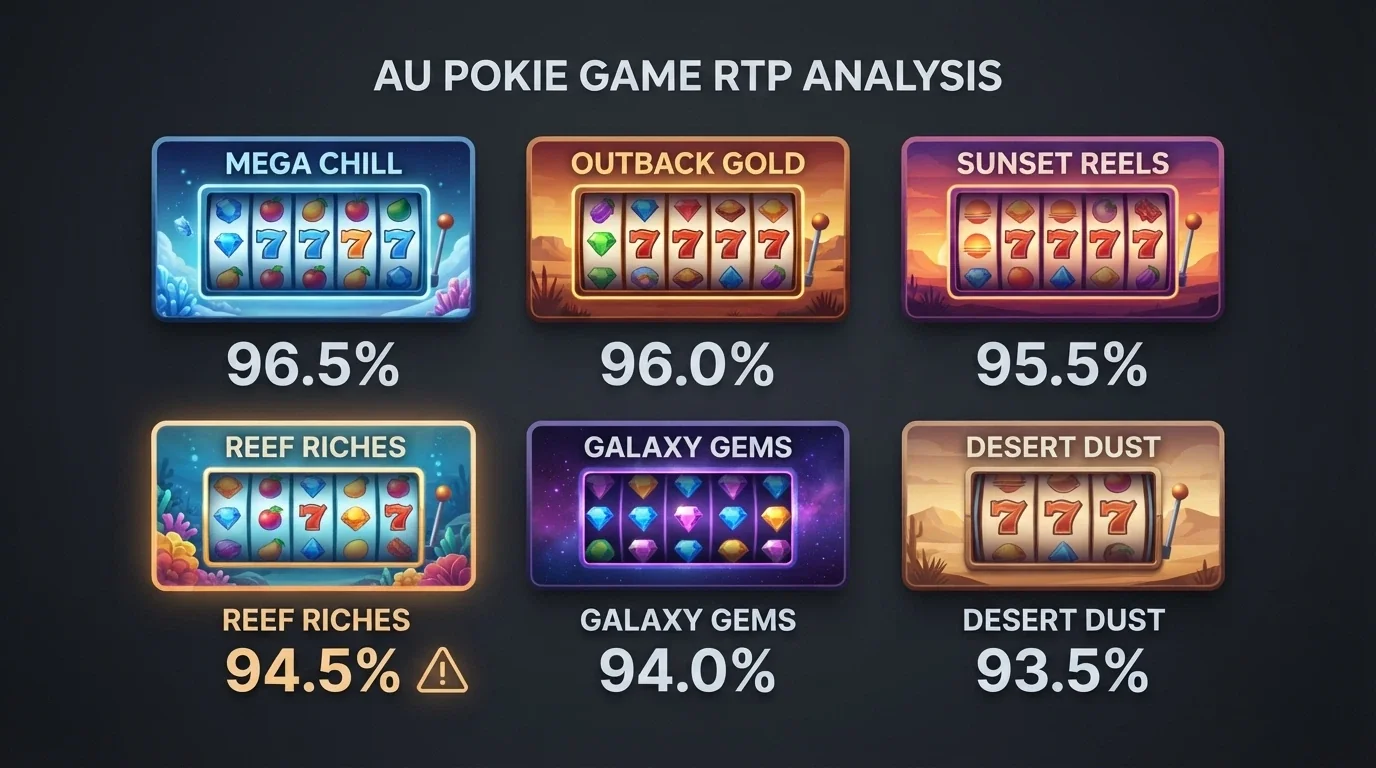
A pokie’s RTP — return to player — determines how much of the turnover you keep, and a lower RTP means more turnover lost and a slower path to cashout by definition. The mechanics are simple: a 96% RTP returns 96 cents of every dollar wagered over the long run; a 94% RTP returns 94 cents. Across thousands of spins, the two-point gap compounds, and the player’s balance runs out faster on the lower-RTP version of the same game. Withdrawal speed and pokie RTP are linked through the player’s bankroll: a game with a lower RTP depletes the bankroll faster, which means more frequent deposits, more frequent withdrawal requests, and more exposure to the operator’s withdrawal pipeline.
Real-money pokies and withdrawal speed: what players need to know
Playing pokies for real money at an offshore casino means the winnings clear through the same withdrawal pipeline as any other game. The pokie itself does not speed up the payout; the withdrawal method does. Royal Reels offers 5,400+ pokies from 40+ software providers, which is the largest library in the featured set and a useful benchmark for the segment, but the withdrawal timeline for a pokie win is the same as the timeline for any other casino-game win.
Demo mode availability — the chance to play a pokie without wagering real money — is operator-dependent and was not confirmed for every featured operator this review cycle. The Australian pokies terminology is worth noting for a reader new to offshore play: pokies is the local word for slot machines, and the offshore casinos use it interchangeably with “slots” in their game libraries. The mechanics are identical; only the vocabulary differs.
Provider RTP vs platform RTP: the Bizzo warning
The same pokie can pay out differently on different platforms. The provider publishes a default RTP — for many popular pokies, that figure is 96.5% — but the operator can configure the game to run at a lower RTP, and that configuration is what the player actually plays against. Bizzo Casino is the confirmed example in this guide: research found that a familiar pokie can run at 94.5% on Bizzo versus the 96.5% default elsewhere, a two-point gap that compounds across thousands of spins. RTPs vary by platform, and the player who assumes otherwise is paying for the assumption.
The SoftSwiss white-label stack, which Bizzo runs on, is one of the platforms that supports adjustable RTP. A player cannot tell from the game screen which configuration is running; the RTP is set in the backend and only the casino and the provider know the figure. The honest practice is to check the game’s information or help screen at the specific casino before wagering — but the figure is not always published. The player who assumes the provider’s default is making a reasonable assumption that the operator may not honour.
Live dealer and new casinos: do fresh sites pay out any quicker?
Live-dealer games and newly launched casinos market themselves as premium experiences, but the withdrawal pipeline is the same one every operator uses. The dealer being live on camera does not change how fast the money moves; a new brand on a white-label platform does not change the banking rails a payout runs through. Same pipeline. Same speed.
Live dealer: same withdrawal pipeline, same speed rules
Live dealer is a game category, not a withdrawal category. The dealer is live on camera, the cards are physical, the roulette wheel is real — but the winnings land in the casino account the same way they land for any other game, and the withdrawal request goes through the same method and the same timeline. SkyCrown is the confirmed live-dealer operator in the featured set, with Evolution Gaming as the live-casino provider. Evolution is the dominant provider on AU-facing platforms and the one most players will recognise from the studio.
A live-dealer win follows the withdrawal rules in the Payments section of this guide, not a separate live-dealer rule set. The same PayID, crypto, e-wallet, card and bank-transfer speeds apply. The same minimums and maximums apply. The same KYC threshold applies. Live-dealer games offer a different table environment, but they rely on the identical cashout pipeline as standard pokies or table games.
New casinos: fresh brand, same offshore reality
A newly launched casino markets its novelty — the welcome offer, the modern interface, the new game library — but it is still an unregulated offshore operator with no Australian licence, no BetStop coverage, and no withdrawal track record for anyone to check. The white-label platform that powers most new casino launches is the same SoftSwiss-style stack that powers longer-running operators, and the underlying payment infrastructure is the same set of methods and processors. The brand is new; the reality is the same.
The absence of a payout track record is the risk a new casino carries that an established operator does not. A player can read withdrawal reviews for Royal Reels or WinSpirit or RocketPlay and see what other Australian players experienced; a player looking at a brand launched in the last six months has no comparable data. The evaluation framework for a new casino before depositing is the same as for any offshore operator: check the licence (and whether it is verifiable), check the supported payment methods, read the withdrawal terms, and weigh the absence of a track record against any welcome offer that compensates for it. The novelty is the marketing hook. The offshore reality is what the player actually buys.
How we selected and ranked these operators
The selection and ranking framework below describes what this guide does, what it does not, and which sources fed into each decision.
- Sources used: The Australian Communications and Media Authority register, operator terms and conditions pages, and independent withdrawal-test data from PokiesAustralia (tested PayID times), Betsquare (method-by-method median and worst-case times), Gambling360 (method-speed rankings), and AussiePokies96 (crypto settlement times).
- Criteria: Withdrawal speed (independently tested where available, operator-stated where not), licence transparency (a verifiable licence number scored higher than an unverified Curacao registration), bonus-term clarity (operators that publish wagering, validity and maximum-cashout figures ahead of deposit scored higher), and AU-audience targeting (operators with PayID support, AUD account currency and AU-facing customer service ranked above crypto-only or EUR-only platforms).
- Licensed-wagering contrast: Neds is included as the Northern Territory Racing and Wagering Commission-licensed operator that demonstrates the legal shape of the Australian market — wagering on sports and racing under state/territory licence, with no casino games. Its presence on the list is a contrast, not a casino recommendation.
- What was NOT used: Affiliate commissions, paid placement, unverified user reviews. The ranking reflects performance and disclosure, not commercial relationships.
- What could not be verified: Independent withdrawal-speed data was not available for Stake, Fair Go Casino, Scream Casino, Rainbet or Neds this review cycle; their entries reflect market presence rather than measured performance.
Your money, your call: what to do before you deposit at an offshore casino
The reader now knows the law, the risks, the methods and the operators. The list below is the practical checklist before depositing a dollar at an offshore casino in 2026.
- Confirm the offshore reality. Every AU-facing online casino is offshore and unregulated. The player carries the risk; the operator carries the marketing budget. There is no Australian licence that backs the site, no Australian regulator to escalate a dispute to, and no BetStop coverage.
- Confirm the withdrawal method and speed before depositing. Check that the operator supports the player’s preferred withdrawal method for cashouts, not just for deposits. PayID-in, bank-transfer-out is the most common trap. Crypto is the fastest, PayID the fastest AUD-native, bank transfer the slowest.
- Read the bonus T&Cs in full. Wagering multiplier, bonus validity window, maximum bet during clear-down, maximum cashout from free spins, and any game-weighting restrictions. A A$300 bonus at 40x with a 7-day validity is a 3.3-hour play commitment with no guarantee of payout.
- Verify the KYC trigger point. Most operators demand identity verification before the first serious withdrawal. The verification is faster if the player has documents ready before they withdraw, and the verification is more likely to clear on the first pass if the deposit and the bank account are in the same name.
- Set a loss limit before the first deposit. The licensed market offers deposit limits, activity statements and time-out tools as standard. Offshore casinos offer what the operator chooses to offer, which may be less. A pre-set loss limit is the player’s only tool that works at every operator.
- Know the help lines. The National Gambling Helpline on 1800 858 858 is free, confidential and staffed 24/7. Gambling Help Online offers live chat and counselling. BetStop covers Australian-licensed wagering providers and does not cover offshore casinos.
The honest bottom line: every AU-facing online casino is offshore and unregulated, and the player carries the risk. The licensed alternative for those who want consumer protection is licensed wagering on sports and racing only — no casino games, no pokies, no table games. For anyone who has decided to proceed at an offshore casino despite the legal reality, the checklist above is the framework to use before depositing. The site may be blocked next month; the balance may be unrecoverable; the dispute may have no resolution path. Those are the costs the marketing does not print.
Frequently asked questions about fast withdrawal casinos in Australia
How long does a PayID withdrawal take at an online casino?
Tested PayID withdrawals at leading AU-facing operators run from 25 minutes (Hell Spin) to 35 minutes (Lucky7). Segment median is 2 hours; worst case 8 hours. Many casinos accept PayID for deposits only and pay withdrawals via standard bank transfer, which takes 1 to 3 business days. Confirm PayID is supported for withdrawals, not just deposits, before depositing.
What happens if an offshore casino refuses my withdrawal?
The casino will offer a reason — usually a bonus-term violation, KYC failure, payment-method mismatch or internal review flag. There is no Australian complaints channel: ACMA enforces at the provider end and does not arbitrate disputes, no state consumer protection applies, and no AFCA access exists. Complete KYC before any large withdrawal.
Can I use a credit card to deposit at an Australian online casino?
Credit cards, credit-related products and crypto have been banned for online wagering in Australia since 11 June 2024, under the Interactive Gambling Amendment (Credit and Other Measures) Act 2023. The ban applies to licensed wagering providers. Offshore casinos may still accept cards, but using one does not legalise the underlying offshore transaction.
Can I self-exclude from an offshore casino?
BetStop covers every Australian-licensed wagering provider — roughly 190 operators — with one registration. BetStop does not cover offshore casinos. An offshore casino may offer its own self-exclusion tool, but the operator is not obliged to honour it and no Australian regulator can enforce it. The practical offshore self-exclusion is the decision not to deposit.
Do Bitcoin and USDT clear faster than a PayID transfer?
Yes. Bitcoin takes 30 to 60 minutes; USDT TRC-20 settles under 10 minutes; Solana clears under 5 minutes. PayID’s median payout time is 2 hours, worst case 8 hours. Crypto is the fastest method overall and PayID is the fastest AUD-native option. The casino’s internal approval remains the gate — flagged accounts will not see the network-speed advantage.