
Best Online Casino With High Cashback Bonus Australia — 2026 Review
A $100 cashback on a $1,000 losing week returns $100. A 100% deposit match to $500 hands you $500 of bonus money locked behind $17,500 of required turnover. Both numbers are real, both belong to 2026 Australian-facing offers, and only one of them clears the house edge that sits inside every spin. This page ranks the offshore casinos Australian players visit most, lays out the cashback terms each one carries, and walks through the arithmetic that decides whether a rebate is worth claiming or just a softer way to lose.
Current as of 16 October 2026, verified against the Australian Communications and Media Authority’s register of blocked illegal gambling services and the Interactive Gambling Act 2001.
Table of Contents
- Why Your 2026 Cashback Bonus Is Worth More Than a Welcome Offer
- The Most Visited Cashback Casinos Among Australian Players in 2026
- Online, Mobile or Live Dealer: Where Cashback Plays Hardest
- Crypto Cashback and the Australian Payment Ban
- The Legal Reality: Every Casino on This Page Is Offshore
- Responsible Gambling: When Cashback Makes Losses Feel Safer Than They Are
- How We Selected and Ranked These Cashback Casinos
- Your Money, Your Risk, Your Call: What to Do With What You Now Know
- Frequently Asked Questions
Why Your 2026 Cashback Bonus Is Worth More Than a Welcome Offer
A cashback bonus and a welcome bonus both end up as numbers on a casino account balance, but they were built to do opposite things. A welcome offer is acquisition — the casino is paying you to walk in the door. A cashback bonus is retention — the casino is paying you not to leave. The structural difference shapes everything that follows: how the figure is calculated, what you have to do before you can withdraw it, and what the casino is willing to give back.
A 10% cashback on $1,000 of net losses over a week returns $100. That is the headline figure, the one banners are built around. The interesting question is what that $100 is actually worth once its own wagering terms are applied, and the answer depends on three numbers: the rate, the wagering multiple, and the house edge on the games you clear it on. On a 96.5%-RTP slot library — a 3.5% house edge — 5% cashback is mildly positive expected value, 10% is clearly positive, and anything under 3.5% is negative EV regardless of what the marketing copy says. The percentage is the start of the conversation, not the end.
The casino hands cashback out because it works — it keeps players returning after a losing session and smooths the relationship over weeks rather than minutes. But the rebate the player actually banks is rarely the headline rate. Three things eat into it: game contribution rates that exclude most table games, wagering requirements that re-tax the bonus amount itself, and caps that limit the upside on big weeks. The page that follows walks through each of those mechanics in turn.
How cashback is calculated: net losses, not total bets
The number the casino multiplies its cashback rate against is your net loss — total deposits minus total withdrawals over the calculation window — not your turnover. If you lost $300 across a week but won $150 of it back, your cashback calculates on $150, not $300. That distinction is the whole mechanic, and most players who quote their cashback percentage do not realise how often the base they are multiplying against has already been halved by a withdrawal.
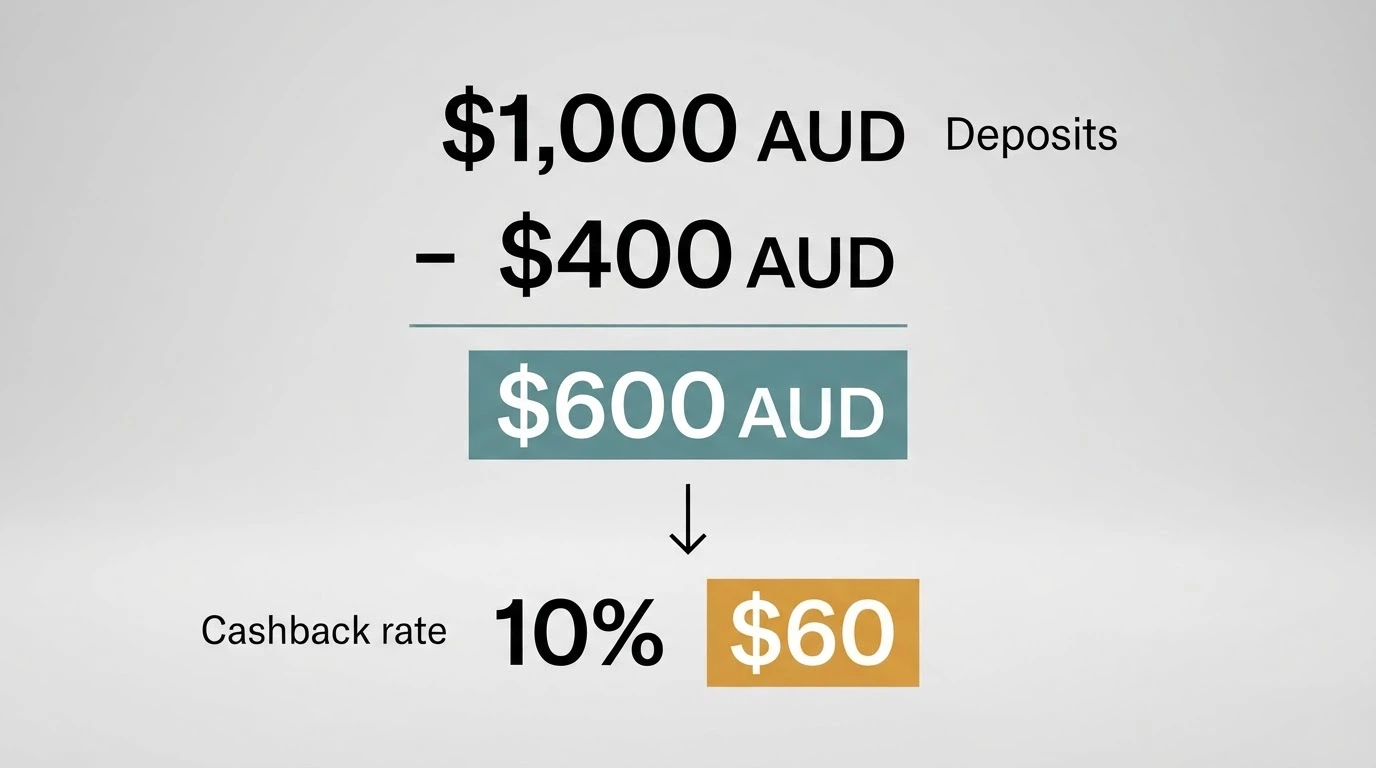
A worked example makes it concrete. Across a Monday-to-Sunday cycle, you deposit $1,000 and withdraw $400, leaving $600 of net loss in the casino’s books. A 10% cashback offer returns $60. The $600, not the $3,500 you might have turned over at the reels, is the base. Turnover-based cashback exists but is rare; net-loss is the industry default and the form every operator on this page uses.
The calculation window matters as much as the formula. Daily cashback resets every 24 hours and is paid on net loss inside that single day. Weekly cashback pools Monday-to-Sunday or Tuesday-to-Wednesday, depending on the operator. Monthly cashback stretches the cycle out further, which suits casual players who cannot generate enough loss in a single week to clear the minimum threshold. Most operators set a minimum-loss floor — typically AU$50 to AU$100 for standard VIP tiers — which locks out players whose losses never reach the trigger.
One edge case worth knowing: when you finish a period net-positive, the cashback is zero. You do not owe the casino anything and you do not receive a rebate. The mechanic only fires on loss. The bonus is, in effect, a tax refund on a net-negative position — and there is no refund on a net-positive one.
Why cashback wagering (1x–10x) beats a welcome bonus (30x–50x) every time
Even a modest 5% cashback with a 3x wagering multiple costs less in expected loss than a $50 deposit match at 35x. The maths favours cashback almost without exception.
A $50 bonus at 35x wagering needs $1,750 in qualifying stakes; deposit-plus-bonus terms, where the bonus is added to the deposit before the multiple applies, double that to $3,500. That $3,500 is the turnover the house edge taxes on its way through. At a 3.5% house edge, the expected loss on the playthrough alone is $122.50 — more than the $50 bonus was ever worth. Cashback wagering, by contrast, rarely exceeds 10x and is most often 1x to 5x on slots. A $100 cashback at 3x needs $300 of qualifying play, not $3,500.
The expected loss on the cashback itself is the figure most pages miss. Using the formula that the industry applies — cashback net of its own wagering tax equals the cashback multiplied by one minus the wagering multiple times the house edge divided by the game contribution — a $100 cashback at 3x wagering on a 96.5%-RTP slot library loses about $10.50 to the house edge and leaves roughly $89.50 net. The same $100 at 10x wagering falls to $65. The headline rate does not change; the real rate does.
The clear implication, assuming only the bonus amount is wagered, is that even a small move down the wagering ladder changes the rebate’s dollar value by tens of dollars on a single $100 cashback. A 5x cashback on the same $100 sits around $82.50 net; a 1x cashback at the same rate returns nearly the full headline figure once the playthrough is complete.
Game contribution rates decide which games the wagering actually clears on. Pokies contribute 100% at most casinos. Table games contribute 10% to 20%. Video poker 10% to 50%. Roulette 20% to 50%. Blackjack 10%. Baccarat and live dealer games 5% to 10%. Progressive jackpot titles contribute 0%, which means a single spin on a progressive does not move the wagering bar at all. A player who plans to clear $300 of wagering on roulette would need $1,500 to $3,000 of actual play to do it.
Max-bet caps during playthrough — commonly $5 per spin or 10% of the bonus — add another constraint. They are not relevant on every spin but they cap the variance a player can use to clear wagering fast, which lengthens the time the bonus sits in the account. And time is itself a constraint: most cashback bonuses carry a 60-day validity window, and the typical wagering-meeting window is 3 to 30 days. A bonus that takes two months to clear is one the player is racing against.
The slots below are the kind of high-RTP, high-contribution titles that grind through cashback wagering with the least expected loss. Their inclusion here is not an endorsement of any specific game; it is what the numbers look like for the most efficient clearing plays.
| Slot Title | RTP | Volatility | Max Win |
|---|---|---|---|
| Gates of Olympus | 96.50% | High | 5,000x |
| Blood Suckers | 98% | Low | — |
| Book of 99 | 99% | High | 1,000x |
Gates of Olympus publishes at 96.50% RTP with high volatility and a 5,000x bet max win. Blood Suckers sits at 98% RTP, low volatility and a hit frequency above 35%, which is why it has long been a wagering-grinder’s favourite. Book of 99 carries the highest published RTP on this list at 99%, paired with high volatility and a 1,000x max multiplier. Each takes the player closer to the clearing playthrough with less house-edge drag than a typical 96% title, and the gap between a 99% RTP and a 94% RTP over $1,000 of turnover is $50 of expected loss — real money, before the bonus even factors in.
Daily, weekly or instant: which cashback cadence works for your play style
Daily cashback resets fast and rewards regular players. NeoSpin’s daily cashback model is the benchmark in the offshore market: 3x wagering — exceptionally low by industry standards — with the bonus appearing after 00:10 UTC the following day. Players have 7 days to activate and 7 days to complete wagering. The minimum deposit to qualify is AU$30. Daily cadence suits a player who logs in every evening and wants their losses returned in a form they can redeploy the next night.
Weekly cashback pools larger sums but carries higher caps — typically AU$200 to AU$500 per cycle for standard tiers. The maths favours a player with concentrated weekend play, where a single losing Saturday can drive most of the week’s net loss. JustCasino’s 10% weekly cashback, calculated Tuesday to Wednesday and capped at $400, is a typical structure. The downside: a player who loses AU$50 in week one and AU$50 in week two receives AU$10 total, whereas on a monthly cycle they would have received nothing at the AU$100 threshold but AU$10 once combined.
Instant cashback is the rarest variant and the most valuable when it exists. It credits the rebate to the real-money balance the moment a loss is finalised, with no opt-in, no wagering window, and no separate bonus balance to track. Withdrawal timelines converge on the casino’s standard cashout times — e-wallet withdrawals often within 24 hours, bank transfers 3 to 5 business days. The structural value of instant cashback is not the percentage; it is the absence of a second wagering tax on the rebate.
| Cashback Type | Typical Rate | Typical Wagering | Typical Cap | Best Suited For |
|---|---|---|---|---|
| Daily | 5–10% | 1x–3x | — | Regular players with daily sessions |
| Weekly | 10–20% | 3x–10x | AU$200–AU$500 | Concentrated weekend play, larger cycles |
| Instant | 10–20% | 0x | — | Players who value withdrawal speed over rate |
The cap column carries an em dash where research does not name a typical figure for that cadence — daily and instant cashback caps vary widely by operator and tier, and the absence is information rather than a missing fact. Which cadence fits depends on play style: daily suits regulars with a stable bankroll, weekly suits weekend-heavy players who can take the cap, and instant suits anyone who values speed over percentage.
Cashback vs deposit match: one returns part of your loss, the other locks your deposit
A deposit match doubles your money but buries it under heavy turnover. A cashback gives you less upfront but costs far less to convert into withdrawable cash. The two structures are not the same product and they reward different behaviours.
The structural difference is timing. A deposit match fires when you fund your account — the bonus lands before any play, as an incentive to start. A cashback fires after a loss — the rebate lands as a recovery, not an entry gift. That timing change is what makes the wagering requirements so different. Deposit-match bonuses are competing with each other on headline size, which forces the wagering up: 35x, 40x, 50x are common. Cashback bonuses do not need a headline rate to attract; the player has already played and lost, and the rebate is retention, not acquisition. The wagering stays low: 1x to 5x is normal, 10x is the ceiling.
In dollar terms, a $50 deposit match at 35x with deposit-plus-bonus terms requires $3,500 of qualifying play. The expected loss on that playthrough, at a 3.5% house edge, is $122.50. The player is paying $122.50 to extract a $50 bonus, before any of the bonus has been played. A $100 cashback at 3x wagering on the same slot library requires $300 of play, with an expected loss of $10.50. The cashback is the cheaper way to add money to your account, even though the deposit match is the bigger number.
Deposit matches favour volume chasers — players who would be playing thousands of dollars regardless of the bonus. Cashback favours disciplined players who would be playing a smaller amount and want a partial rebate when they happen to lose. Most operators offer both, but the bonus terms usually exclude claiming both at once, and the cashback side is rarely advertised as prominently as the welcome offer. The asymmetry is the point: the welcome offer is the headline that pulls a player in, and the cashback is the longer-running product that keeps them there.
Caps, minimum-loss thresholds and the fine print that shrinks your return
A 20% cashback rate capped at AU$200 on a AU$2,000 losing week returns AU$200 — the cap, not the rate, is what your bankroll actually sees. The fine print on a cashback offer does most of the work to decide whether the headline rate is what the player banks.
Maximum cashback caps sit in the AU$200 to AU$500 per cycle range for standard VIP tiers, with higher caps reserved for higher tiers that most players never reach. Wild Tokyo’s weekly cashback, for example, caps at AU$500 at the top tier. The cap matters when the losing week is large — a player with AU$2,000 of net loss and a 20% rate would mathematically be owed AU$400, but a AU$200 cap returns AU$200. The other AU$200 is forfeited.
Minimum-loss thresholds work in the opposite direction. Most offers require AU$50 to AU$100 of net loss in the calculation window before the rebate triggers. Players with smaller bankrolls may never reach the floor on a weekly basis; monthly cashback with the same floor is harder still to hit. The threshold is an implicit filter — it keeps the offer economics manageable for the casino by excluding players whose rebate would not have been worth the processing.
Game eligibility exclusions are the third shrinker. Live dealer tables are excluded from most cashback calculations, with 5% to 10% contribution rates even on offers that nominally include them. Progressive jackpot titles contribute 0%, which means a single AU$1 spin on a AU$5 million jackpot pool does not register against your cashback. Table games typically contribute 10% to 20% — a player clearing $300 of cashback wagering on blackjack would need $1,500 to $3,000 of play.
Bonus validity windows and expiry risk are the final constraint. Most cashback bonuses last 60 days or less from credit, and the time to meet wagering is typically 3 to 30 days. A bonus that sits unactivated past its window expires and the rebate disappears with it. The validation period is shorter than the credit period at most operators — a player has 7 days to opt in and 7 days to complete playthrough at NeoSpin, for example.
Wager-free and no-deposit cashback: the rarest — and most valuable — form
A cashback bonus with zero wagering and no deposit trigger turns the rebate into real cash the moment it lands. It is the gold standard the market almost never offers. Winz.io has run 20% cashback on net losses for up to seven days with no wagering requirement and no cap on the cashback amount, valid for 14 days. Slotozen offers 10% live cashback up to A$5,000 with 0x wagering, applying to live games — a term the rest of the market has not matched, because most operators either exclude live tables from cashback or assign them a 5% to 10% contribution rate that effectively blocks them.
The structure of these offers matters. A 0x wagering cashback pays out the rebate directly without the second house-edge tax that 3x or 10x wagering imposes. At a 3.5% house edge, a $100 cashback at 3x loses $10.50 of expected value to the playthrough. The same $100 at 0x loses nothing — it is the full rebate, withdrawable on the operator’s standard payout timeline.
No-deposit cashback is rarer still. It fires on loss without requiring a fresh deposit to trigger — a structure most operators reserve for VIP tiers or short promotional windows. None of the operators in this review’s ranked set currently publishes a no-deposit cashback bonus, which means a player looking for this form is looking outside the comparison table that follows. The absence is information in itself: the rebate structures the ranked set offers all carry some form of trigger or wagering, and the cleanest terms live elsewhere.
The practical reader takeaway: when a cashback offer advertises zero wagering, verify what is meant — whether the rebate pays as cash, whether game contribution still applies to any opt-in bonus attached to it, and whether the cap is high enough to matter at the player’s typical loss level. A 0x-wagering offer with a AU$50 cap is not the same product as a 3x-wagering offer with a AU$500 cap.
The Most Visited Cashback Casinos Among Australian Players in 2026
Ten operators dominate where Australian players actually place their bets, and every one of them is offshore. This is not a market where an Australian-licensed alternative exists. The Interactive Gambling Act 2001, strengthened by the 2017 amendment, prohibits online casino games, online pokies and in-play betting outright. No Australian casino licence can be issued because the product the licence would govern is banned. What Australian players visit, then, are offshore sites that operate outside Australian rules, with no Australian consumer protection, no Australian complaints body, no BetStop coverage, and the constant possibility that the site itself is added to the ACMA’s blocking list — which stood at 1,564 illegal services as of March 2026.

The comparison below ranks the ten operators by AU market presence — a measure of where Australian traffic concentrates — and flags licence status for each. Cashback terms vary across the ten and were not independently confirmed for most operators in this run. Two operators have confirmed offers, with Stake on a rakeback model and Bizzo on daily cashback, one has a publicly published bonus structure (RollXO, mentioned for context but not in the ranked set), and the remainder carry terms that change frequently enough that a player should verify them on the operator’s own promotions page before depositing.
| Operator | AU Market Share | AU Licence Status |
|---|---|---|
| Rocket Play | 9.4% | Offshore, not AU-licensed |
| Skycrown | 8.55% | Offshore, not AU-licensed |
| Royal Reels | 2.51% | Offshore, not AU-licensed |
| WinSpirit | 1.55% | Offshore, not AU-licensed |
| Stake | 1.28% | Offshore, not AU-licensed |
| Rainbet | 1.28% | Offshore, not AU-licensed |
| Scream Casino | 0.99% | Offshore, not AU-licensed |
| FairGO | 0.80% | Offshore, not AU-licensed |
| Bizzo Casino | 0.57% | Offshore, not AU-licensed |
| Rocket Casino | 0.57% | Offshore, not AU-licensed |
Rocket Play
The largest AU-market operator by a clear margin at 9.4% share, Rocket Play’s scale tells you something about liquidity — when Australian players have to choose somewhere offshore to play, a meaningful share of them land here. The game-provider backbone is the same four-studio quartet that runs through most of the upper-ranked set: Pragmatic Play, Play’n GO, Nolimit City and Hacksaw Gaming. Pragmatic Play publishes RTP on every title, with headline games sitting at 96.5% on standard configuration. Play’n GO is consistent at 96.21% across most titles. Nolimit City sits in a 96.0% to 96.4% theoretical RTP band. None of those RTPs is high enough on its own to make a sub-3.5% cashback offer positive EV.
Cashback terms were not confirmed in this review’s research pass. A player considering the operator should check Rocket Play’s current promotions page directly — the bonus terms in this market change weekly and the live offer at the time of deposit is the one that binds. The offshore status is the structural point: no AU consumer protection, no AU complaints body, no BetStop coverage, and the site can be added to the ACMA’s blocking list at any time.
The verdict for Rocket Play: the largest reach in AU traffic, the four-studio provider backbone most players expect from the offshore market, and exactly the operator whose cashback terms need to be checked on the day of deposit. Nothing else changes that picture.
Skycrown
Runner-up at 8.55% AU market share, Skycrown sits close enough behind Rocket Play that the two are sometimes mentioned in the same breath. The provider backbone is identical: Pragmatic Play, Play’n GO, Nolimit City and Hacksaw Gaming. The same RTPs apply. The same offshore caveat applies.
Cashback specifics are unconfirmed in this review. The promotional page is the source that binds, not any aggregator or third-party listing, because terms in this market are rewritten as often as weekly. A player cross-shopping Skycrown against Rocket Play is choosing between two near-identical platforms with different bonus calendars and different withdrawal histories — the comparison comes down to those two specifics, neither of which this review can verify on the reader’s behalf.
The verdict for Skycrown: a near-clone of the market leader in terms of providers, RTPs and offshore status. The reason to pick one over the other is what each is currently offering on its own promotions page, not the market-share ranking.
Royal Reels
Third-ranked at 2.51% AU share, Royal Reels is where the table starts to differentiate in ways that matter. The provider backbone is the same four studios but with a granular title count: roughly 350 Pragmatic Play titles, 260 from Play’n GO, 120 from Nolimit City and 140 from Hacksaw Gaming. The library depth is the widest in the ranked set outside the very top.
The figure that matters more than the title count is Royal Reels’ Fair Bonuses Score of 53/100 — a below-average rating from an independent bonus-evaluation framework. A score below the median signals that the operator’s published terms on the offers tested contained restrictions or structural features that were worse than the average of the operators in their sample. The 53/100 does not name a specific cashback offer, but it does flag the operator’s overall bonus architecture as one a player should read carefully before claiming.
The verdict for Royal Reels: the deepest library in the upper half of the ranked set, paired with a below-average Fair Bonuses Score. The combination makes it an operator to investigate specifically — and to read the small print on any cashback offer before activating it.
WinSpirit
A mid-pack 1.55% AU market share and almost no independently confirmed data. WinSpirit sits in the part of the ranked set where this review’s research file thinned out. No game providers were confirmed from independent review sources for this operator in the most recent research pass. No cashback terms were confirmed. The brand is real — it appears in the market-presence data — and the operator carries traffic, but the dossier behind it is light.
The practical advice is the same one that applies to every thinly-covered operator on this list: verify the licence jurisdiction the operator actually holds, the cashback terms on the operator’s own promotions page, and the withdrawal history from independent player reports before depositing any amount the player is not prepared to lose. With WinSpirit specifically, that due-diligence step is the page’s main recommendation.
The verdict for WinSpirit: a real operator with measurable AU traffic, but a research file too thin to recommend past the basic verification checklist. The market-share rank says “Australian players go here”; nothing else on this page says “Australian players should go here”.
Stake
The only rakeback model in the ranked set, and the only operator whose retention product is built on a fundamentally different mechanic from the cashback bonuses the rest of the table runs. Rakeback is a continuous return on the house edge of every bet — Stake’s published tier ladder starts at roughly 5% base — paid weekly. The mechanic differs from cashback in two ways. Rakeback fires on every spin, win or lose, so the rebate does not require a net-loss cycle to trigger. Rakeback scales with volume, which means high-volume players extract more from the structure than casual ones do.
The platform is crypto-native — deposits and withdrawals run through Bitcoin, Ethereum and other digital currencies rather than through bank rails. For Australian players that architecture has a hard edge. Since 11 June 2024, credit cards, credit-related products and digital currency have been banned as payment for online wagering under the Interactive Gambling Amendment (Credit and Other Measures) Act 2023, with operator penalties up to $247,500. Stake’s crypto-native model is built around a payment method that Australian law now classifies as a prohibited route into offshore wagering. The operator continues to accept Australian IP addresses, but the deposit side is, technically, transacting outside Australian rules.
The verdict for Stake: the cleanest retention structure in the ranked set for high-volume crypto-native players, with a published tier ladder and a weekly cadence that suits regular play. The cost is the crypto payment route, which is banned for Australian-deposited wagering, and the offshore status that applies to every operator on this page.
Rainbet
Tied with Stake at 1.28% AU market share and almost no independently confirmed data on providers, bonuses or cashback. Rainbet sits in the part of the ranked set where the research file is at its thinnest. The brand name carries traffic; the dossier behind it does not carry much.
What a player should look for before depositing is the same checklist that applies to every thinly-covered operator on this list: licence jurisdiction, current cashback terms, withdrawal history from independent player reports, and the operator’s policy on Australian players specifically. None of that could be confirmed from independent sources in this review.
The verdict for Rainbet: a tied-seventh operator with real AU traffic, a thin research file, and the standard offshore caveats that apply across the ranked set. The market-share number says “people go here”; the rest is for the player to verify.
Scream Casino
At 0.99% AU market share, Scream Casino sits under 1% and is one of the smallest operators in the ranked set. The data file is light: no confirmed providers, no confirmed cashback terms, no confirmed welcome bonus structure from this review’s research pass.
The due-diligence checklist applies in full. For an operator at this market-share level, the practical question is whether the bonus terms and the withdrawal history are strong enough to justify the additional risk of depositing at a smaller operator where the brand recognition, the player community and the regulatory leverage a player has at a larger site are all lower.
The verdict for Scream Casino: a sub-1% share operator with a thin research file. The case for depositing is whatever the operator is offering on its own promotions page at the moment of sign-up, weighed against the additional risk of playing at a smaller brand where the offshore caveats land harder.
FairGO
A 0.8% AU market share and a brand name that promises fairness by design. The research file does not confirm any cashback terms, game providers, or licence jurisdiction independently for FairGO in this review. The operator’s name sets an expectation the data on this page cannot verify.
What the name does is frame the comparison: a player looking at FairGO is implicitly being invited to take the brand promise on trust. The verification steps before depositing are the same as for every other thinly-covered operator on this list, but they are especially important here because the brand promise is part of the offer. If the cashback terms, the wagering multiples and the withdrawal history do not hold up against the operator’s own marketing copy, the name is the only verifiable claim.
The verdict for FairGO: the brand name is the most identifiable feature, and the research file is too thin to confirm whether the offer behind the name matches the promise in front of it. The standard offshore caveats apply in full.
Bizzo Casino
One of only two operators in the ranked set with a confirmed cashback offer, and the only one with a confirmed daily cadence. Bizzo runs daily cashback per an independent review, sits on a library of 3,000+ titles and is positioned as crypto-friendly — a stack that suggests the operator is competing on breadth and on the speed of the rebate cycle rather than on headline percentage.
The 0.57% AU market share is the figure that needs context. Bizzo is at the bottom of the ranked set by traffic but carries the broadest confirmed feature set in the lower half: a daily cashback offer, a 3,000+ title library, and crypto-friendly banking. The breadth-of-product picture is stronger than the traffic rank suggests, and the daily cadence means a player who logs in regularly can compound the rebate faster than at weekly-cadence operators.
The crypto-friendly positioning carries the same June 2024 payment ban caveat as Stake. Crypto deposits for online wagering from Australia have been prohibited since 11 June 2024, with operator penalties up to $247,500. Bizzo continues to operate, and the operator’s own terms govern what it accepts, but the deposit side is, technically, outside Australian rules.
The verdict for Bizzo Casino: the strongest profile in the bottom half of the ranked set on confirmed features — daily cashback, a 3,000+ title library, crypto-friendly banking — paired with the offshore and crypto-deposit caveats that apply across the table. A regular player who can fund the account through a non-prohibited method and wants the daily cadence will find the offer competitive with anything else in this market-share band.
Rocket Casino
The smallest operator in the ranked set at 0.57% AU share, sharing a name root with the market leader and carrying the same risk of player confusion that any brand-name overlap creates. No cashback terms were independently confirmed for Rocket Casino in this review. No game-provider data was confirmed. The research file is light.
The brand-name collision is itself a consideration. A player searching for Rocket Play and landing on Rocket Casino has misidentified the operator, and the smaller site’s market position does not give it the same brand recognition as the larger one. The verification steps before depositing apply in full and should start with confirming the operator’s actual licence jurisdiction and cashback terms on its own site, not on any third-party listing that may have conflated the two brands.
The verdict for Rocket Casino: a sub-1% operator with a name that overlaps the market leader and a research file too thin to confirm its offer. The standard offshore caveats apply in full, and the brand-name collision is one more reason to verify every term on the operator’s own page before depositing.
Online, Mobile or Live Dealer: Where Cashback Plays Hardest
The device you play on and the game category you pick both change which cashback terms apply, and the differences can cost you the bonus entirely. A rate that covers pokies may exclude the live tables. An app may carry a push-notification trigger that the desktop site never shows. A mobile-browser session may mirror the desktop terms exactly, with no difference at all. The structure of how a casino applies its cashback across platforms is one of the more opaque parts of the standard bonus terms, and it is where small print can erase the headline rate.

The default experience is desktop browser play, and that is where cashback offers are designed and displayed. Every other variant is measured against it.
Online cashback casinos: the standard experience
Desktop browser play is where cashback offers are designed, displayed and most often described in operator marketing. The standard flow is straightforward: the player logs in, opens the promotions page, opts into the cashback offer if required, plays, and the rebate calculates on net loss over the defined cycle. The opt-in step is not universal — some operators credit cashback automatically, others require a one-click activation inside the promotion window.
The game library available on desktop is the reference point for every comparison. Pokies contribute 100% to cashback wagering at most casinos, table games 10% to 20%, live dealer 5% to 10%, and progressive jackpot titles 0%. A player who plans to clear cashback wagering on desktop has the widest eligible game set and the highest effective contribution rate.
Desktop remains the reference point because it is the platform the cashback terms were written for. Mobile-app and live-dealer variants either inherit the desktop terms or modify them, and the modifications are usually downward — lower contribution rates, narrower eligibility, separate opt-in flows. A player who wants to compare cashback offers across operators should do it on the desktop terms, since that is the cleanest baseline.
Mobile cashback: apps vs browser play
Mobile play runs on two architectures: a dedicated casino app downloaded from the App Store or Google Play, or a browser session at the mobile version of the desktop site. Most operators support both, and the cashback terms usually do not diverge — what applies on desktop applies on mobile browser, and what applies on mobile browser applies inside the app.
Where mobile cashback can diverge is in the operator’s promotional layer. A push notification on a mobile device can carry an exclusive cashback rate, a flash-offer window, or a one-click opt-in that the desktop site does not surface. The mechanic is the same — net loss over a calculation window, multiplied by the cashback rate — but the trigger is mobile-specific. Whether any of the operators in this review’s ranked set currently offers a mobile-exclusive cashback rate is not confirmed in this research pass, and the verification step is to check the operator’s app page directly.
The practical difference for a player is friction. Mobile apps reduce the opt-in step to a tap, surface bonus notifications at session start, and track play in the background so the cashback calculation runs without manual input. Mobile-browser play on the same operator typically mirrors the desktop experience, with the same opt-in flow and the same calculation. The architecture that wins is whichever one the player actually uses — a $100 cashback is worth the same regardless of which screen it is calculated on.
Live casino cashback: rare but real at a handful of operators
Most casinos exclude live dealer tables from cashback entirely, or assign them a 5% to 10% contribution rate. The economic reason is structural: live dealer games carry a higher operating cost than pokies, and the house edge on some bets is narrower, which leaves less margin for the casino to rebate from. A 5% to 10% contribution rate means a player who clears $300 of cashback wagering on live tables would need $1,500 to $3,000 of play to do it.
The rarity is finding a live-specific cashback offer with clean terms. Slotozen’s 10% live cashback up to A$5,000 with 0x wagering is the outlier — a term the rest of the market has not matched. Most live-specific cashback offers carry higher wagering multiples, lower caps, or contribution rates that make the effective rebate too small to be worth chasing.
How to check before depositing: the bonus terms on the operator’s own promotions page will name whether live dealer games are included in the cashback calculation, what the contribution rate is, and whether any game-category-specific caps apply. If the terms do not name live dealer at all, the default is exclusion — the player should assume live play does not contribute to the cashback figure until the operator confirms otherwise. Where live play does contribute, the rate is almost always lower than the slot contribution rate, and the rebate the player banks on live play is smaller than the headline percentage suggests.
Crypto Cashback and the Australian Payment Ban
Crypto casinos may offer higher cashback rates and faster payouts, but depositing with Bitcoin at an offshore casino broke Australian payment law in June 2024. The bonus and the ban pull in opposite directions.

The upside of crypto cashback is real. Operators that take crypto deposits typically settle withdrawals faster — blockchain transactions clear in minutes rather than the 3 to 5 business days of a bank transfer. Cashback offers tied to crypto reloads can carry zero wagering on the rebate itself: RollXO’s 5% no-wager crypto reload on every deposit is the clearest example in the offshore market, with the cashback credited as cash and uncapped. Fiat-equivalent offers rarely match the structure, because the processing cost and the house-edge tax on fiat cashback rebates are higher.
The legal side is the brake. Since 11 June 2024, credit cards, credit-related products and digital currency have been banned as payment for online wagering under the Interactive Gambling Amendment (Credit and Other Measures) Act 2023. Operator penalties for accepting those payment methods reach $247,500. A player depositing with Bitcoin from an Australian IP address is transacting outside Australian rules — the offshore casino is breaking the prohibition itself, and the Australian player’s deposit method is a prohibited route under the same Act.
The structural tension is that an AU player who wants the better cashback terms and faster withdrawals has to deposit through a payment method the law has banned. The operator continues to accept Australian IP addresses, and the deposit clears, but the legal status of the transaction is outside Australian rules. The offshore status of every operator on this page is the broader frame; the crypto payment ban is a sharper version of it.
What changes on 1 January 2027 is the closing of the practical workaround. The Interactive Gambling Amendment (Gambling Reform) Bill 2026 gives banks and payment providers express authority to block transactions to illegal gambling operators. A crypto deposit that flowed through a local exchange and then to an offshore casino wallet is a transaction a bank can refuse to clear once the new powers come into force. The crypto cashback offer is still sitting on the operator’s promotions page; whether an Australian player can fund it through a domestic bank is the question the 2027 reform answers.
The Legal Reality: Every Casino on This Page Is Offshore
Online casino is prohibited in Australia — not grey, not unregulated, but banned. Every operator listed on this page operates without an Australian licence because no such licence can exist. What that means in practice is that an Australian player who deposits at any of these operators has no Australian consumer protection, no Australian complaints body, no BetStop coverage, no recourse if the operator refuses a withdrawal or voids a win, and the constant possibility that the ACMA has the site blocked at the DNS level the morning after a deposit.

The prohibition is not new. The Interactive Gambling Act 2001, strengthened by the 2017 amendment, has been the federal position for the better part of two decades. What is new is the 2026 reform, which passed Parliament on 19 August 2026 and commences on 1 January 2027 — the biggest shake-up of Australian gambling law in a decade. It tightens advertising, expands enforcement, and gives banks the power to block transactions at the payment level.
The section below walks through what the prohibition covers, how ACMA has enforced it, and what changes in 2027. None of this alters the offshore status of the operators on this page; what it alters is the practical risk of depositing at them.
The Interactive Gambling Act 2001: why no online casino holds an Australian licence
The Interactive Gambling Act 2001 makes it an offence to provide online casino games to anyone in Australia. The law does not issue licences for what it prohibits. The 2017 amendment closed loopholes that had allowed some offshore operators to keep offering their product to Australian players through grey-area structures, and gave ACMA the enforcement and blocking powers it uses today.
What the IGA prohibits: online casino games, online pokies, and in-play betting on a sporting event once it has started. What it permits and what state and territory licensing does cover: wagering on races and sport placed before the event begins, lotteries and keno, through operators licensed by a state or territory. The Northern Territory Racing and Wagering Commission, administered through Licensing NT, is the de facto national licensor for that permitted wagering market, with licence terms running up to 20 years. NT licences do not cover online casino. No Australian licence does.
The minimum age for all commercial gambling in Australia is 18. The IGA targets the provider, not the player — an individual punter is not prosecuted under the Act. That is the only part of the law an Australian player can rely on with confidence.
The distinction that matters most for this page: an NT-licensed bookmaker is licensed to take pre-event wagering. An offshore casino is not licensed to do anything in Australia. The two are different products under different regulatory regimes. Players cross-shopping between them are using two separate legal categories of operator, and the consumer protection regime for the offshore side is the one this page is missing.
Offshore operators and ACMA enforcement: 1,564 sites blocked and counting
The ACMA has been blocking illegal gambling sites since November 2019. The current figure is 1,564 illegal gambling and affiliate websites blocked at the DNS level by Australian ISPs, and 225 or more illegal services that have withdrawn from the Australian market since enforcement was strengthened in 2017. Both numbers grow each quarter.
The ACMA’s enforcement powers cover investigations, formal warnings, civil penalty proceedings, referrals for prosecution, and the blocking requests that direct ISPs to take sites offline for Australian users. The blocking is DNS-level — Australian IP addresses cannot resolve the domain — which means a player who has deposited at a blocked site can find their account inaccessible. A balance can sit on a site that has just been added to the list.
What that means for a player considering the operators on this page: the operator may be on the ACMA list today, tomorrow, or never. The market-presence data reflects where Australian traffic concentrates; it does not reflect enforcement risk, and ACMA blocking does not require advance notice. A player who deposits at an offshore casino is taking the position that the operator will remain accessible for the duration of their play — a position that is currently true for the ten operators in this review but is not protected by anything in Australian law.
What the 2026 gambling reform changes on 1 January 2027
The Interactive Gambling Amendment (Gambling Reform) Bill 2026 passed Parliament on 19 August 2026 and commences on 1 January 2027. It is the biggest shake-up of Australian gambling law in a decade, and four of its measures matter directly to how offshore casinos target Australian players.
Wagering advertising is capped at three ads per hour between 6:00 am and 8:30 pm, with a live-sport blackout from 15 minutes before until 5 minutes after a live event. Radio ads are barred during school times. Broadcasting sporting odds is banned outright. Online wagering ads can only be shown to logged-in, confirmed 18+ users who have not opted out. The advertising reforms are to be implemented by new legislation the Australian Government will develop in the run-up to the 1 January 2027 commencement date.
Athletes, celebrities and influencers are barred from promoting wagering products from 1 January 2027. The current use of sporting personalities and high-profile ambassadors by both licensed bookmakers and offshore operators stops at the same date.
Direct marketing of inducements is prohibited for 14 days after a customer signs up, for three months after a person deregisters from BetStop, and indefinitely for customers identified as at-risk. The marketing window for a new signup closes fast.
A national wagering advertising opt-out register, known as AdStop, will be administered by the ACMA but is not expected to be operational by 1 January 2027 and will likely commence on a later day fixed by proclamation. The opt-out mechanism exists in the legislation but is not ready at the date the advertising caps come into force.
Banks and payment providers gain express authority to block transactions to illegal gambling operators from 1 January 2027. A bank can refuse to clear a transaction to an offshore casino wallet, and the practical effect is that some of the deposit routes currently available to Australian players — particularly those that flow through Australian banks before reaching an offshore operator — close. Crypto deposits that route through Australian exchanges are within reach of the same authority.
None of these measures alters the offshore status of the operators on this page. The 2027 reform changes the marketing and the payment rails around them. It does not make them legal.
Responsible Gambling: When Cashback Makes Losses Feel Safer Than They Are
Cashback softens the sting of a losing session — and that is precisely why it can make chasing losses feel rational when the numbers say the opposite. The mechanics of a rebate, particularly a low-wagering or wager-free one, make a player feel they are getting something back rather than losing. That perception shift is the harm surface of the offer.

The Australian data on gambling harm sits behind every cashback offer on this page. Problem gambling affects about 2.1% of Australian adults — roughly 430,000 people — with high-risk gambling at 1.8% as of 2022. By March 2026, an estimated 13.0% of the population (2,857,000 people) were experiencing some form of gambling harm from their own gambling, and 15.1% (3,320,000 people) including others’ gambling harm. Participation in any gambling activity declined to 58.8% in 2025, continuing a long-term downward trend, but risky gambling increased from 13.7% to 19.4% between 2024 and 2025 — a sharp one-year rise. More than half (56.1%) of individuals who gambled in 2025 mainly participated online.
The annual health loss associated with gambling harm in Australian adults is estimated at over 400,000 Years Lived with Disability. An estimated 1,970,000 Australian adults are classified as having at-risk or problem gambling. Both figures are from the most recent reporting on gambling-related harm in Australia.
The pages below are for any reader who feels the weight of any of those numbers.
Bankroll management when cashback is in play
A 10% cashback rate turns a $500 loss into a $450 loss — not a $50 win — and treating the rebate as a second chance at the same bankroll is how a managed loss becomes a spiral.
The arithmetic of loss-chasing with a cashback buffer is straightforward. A player with a $500 bankroll who loses the full amount over a session and receives $50 cashback has $50, not $500. Redeploying that $50 with the expectation of running it back up to $500 requires winning ten times the starting balance, which is the same impossible expectation the original bankroll ran into. The cashback does not change the underlying house edge; it lowers the loss in absolute terms and gives the player another session’s worth of capital. Whether that capital is well-used is a separate decision, and the maths says it should be treated as a partial refund, not as a fresh deposit.
The minimum-loss threshold is a natural stop point for small-stakes players. Most cashback offers require AU$50 to AU$100 of net loss before the rebate triggers. A player who sets their session-loss ceiling at the threshold and stops when they hit it has built the offer’s own structure into their bankroll discipline — the cashback either fires at the planned stop or the player has not lost enough to need it.
How to set a deposit-and-loss ceiling that cashback does not override: decide the ceiling before the session starts, write it down, and treat the cashback as a buffer against future sessions, not as bonus funds to redeploy on the next spin. The mechanic works when the player is willing to walk away. The mechanic fails when the rebate becomes a reason to stay.
Where to get help: helplines, BetStop and the numbers behind the harm
The National Gambling Helpline is 1800 858 858 — free, confidential and staffed 24 hours a day, seven days a week. Online chat and counselling are available through Gambling Help Online. Both services are free, confidential and staffed by counsellors trained in gambling-specific harm.
BetStop — the National Self-Exclusion Register — has had 67,480 registrations since going live in August 2023, with 41,290 exclusions still active as at 31 July 2026. 78% of registrants were under 40, and 38% chose lifetime exclusion. One registration excludes a person from every Australian-licensed online and phone wagering service in a single step.
BetStop’s critical limitation: it binds Australian-licensed wagering services only. An offshore casino is not connected to the register and will keep accepting a self-excluded person’s money. None of the ten operators on this page are covered by BetStop. A player who has registered with BetStop and is considering an offshore casino is transacting outside the protection the register was designed to provide.
The harm data behind both services is the case for using them. Risky gambling increased from 13.7% to 19.4% between 2024 and 2025. 13.0% of the Australian population are experiencing gambling harm from their own gambling. The annual health loss is over 400,000 YLDs. The self-test and counselling infrastructure exists because the data shows it is needed. The National Gambling Helpline is the page’s final word on what to do with any of those numbers.
How We Selected and Ranked These Cashback Casinos
Every operator on this page earned its place through market-presence data among Australian players, not through paid placement, affiliate preference or editorial guesswork. The selection basis is traffic: where Australian players are actually playing, ranked by share of that traffic.
The evaluation criteria applied are three. Market share, drawn from independent operators data covering Australian-facing play. Licence status, verified against the ACMA register of blocked illegal gambling services and the Interactive Gambling Act 2001. Cashback terms, reviewed directly from operator websites and independent casino review sources where confirmation was possible.
The ranking methodology is market-presence order, not a cashback-rate leaderboard. Cashback terms change frequently — often weekly — and were not independently confirmed for most operators in this research pass. A rank driven by a percentage figure would have been stale before the article was published. The market-presence rank reflects where the players are; the cashback commentary in each operator profile reflects what is verifiable.
What this review does and does not claim. It is a snapshot of the operators Australians visit most, with a cashback lens applied. It is not a guarantee of current cashback terms at any specific operator. It is not a recommendation to deposit at any specific operator. It is not a substitute for reading the operator’s own promotions page before depositing. Each of those verification steps is the player’s own, and each one matters more than the rankings on this page.
Your Money, Your Risk, Your Call: What to Do With What You Now Know
Cashback is the most player-friendly bonus structure in online gambling, but only when the rate clears the house edge, the wagering is low, the cap is high, and you accept that every operator on this page is offshore. Four numbers decide whether a cashback offer is worth claiming.

Rate versus house edge. On a 96.5%-RTP slot library (a 3.5% house edge), anything under 3.5% cashback is negative EV regardless of the marketing. 5% is mildly positive EV. 10% is clearly positive EV. A 10% cashback bonus with clean terms produces a +6.5% expected value on every dollar of net loss returned. Below the house edge, the offer is a tax on play dressed up as a rebate.
Wagering multiple. Cashback wagering rarely exceeds 10x, often 3x to 5x. The same $100 cashback at 3x wagering leaves roughly $89.50 after the playthrough’s house-edge tax. At 10x, the same $100 falls to $65. The lower the multiple, the closer the rebate is to its headline rate.
Cap. Maximum cashback caps sit in the AU$200 to AU$500 per cycle range for standard tiers. A 20% rate capped at AU$200 on a AU$2,000 losing week returns AU$200 — the cap, not the rate, is what the bankroll sees.
Offshore status. Every operator on this page is offshore, unlicensed in Australia, and outside Australian consumer protection. No AU complaints body. No BetStop coverage. The site can be blocked at any time with a balance still on it. The 2027 reform gives banks the power to block transactions to illegal gambling operators from 1 January 2027, which closes some deposit routes. The offshore caveat is the structural fact behind every offer.
Why cashback works best as a partial-loss rebate for players who would be playing anyway, not as a reason to play: the offer improves a session the player was already going to have. It does not create value in a session the player would otherwise have skipped. The difference matters, and the marketing pages that frame cashback as a reason to deposit do not name it.
The one action this page recommends: check the operator’s current cashback terms on its own promotions page before depositing. This review is a snapshot. Terms change. The verification step is short — five minutes on a single web page — and it is the only step that confirms the offer at the moment of deposit.
For any reader feeling the weight of any of the figures in the section on responsible gambling: the National Gambling Helpline is 1800 858 858, free, confidential and staffed 24 hours a day, seven days a week. Gambling Help Online provides chat and counselling. Both are free and both are confidential.
Frequently Asked Questions
Are cashback bonuses at online casinos available to players in Australia?
Yes — at offshore casinos. Online casino is prohibited under the Interactive Gambling Act 2001 and no Australian casino licence exists, so every cashback offer available to an Australian player sits on an offshore platform with no Australian consumer protection, no Australian complaints body, and no BetStop coverage. The offers exist; the legal and protective framework around them does not apply to any operator on this page.
What is the best cashback percentage offered by online casinos in 2026?
The headline rate alone does not decide the answer. A 10% cashback at 3x wagering on a 96.5%-RTP slot library is worth more than a 20% rate at 30x wagering, because the lower wagering multiple preserves more of the rebate’s real value. The strongest offers in the current market combine a rate above 5% with a wagering multiple of 1x to 5x and a cap at or above AU$500 per cycle.
How do daily, weekly, and instant cashback bonuses compare?
Daily cashback resets every 24 hours, suits regular players and typically carries a 1x to 3x wagering multiple. Weekly cashback pools larger sums across a seven-day cycle, with caps in the AU$200 to AU$500 range. Instant cashback credits the rebate as real cash the moment a loss is finalised, with no wagering — it is the rarest form and the fastest to withdraw. Each fits a different play pattern.
Can I get cashback on live casino games, or is it only for pokies?
It depends on the operator. Most casinos exclude live dealer tables from cashback calculations, with 5% to 10% contribution rates on offers that nominally include them. Progressive jackpot titles contribute 0%. Pokies contribute 100% at most operators. A live-specific cashback offer with clean terms, such as 10% up to A$5,000 with 0x wagering, exists at a handful of operators but is the exception rather than the rule.
What is BetStop and does it cover offshore casino cashback offers?
BetStop is the National Self-Exclusion Register, live since August 2023, with 67,480 registrations and 41,290 active exclusions as at 31 July 2026. One registration excludes a person from every Australian-licensed online and phone wagering service. BetStop does not bind offshore casinos. None of the operators on this page are covered by the register.