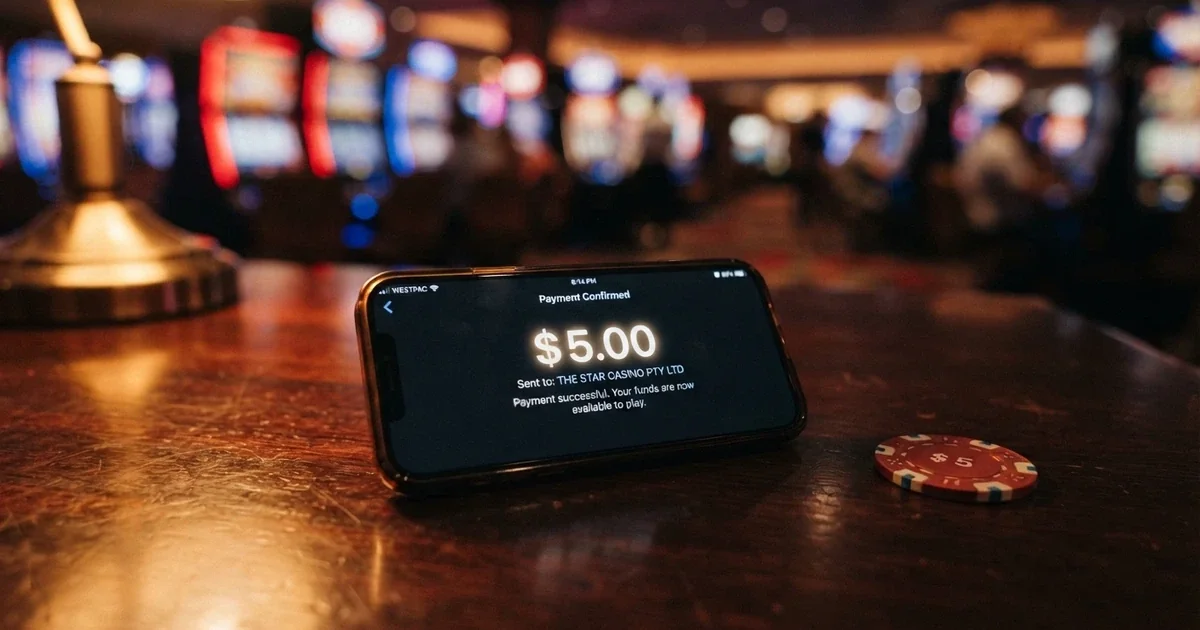
$10 No-Deposit PayID Casino Bonuses for Australian Players: What the Chip Is Actually Worth
 Available in AU
A $10 free chip at an Australian-facing online casino looks like a gift. It is rarely a gift. The face value is the smallest number a real-money casino can put on a no-deposit promotion and still look like an offer rather than a teaser, and at that size the wagering multiplier, the maximum cashout cap and the list of games you are allowed to play decide almost everything. PayID is what gets the rest of your money in and out quickly. The combination is what most “best Australian online casino” listicles are built around, and most of them skip the three terms that turn the offer from a free trial into a hole in your bankroll.

This page ranks every $10-tier no-deposit bonus we could find at an AU-facing online casino, runs the same comparison across the ten brands that carry one, and explains the arithmetic that turns a tenner into a $600 grind before you can withdraw a cent. It is written for a player in Australia deciding where to deposit, where to claim, and whether a no-deposit bonus is worth the time it takes to read the terms.
Current as of 18 October 2026. Bonus terms, wagering multiples, cashout caps and licence claims verified against the Curaçao eGaming register and the operators’ own published terms pages.
Table of Contents
- What a $10 No-Deposit Casino Bonus Actually Gets You in 2026
- Why Your 2026 No-Deposit Bonus Is Smaller Than It Looks
- 10 Casino Bonuses Compared: Every $10 No-Deposit Offer We Could Find for AU Players in 2026
- PayID at AU Online Casinos: Why It Is the Default Deposit Method in 2026
- Is It Legal? What the Interactive Gambling Act Actually Says About Online Casinos in 2026
- Staying Safe: Gambling Help and Limits for AU Players in 2026
- How We Chose and Ranked These Casinos
- What to Do with Your $10 No-Deposit Bonus: A Verdict That Puts the Player First
- Frequently Asked Questions
What a $10 No-Deposit Casino Bonus Actually Gets You in 2026
A no-deposit bonus is casino credit a site credits to a new account without requiring a deposit. The $10 chip is the bottom rung of the real-money no-deposit ladder. Below it sit 5–10 free-spin bundles that pay $0.10–$0.20 per spin, and above it sit $20 or $50 chips and 50- to 100-spin drops. A $10 chip is the smallest unit that still functions as cash you can spread across the games a site lets you play, which is why it is the most common “try the casino” promotion at the offshore brands that accept Australian players.
Australia does not have a licensed online casino market. The Interactive Gambling Act 2001 prohibits online casino games, online pokies and in-play betting outright, and no state or territory has ever issued a licence for any of them. Every brand on this page operates offshore under a Curaçao eGaming licence. None holds an Australian casino licence, because no such licence exists to be held. The terms the operator publishes are the terms you sign up to, and there is no Australian regulator to complain to if the operator ignores them.
The no-deposit bonus is not the same as a deposit match. A deposit match adds a percentage of your first deposit as bonus money and asks you to play through it before withdrawing; it is large, often 100% to 400% of the deposit, and is the centrepiece of the welcome package. A no-deposit bonus is the smaller offer that lands first, designed to let you try the site before risking your own money. At Australian-facing casinos the no-deposit is almost always the smaller, stricter, higher-wagering offer. Typical wagering on AU no-deposit bonuses runs 40x to 60x the bonus amount, and maximum cashout sits between A$50 and A$150 for most brands. PlayCroco’s A$180 ceiling and Uptown Pokies’ A$200 ceiling are the generous outliers; Ozwin’s $50 ceiling is the floor.
The structure matters. A no-deposit bonus is a credit, not a withdrawal. Until you have met the wagering requirement the balance is bonus money and the casino can — and routinely does — refuse to pay it out. The chip is best understood as a paid test drive: the casino gives you a sample of its software, and the terms decide how much of the sample you get to take home.
The Mechanics: How a No-Deposit Chip Actually Works
The full chain runs in four stages: claim, play, meet the wagering, withdraw. Each stage has a rule that costs the player if it is missed.
Claiming is the first stage. Some operators credit the chip automatically the moment the account is verified. Others require a bonus code at sign-up, a request via a Telegram channel, an app download, or an email verification step. Bizzo’s 10 free spins credit after the mobile app is installed. NeoSpin’s 50 free spins require a Telegram channel request. HellSpin’s 10 free spins can be unlocked either by app install or by email verification. The trigger is the part most players skip; the offer does not appear until the trigger has fired.
The wagering clock starts the moment the bonus is credited. Most no-deposit bonuses expire in 3 to 7 days, and an unplayed chip vanishes when the clock runs out. There is no rollover for an unused bonus; the casino takes it back, and the player is back to an empty wallet.
Playing is the third stage, and the rules tighten here. Pokies contribute 100% toward the wagering requirement at almost every AU-facing casino. Table games contribute 10% or 0% — the wagering meter barely moves on blackjack or roulette. Live casino is excluded entirely. The standard max bet per spin during wagering is A$5; placing a single bet above that limit, even once, is grounds for the casino to void the entire bonus balance and any winnings that came with it. Free spins are locked to a single title and carry a fixed value between $0.10 and $0.20 per spin.
Withdrawing is the last stage, and the one with the cap. Once wagering is met, the bonus balance converts to withdrawable cash, but only up to the maximum cashout limit. Anything above the cap is forfeit. At PlayCroco the cap is A$180; at Ozwin it is $50; at Uptown Pokies it is A$200. The cap applies to winnings, not to the chip, so a player who never wins anything loses nothing extra, and a player who lands a big hit loses everything above the cap. The conversion is automatic; the forfeit is silent.
Why Your 2026 No-Deposit Bonus Is Smaller Than It Looks
The gap between the advertised A$10 and the amount a player can actually withdraw is the single most important fact about a no-deposit bonus. Three terms create the gap: the wagering requirement, the maximum cashout cap, and the game-eligibility list. A fourth — the bonus expiry window — closes the door on anyone who dawdles. Read together, the four terms shrink a $10 free chip into a coin-flip trial with a ceiling that is usually set by the casino and not by the player.
The reason a $10 chip is so tight is that it sits at the bottom of the denomination ladder. The arithmetic on a $50 chip, with the same 50x wagering, is $2,500 in required turnover; the player who lands a moderate hit early in the session has enough runway to grind through it. A $10 chip with 60x wagering demands $600 in turnover before a cent is withdrawable, and a player who hits early has only the cashout cap — typically A$50 to A$200 — to aim for. The cap is the ceiling. The chip is the door.
Wagering Requirements: 60x Turns a $10 Bonus into a $600 Grind
Wagering is the total amount a player must bet, in aggregate, before bonus money converts to withdrawable cash. The multiplier is applied to the bonus amount. A $10 chip at 60x wagering is $600 of required turnover; a $10 chip at 30x wagering is $300. The required turnover is the same number whether the player wins or loses on any individual spin, because the casino counts every bet placed while the bonus is active, wins and losses both.

The Australian-facing market clusters around 40x to 60x wagering on no-deposit bonuses. PlayCroco, Fair Go and Ozwin all sit at 60x. Uptown Pokies sits at 50x. NeoSpin, HellSpin, Bizzo and Woo all sit at 40x. Royal Reels sits at 30x — the lowest in the set, and the only one that demands less than A$300 in turnover on a $10 chip. Betzoid’s analysis of 22 Australian no-deposit promotions found only 8 of 22 carried a wagering requirement at or below 40x, which puts the typical AU no-deposit chip firmly in the 50x to 60x band.
Wagering applies to the bonus amount only, not to the bonus plus a deposit, because there is no deposit. A player using only the A$10 chip must turn over A$600 at 60x wagering before a cent converts. The same player on a 100% deposit match would be turning over the bonus portion only — typically 30x to 40x of the bonus, with a deposit behind it. The no-deposit multiple is higher because the casino is taking more risk on money it gave away.
The low multiplier matters more than the face value. A $20 chip at 50x wagering demands A$1,000 in turnover; a $10 chip at 30x wagering demands A$300. The player who values their time should rank by the turnover required, not the face value offered. A chip that takes less grinding is worth more to most players than a chip with a higher headline number attached to a heavier multiplier.
Max Cashout Caps: Your Winnings Hit a Ceiling Long Before You Do
The cashout cap is the maximum the casino will pay out from a no-deposit bonus, applied to winnings, not to the chip. A $10 chip at PlayCroco with a A$180 max cashout means a player can win up to A$180 from the chip, after wagering, and the rest is forfeit. A $10 chip at Ozwin with a $50 max cashout means the same player can win up to $50, and the rest is forfeit. The cap is a ceiling, not a target, and the casino sets it.
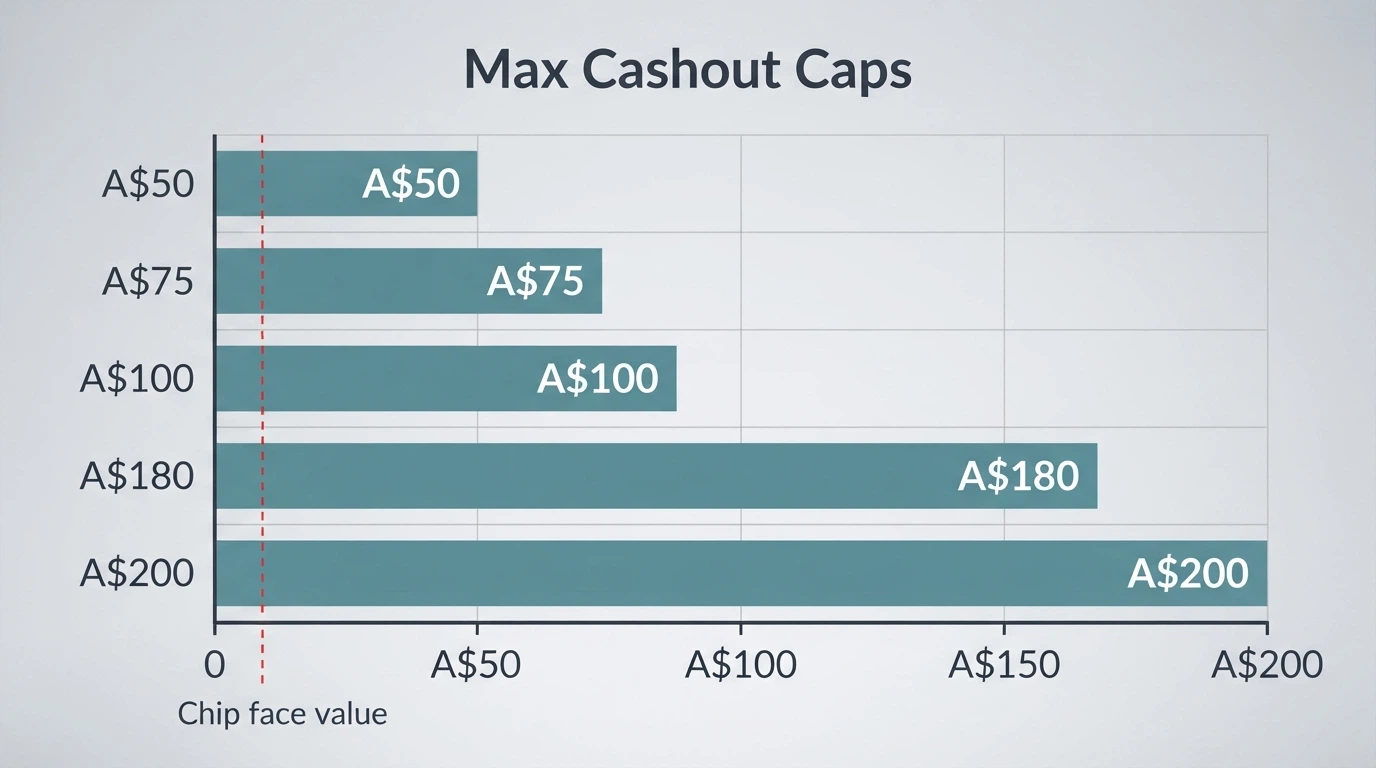
The range in the AU market is A$50 to A$200. PlayCroco’s A$180 cap is 18 times the face value of its chip, the most generous ratio in the set. Uptown Pokies’ A$200 cap is the highest absolute number, attached to a A$20 chip that demands 10x the face value. Ozwin’s $50 cap is the lowest absolute number, attached to a A$10 chip that demands 5x the face value. HellSpin’s A$100 cap on free-spin winnings is in the middle. NeoSpin’s A$75 cap on its 50-spin bundle is the floor for the free-spins group.
A low wagering requirement with a tight cap can be worse than a high wagering requirement with a generous cap. A A$10 chip at 30x wagering with a $50 cap gives a player one path: grind $300 in turnover, hope for a moderate hit, and accept that anything above $50 disappears. A A$10 chip at 60x wagering with a A$180 cap gives a player the same starting point but a higher ceiling, so a bigger hit at any point in the session is still worth something. The cap is what the player is actually playing for; the wagering is the cost of getting there.
The cap applies only to winnings, not to the chip. A player who loses the chip and never wins anything loses nothing extra; a player who lands a 100x hit on the first spin forfeits everything above the cap. The cap is therefore a tax on luck, paid by the players who most need the money and silently deducted by the casino at conversion.
Pokies-Only: What You Can Actually Play with Your Bonus
Pokies clear the wagering meter. Almost nothing else does. Pokies contribute 100% toward the wagering requirement at every brand in the set; table games contribute 10% or 0%; live casino contributes 0% and is excluded outright. A player who tries to grind the bonus at blackjack is contributing one-tenth of every bet toward the same target; a player who tries to grind it at live roulette is contributing nothing at all.
Provider restrictions narrow the list further. Fair Go, PlayCroco, Ozwin and Uptown Pokies all run on RTG (RealTime Gaming) software, which means the only games that count toward wagering are the RTG pokies in the operator’s library. A player who arrives with a preferred title from a different studio finds that the game does not contribute, even if the casino carries it under a different section. Fair Go carries RTG pokies only, period; a player who logs in expecting NetEnt or Pragmatic Play will not find them.
Free spins are locked to a single title. NeoSpin’s 50 free spins are locked to Big Bass Bonanza. Royal Reels’ 50 free spins are locked to Sweet Bonanza. Jackpot Jill’s 25 free spins are locked to Wolf Treasure. A player who claims the spins plays the named game, on the named game’s RTP and volatility, for the duration of the drop. The freedom of choice a free chip gives does not extend to a free-spins bundle.
| Slot Title | Provider | RTP | Volatility | Max Win |
|---|---|---|---|---|
| Book of Dead | Play’n GO | 96.21% | High | x5,000 |
| Big Bass Bonanza | Pragmatic Play / Reel Kingdom | 96.71% | Medium-High | x2,100 |
| Starburst | NetEnt | 96.09% | Low | ~x500 |
The table is short on purpose. Research covers RTP for a handful of titles and volatility for fewer, so most slots on the AU-facing market take the no-data marker and stay out of the column. Of the three named, Big Bass Bonanza is the most common no-deposit-spin target; it has an RTP of 96.71% and a max win of x2,100, with a bonus round that fires roughly once every 114 spins on average. Book of Dead sits at 96.21% with high volatility and a x5,000 max win — riskier session, larger ceiling. Starburst at 96.09% with low volatility is the steady grinder: smaller wins, longer session, the kind of title a player picks when the goal is to clear wagering rather than to chase a feature.
Free Chips vs Free Spins: Two Very Different Kinds of “Free”
A free chip is cash credit; a free-spins bundle is a fixed number of spins at a fixed stake. They look interchangeable in a listicle. They are not.
| Bonus Type | What You Get | Wagering On | Typical Max Cashout | Game Choice |
|---|---|---|---|---|
| Free chip | A$10–A$20 cash credit, playable across eligible pokies | The full chip amount | A$50–A$200 | Broad — chip applies to all eligible pokies |
| Free spins | 10–50 spins at $0.10–$0.20 per spin, locked to one title | The winnings from the spins, not the spin value | A$75–A$200 | Locked — one named slot |
A free chip is the more flexible tool. The player decides which eligible pokie to play, how much to bet per spin (within the A$5 cap), and when to walk away. A A$10 chip at 60x wagering is A$600 in required turnover, and the player spreads that turnover across the games the operator lets them play. A A$20 chip at 50x wagering is A$1,000 in required turnover — double the cost — but the same freedom of choice.
A free-spins bundle is the more constrained tool. The player takes 10 to 50 spins at a fixed stake on a single named title, the winnings are subject to wagering, and the player cannot switch games until the spins are used. NeoSpin’s 50 free spins on Big Bass Bonanza, with 40x wagering and a A$75 cap, is the largest free-spins bundle in the set; even so, the A$75 cap and the single-title lock mean the ceiling is set by the casino, not by the spin. Bizzo’s 10 free spins for app install, with 40x wagering and a 7-day expiry, is the smallest.
Expiry windows run 3 to 7 days for both types. A player who claims a no-deposit bonus and walks away for the weekend is likely to find the bonus expired on Monday. The clock is the other ceiling: the casino sets the cap on winnings and the cap on time, and the player is expected to clear both before either one closes.
The two types suit different players. A pokie explorer who wants to feel out a new casino takes a free chip and spreads it across the lobby. A slot-focused player who has a preferred title takes a free-spins bundle on that title and accepts the lock. Neither type is objectively better. The chip costs more grinding per dollar won but gives the player the wheel; the spins cost less grinding but lock the player to one reel.
Welcome Bonuses: What Happens After the No-Deposit Offer
The no-deposit bonus is the hook. The welcome package is where the real money moves. Every brand in the set offers a first-deposit match, and the no-deposit chip is the small print on the way to a much larger bonus that comes with the player’s first deposit.
Welcome match rates run 100% to 400%. HellSpin leads with a 150% match up to A$450 plus free spins on Wild Walker, on a minimum A$25 deposit and 40x wagering. NeoSpin offers 100% up to AU$1,500 plus 100 free spins on Fruit Million, on a minimum AU$30 deposit and 40x wagering. PlayCroco offers 200% up to A$5,000 plus 20 free chips, on a minimum A$10 deposit. Uptown Pokies and Ozwin both offer 400% matches, the highest in the set, with Ozwin capping at A$4,000 and Uptown Pokies running the same headline number on a different structure. Stake, included for completeness, does not offer a no-deposit bonus at all — its 200% deposit match up to $2,000 is the entry point, and the only offer a new player can claim.
The wagering shift is the quiet part. No-deposit wagering runs 40x to 60x at most brands. Welcome match wagering runs 30x to 40x, typically on the bonus amount only. The player who graduates from a $10 chip at 60x to a $200 deposit match at 30x is paying half the multiple on ten times the money, and the per-dollar grind changes shape. The chip is a sampler; the welcome match is the real campaign, and the casino is happy to drop the multiplier to keep the player in the chair.
Minimum deposits sit between A$10 and A$30 at most brands. PlayCroco accepts A$10. HellSpin requires A$25 for the welcome match. NeoSpin requires AU$30. The A$10 floor is the entry-level PayID deposit across the market, and the brands that meet it pick up the cost-sensitive player who wants to test the cashier before committing more.
10 Casino Bonuses Compared: Every $10 No-Deposit Offer We Could Find for AU Players in 2026
Ten AU-facing brands carry a no-deposit offer at the $10 tier or close to it. The table below lays each one out across bonus type, wagering multiple, maximum cashout, licence jurisdiction and the game providers on the platform. Empty cells are the ones the inputs do not cover, and they are not filled in.

| Casino | No-Deposit Bonus | Wagering | Max Cashout | Licence | Game Providers |
|---|---|---|---|---|---|
| PlayCroco | A$10 free chip | 60x | A$180 | Curaçao eGaming | RTG |
| Fair Go | A$10 free chip | 60x | A$150–A$180 | Curaçao eGaming | RTG |
| Ozwin | A$10 free chip | 60x | $50 | Curaçao eGaming | RTG |
| Uptown Pokies | A$20 free chip | 50x | A$200 | Curaçao eGaming (Antillephone N.V.) | RTG |
| HellSpin | 10 free spins | 40x | A$100 | Curaçao eGaming | Multi-provider (Pragmatic Play, NetEnt, Play’n GO) |
| Bizzo Casino | 10 free spins (app install) | 40x | — | Curaçao eGaming | Multi-provider (8,000+ games) |
| Woo Casino | 10 free spins | 40x | — | Curaçao eGaming | Multi-provider (Pragmatic Play, NetEnt) |
| NeoSpin | 50 free spins (Telegram) | 40x | A$75 | Curaçao eGaming | Multi-provider (BGaming, Pragmatic Play) |
| Royal Reels | A$10 no-deposit | 30x | Shown on activation | Curaçao eGaming | Multi-provider |
| Stake | None | — | — | Curaçao eGaming | Multi-provider (Stake Originals + others) |
The split that matters is RTG-only versus multi-provider. PlayCroco, Fair Go, Ozwin and Uptown Pokies all run on RealTime Gaming software, which means a player at one of these brands can only grind the wagering on RTG pokies. The RTG library is large — PlayCroco lists 3,000+ titles, Uptown Pokies 300+, Fair Go and Ozwin 200+ — but the title the player wants may not be there. HellSpin, Bizzo, Woo, NeoSpin, Royal Reels and Stake all run multi-provider platforms, which means more studios, more titles, more chances that the specific pokie a player wants is in the lobby.
The other split is chip versus spins. The four RTG brands and Royal Reels all offer cash chips. HellSpin, Bizzo, Woo and NeoSpin offer free-spins bundles, and the free-spins bundles are locked to single titles with low max cashout caps. The cash-chip brands give the player freedom of game choice; the free-spins brands give the player a fixed cost and a fixed ceiling. The ranking below is alphabetical, not ordered, and the verdict on each one sits in its own section.
PlayCroco: The $10 Chip with the Highest Cashout Ceiling
PlayCroco is the A$10 chip with the best ceiling in the set. The chip credits on sign-up, carries 60x wagering and pays out up to A$180 on conversion — 18 times the face value. The 60x wagering means A$600 in required turnover before a cent becomes withdrawable, which is the standard high-end of the AU no-deposit range, but the cashout cap justifies the grind for a player who lands a moderate hit early.
The platform runs on RTG (RealTime Gaming) software. The library is large — 3,000+ games — but the brand and the studio are the same everywhere in the RTG family: pokies from one provider, table games from the same provider, no Pragmatic Play, no NetEnt, no Play’n GO. A player who arrives with a specific non-RTG title in mind will not find it. A player who likes RTG pokies will find a deep library and consistent gameplay.
PayID deposits clear in under 60 seconds, and the minimum deposit is A$10 — the lowest in the set. Weekly withdrawals cap at A$7,500, which is generous for a $10-deposit brand. The Curaçao eGaming licence is the standard offshore wrapper, and the welcome match after the no-deposit chip is 200% up to A$5,000 plus 20 free chips, on the same 60x wagering terms as the no-deposit.
PlayCroco ranks as the top option for a player who wants the highest cashout ceiling in the set and is willing to grind 60x wagering on RTG pokies. The $10 minimum deposit and the $7,500 weekly withdrawal cap are the practical enablers; the 18x cap is the reason the chip is worth claiming.
Fair Go: High Wagering, Solid Cap, RTG-Only
Fair Go’s $10 chip carries 60x wagering and a A$150–A$180 max cashout, which puts the brand in the same band as PlayCroco on the cost side and the same band as Uptown Pokies on the ceiling side. The chip credits on sign-up, the wagering runs on the bonus amount only, and the cap applies to winnings, not to the chip.
The platform is RTG-only. Fair Go lists 200+ pokies in its library, and only RTG pokies clear the playthrough — a player who tries to grind the bonus at table games or live casino will see the meter barely move, because table games contribute 10% or 0% and live casino is excluded. The RTG library is the narrowest of the four RTG brands in the set, with around 200 titles against PlayCroco’s 3,000+ and Uptown Pokies’ 300+. A player who already knows the RTG roster will find their favourites; a player who has never played RTG will find a smaller selection than the headline numbers suggest.
The welcome package after the no-deposit chip is 100% up to A$1,000 plus 100 free spins, on 30x wagering — a substantial drop from the no-deposit 60x, which is the typical shift in the Australian-facing market from the sampler to the campaign.
Fair Go is the right choice for a player who already knows the RTG pokies and is happy to grind them at 60x wagering. The cap is competitive with the rest of the set, and the welcome match is the second-most generous in the RTG group.
Ozwin: The Tightest Cashout Cap in the Set
Ozwin’s $10 chip carries 60x wagering and a $50 max cashout — the lowest absolute ceiling in the set. The chip credits on sign-up, the wagering is on the bonus amount, and the cap is the cost a player pays for the rest of the package: 200+ RTG pokies, a 400% welcome match up to A$4,000 plus 100 free spins, and the standard Curaçao wrapper.
The $50 cap is the problem. A player who lands a moderate hit early in the session — say, a 5x win on the chip — collects the full $50 plus the chip, hits the cap, and has nothing left to grind for. A player who lands nothing finishes the wagering requirement, claims nothing, and walks away with a session but no payout. The arithmetic is unfavourable either way: the wagering is high, the cap is low, and the upside is constrained.
The RTG library is the same 200+ pokies as Fair Go, and the wagering rules are the same: pokie play at 100% contribution, table games at 10% or 0%, live casino excluded. The welcome match is the highest headline number in the set — 400% up to A$4,000 — but the 60x wagering on the no-deposit chip is the same 60x that runs across the RTG family.
Ozwin targets the player who values the welcome match more than the no-deposit chip. The chip itself is the tightest in the set on cap, and a player chasing the no-deposit offer alone is grinding harder for less.
Uptown Pokies: The Biggest Free Chip and the Highest Cap
Uptown Pokies runs the largest free chip in the set — A$20 — at 50x wagering, with a A$200 max cashout. The chip is twice the face value of PlayCroco’s, the wagering is ten points lower, and the cap is the highest absolute number in the table. By headline measure, this is the strongest no-deposit offer available at an AU-facing casino.
The platform is RTG-only, under a Curaçao eGaming licence issued through Antillephone N.V. The library lists 300+ pokies, and only RTG titles clear the wagering. The minimum deposit for the welcome match is A$20, which is one tier above the A$10 floor set by PlayCroco and Bizzo, and the welcome match is 400% up to A$4,000 plus 100 free spins on 30x wagering.
The trade is the size of the chip against the size of the grind. A A$20 chip at 50x wagering is A$1,000 in required turnover, double the A$600 at PlayCroco. The ceiling is higher, but the cost is higher, and a player who never lands a meaningful hit is paying twice the turnover for nothing. The A$200 cap only matters for a player who lands a hit; for everyone else, the A$1,000 turnover is the bill.
Uptown Pokies is the right choice for a player who wants the largest chip and the highest cap in the set, and is prepared to grind A$1,000 in turnover on RTG pokies to reach it. For a player who values the time-to-cashout over the headline, PlayCroco’s A$600 turnover on a A$10 chip with a A$180 cap is the more efficient offer.
HellSpin: Free Spins with the Best Withdrawal Speed
HellSpin offers 10 free spins as a no-deposit bonus, unlocked either by installing the mobile app or by completing email verification. The wagering is 40x on the bonus, the max cashout on free-spin winnings is A$100, the max bet during bonus play is A$5, and the bonus expires in 7 days. The wins are smaller than a $10 chip, but the wagering is at the lower end of the AU range and the platform is multi-provider.
HellSpin is the only brand in the set with a tested PayID withdrawal time. PayID withdrawals cleared in 25 minutes in the round of testing the page is current to — the fastest in the set, against 28 minutes at Goldenbet and 35 minutes at Lucky7. The welcome package is 150% up to A$450 plus free spins on Wild Walker, on a minimum A$25 deposit and 40x wagering. The library runs Pragmatic Play, NetEnt, Play’n GO and other studios, so a player who arrives with a preferred title from a major studio is more likely to find it here than at any RTG-only brand.
The 10 free spins are small. At a $0.10–$0.20 spin value, the total face value of the bundle is A$1 to A$2, well below the A$10 chip at PlayCroco, Fair Go, Ozwin or Royal Reels. The wagering applies to the winnings from the spins, not to the spin value, so the actual cost depends on what the spins pay out. A $2 spin value with 40x wagering on the winnings is a much lighter requirement than a $10 chip at 60x, but the ceiling is the A$100 cap, and a player who hits it walks away with A$100.
HellSpin is the right choice for a player who wants multi-provider titles, a fast PayID withdrawal, and a free-spins bundle rather than a cash chip. The 10 free spins are the entry ticket; the 25-minute PayID withdrawal is the real differentiator.
Bizzo Casino: App-Install Free Spins on an 8,000-Game Library
Bizzo offers 10 free spins for installing the mobile app, on 40x wagering and a 7-day expiry. The trigger — app install — is the strictest in the set, and the bonus does not credit until the app is on the device. The free spins are smaller than the A$10 chips at the RTG brands and the 50-spin bundle at NeoSpin, but the platform is the largest in the set.
Bizzo’s library is 8,000+ games across multiple providers, the deepest catalogue on the page. The minimum deposit is A$10, which matches PlayCroco as the lowest entry-level deposit in the set. The welcome package is up to A$7,250 plus 175 free spins plus a bonus game, on a Curaçao eGaming licence, and the maximum cashout on the no-deposit free spins was not confirmed in the research round — a fact the table flags with the no-data marker.
The 10 free spins are a teaser, not a campaign. The wagering is light at 40x and the platform is broad, but the player is being paid in spins rather than cash, and the value of the offer depends on the title the spins are locked to. The welcome match, by contrast, is the largest headline number in the set, and the 8,000-game library is the reason a player would pick Bizzo over the RTG brands.
Bizzo is the right choice for a player who values catalogue depth over the no-deposit size, and is willing to install an app to claim 10 free spins. The welcome match is the campaign the no-deposit spins introduce; the no-deposit itself is the door.
Woo Casino: 10 Free Spins with a Multi-Provider Line-Up
Woo Casino offers 10 free spins as a no-deposit bonus on 40x wagering, with a multi-provider platform that includes Pragmatic Play and NetEnt alongside other studios. The welcome package is up to A$6,500 plus 200 free spins, on a Curaçao eGaming licence, and the minimum deposit and the no-deposit max cashout were not confirmed in the research round.
The free-spins bundle is the same 10-spin count as HellSpin and Bizzo, on the same 40x wagering, with the same multi-provider platform category. The differentiator is the welcome package — 200 free spins plus a A$6,500 match is a competitive headline — and the brand’s presence on the comparison pages that rank AU-facing casinos. The free spins themselves are a sampler for a player who wants to see a multi-provider platform without committing a deposit.
The gaps matter. Research did not confirm a max cashout for the no-deposit free spins, and the table flags it. A player who claims the spins without checking the cap on the operator’s own terms page is playing a different game than the player who reads the terms first.
Woo is the right choice for a player who wants a multi-provider platform and a large welcome package, and who is willing to read the terms on the operator’s own page to fill the gaps the comparison table leaves open.
NeoSpin: 50 Free Spins on Big Bass Bonanza — the Biggest Free-Spins Bundle
NeoSpin’s no-deposit offer is 50 free spins on Big Bass Bonanza, distributed via the operator’s Telegram channel, on 40x wagering with a A$75 max cashout and a 7-day expiry. The bundle is the largest free-spins no-deposit in the set — five times the 10-spin drops at HellSpin, Bizzo and Woo — and the locked title is one of the highest-RTP pokies on the market at 96.71%.
The platform is multi-provider, with BGaming and Pragmatic Play among the studios on the roster. The welcome package after the no-deposit spins is 100% up to AU$1,500 plus 100 free spins on Fruit Million, on a minimum AU$30 deposit and 40x wagering. The minimum deposit is the highest in the set at the welcome-match level, which signals a brand aimed at a player willing to commit a larger first deposit.
The trade is the bundle size against the cap. A$75 is the lowest max cashout in the free-spins group, and Big Bass Bonanza’s bonus round fires roughly once every 114 spins on average, so a player is unlikely to hit a feature on 50 free spins unless the bonus lands early. The 50-spin bundle is generous in count, modest in ceiling, and locked to a single title.
NeoSpin is the right choice for a player who likes Big Bass Bonanza specifically, is willing to join a Telegram channel to claim the spins, and accepts the A$75 cap. The 100-spin welcome drop on Fruit Million is the campaign that follows, and the AU$1,500 match is the reason to deposit.
Royal Reels: The Only 30x Wagering in the Set
Royal Reels offers an A$10 no-deposit chip on sign-up, with 30x wagering — the lowest wagering multiple in the set. The cashout cap is shown on activation rather than published in advance, which is the one term the player has to check before claiming. The platform is multi-provider, and the Friday free-spins drop is 50 spins on Sweet Bonanza, on 40x wagering with a A$100 max cashout.
The 30x wagering is the differentiator. A $10 chip at 30x is A$300 in required turnover — half the cost of PlayCroco’s A$600, less than a third of Uptown Pokies’ A$1,000. A player who values their time above the headline chip size is paying half the grinding for the same face value. The cap is the one term the player must read on activation, because it is not published in advance; the 30x wagering is what makes the offer worth checking.
The platform runs multi-provider titles, so a player who arrives with a specific studio in mind is more likely to find it than at the RTG-only brands. The Friday free-spins drop is a recurring promo, not a one-time welcome, and the 50-spin count on Sweet Bonanza is competitive with NeoSpin’s 50-spin drop on Big Bass Bonanza — different title, different volatility, different cap.
Royal Reels is the right choice for a player who values low wagering over headline chip size, and is willing to read the activation screen to confirm the cap before claiming. The 30x wagering is the cheapest in the set; the cap is the one thing the comparison table does not show.
Stake: No No-Deposit Bonus — Here Is What It Offers Instead
Stake does not offer a no-deposit bonus. The brand’s entry point is a 200% deposit match up to $2,000, on a Curaçao eGaming licence, with a multi-provider platform that includes proprietary Stake Originals alongside Pragmatic Play and other studios. Stake is included on this page for completeness, as a high-traffic AU-facing brand, and to give a player a comparison point against the brands that do run a no-deposit.
The deposit match is generous in headline terms — 200% on the first deposit, up to $2,000 — and the platform is one of the deepest multi-provider libraries in the iGaming market, with Stake Originals as the proprietary layer. The wagering terms on the deposit match were not confirmed in the research round, and the table flags the gaps.
A player who arrived at this page looking for a $10 no-deposit chip will not find one at Stake. A player who arrived looking for a high-deposit-match alternative to the no-deposit sampler finds one. The two products are not interchangeable; the no-deposit chip is a trial, the deposit match is a campaign, and Stake has chosen the campaign.
Stake is the right choice for a player who has decided to deposit and is comparing welcome matches, not for a player who wants a no-deposit trial. The 200% match is the offer; the absence of a no-deposit is the cost of entry.
PayID at AU Online Casinos: Why It Is the Default Deposit Method in 2026
PayID is the deposit rail that runs on Australia’s New Payments Platform, the real-time settlement system that the big four banks and most of the regionals built between 2017 and 2018. PayID transfers clear in real time, 24 hours a day, 7 days a week, including weekends and public holidays. The transfer is between bank accounts identified by a mobile number, email address or ABN, and the receiving bank matches the identifier to the BSB and account number behind it. The user never sees a BSB or an account number, and the operator never sees a card number.
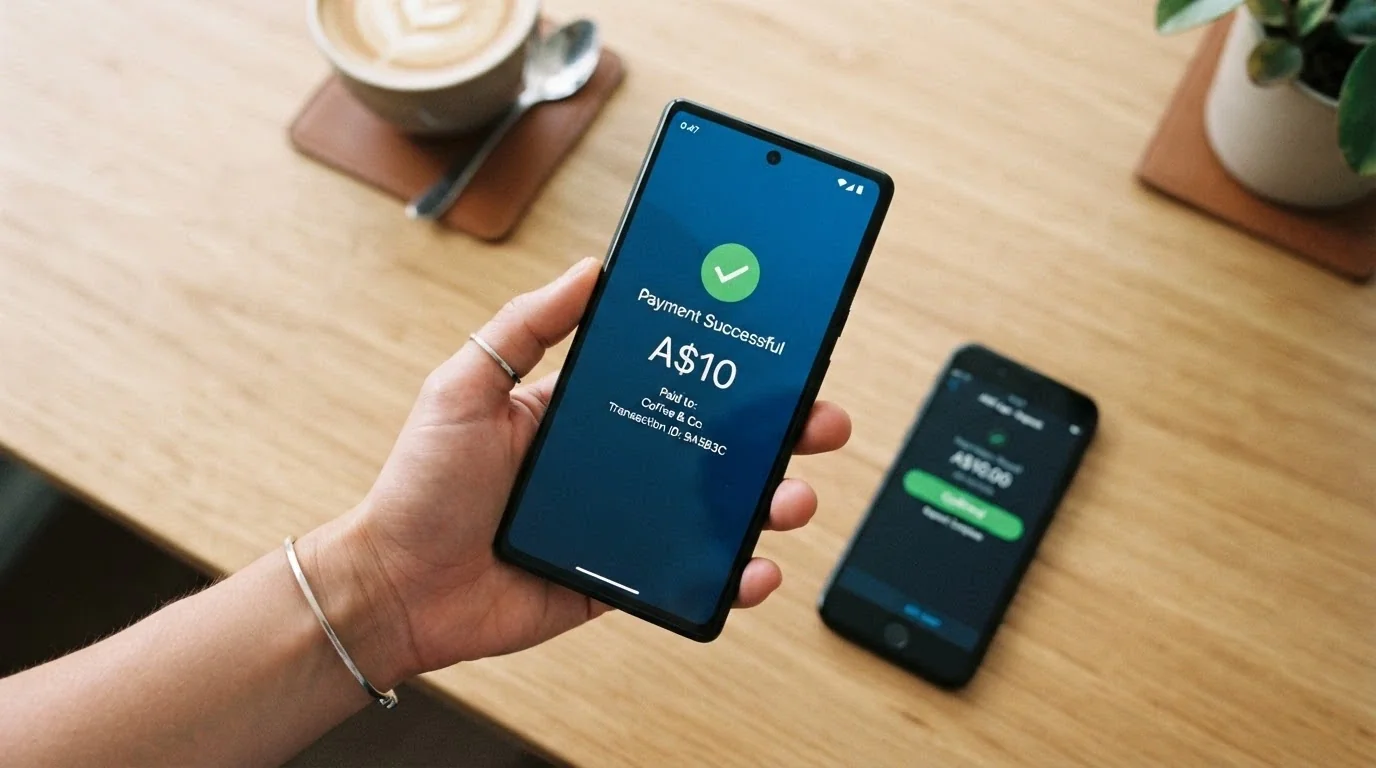
For an Australian player depositing at an offshore casino, PayID is the fastest and cheapest option. Deposits land in under 60 seconds. Australian banks charge A$0 for PayID transfers in the standard case. The minimum deposit across PayID-friendly AU-facing casinos sits in the A$10 to A$30 band, with PlayCroco and Bizzo at the A$10 floor and HellSpin, NeoSpin and Uptown Pokies in the A$20 to A$30 tier. The A$10 minimum is the entry-level deposit for the brands that want the cost-sensitive player; the A$30 ceiling is the deposit floor for brands that want a player willing to commit more.
PayID is the most widely used real-money deposit method for Australian pokies players, and the reason is the combination of speed, cost and privacy. A card deposit shares the card number with the operator; a PayID deposit shares only the identifier — typically a mobile number or an email — and the operator never sees the underlying account. The Australian banks that back PayID treat the identifier as a routing token, not as account credentials, and the operator cannot use it to draw funds outside the deposit the player has approved.
The credit card ban since 11 June 2024 has made PayID more central. The Interactive Gambling Amendment (Credit and Other Measures) Act 2023 made it an offence for an operator to accept a credit card, credit-related product or digital currency from an Australian customer, with a A$247,500 penalty for non-compliance. Debit cards, bank transfers, PayID, Osko and BPAY are the legal routes for licensed wagering, and PayID is the fastest of them. A site that asks for a credit card or a crypto deposit from an Australian is operating outside the AU rules, and that fact is itself information about the operator.
PayID Withdrawals: How Fast Your Money Actually Arrives
PayID withdrawals are the same rail in reverse, with one extra step: the operator has to approve the withdrawal before the PayID transfer fires. The approval step is where the operator’s processing time sits, and the processing time is what separates a fast PayID withdrawal from a slow one.
Three operators were tested for PayID withdrawal speed. HellSpin cleared in 25 minutes. Goldenbet cleared in 28 minutes. Lucky7 cleared in 35 minutes. The 25-minute figure is the floor in the set and the headline; the 35-minute figure is still well under the time a bank transfer or a card withdrawal takes, where two to five business days is the typical range. The variance is the operator’s processing, not the PayID rail; the rail itself is real-time.
The privacy benefit carries over. A PayID withdrawal goes back to the same identifier the player deposited from, and the operator does not see the card number behind the player’s bank account. The player who deposited with a debit card and then asked for a card refund gives the operator the card number to draw against; the player who deposited and withdrew via PayID gives the operator only the identifier.
PayID is not available at every operator. The brands in the set that confirm PayID support — PlayCroco, HellSpin, Bizzo, Royal Reels, Stake and the RTG family generally — are the ones that have built a PayID cashier. Brands that do not support PayID fall back on bank transfer, which is slower, or on crypto rails, which are now illegal for an Australian customer under the credit-and-crypto ban. The PayID-friendly brands are the brands a player can move money through fastest.
The $10 Minimum: What a Ten-Dollar Deposit Actually Unlocks
The A$10 minimum is the entry-level deposit across the PayID-friendly AU-facing market. PlayCroco and Bizzo set the floor at A$10. Fair Go, Ozwin, Royal Reels and Woo do not publish a confirmed minimum in the research round. HellSpin requires A$25 for the welcome match. NeoSpin requires AU$30. Uptown Pokies requires A$20 for the match bonus.
A A$10 deposit is the smallest amount that unlocks the welcome match at the A$10-floor brands. It is also the smallest amount that lets a player test the cashier — the deposit speed, the PayID identifier match, the bonus credit — before committing a larger sum. A player who is comparing two brands will often deposit A$10 at each, claim the welcome match at the lower tier, and decide which cashier to use for a larger second deposit.
A A$30 deposit, by contrast, is the floor at the brands aimed at a more committed first-deposit player. NeoSpin’s AU$30 minimum is the highest in the set, and the welcome match of 100% up to AU$1,500 plus 100 free spins is the campaign aimed at that player. The minimum is the brand signalling the deposit size it expects.
The A$10 to A$30 band is the practical PayID range. Deposits below A$10 are rare; deposits above A$30 are welcome but not required. A player who values the lowest possible entry point ranks PlayCroco and Bizzo first; a player who wants the largest welcome match at the standard minimum ranks NeoSpin and HellSpin first. The two are not the same player.
Credit Cards and Crypto Are Banned — PayID Is the Compliant Choice
Since 11 June 2024, the Interactive Gambling Amendment (Credit and Other Measures) Act 2023 has made it an offence for an operator to accept a credit card, a credit-related product or digital currency from an Australian customer. The penalty for non-compliance is up to A$247,500 per breach. The law applies to operators offering wagering to Australian customers, which includes the offshore brands on this page even though none of them holds an Australian licence.
The credit-and-crypto ban was passed in 2023 and took effect in June 2024, closing a payment-method loophole that had let Australian customers fund online wagering with credit. The intent was to reduce harm by removing a payment rail that let customers spend money they did not have in the bank. The effect on the player at an offshore casino is the same: a site that asks for a credit card or a crypto deposit from an Australian is breaking AU rules, and the player is on a site that does not follow AU rules.
The legal deposit routes for an Australian customer at a licensed wagering operator are debit card, bank transfer, PayID and Osko, and BPAY. At an offshore casino, the same rails apply, with PayID as the fastest and cheapest. A site that asks for a credit card is a site that is not checking which country the player is in; a site that asks for crypto is a site that is choosing a rail that is illegal for Australian customers. Neither is a good sign.
The 1 January 2027 reform expands the payment-block powers. From that date, banks and payment providers gain express statutory authority to block transactions to illegal gambling operators. The A$247,500 penalty remains; the new power is the bank’s. An Australian player who has been funding an offshore casino via PayID or bank transfer may find the bank declines the transaction under the new rule. The reform does not make the offshore casino legal; it makes the payment harder to make.
Is It Legal? What the Interactive Gambling Act Actually Says About Online Casinos in 2026
Online casino games, online pokies and in-play sports betting are prohibited in Australia under the Interactive Gambling Act 2001. The Act, passed in 2001 and strengthened by amendments in 2017, makes it an offence to provide these products to a person in Australia. There is no licence for online casino anywhere in the country, federally or in any state or territory, and no operator on this page holds an Australian casino licence because no such licence can be issued.

The Act targets the provider, not the player. The individual player is not prosecuted for using an offshore casino; the Act’s civil penalty provisions and criminal offences apply to the person or company providing the prohibited service. This is the part most players do not know: the player is not breaking the law by using an offshore casino, but the casino is breaking the law by offering the product. The enforcement flows upstream, toward the operator.
What is permitted is narrower. Australians can legally place wagers on sporting events and races before the event begins, through state- and territory-licensed wagering operators. Lotteries and keno are permitted through licensed operators. The Northern Territory Racing and Wagering Commission, administered through Licensing NT, is the de facto national licensor for online wagering; major Australian-facing bookmakers hold NT licences. None of them offers online casino games, because the licence does not cover casino, and the IGA prohibits them anyway.
The minimum age for all commercial gambling in Australia is 18. This applies across every licensed product, and offshore operators apply the same age check in their sign-up process, though the verification depth varies. A player under 18 is on the wrong side of every rule that applies, AU-licensed or offshore.
ACMA Enforcement: 1,564 Sites Blocked and 225 Operators Gone
The Australian Communications and Media Authority is the federal regulator that enforces the online prohibition. ACMA investigates complaints, issues formal warnings, refers operators for civil penalty proceedings, and directs Australian internet service providers to block illegal sites. The blocking power was added by the 2017 amendments and has been the most visible part of ACMA’s enforcement.
Since the first blocking request in November 2019, ACMA has had 1,564 illegal gambling and affiliate websites blocked by Australian ISPs. The number includes both the operator sites and the affiliate pages that market them, and the block list is updated continuously. Since enforcement was strengthened in 2017, more than 225 illegal services have withdrawn from the Australian market entirely — some after ACMA action, some after a blocking request made the AU market too expensive to maintain.
The risk for a player is direct. A site can be blocked mid-session, mid-deposit, or mid-balance. ACMA does not compensate players who have funds at a blocked site, and the operator is not obligated to return the balance under Australian law. The 1,564 blocks are a running total, and the next one could be the brand a player is logged into tonight.
ACMA’s enforcement powers have expanded with each round of amendments. The 2017 amendments added the blocking power; the 2023 credit-and-crypto amendments added the payment-method ban; the 2026 reform, which commences on 1 January 2027, adds the bank-blocking power. Each round closes a loophole the offshore industry had been using, and each round reduces the convenience of running an illegal product to Australian customers.
Offshore Casinos: No AU Licence Means No AU Protection
An offshore casino holds a Curaçao eGaming licence, not an Australian licence. The Curaçao licence is a real regulatory instrument — operators are required to keep player funds in segregated accounts, submit to RNG testing, and maintain responsible gambling tools — but it is enforced in Curaçao, not in Australia. The player has no Australian consumer protection, no Australian complaints body, and no recourse under Australian law if the operator refuses a withdrawal or closes the account.
BetStop, the National Self-Exclusion Register, does not reach offshore casinos. A player who has registered with BetStop is excluded from every Australian-licensed wagering service in a single step; an offshore casino is not connected to the register, and the exclusion does not propagate. The 67,480 BetStop registrations as at 31 July 2026 — of which 41,290 remain active — apply to licensed wagering only. A self-excluded player can still open an account at an offshore casino, deposit, claim a no-deposit bonus, and lose the balance, because the offshore operator has no way to check the register and no obligation to do so.
ACMA cannot recover a player’s money. The regulator can block the site, fine the operator, and refer the matter for civil penalty proceedings, but it cannot compel an offshore operator to pay out a contested balance. The dispute sits between the player and the operator, in the operator’s jurisdiction, under the operator’s terms. A player who has been denied a withdrawal at an offshore casino has, in practice, no path to resolution short of the operator’s own internal complaints process — which is the same body that made the decision.
The site can be blocked at any time. A player who holds a balance at an offshore casino on the day ACMA adds the site to the blocking list is in the same position as a player whose bank has just declined a withdrawal: the money is in the operator’s hands, and the operator’s hands are out of Australian reach. This is the practical cost of the offshore route, and it is the reason the next section on the 2026 reform matters.
The 2026 Reform: What Changes on 1 January 2027
The Interactive Gambling Amendment (Gambling Reform) Bill 2026 passed Parliament on 19 August 2026. Its measures commence on 1 January 2027. The reform does not legalise online casino; it tightens the prohibition and gives regulators and banks new tools to enforce it.
The advertising changes are the most visible. From 1 January 2027, wagering advertising on free-to-air television is capped at three ads per hour between 6:00 am and 8:30 pm. Wagering advertising is banned from 15 minutes before a live sporting event until 5 minutes after it ends. Radio wagering ads are barred during school drop-off and pick-up times. Broadcasting sporting odds is banned outright. Online wagering ads can only be shown to logged-in, age-verified users who have not opted out. No wagering advertising is allowed inside sports venues or on uniforms. Athletes, celebrities and influencers are barred from promoting wagering products.
The payment changes are the most consequential for an offshore-casino player. From 1 January 2027, banks and payment providers gain express statutory authority to block transactions to illegal gambling operators. A PayID or bank-transfer deposit to an offshore casino may be declined by the bank under the new rule. The credit-card-and-crypto ban remains; the new power is the bank’s.
The inducement changes affect how licensed operators can market to customers. From 1 January 2027, direct marketing of inducements — sign-up offers, referral bonuses, “free bet” prompts — is prohibited for 14 days after a customer signs up, for 3 months after a person deregisters from BetStop, and indefinitely for customers identified as being at risk of gambling-related harm. The rules apply to licensed operators; offshore operators do not have an Australian marketing licence to lose.
The core prohibition does not change. Online casino remains prohibited under the IGA, and the 2026 reform does not legalise it. The reform changes the way the prohibition is enforced — through advertising caps, payment blocks and inducement restrictions — and gives the banks a tool they did not have. The player at an offshore casino is still on an illegal site; the bank just has more power to make the deposit fail.
Staying Safe: Gambling Help and Limits for AU Players in 2026
About 2.1% of Australian adults — roughly 430,000 people — experience problem gambling, according to the Australian Institute of Health and Welfare’s 2022 data. A further 1.8% sit in the high-risk category. The numbers are a population-level estimate and not a prediction for any individual player, but they are the reason the help infrastructure exists and the reason the offshore gap matters.
BetStop, the National Self-Exclusion Register, is the single most powerful player-protection tool in the Australian system. Live since August 2023, BetStop lets a person exclude themselves from every Australian-licensed online and phone wagering service in a single registration. The exclusion periods range from three months to a lifetime, and licensed operators must not accept the person or send them marketing during the exclusion. As at 31 July 2026, 67,480 people had registered, 41,290 exclusions were still active, 78% of registrants were under 40, and 38% had chosen a lifetime exclusion.
The gap is offshore. BetStop binds Australian-licensed wagering services only. An offshore casino is not connected to the register, and the exclusion does not propagate. A self-excluded player can still open an account at an offshore casino, deposit, and claim a no-deposit bonus. The exclusion is enforced by the AU-licensed operator, and the offshore operator is not in that set. This is the practical reason the offshore route is the riskier route: every tool that the AU-licensed system offers — self-exclusion, deposit limits, activity statements, take-a-break — does not reach the offshore brand.
The licensed wagering operators also offer customer-set deposit limits and activity statements under their state and territory conditions. A deposit limit is a ceiling the player sets on their own deposits over a day, week or month; the operator enforces it. An activity statement is a regular summary of deposits, withdrawals and net position that the player can review. Both are mandatory at AU-licensed wagering operators; neither is guaranteed at an offshore casino.
Deposit Limits and Activity Statements: The Tools That Work — and the Ones That Do Not
AU-licensed wagering operators are required to offer customer-set deposit limits and activity statements under the conditions of their state or territory licence. The deposit limit is the player’s own ceiling: a daily, weekly or monthly cap that the operator enforces at the cashier. The activity statement is a regular summary — usually monthly — of the player’s deposits, withdrawals, and net position, delivered in a form the player can read.
Both tools are standard at the major Australian-licensed bookmakers. The Northern Territory Racing and Wagering Commission, which is the de facto national licensor, requires its licensees to offer deposit limits, activity statements and take-a-break functions as part of the licence conditions. The specific implementation differs by operator and by state, but the framework is the same: the player sets a limit, the operator enforces it, and the player can read the result.
Offshore casinos are not required to offer any of this. The Curaçao eGaming licence requires responsible gambling tools at the level of the Curaçao regulator’s rules, and the depth of those tools varies by operator. Some offshore brands offer deposit limits, some offer take-a-break, and some offer neither. A player who relies on a deposit limit at an offshore casino should confirm the limit is enforced — set it, deposit up to the limit, try to deposit again, and see whether the cashier blocks the second attempt. The player who finds the limit unenforced has learned something the comparison table does not show.
The activity-statement gap is harder to close. An offshore casino does not deliver a monthly activity statement to the player’s inbox, and the player has to log in and pull the data from the account page. A player who does not log in regularly is the player most likely to lose track of the running total. The licensed market’s activity statement is the regulatory nudge; the offshore market leaves the nudge to the player.
The National Gambling Helpline and Where to Get Help
The National Gambling Helpline is 1800 858 858. It is free, confidential and staffed 24 hours a day, 7 days a week. The helpline routes callers to counselling, information and referral services in their state or territory, and is the single number to remember for anyone in Australia who is worried about their own gambling or someone else’s.
Gambling Help Online is the web counterpart, at gamblinghelponline.org.au. The site offers live online chat, email support, self-assessment tools and a directory of face-to-face counselling services across the country. The self-assessment is a short questionnaire that helps a player gauge whether their gambling is causing harm; the result is not a diagnosis, but it is a structured way to ask the question.
State and territory gambling help lines are also available, and the National Gambling Helpline routes to them. Each state runs its own counselling service, with face-to-face appointments in capital cities and regional centres. The help is free, and a player who is not ready to call can start with the online chat at Gambling Help Online and move to the phone or to face-to-face when ready.
The helpline is for players who want to talk. BetStop is for players who want to act. The two are complementary: a player who calls the helpline can be referred to BetStop for self-exclusion, and a player who registers with BetStop is given the helpline number as part of the registration process. The infrastructure is built around the assumption that a player in trouble will use more than one tool, and the helpline is the entry point for most of them.
How We Chose and Ranked These Casinos
The ten operators on this page are the brands that carried a $10-tier no-deposit bonus at the time of research, plus Stake as a high-traffic AU-facing brand without a no-deposit for comparison. The set is the working pool, not the whole market; an Australian player searching the AU-facing offshore space will find more brands than these ten, and the brands that did not carry a no-deposit at the $10 tier are not on the page.
Bonus terms were verified across CasinosHub, AustralianGamblers, TrueBlueCasinos and the operators’ own published terms pages. The verification cross-checked the bonus amount, the wagering multiple, the max cashout cap and the game-eligibility list, and any term that did not match across two sources was re-checked against the operator’s own page. Where the operator’s page and an affiliate page disagreed, the operator’s page was treated as the source of truth, on the basis that the operator’s terms are the ones the player signs up to.
Licence claims were checked against the Curaçao eGaming register. The exact licence numbers cited in some research notes — CGA/2025/2688/1354, OGL/2024/1569/0782 — are the format the Curaçao eGaming authority uses; brand-level licence numbers were not confirmed for every brand in this round, and the table flags the gap. The PlayCroco and Royal Reels licence numbers were not confirmed this round; the Curaçao eGaming status was. Uptown Pokies’ licence through Antillephone N.V. was confirmed.
The ranking criteria are qualitative, not weighted. A higher cashout cap is better than a lower one, all else equal. A lower wagering multiple is better than a higher one, all else equal. A multi-provider platform is more useful to most players than a single-provider platform. The ranking in the table is alphabetical, not ordered, and the verdict on each brand sits in its own section. There is no spreadsheet behind the ranking and no numerical score; the comparison is the table, and the verdicts are the editor’s reading of it.
Betzoid’s analysis of 22 Australian no-deposit promotions was used as a quality benchmark for the wagering range and the cashout cap distribution. The 8-of-22 figure — that only 8 of 22 no-deposit offers carry wagering at or below 40x — is the basis for saying the AU no-deposit market is firmly in the 50x to 60x band, and the table reflects that.
What to Do with Your $10 No-Deposit Bonus: A Verdict That Puts the Player First
A no-deposit bonus is a trial. The casino gives the player a sample of its software, and the terms decide how much of the sample the player gets to take home. A player who treats the bonus as a payout plan is the player the casino’s terms are designed for; a player who treats the bonus as a test drive is the player the casino’s terms are not designed for, and is the one who walks away with the most.
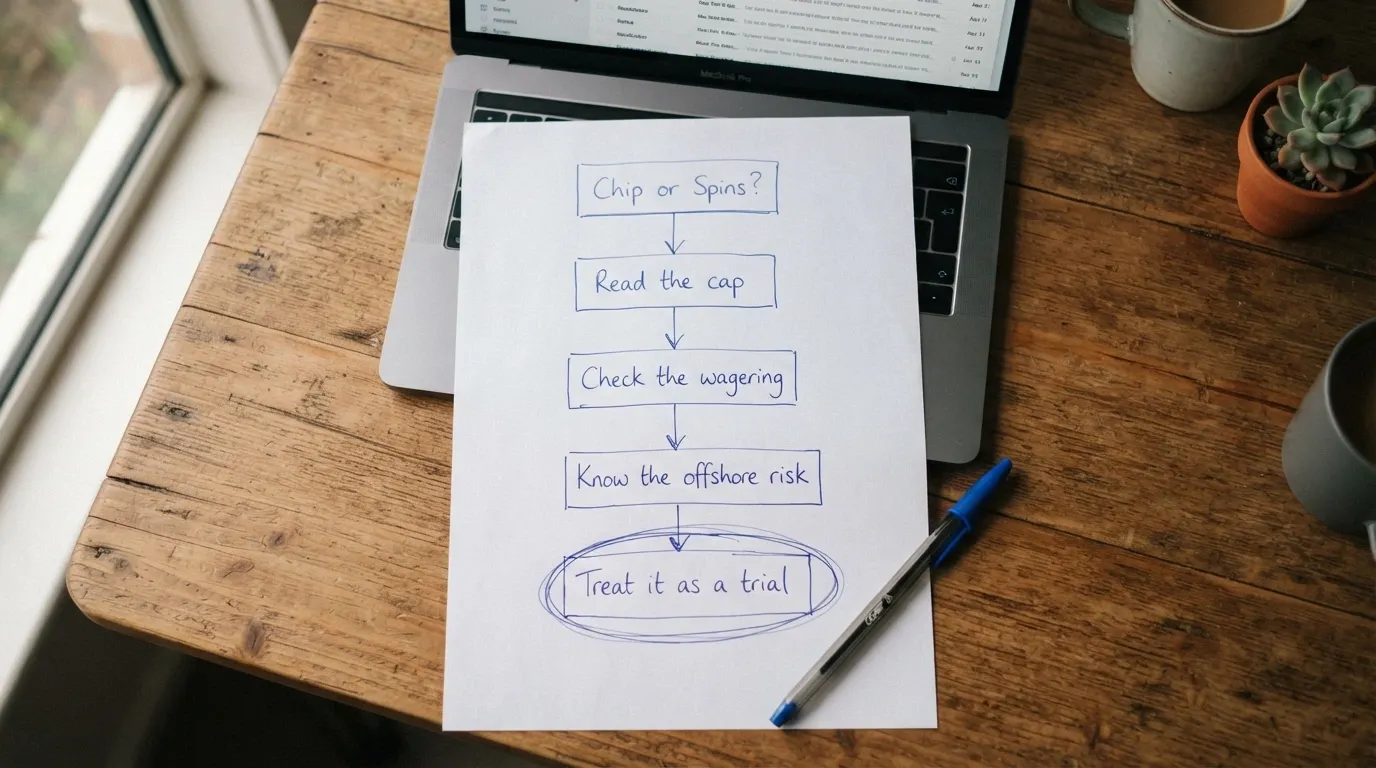
The first decision is chip or spins. A free chip is flexible — the player picks the game, the bet size, and the moment to stop. A free-spins bundle is locked to a single title and a fixed stake, and the player is along for the ride. A pokie explorer who wants to feel out a new casino takes the chip and spreads it across the lobby. A slot-focused player who has a preferred title takes the spins on that title and accepts the lock.
The second decision is the cap. Read the maximum cashout before the wagering number. The cap is the ceiling on what the player can actually walk away with, and it is the term most often buried in the small print. PlayCroco’s A$180 cap is 18x the chip; Ozwin’s $50 cap is 5x; NeoSpin’s A$75 cap is 1.5x. The cap is the difference between a no-deposit bonus and a token gesture, and the cap is what the player is playing for.
The third decision is the wagering. A 30x wagering on a $10 chip is A$300 in turnover; a 60x wagering on the same chip is A$600. The lower multiple is cheaper, the higher multiple is the standard, and the player who has 30x available at Royal Reels is paying half the grinding of the 60x brands for the same face value.
The fourth decision is the offshore reality. An offshore casino is a site with no Australian consumer protection, no BetStop coverage, no ACMA complaints body, and the risk of being blocked mid-balance. A player who is not prepared to lose the deposited amount to a site that may be blocked tomorrow is a player who should not deposit at all. The no-deposit chip is the casino’s way of letting the player test the cashier and the cashier speed before risking their own money; the welcome match is the campaign that follows, and the campaign carries the same offshore risk at a larger scale.
The best no-deposit bonus is the one whose terms the player has read. The PlayCroco chip with its 18x cap is the most generous ceiling; the Royal Reels chip with its 30x wagering is the cheapest to clear; the NeoSpin 50 free spins on Big Bass Bonanza is the largest free-spins bundle. None of them is a payout plan. All of them are trials. The player who claims one, clears the wagering, takes the winnings up to the cap, and walks away has used the bonus the way the bonus is meant to be used. The player who chases a feature round, ignores the cap, and grinds past the expiry is the player the bonus is designed for, and the player who finishes the session with nothing to show for it.
The arithmetic on a $10 chip at 60x wagering, played on a pokie with a 96.71% RTP, gives an expected loss of A$19.78 over the A$600 in required turnover. That is the statistical cost of the bonus under the stated assumptions: the average outcome across many spins, not the outcome on any individual spin. A player who plays to the cap collects A$180; a player who plays to the expiry collects zero; the average across the population of players who claim the bonus and play through the wagering sits between those two numbers, and the house edge is what eats the distance. The chip is the casino’s gift, and the cost of unwrapping it is fixed. Treat it as a trial, read the cap, and walk away when the trial is over.
Frequently Asked Questions
Can I use PayID to deposit $10 at an online casino in Australia?
PayID is supported at most AU-facing offshore casinos, including PlayCroco, HellSpin and Bizzo, and deposits clear in under 60 seconds with zero fees from Australian banks. The minimum PayID deposit is typically A$10 to A$30 across the set, and the credit card and crypto ban since 11 June 2024 makes PayID the default rail for Australian players. Offshore casinos are not licensed in Australia, so a PayID deposit at one of them is a transaction with a Curaçao-licensed operator, not an Australian-licensed one.
Which pokies can I play with a $10 no deposit bonus?
A $10 chip typically applies to all eligible pokies in the operator’s library, with pokies contributing 100% toward the wagering requirement. RTG-only brands like PlayCroco, Fair Go, Ozwin and Uptown Pokies restrict play to RTG pokies; multi-provider brands like HellSpin, Bizzo and NeoSpin include Pragmatic Play, NetEnt, BGaming and other studios. Free-spins bundles are locked to a single title — Big Bass Bonanza at NeoSpin, Sweet Bonanza at Royal Reels, Wolf Treasure at Jackpot Jill — and the locked title is the only game the spins can be used on.
How long does a PayID withdrawal take from an online casino?
PayID withdrawals are limited by the operator’s processing time, not by the PayID rail itself, which settles in real time. HellSpin tested at 25 minutes for a PayID withdrawal, Goldenbet at 28 minutes and Lucky7 at 35 minutes — the fastest in the tested set. A bank transfer or card withdrawal typically takes two to five business days, which is the benchmark PayID is measured against. The operator’s approval step is the variable; the rail is the constant.
What happens if I win big on a no deposit bonus — can the casino refuse to pay?
A no-deposit bonus carries a maximum cashout cap that applies to winnings, not to the chip. PlayCroco’s cap is A$180; Uptown Pokies’ is A$200; Ozwin’s is $50. Anything above the cap is forfeit at conversion, and the casino is within its terms to apply the cap. The casino can also refuse a withdrawal if the player has breached a bonus term — most commonly by betting above the A$5 max-spin limit during wagering — and the terms give the operator broad discretion. The dispute sits between the player and the operator, in the operator’s jurisdiction, because the casino is offshore and not subject to Australian consumer law.
Are offshore online casinos safe for Australian players?
An offshore casino is a Curaçao-licensed operator offering a product that is prohibited under Australia’s Interactive Gambling Act 2001. The player is not prosecuted, but the player has no Australian consumer protection, no BetStop coverage, no ACMA complaints body, and no recourse if the operator refuses a withdrawal. The site can be blocked at any time by ACMA, and ACMA cannot recover a player’s balance. The Curaçao licence is a real regulatory instrument, but it is enforced in Curaçao, not in Australia. The safety gap is the offshore route’s defining feature, and a player who chooses it accepts the gap.
How do I self-exclude from online gambling in Australia?
BetStop, the National Self-Exclusion Register, lets a person exclude themselves from every Australian-licensed online and phone wagering service in a single registration. As at 31 July 2026, 67,480 people had registered, with 41,290 exclusions still active. BetStop binds licensed wagering services only — an offshore casino is not connected to the register, and the exclusion does not propagate. For support with the decision to self-exclude, the National Gambling Helpline is 1800 858 858, free and confidential, 24/7, with online chat and counselling through Gambling Help Online at gamblinghelponline.org.au.
Written by the editors at POLi Casinos AU.