What “Best Keno Online Casino Australia” Actually Returns in 2026
 Available in AU
Type “best keno online casino Australia” into a search bar and the page loads with promises. Three hundred per cent welcome packages. Multi-thousand-dollar match bonuses. Twenty-three keno formats and four hundred free spins. Every result on the first page leads to the same place: an offshore casino that has no licence to take a bet from anyone on Australian soil.
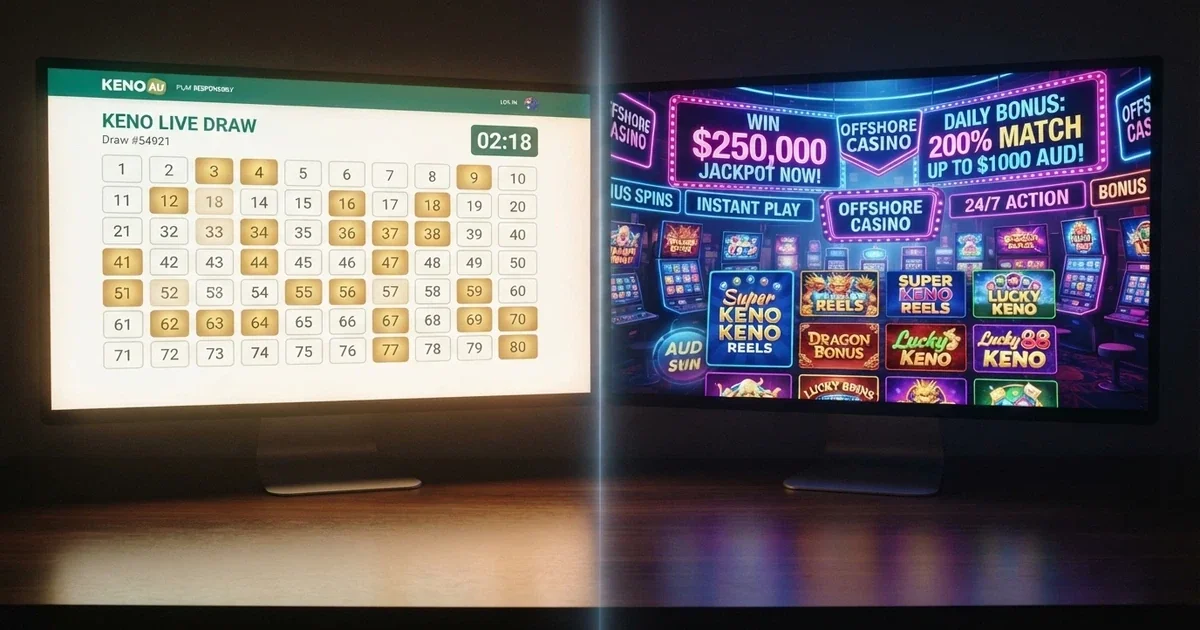
That is not a casual gap in the marketing copy. The Interactive Gambling Act 2001 — the IGA — makes it an offence for any operator to provide real-money interactive casino games, online pokies or in-play betting to a person physically in Australia. Keno, when offered as a casino product, sits inside that prohibition. There is no path to an Australian-licensed online casino because none exists. The page that promises one is selling access to an illegal service.
This guide lays out what actually sits behind the marketing. The legal split between licensed lottery keno and offshore casino keno. The ten operators that dominate the search results and what each one is worth. The mechanics of the game, the variants a player will meet, and why no spot-picking system will beat the maths. And the harm-minimisation infrastructure that exists for Australian residents — and the empty corner of it where offshore casinos sit outside every protection.
Data current as of 18 October 2026 · Verified against the ACMA register, the Curaçao Gaming Authority, and Anjouan licensing records.
Table of Contents
- The Two Faces of Online Keno in Australia
- The 10 Keno Casinos Targeting Australian Players Right Now
- Neospin
- SkyCrown
- Fair Go
- Wild Tokyo
- Golden Crown
- WinSpirit
- Rainbet
- Scream Casino
- Royal Reels
- KenoGO (Tabcorp) — The Only Legal Online Keno in Australia
- From Classic Draws to Live Dealers: Every Keno Format Explained
- Playing Keno for Free Before You Risk a Cent
- Bitcoin and Crypto Keno Casinos
- Why Most Keno “Strategy” Advice Is a Losing Bet
- The Law That Makes Online Keno Casinos Illegal (and the One Exception)
- What Happens When the Fun Stops
- How We Selected and Ranked These Keno Casinos
- So, Should You Play Online Keno in Australia?
- Frequently Asked Questions
The Two Faces of Online Keno in Australia
A keno draw is a keno draw. Eighty numbers, twenty spots, a payout table, a winning ticket. The machine behind the curtain, however, decides whether the product is legal in Australia or whether the operator is breaking the law by offering it.
Lottery keno, the form that runs in licensed clubs and pubs from Broome to Hobart, is a state-regulated product. Tabcorp holds the licences in the Northern Territory, Victoria, and the ACT for the online variant marketed as KenoGO. Because keno is classified as an “excluded lottery service” under section 8D of the IGA, that online keno product is the one legal way an Australian can place a real-money keno bet over the internet.
Casino keno, the form that lives inside offshore casino lobbies, is a different beast in the eyes of the law. The same game, played through a Curaçao- or Anjouan-licensed website, is an interactive gambling service offered to a person in Australia. The IGA prohibits exactly that. The operator is committing an offence each time a deposit is taken. The player is using a product no Australian regulator has approved.
What the Search Results Won’t Tell You About Online Keno
Searching for ‘best keno online casino Australia’ brings up a wall of affiliate review sites. CasinoAudit, TheSunPapers, Crazyvegas, Slotozilla — name the outlet and the format is the same: a top-rated list of offshore casinos ranked by bonus size, an enthusiastic paragraph about game variety, a payment-methods block that lists crypto and e-wallets, and a single line near the bottom that says “technically, online casino is prohibited in Australia, but players are not prosecuted.” That line is doing a lot of work, and it is doing it dishonestly.
CasinoAudit, one of the few outlets that publishes aggregated data, ran the numbers on 171 audited keno casinos and reported an average overall rating of 71.1 out of 100, with an average bonus-fairness score of 60.1. Those are middling numbers drawn from a sample that is, by definition, drawn from offshore operators. The affiliate review model is built around the operator paying for placement; the licence status rarely gets more than a sentence. The harder questions — what recourse an Australian player has if a payout is withheld, whether the licence is even verifiable, what protections exist if the operator disappears overnight — are the ones the affiliate page is structurally disincentivised to ask.
The omission is not accidental. Telling an Australian reader that the entire category is prohibited, and that the payment methods the site recommends (crypto in particular) are themselves banned for online wagering in Australia, would not sell many sign-ups.
Why “Real Money Keno” in Australia Means Two Completely Different Things
The phrase “real money keno” describes both products, and the confusion is not accidental either. To a player choosing a number on a screen, a number on a screen is what is happening in both cases. The frame around it — the licence, the regulator, the legal status of the deposit — is invisible at the moment of play.
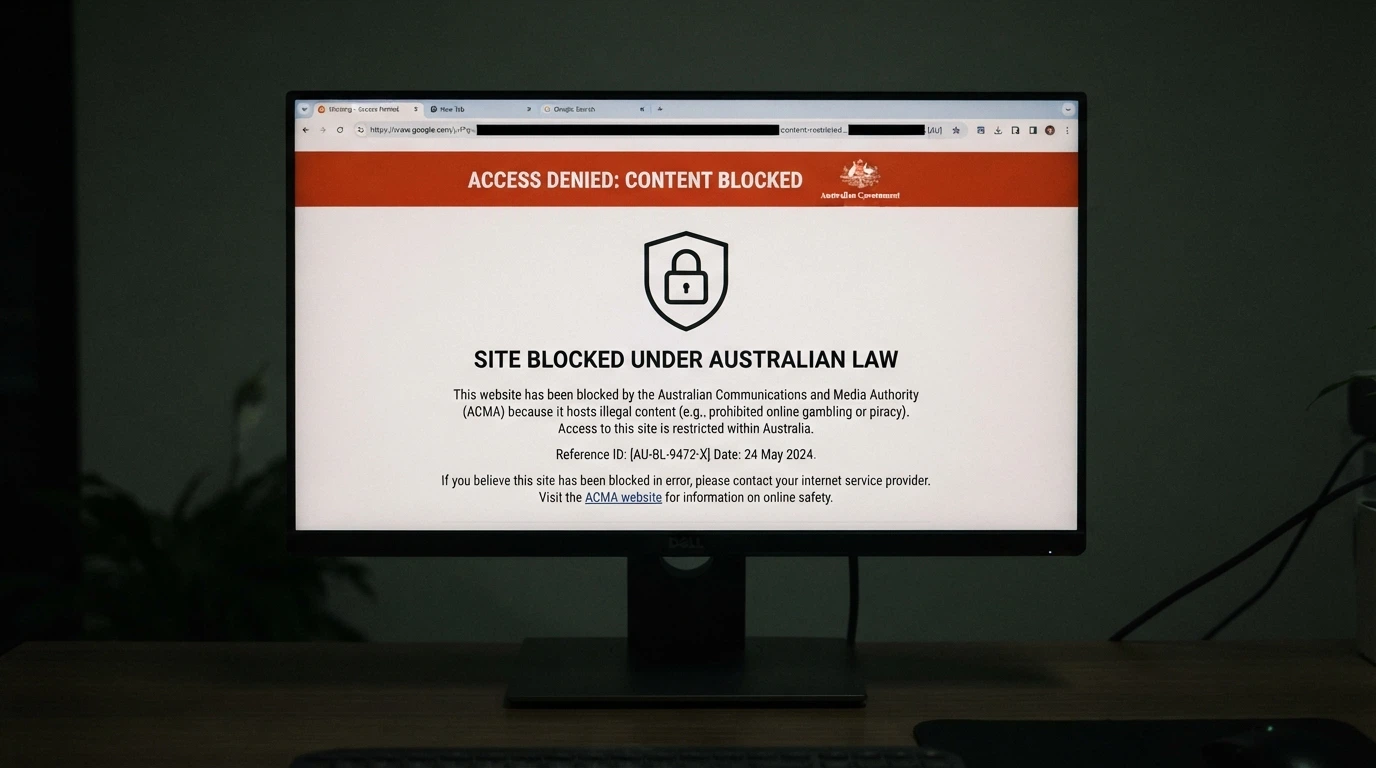
Casino keno, the illegal variant, takes a deposit in cryptocurrency or a credit card and runs the draw through a server in Curaçao or Anjouan. The operator holds no Australian licence. There is no Australian complaint pathway if a withdrawal stalls. The site itself can be blocked by the ACMA without notice. Credit cards and digital currency are both banned as payment methods for online wagering under Australian law, with penalties up to A$247,500 for non-compliance by Australian-licensed providers — a provision that targets providers rather than players but that does underline which side of the law the transaction sits on. The ACMA has had 1,564 illegal gambling and affiliate websites blocked at the ISP level since November 2019.
Lottery keno, the legal variant, runs through Tabcorp’s KenoGO platform. KenoGO Classic draws every three minutes, accepts tickets from A$1, and tops out at a A$1,000,000 prize. There are no wagering requirements because it is a lottery product, not a casino bonus. The rules and prize structure are set by the state regulator, not by the operator.
The 10 Keno Casinos Targeting Australian Players Right Now
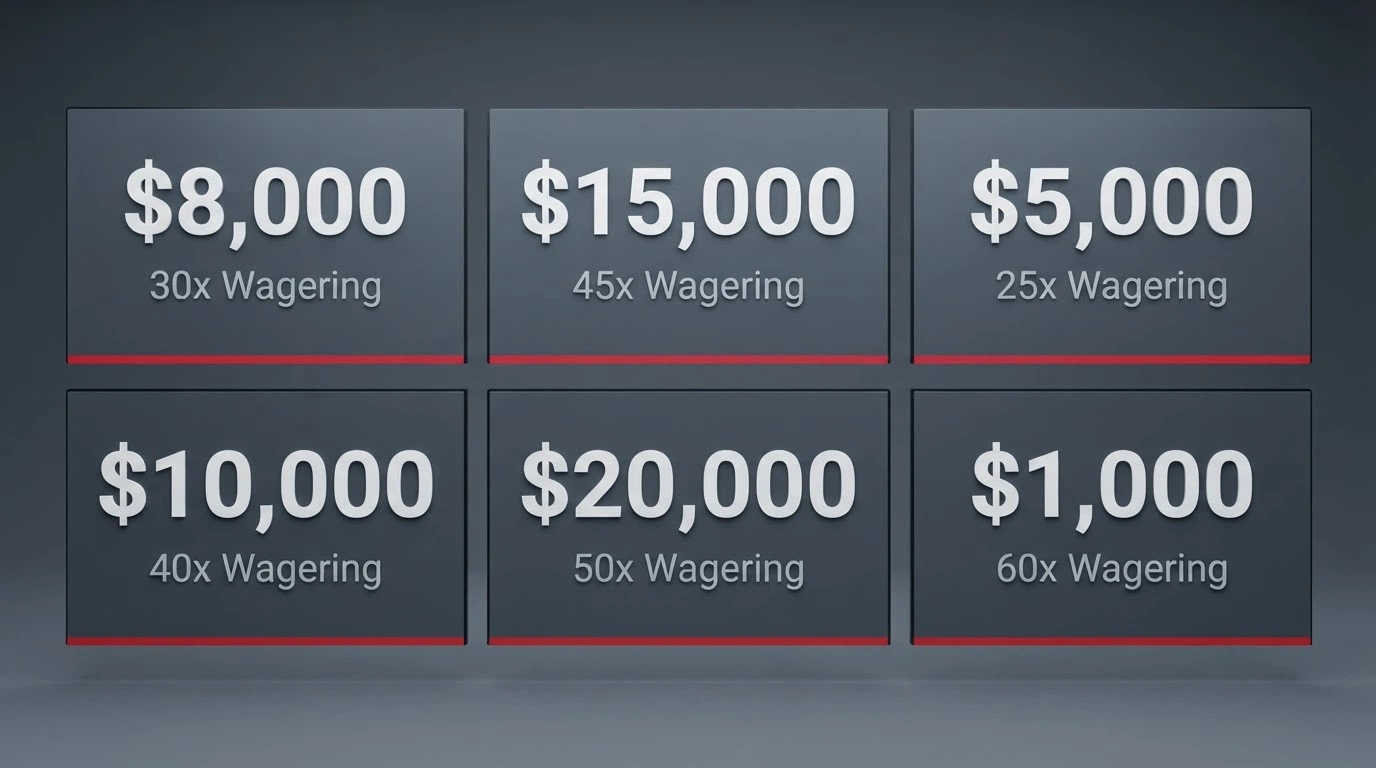
The table below ranks the operators that dominate the search results. The “Legal Status” column repeats itself for a reason — every row except the last is the same status. The “Signature Trait” column tries to capture what differentiates each one within an unregulated set: the bonus number, the keno catalogue size, the licence verifiability, or the data gap that prevents any assessment at all.
| Operator | Legal Status in Australia | Licence | Signature Trait |
|---|---|---|---|
| Neospin | Illegal in AU (Offshore) | Curaçao (exact number unconfirmed) | 14 keno formats; 5,800+ total games |
| SkyCrown | Illegal in AU (Offshore) | Curaçao (exact number unconfirmed) | 450% multistage welcome to A$8,000 + 400 FS; 30x wagering |
| Fair Go | Illegal in AU (Offshore) | Curaçao 1668/JAZ | A$100 no-deposit chip, 60x wagering, ~A$180 max cashout |
| Wild Tokyo | Illegal in AU (Offshore) | Curaçao (exact number unconfirmed) | 23 keno formats — widest catalogue in the set |
| Golden Crown | Illegal in AU (Offshore) | Curaçao (exact number unconfirmed) | 100% match up to A$15,000 + 300 FS; wagering unconfirmed |
| WinSpirit | Illegal in AU (Offshore) | Unconfirmed | Safety Index 3.2 / 10 (Very Low) per Casino Guru |
| Rainbet | Illegal in AU (Offshore) | Anjouan ALSI-152406029-FI2 (valid through June 2027) | Crypto-focused; one of the few verifiable licence numbers |
| Scream Casino | Illegal in AU (Offshore) | Unconfirmed | — |
| Royal Reels | Illegal in AU (Offshore) | Unconfirmed | — |
| KenoGO (Tabcorp) | Legal (Licensed Lottery) | Tabcorp (NT / VIC / ACT) | The only legal online keno product in Australia |
What “Best” Actually Means When Every Casino Is Offshore
Ranking illegal operators is not the same exercise as ranking licensed ones. In a regulated market, the comparison is built on licences granted by a national regulator, complaint histories that are searchable, deposit limits that are statutorily capped, and dispute resolution pathways an aggrieved player can actually walk. None of that exists for any of the offshore brands in this set.
The ranking here measures what can be measured within those limits. It does not measure “best for an Australian player,” because no operator in this table is a legal option for an Australian player. What it measures is which operators carry the most keno variants, which hold a verifiable licence, which publish their wagering terms in a form a reader can check, and which have any independent safety data attached to them at all. The remaining differences — the bonus size, the headline match percentage, the number of free spins — are paid for by the player in the form of wagering turnover that the operator almost never publishes in a comparable form.
The Criteria We Used to Separate the Risky from the Reckless
Four factors determine where an operator sits in the set. The first is licence verifiability. Rainbet publishes its Anjouan licence number, ALSI-152406029-FI2, and the licence is valid through June 2027 — the only verifiable number in the table. Fair Go’s Curaçao licence (1668/JAZ) is also on the public record. The other offshore brands either do not publish a number or publish one that cannot be checked against the issuer’s register at the time of writing.
The second is keno catalogue depth. Neospin carries 14 keno formats. Wild Tokyo carries 23. The remainder carry an unknown number. Wider catalogues do not make a casino safer; they make it more useful as a comparison if a player has decided to play anyway.
The third is bonus-term transparency. SkyCrown publishes a 30x wagering figure. Fair Go publishes both its deposit bonus terms and the no-deposit chip terms, including the 60x wagering and the ~A$180 max cashout. Golden Crown publishes a headline figure of A$15,000 in match bonus plus 300 free spins, but the wagering requirement is not on the public page. The remaining operators do not surface their terms in a form a reader can quote back.
The fourth is independent safety data. Casino Guru’s Safety Index is the only public scoring system that touches this set, and it rates WinSpirit at 3.2 out of 10 — labelled “Very Low.” CasinoAudit’s aggregated data found an average bonus-fairness score of 60.1 across 171 audited keno casinos, and that 59% of those casinos offer payouts within 24 hours. That is the floor of the data. The rest of the rankings is the absence of independent assessment.
The Real Cost of a “Welcome Bonus”
SkyCrown’s headline offer reads 450% up to A$8,000 plus 400 free spins. The 450% is striking, the A$8,000 is impressive, and the wagering requirement is 30x. Working the maths: a player who claims the full A$8,000 bonus has to turn over A$240,000 before any withdrawal is possible. Assuming a keno variant with an RTP of around 97% — Spribe’s Keno sits at that figure — the house edge on that required turnover is 3%, which works out to an expected loss of about A$7,200 from the clearing process alone. The bonus pays A$8,000. The expected cost of clearing it is A$7,200. The marketing frames the bonus as a gift; the arithmetic frames it as a transaction.
That figure is an estimate, not a guarantee. Actual results over any given session will swing above and below the expected loss, sometimes dramatically. But the average is the only number the house can price against, and the house prices against it precisely. Anyone claiming the SkyCrown bonus should treat it as a roughly A$7,200 entry fee dressed as an A$8,000 windfall, with the consolation that they will probably play through more than A$240,000 worth of keno to reach the cashout point.
Neospin
Neospin is the operator that shows up most often in Australian affiliate keno rankings, and the catalogue depth is what draws the listings in. The site advertises 14 keno formats — Classic, Super, Turbo and Video variants — across a broader library of more than 5,800 casino games. By the standards of offshore casino libraries, that is mid-range: large enough that keno is unlikely to feel buried, smaller than the multi-thousand-game lobbies that pass for standard at the larger Curaçao-licensed brands.
The welcome package is a 300% deposit match up to A$11,000 plus 300 free spins, structured across the first deposits. The wagering requirement is not on the public page in a form a reader can verify; based on the broader market, that figure likely sits in the 30x to 40x range for the bonus portion, but “likely” is doing the work of “confirmed” in that sentence, and the difference matters.
The licence is Curaçao, and the exact licence number is not confirmed against the regulator’s public register at the time of writing. The site is offshore. No Australian consumer protection applies. No BetStop coverage. No local dispute resolution.
The signature trait is catalogue breadth — 14 keno formats in one place, with no wagering term on the page that lets a player calculate what they are signing up for. That is enough to be a serious choice for the variant-curious. It is not enough to be a safe one.
SkyCrown
SkyCrown is the brand that leads the bonus race in the affiliate rankings. The headline figure is 450% across a multistage welcome package up to A$8,000 plus 400 free spins. Of the brands in this set, SkyCrown is the one that publishes a wagering figure: 30x on the bonus. That makes it one of the few operators where the maths is actually doable, and that legibility is the real story behind the headline.
The 30x wagering is the lever that turns the welcome package from gift to transaction. The calculation in the previous section works through it: A$240,000 of turnover at a roughly 97% RTP keno variant leaves an expected loss of about A$7,200 from clearing alone. The bonus is a 30x bet on the house edge of the games the operator ships, dressed as a 450% match. The operator knows the maths; the marketing copy hopes the player does not.
SkyCrown’s licence is Curaçao. Exact licence number not confirmed against the public register. The keno catalogue size is not publicly stated beyond the broader casino-library claims typical of Curaçao-licensed brands. The site sits offshore, the payment methods are predominantly crypto and e-wallets, and the credit-card ban does not stop an Australian player from using one on an offshore site — it only stops the Australian-licensed provider from accepting it.
Anyone who treats the A$8,000 as a real-A$8,000 rather than as a bet on 30 turns of the house edge will lose the maths. Anyone who treats it as the latter is at least playing a game whose rules are written down.
Fair Go
Fair Go is the Australian-facing brand in the set — and “Australian-facing” here means the AUD is the default currency, the payment methods lean toward POLi and BPAY rather than crypto, and the games library is built around Realtime Gaming and SpinLogic. The licence is Curaçao Gaming Board, licence number 1668/JAZ, which is one of the few verifiable numbers in this set.
The welcome package is up to A$1,000 spread across five 100% match deposits, with 30x wagering on the bonus plus deposit. The bonus-and-deposit multiplication is the structural catch: a A$200 deposit that claims a A$200 bonus carries a A$12,000 turnover requirement before withdrawal, not an A$6,000 one. Most readers will see “30x” and stop reading. The design of the term is that the full meaning is in the next four words.
The second offer is more revealing. Fair Go publishes a no-deposit A$100 free chip with 60x wagering and a ~A$180 maximum cashout. The chip is credit to play RTG pokies specifically — not keno. The 60x multiplier is double the deposit bonus rate. The maximum cashout of A$180 is the structural ceiling: even if a player clears the wagering, the operator pays out the equivalent of less than two times the chip. That is the operator’s model on full display. A free-credit offer that costs the player sixty times the chip in turnover and rewards them with less than two times it on the way out is generous only in the sense that the marketing copy calls it that.
Fair Go is the operator that publishes the most terms and the most bonus structures, and is therefore the one whose offers can be assessed before they are claimed. The brand is the closest the offshore set comes to transparency. The products that come with that transparency cost what they cost.
Wild Tokyo
Wild Tokyo is the operator that wins the catalogue comparison in the set. Twenty-three keno formats is more than any other brand on this page, and the broader casino library sits in the multi-thousand range typical of larger Curaçao-licensed brands. For a player whose main interest is keno variant breadth, Wild Tokyo is the answer to the catalogue question.
That is about all the public data carries. The licence is Curaçao, the exact number is not confirmed against the register, the welcome bonus terms are not on the public page in a form a reader can quote, the wagering requirement is unpublished, and the keno provider list is not confirmed. The brand is on the affiliate lists because the catalogue is wide and the marketing is willing. It is not on them because the terms are visible.
The honest assessment is that the catalogue makes Wild Tokyo interesting and the opacity of its terms makes it impossible to assess. A player treating the operator as a serious option needs to register, deposit, and read the bonus terms inside the cashier before they can put a number on what the welcome package will cost. That is the operator’s choice about how to publish its product. The reader’s choice is whether to accept that opacity.
Golden Crown
Golden Crown’s headline figure is the largest in the set: 100% match up to A$15,000 plus 300 free spins. A$15,000 is a meaningful number, and on its own it sits above every other welcome package on the page. Wagering requirements are not on the public page; the bonus-validity window is not on the public page; the keno game count is not on the public page; the licence is Curaçao with the exact number unconfirmed.
That combination — big headline, missing terms — is the classic affiliate-friendly setup. The number is what the affiliate ranks by; the terms are what the player pays for. Without a wagering multiplier on the page, a reader has no way to know whether the A$15,000 costs A$30,000 or A$600,000 to clear. Without a bonus-validity window, there is no way to know how much keno a player has to play within what timeframe. The structure of the offer is “claim and find out.” The structure of this page is “here is what is and is not on the public record.”
Golden Crown ships the largest headline number in the set and the thinnest set of published terms. The gap between the two is the operator’s bet that the reader will not do the maths. The bet is usually right. The maths is rarely favourable when it is done.
WinSpirit
WinSpirit is the operator that ships with the lowest public safety signal in the set. Casino Guru’s Safety Index — the only independent scoring system that rates operators in this space — gives WinSpirit a 3.2 out of 10, labelled “Very Low.” That label is not editorial colour; it is the lowest tier in the index’s scoring band.
The licence jurisdiction is not confirmed. The welcome bonus is not on the public page in a form that can be quoted. The wagering requirement is not on the public page. The keno game count is not on the public page. The catalogue is, by every indication, smaller than the major Curaçao brands but not in a way that is published.
The Casino Guru score is not the only factor that matters, but it is the only published one, and it does not read well. A reader choosing among the offshore options could reasonably treat that combination — worst independent score, thinnest own disclosure — as a hard “no.”
Rainbet
Rainbet is the operator that ships with the most legible licence in the set. The licence is Anjouan, number ALSI-152406029-FI2, and it is valid through June 2027. The Anjouan licence is the newer of the small-island regulator frameworks that have absorbed operators leaving Curaçao’s restructured regime. It is verifiable against the regulator’s public record. It is not a particularly demanding licence by international standards, but it is a licence, and it is the one.
Rainbet is also a crypto-focused platform. That fact combines awkwardly with the Australian reality that digital currency is banned as a payment method for online wagering, with penalties up to A$247,500 for the licensed-provider side of the transaction. The operator is offshore, the IGA does not reach it, and the credit-card and crypto ban operates against Australian-licensed providers rather than against the individual player. The combination is worth noting. The reader using crypto on Rainbet is using a payment method that is illegal for an Australian-licensed operator to accept. The operator is not Australian-licensed. The math on that is the reader’s, not the page’s.
Welcome bonus terms are not on the public page. Keno game count is not on the public page. The licence is the most legible in the set; the offer is not.
Rainbet is the operator that publishes its licence number and is, by that test, the most transparent of the offshore brands. The crypto payment stack is not a neutral feature for an Australian player; the licence expiry in mid-2027 is a short shelf life. The verdict is that the operator is the most verifiable in the set and is still, by definition, not a legal option in Australia.
Scream Casino
Scream Casino is the first of two operators in the set where the data gap is the assessment. The licence jurisdiction is not publicly confirmed. The welcome bonus is not publicly confirmed. The wagering requirement is not publicly confirmed. The keno game count is not publicly confirmed. The brand appears in affiliate keno lists; the brand does not appear in any independent licence register or safety assessment that this page could verify.
That combination puts Scream Casino in a category the rest of the operators in the set at least partially avoid. There is no verifiable licence number, no Casino Guru Safety Index, no aggregated CasinoAudit score. There is a brand name and an affiliate ranking. The honest assessment is that the operator cannot be meaningfully evaluated against the criteria this page uses for the others, and the absence of public data is itself a finding.
The reader is being asked to take the affiliate placement on trust. The page is not in a position to verify the trust.
Royal Reels
Royal Reels is the second of the two operators where the data gap is the assessment. Same shape as Scream Casino: licence jurisdiction not publicly confirmed, welcome bonus not publicly confirmed, wagering requirement not publicly confirmed, keno game count not publicly confirmed. Brand appears in affiliate lists. Brand does not appear in independent registries that can be checked.
The same honest assessment applies. Royal Reels cannot be evaluated against the criteria used elsewhere on this page, and the absence of public data is itself a finding. A reader looking at the brand has no licence number to verify, no wagering term to read, no safety score to check. The affiliate ranking is the only public signal, and the affiliate ranking is paid placement.
For the cautious reader — and that should be every reader of this section — two brands that ship with no public data on a page about Australian keno casinos are two brands to skip until the data arrives.
KenoGO (Tabcorp) — The Only Legal Online Keno in Australia
KenoGO is not a casino. It is the online face of a licensed Australian lottery keno product, operated by Tabcorp under state and territory licences across the Northern Territory, Victoria and the ACT. That positioning is what makes the product legal. Section 8D of the Interactive Gambling Act 2001 classifies keno as an “excluded lottery service,” which means it can be offered online by a licensed lottery operator without falling foul of the IGA’s prohibition on interactive gambling services. Tabcorp holds those licences. No other operator holds equivalent ones for keno.
KenoGO Classic draws every three minutes. The minimum ticket is A$1. The top prize on a single ticket is A$1,000,000. The product is pari-mutuel — payouts are set against the pool rather than against a fixed paytable — and the prize structure, draw frequency and game rules are set by the regulator, not by the operator. There are no wagering requirements because KenoGO is not a casino bonus. There is no welcome package because KenoGO is not competing on bonus terms.
The trade-off is the obvious one. KenoGO carries one draw format. The offshore casinos carry dozens. KenoGO pays lottery-tax-level odds on a fixed prize structure. The offshore casinos carry variants with published RTPs ranging from 94.50% to 99.60%. The licensed product offers the legal route, the AUD-native payment stack, and the BetStop protection. The offshore products offer the catalogue and the marketing copy.
KenoGO is the only option on this page that does not require the reader to weigh legal exposure against game variety. The fact that the comparison is offered at all is itself the structural problem with offshore online keno in Australia.
From Classic Draws to Live Dealers: Every Keno Format Explained
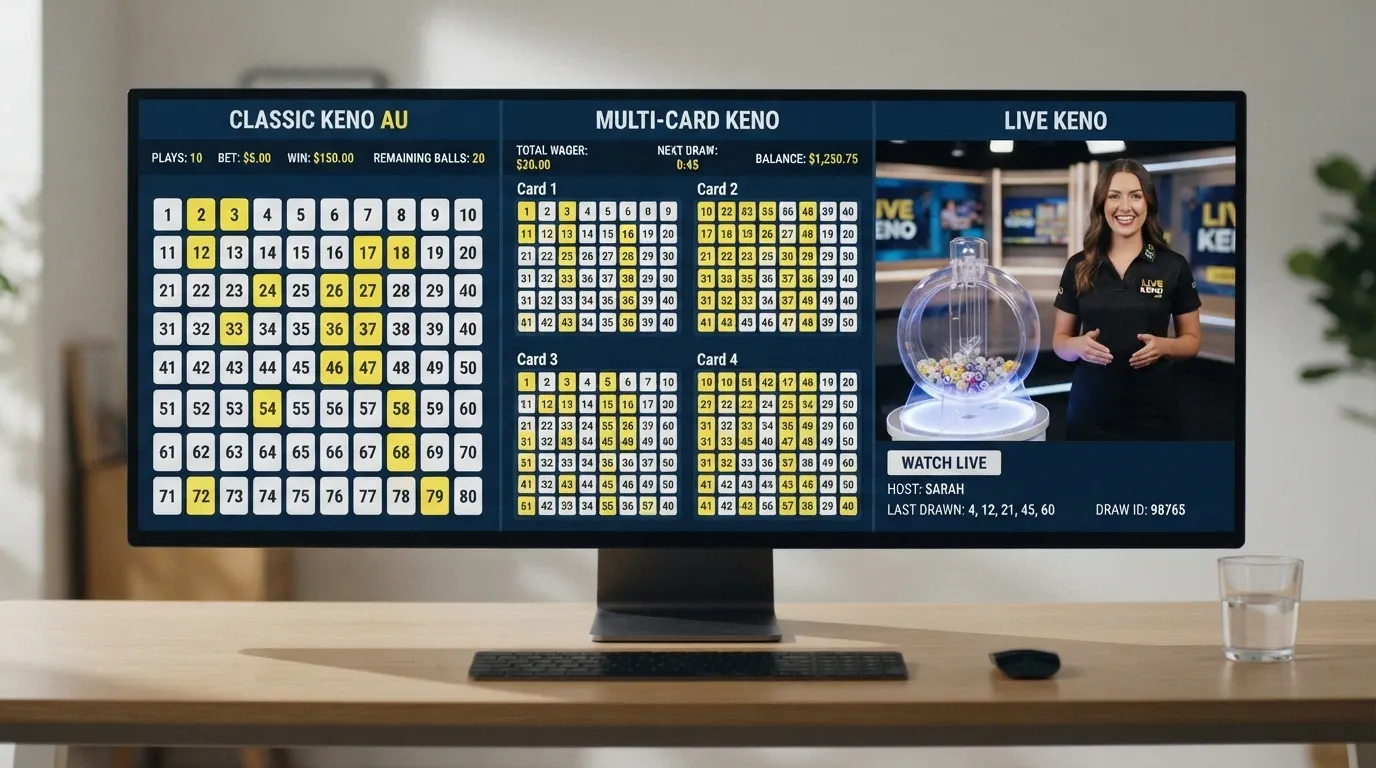
Offshore casinos carry more keno variants than the legal alternative, and the variants matter. The classic 80-ball draw is the one every casino ships. The 4-card variant multiplies exposure per round. The live-dealer version adds a human host and a fixed pace. The keno-themed pokie repackages the mechanic into a slot. Each variant plays differently, prices differently, and pays differently. The table below lists the variants with confirmed RTP and provider data.
| Game Title | Provider | RTP | Volatility |
|---|---|---|---|
| Spribe Keno | Spribe | 97% | Medium |
| Keno 10 (1 Minute) | Galaxsys | 99.60% | — |
| Across the Universe Keno | Galaxsys | 94.50% | — |
| Tequity Keno | Tequity | 99.07% | — |
| YOriginal Keno | YOriginal | 99% | n/a |
The spread is real. Spribe’s Keno at 97% sits in the middle of the band. Galaxsys’ Keno 10 (1 Minute) is the high end at 99.60%, with a faster draw cadence that justifies the name. Across the Universe Keno, also Galaxsys, drops to 94.50% — a five-point swing within the same provider. Tequity Keno and YOriginal Keno both sit at the 99% mark with a 1,000x max win. The volatility column is sparser: only Spribe and YOriginal have it published in this set, at medium and high respectively. The remaining titles have no published volatility rating.
That spread is the structural fact behind the catalogue. Two games from one provider can sit five percentage points apart on RTP, with no headline change to the gameplay beyond draw cadence. A player picking by name rather than by maths is picking blind.
Classic 80-Ball Keno: The Game Every Casino Carries
Eighty balls, twenty spots, one draw. The standard format and the one every casino — including the lottery operators — ships first. The player marks between one and twenty numbers from the 1-to-80 grid; the game draws twenty numbers at random; payouts depend on how many of the marked numbers match the drawn numbers. A 1-spot ticket hits 25% of the time, because each ball has a 1-in-80 chance of being drawn and a single marked number either matches one of the twenty drawn balls or it does not. The maths underneath is simple. The paytable in front of it is the only thing that varies.
The classic RNG is fair: every ball has a 1-in-80 chance of being drawn each game, regardless of what came before. Past draws do not predict future draws. Hot-number boards are not data; they are retention tools dressed as data. The independent nature of the draws is what makes every “system” sold to beat keno a marketing claim rather than a mathematical one.
The 4-to-6-spot range is widely considered the best balance between hitting often and earning worthwhile payouts. Lower spot counts hit more frequently but pay small; higher spot counts pay large but miss most of the time. A 10-spot ticket that requires every one of ten marked numbers to come up is a different game to a 4-spot ticket, and the paytable prices the difference exactly.
Multi-Card and 4-Card Keno: More Spots, More Action
Multi-card keno lets a player mark several cards in a single draw. A 4-card variant plays four separate marked grids against the same twenty drawn numbers, paying out independently on each. The format appeals to high-volume players because the round cadence is identical to a single-card draw — but the stake is four times higher.
The structural effect is the obvious one. Multiplied exposure per round, same house edge per card. A player who plays 4-card keno at A$1 per card is staking A$4 per round, not A$1. The draw still produces twenty numbers; each card still has a 1-in-80 chance per ball. The house edge does not soften because the player has spread the bet across cards. The format speeds up turnover. It does not improve odds.
Several of the featured operators — including Neospin, with its 14 keno formats — carry multi-card variants. The exact per-operator availability of 4-card keno across the rest of the set is not exhaustively published.
Live Dealer Keno: The Closest You’ll Get to a Keno Lounge Online
Live keno streams a human host drawing numbers on camera, which feels more transparent than an RNG because the player can see the draw happen. The illusion of transparency is the appeal. The underlying maths is identical: the same 1-in-80 per ball, the same paytable, the same house edge. The camera changes the experience. It does not change the odds.
The fixed draw pace is the other structural feature. Live dealer keno draws on the operator’s schedule, not the player’s. RNG keno lets a player click “draw” at any pace they choose; live keno runs at whatever interval the studio sets. For a player who values the social texture of a keno lounge, the trade is worth making. For a player who values pace, RNG is the format.
The exact per-operator availability of live keno across the featured set is not exhaustively published. Live keno is present at several of the offshore brands; whether the specific table is running when a given player logs in is a question the lobby, not this page, answers.
Keno Slots and Pokies: When the Draw Game Meets the Reels
Keno-themed pokies — “keno pokies” — combine the number-picking mechanic with a slot-machine reel structure and a different RTP model entirely. The keno mechanic inside a pokie is decoration around a slot engine. The reels spin; the bonus round fires; the paytable is the pokie’s paytable, not a keno paytable. The RTP is the pokie’s RTP, which can sit anywhere in the 90s depending on the title.
The volatility profile is the structural difference. Draw keno plays flat: the player marks numbers, the draw happens, the payout is set by the paytable. A keno pokie plays with variance: bonus rounds, free-spin triggers, scatter pays, and the slot-style hit-and-miss cadence that draws pokies is famous for. A player expecting the rhythm of draw keno from a keno pokie is in for a different game.
The exact per-operator catalogue of keno-themed pokies across the featured set is not confirmed. Competitor reviews highlight keno pokies as a common variant, and several featured operators carry pokie libraries that include keno-themed titles.
Playing Keno for Free Before You Risk a Cent
Free-play and demo modes let a player test a keno variant without depositing. The mode is not universal across offshore casinos — some operators restrict demo access to logged-out browsers, others require an account, others gate demos behind registration and email verification. The legal Australian alternative, KenoGO, does not offer a demo mode because KenoGO is a real-money lottery product with tickets starting at A$1 and a three-minute draw cadence. The free-play option on the legal side is to play at the minimum ticket size.
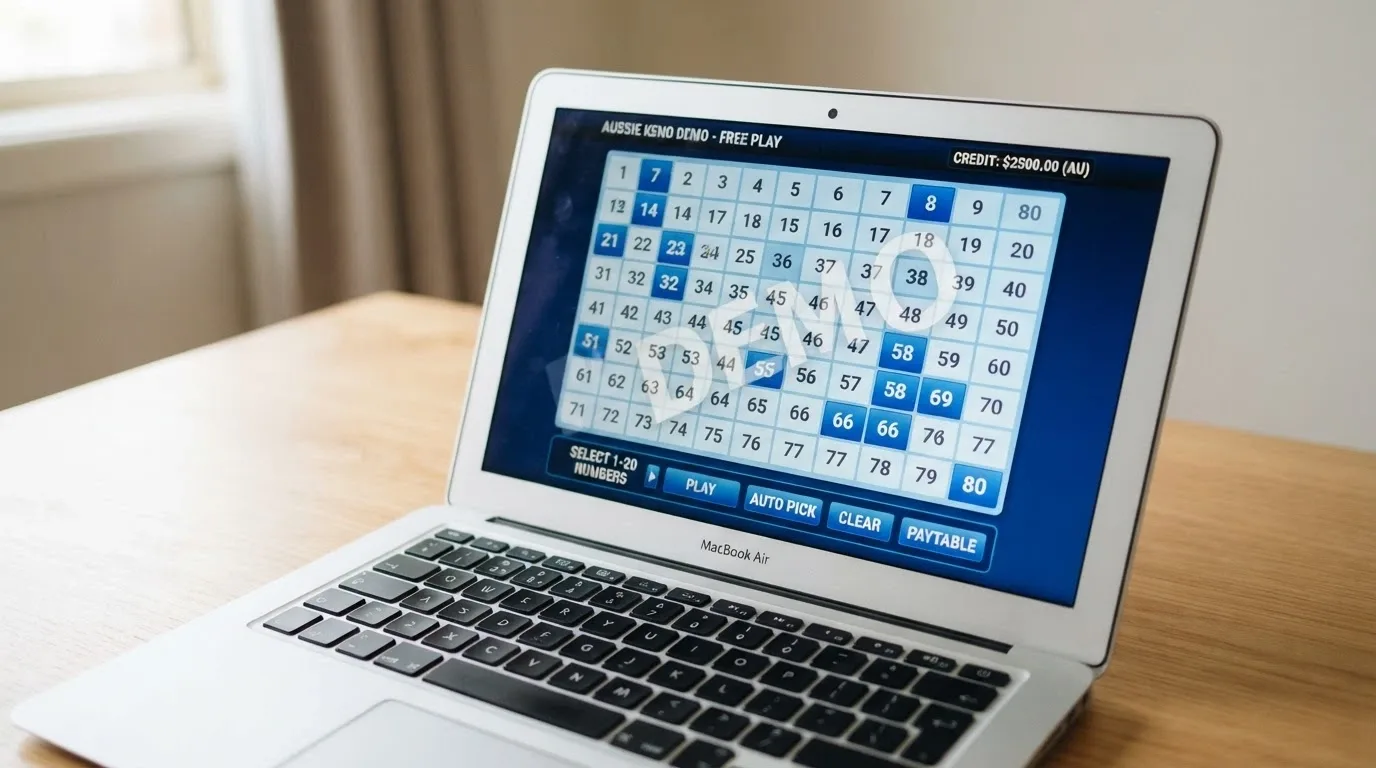
The useful function of demo mode is to learn the rules of a variant before staking real money. The useless function is to read demo results as predictive of real-money results; the RNG is the same RNG in both modes, but the variance in a 50-spin demo session does not predict the variance in a 500-spin real session. Free-play is a learning tool, not a strategy tool.
The exact per-operator demo availability across the featured set is not exhaustively published. Several of the featured operators carry free-play keno in some form; the specific terms — registration required, country restriction, keno variants included — vary by operator and are best checked at the cashier.
Bitcoin and Crypto Keno Casinos
Several of the featured operators accept Bitcoin and other cryptocurrencies as both deposit and withdrawal methods. Rainbet is built around the crypto stack. Others in the set accept crypto alongside fiat e-wallets. The pitch is familiar: faster withdrawals, lower fees, more privacy. The Australian legal reality is less convenient.
Credit cards and digital currency are both banned as payment methods for online wagering in Australia, with penalties up to A$247,500 for non-compliance. The ban operates against Australian-licensed providers — the IGA targets the operator, not the player — but it is the clearest signal Australian regulators have sent about the payment methods they consider appropriate for online gambling. Using crypto on an offshore casino is not, in itself, a criminal offence for the Australian player. Using crypto on an Australian-licensed operator is. The offshore casino is not Australian-licensed. The structural fact is that an Australian player using crypto on an offshore casino is using a payment method that is illegal for an Australian operator to accept, at an operator that is illegal for an Australian player to use, in combination.
The anonymity trade-off is the other side. Crypto transactions do not go through the Australian banking system, which means the player does not get the new protection that arrives from 1 January 2027 — the bank’s express authority to block transactions to illegal operators. Whether that is a feature or a bug depends on whether the player wants to be blocked.
For an Australian reader, the crypto path removes the only friction point the regulated system is about to add. It also removes the only paper trail that would allow the player to demonstrate a dispute to a regulator. The combination is not accidental.
Why Most Keno “Strategy” Advice Is a Losing Bet
Keno is a game of pure chance. Every draw is independent. Every ball has a 1-in-80 chance of being drawn regardless of what came before. The strategy advice that promises to beat it — hot numbers, cold numbers, wheeling systems, due numbers — relies on the gambler’s fallacy dressed up as analysis. The only real edge in keno is the one the player brings: choosing a risk profile, controlling session volume, and refusing to chase.
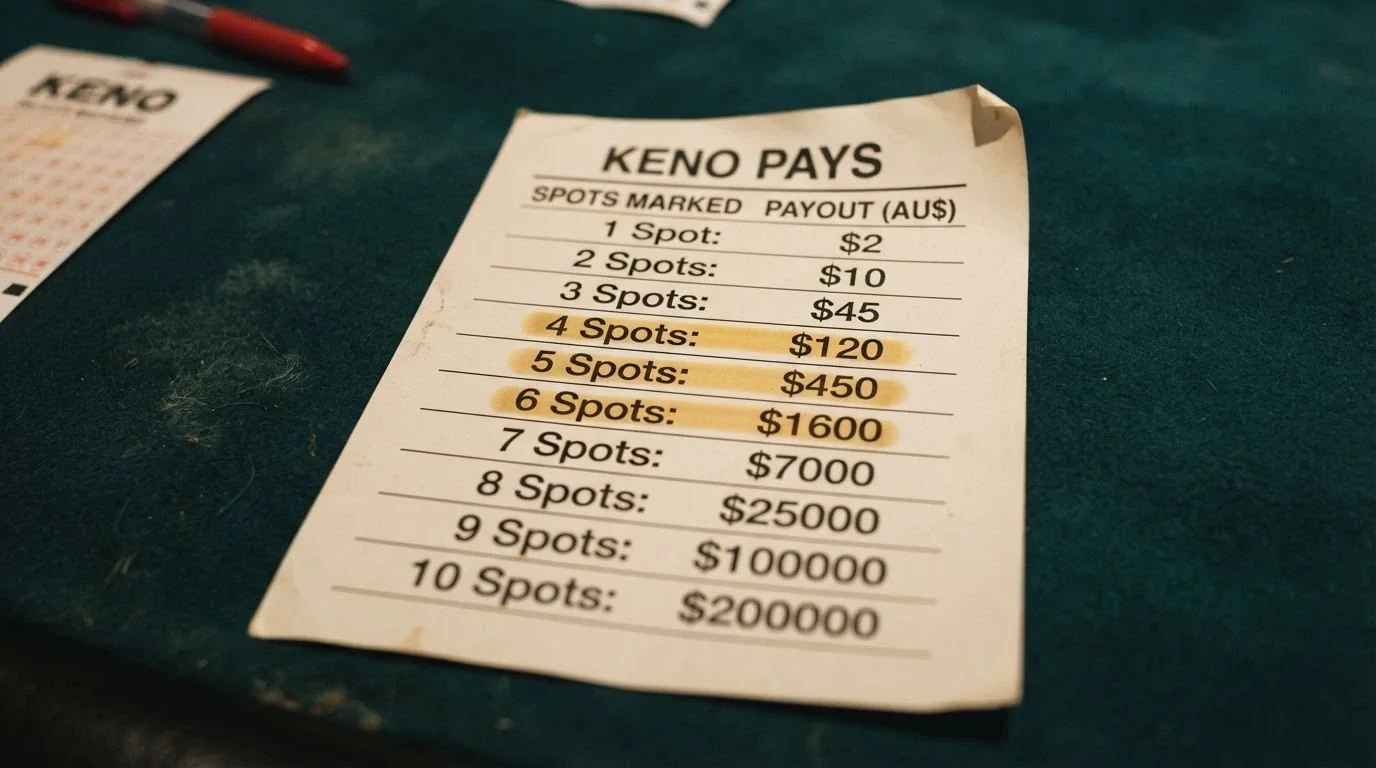
The wider keno-strategy literature agrees. “Your ‘edge’ doesn’t come from secret numbers — it comes from choosing a sane risk profile, controlling session volume, and avoiding the chasing behaviours that turn a fun draw game into a bankroll leak.” That is the structural reality of a game where every outcome is random and the paytable is fixed. The house has an edge; the player has a budget. The player can choose how much of the budget to spend per draw. The player cannot choose which numbers come up.
The Rules of Keno: Simpler Than You Think
Pick numbers. Watch the draw. Check the paytable. The mechanics are dead simple. The mathematics underneath is what most players never learn.
A 1-spot ticket hits 25% of the time because each ball has a 1-in-80 chance and one in four draws will contain any given number — twenty drawn balls out of eighty. A 10-spot ticket that requires ten marked numbers to come up is a much rarer event; the probability of a clean 10-spot hit depends on combinations rather than single-ball chances, and it drops fast. Marking 4 to 6 spots offers the best balance between hitting often and earning worthwhile payouts, which is the standard range that keno paytables are tuned to reward.
The difference between fixed-odds and pari-mutuel keno is worth knowing. Fixed-odds keno — the offshore casino default — pays a published multiple of the stake regardless of how many other players hit. Pari-mutuel keno — the lottery product, including KenoGO — pays from a pool, with prize tiers set by the regulator and divided among winners. The fixed-odds structure favours the operator’s house edge. The pari-mutuel structure favours the lottery’s published odds. They are different products with the same name.
Spot Selection, Hot Numbers, and Other Keno Myths
Every keno lounge, online or off, has a hot-numbers display. The display lists the numbers that have come up most frequently in recent draws. The display is wrong in a way that the operator knows and the player usually does not. Each draw is independent; each ball has a 1-in-80 chance regardless of history; past results do not predict future results. The hot-numbers board is a retention device dressed as data.
The gambler’s fallacy in keno is the same fallacy as in roulette: the belief that an outcome becomes more likely because it has not happened recently. A number that has not come up in fifty draws is not “due.” It has the same 1-in-80 chance it has always had. Numbers have no memory. Players who believe they do pay for the privilege.
The honest reading of keno strategy is that there is no strategy that changes the odds. The only choices a player makes are about session volume — how many draws, at what stake, for how long — and about which paytable to play against. The paytable comparison is a real choice: a 99.60% RTP game is a fundamentally different proposition from a 94.50% RTP game, and the player’s edge in expected terms is the five-point spread. Spot selection, hot numbers and lucky numbers do not affect the expected outcome at all.
The Law That Makes Online Keno Casinos Illegal (and the One Exception)
The Interactive Gambling Act 2001 is the federal statute that prohibits online casino games, online pokies and in-play sports betting to persons in Australia. The prohibition operates against the operator: it is an offence for an entity to provide a real-money interactive gambling service to someone physically in Australia, unless the operator holds an Australian licence and the service falls within the licensed categories. There is no Australian licence for online casino keno. The licensed keno product is the lottery keno product, offered under section 8D’s excluded-lottery-service exception.
The Interactive Gambling Amendment (Gambling Reform) Bill 2026 passed Parliament on 19 August 2026, and the amendment commences on 1 January 2027. The amendment does not change the underlying prohibition; it changes the enforcement toolkit around it. The new powers are the structural story for the next twelve months.
How the ACMA Blocks Illegal Casinos (and Why New Ones Keep Appearing)
The ACMA enforces the prohibition. The mechanism is site blocking at the ISP level, applied to sites that offer or advertise prohibited interactive gambling services to Australian users. The ACMA has had 1,564 illegal gambling and affiliate websites blocked since November 2019. More than 225 illegal services have withdrawn from the Australian market since 2017 rather than face the blocking action.
The whack-a-mole problem is structural. A blocked operator launches under a new domain and is back online within days. The ACMA’s response is to block the new domain; the operator’s response is to launch another. The published figure of 1,564 blocked sites is the cumulative count of domains blocked, not the count of operators — most operators cycle through multiple domains over the years.
For an Australian reader, the site-blocking reality means that any of the offshore brands on this page could become inaccessible from an Australian ISP without notice. The brand may continue operating in other jurisdictions; the Australian access simply stops. Funds held in an account at the moment of blocking are not necessarily recoverable. The offshore operator has no obligation to refund them, and there is no Australian complaints body to apply pressure.
What the 2026 Amendment Changes for Australian Punters
The Interactive Gambling Amendment (Gambling Reform) Bill 2026 changes three things that matter to a player.
The first is the bank payment-blocking power. From 1 January 2027, banks and payment providers gain express authority to block transactions to illegal gambling operators. That authority is the structural answer to the question of how to stop deposits flowing to offshore casinos. The bank decides the operator is illegal, the bank blocks the transaction, the deposit does not land. The offshore operator can still try; the player still has crypto; the friction is the new part.
The second is the inducement-marketing ban. From 1 January 2027, direct marketing of inducements — bonus offers, free bets, “claim now” emails — is prohibited for 14 days after a customer signs up with an Australian-licensed operator. The window is the cooling-off period. Offshore operators are not bound by the rule; the rule targets the licensed side.
The third is the broader advertising reform. From 1 July 2027, broadcast gambling ads are restricted to three per hour, with a live-sport blackout and a ban on athlete and celebrity promotion. The opt-out register — the mechanism by which a player can signal “do not target me with gambling ads” — is not ready by then. The reform is real; the supporting infrastructure is delayed.
The Lottery Keno Exception: How Section 8D Keeps KenoGO Legal
Section 8D of the IGA defines a class of “excluded lottery services” that are carved out of the prohibition on interactive gambling. Keno sits inside that class. A licensed lottery operator can offer keno online to Australian customers without breaching the Act, because the product is regulated as a lottery rather than as an interactive casino game.
Tabcorp holds the relevant licences — across the Northern Territory, Victoria and the ACT — for the KenoGO product. The state and territory regulators license the operator. The federal prohibition does not apply because the product is licensed at the state level as a lottery product.
No other operator has replicated the model. No offshore operator can — they are not lottery-licensed in any Australian jurisdiction. No other Australian operator has emerged with an equivalent online keno product, partly because Tabcorp’s state-level coverage is difficult to compete against and partly because the regulatory carve-out is narrow. KenoGO is the only legal online keno product in Australia. The legal alternative is, by structure, a single product.
What Happens When the Fun Stops
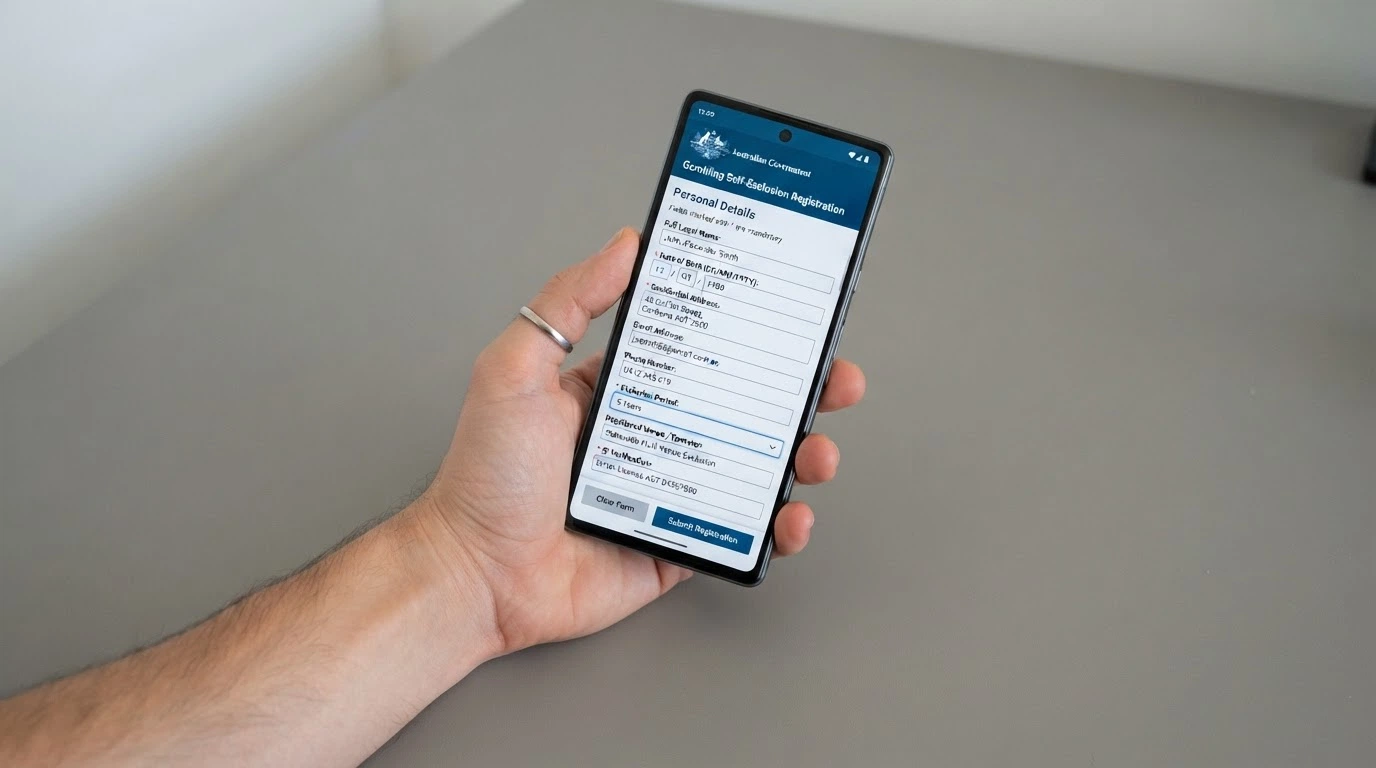
Australian gambling-harm infrastructure exists. It is built for Australian-licensed wagering services, which is both its strength and its limit.
- National Gambling Helpline: 1800 858 858, free, confidential, staffed 24/7. The line is the front door of the support system and the first call for anyone who feels their gambling is no longer recreational.
- Gambling Help Online: online chat and counselling at gamblinghelponline.org.au, for people who prefer not to phone.
- BetStop: the National Self-Exclusion Register, run by the ACMA. As of 31 July 2026, 67,480 people had registered, with 41,290 exclusions still active. 78% of registrants were under 40. 38% chose a lifetime exclusion.
- Harm prevalence: about 2.1% of Australian adults — roughly 430,000 people — experience problem gambling.
The critical gap is BetStop’s coverage. The register covers Australian-licensed wagering services. It does not cover offshore casinos. An Australian player who registers with BetStop is excluded from licensed wagering operators; the exclusion has no effect on the offshore casinos on this page. The block on Australian payment methods — credit cards and crypto — does not extend to the offshore payment stack. The site-blocking regime can take down an Australian ISP’s access to a domain, but the offshore operator can simply launch a new one.
The combination is the structural problem. The harm-minimisation infrastructure exists and is well-used. The operators that pose the highest risk — the offshore casinos with the biggest bonus packages and the broadest keno catalogues — sit outside it.
How We Selected and Ranked These Keno Casinos
The operators on this page were drawn from the top-ranking affiliate and review pages for “best keno online casino Australia” in the 2026 search results. Each was checked against the public licence registries available — the Curaçao Gaming Authority, the Anjouan register, and the Australian state and territory regulators for the legal alternative.
The ranking criteria were: licence verifiability, keno format count where published, bonus-term transparency, independent safety assessment where available, and the explicit absence of public data where it was not. The criteria are qualitative rather than weighted: this page does not invent a score out of thin air or rank operators by an arbitrary formula. Where a field is not on the public record, the table says so rather than filling the gap with a guess.
Casino Guru’s Safety Index is the only independent scoring system that covers any of the featured operators in the table, and it rates WinSpirit at 3.2 out of 10. CasinoAudit’s aggregated data — 171 audited keno casinos, an average overall rating of 71.1 out of 100, an average bonus fairness of 60.1 out of 100 — is the only published cross-operator benchmark available. Both systems are imperfect; both are more rigorous than the affiliate ranking alone.
The legal alternative, KenoGO, is included in the ranking not as a competitor to the offshore casinos but as the contrast that defines the legal landscape. The comparison column on the table is the only place the licensed product meets the offshore products on the same page.
So, Should You Play Online Keno in Australia?
The legal landscape leaves Australian keno players with one licensed path and a field of offshore operators that offer more variety at more risk. The trade-off is real, and it has a price tag on both sides.
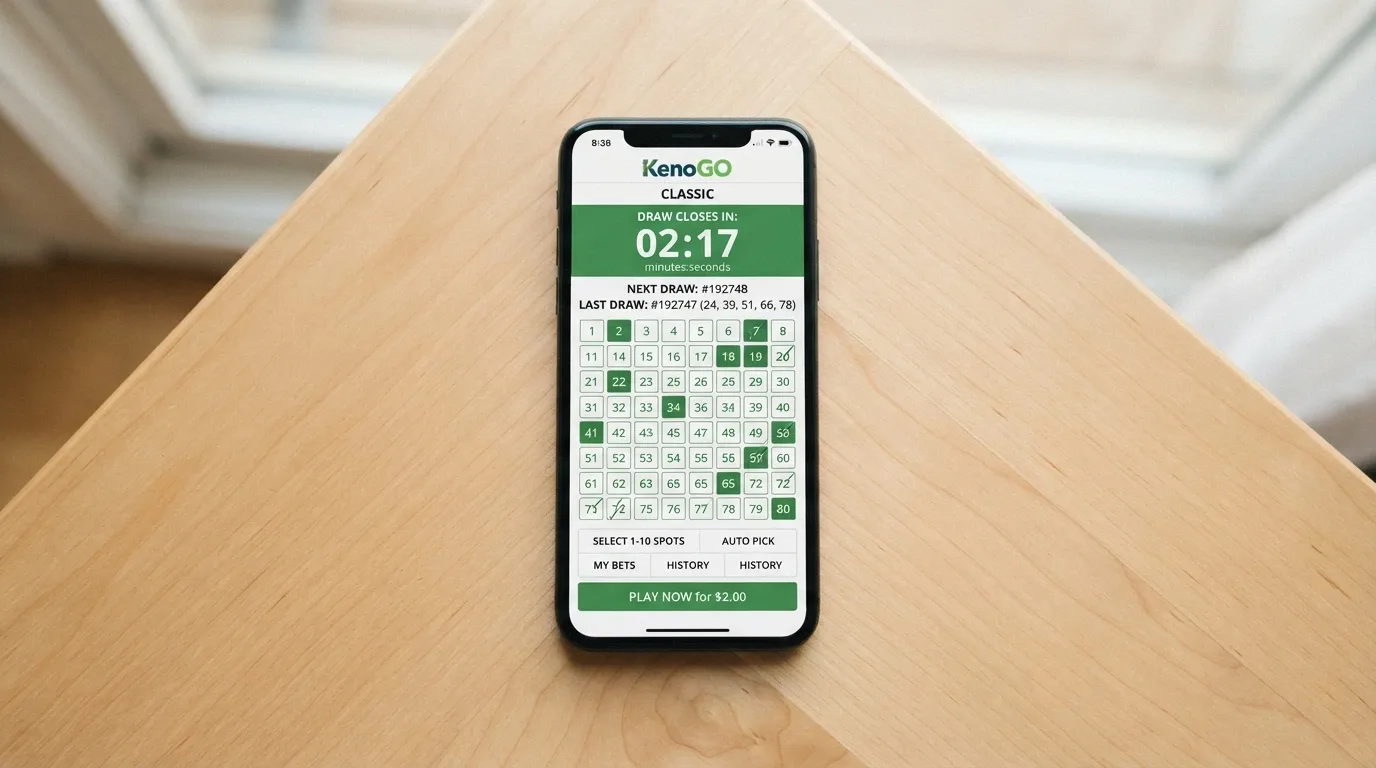
On the licensed side, KenoGO is the only legal online keno product. The catalogue is a single draw format. The paytable is a lottery paytable. The payment methods are the regulated stack. The player protection is BetStop, the helpline, and the harm-prevention infrastructure. The expected loss is set by the lottery’s published odds. None of that is impressive marketing copy. All of it is the floor of what “legal” means in this category.
On the offshore side, the operators carry anywhere from 14 to 23 keno formats, welcome packages up to A$15,000, RTPs ranging from 94.50% to 99.60% across confirmed titles, and crypto payment stacks that the licensed side does not offer. The cost is the legal exposure, the absence of Australian consumer protection, the absence of BetStop coverage, the ACMA site-blocking risk, and the credit-card and crypto payment ban that operates against Australian-licensed providers. The expected loss on a bonus like SkyCrown’s A$8,000 is roughly A$7,200 from clearing the 30x turnover at a 97% RTP keno variant — a number that flips the framing from bonus to entry fee.
The honest verdict is that the licensed product is the only one a reader can play without weighing legal exposure, and the offshore products are the only ones that carry the catalogue the marketing copy promises. A reader who values the catalogue and has decided to accept the legal exposure is making a choice the page has not made for them. A reader who values the legal certainty has only one option. The trade-off is real on both sides. It is the reader’s call which side of it matters more.
Frequently Asked Questions
Is online keno legal in Australia, and what is the difference between lottery keno and casino keno?
Online keno is legal in Australia only when offered as a lottery product under section 8D of the Interactive Gambling Act 2001 — that is the carve-out that lets Tabcorp’s KenoGO operate online legally. Casino keno, offered by offshore operators under Curaçao or Anjouan licences, is an interactive gambling service that the IGA prohibits being provided to persons in Australia. The two products look identical at the moment of play; the legal frame around them is the difference.
What are the actual odds of hitting 10 numbers in online keno, and does a hot-numbers strategy work?
A 10-spot ticket requires every one of ten marked numbers to come up out of twenty drawn from eighty, and the probability drops sharply as the spot count rises. The exact odds depend on the paytable and on whether the game is fixed-odds or pari-mutuel, but a 10-spot clean hit is a low-percentage event in either format. Hot-numbers strategies do not work because each draw is independent — every ball has a 1-in-80 chance regardless of history — and the hot-numbers display is a retention device, not a predictive tool.
Why do most best keno casino lists feature offshore sites like Neospin or SkyCrown, and are they safe for Australians?
Affiliate review sites rank offshore operators by bonus size and game variety because that is what affiliate revenue rewards, and no Australian-licensed online casino exists to compete against them. “Safe for Australians” depends on what the reader means: offshore casinos are not illegal for the individual player to use, but they offer no Australian consumer protection, no BetStop coverage, no local dispute resolution, and face the ACMA site-blocking regime. The marketing copy is not the safety story.
How does BetStop apply to online keno, and can I self-exclude from an offshore casino?
BetStop — the National Self-Exclusion Register — covers Australian-licensed wagering services. Registering excludes a player from every licensed operator in the country for the chosen period (minimum three months, options up to lifetime). The exclusion does not apply to offshore casinos. An Australian player who self-excludes from the licensed market still has full access to every offshore casino on this page, and the offshore operator has no obligation to honour a BetStop registration.
Are credit cards and crypto banned for online keno in Australia, and what happens if I use them on an offshore site?
Credit cards, credit-related products and digital currency (crypto) are banned as payment methods for online wagering in Australia, with penalties up to A$247,500 for non-compliance by Australian-licensed providers. The ban targets the licensed provider, not the individual player. Using credit or crypto on an offshore casino is not a criminal offence for the player — but the offshore casino is itself offering a prohibited interactive gambling service, the transaction crosses a payment channel the regulator has flagged, and from 1 January 2027 banks can block transactions to illegal operators without further notice.
What are the best legal, licensed keno apps or websites available to Australians?
KenoGO is the only legal online keno product available to Australians. It is operated by Tabcorp under state and territory licences across the Northern Territory, Victoria and the ACT, draws every three minutes, accepts tickets from A$1, and offers a top prize of A$1,000,000 on a single ticket. There is no comparable licensed alternative; the s8D carve-out is narrow and Tabcorp is the only operator with the relevant licences. For a player who wants a legal online keno option, KenoGO is the option.
Created by the ”POLi Casinos AU” editorial team.