
Casino bonus codes in Australia: what the code buys, what the wagering costs, and why every offer sits offshore
A casino bonus code looks like a five-character shortcut to free money. In Australia it is something else. Every operator reaching Australian players with a bonus code sits outside Australian licensing, the Interactive Gambling Act 2001 makes providing an online casino to a person in Australia an offence, and the headline number on the offer rarely matches what reaches your wallet. This page reads the small print. It covers how bonus codes are actually redeemed, the four offer shapes you will meet, the wagering and cashout traps that decide what is really yours at the end, and the offshore reality behind every brand on the ranking.

Verified as of 16 October 2026 against the Australian Communications and Media Authority enforcement register and the Interactive Gambling Act 2001.
Table of Contents
- What a Casino Bonus Code Actually Is (and Why Most Fall Short in 2026)
- The Bonus Types You’ll Find — and Which Ones Are Worth Your Time
- The Bonus Codes Available to Australians — and the Offshore Operators Behind Them
- Is It Legal? Why Australia’s Casino Rules Make Every Bonus Code a Calculated Risk
- Responsible Gambling — The Tools That Protect You Before You Claim Anything
- How We Evaluated These Operators
- Before You Claim That Code — What to Actually Do
- Frequently Asked Questions
What a Casino Bonus Code Actually Is (and Why Most Fall Short in 2026)
The marketing pitch is short and tempting: enter a code, get bonus cash, withdraw your winnings. The pitch leaves three things out. It never says how many times you must turn the bonus over before a withdrawal clears. It never says what the maximum cashout is, and most players never read that line. And it never says the operator offering the code has no Australian licence and is not connected to the country’s self-exclusion register. In 2026 the second and third omissions are the ones that hurt.
A bonus code is a redemption key. It ties you to one specific offer with its own wagering multiple, its own cashout ceiling, its own expiry window. Two players registering at the same casino with two different codes may face two different sets of terms. The code is the switch that determines which set binds your account. Once it is entered, you are committed — and switching offers mid-play is rarely possible.
How a bonus code works — the claim process step by step
The claim flow is short, but every step after the code is entered binds you to the terms. The flow runs five steps.

First, you find the code. It might be on the casino’s own promotions page, in an email offer, on an affiliate hub, or pasted into a banner ad. The code’s age matters: many codes expire 24 to 72 hours after credit if unused, so a stale code you have been sitting on for a week may no longer redeem.
Second, you register or sign in. New players fill the registration form; existing players go straight to the cashier. Some operators require a phone-verification step before a no-deposit bonus credits, and that step can take minutes or hours depending on how the verification queue runs.
Third, you enter the code. The field is usually in the cashier — a “promo code” or “bonus code” box at deposit time — or on a dedicated bonuses page in your account. Some operators require the code at registration rather than at deposit; the order matters because a code entered at the wrong stage either does not register or registers against the wrong offer.
Fourth, the bonus credits. The bonus appears in a separate balance from your real cash, and that distinction is the central mechanic of the offer. Real cash plays first, and once it is gone, the bonus balance takes over under the wagering terms.
Fifth, the terms activate. The wagering multiple starts counting bonus play. The validity clock starts running. The max cashout cap is now sitting on any winnings that may eventually clear. From this point on, switching offers usually requires forfeiting the existing bonus and its accumulated winnings.
If the code is expired or invalid, three things can happen. The cashier may reject it outright and you see an error message. The casino may silently apply a default welcome offer instead, and you may not realise you are playing under different terms than the ones you read. Or the code may be accepted but the bonus never credits, and you spend the next several hours arguing with support.
Bonus code vs no-code bonus — the real difference
Some offers require a code. Others credit automatically the moment you register, deposit, or meet a trigger. The difference is not about generosity — it is about marketing control.
An automatic bonus credits without any input from you. You deposit A$100 and the casino matches it with A$100 in bonus funds. There is no code, no field to fill. The marketing pitch is the offer itself. Automatic bonuses are common at deposit-match level because the casino wants you to commit to the deposit first and read the terms later.
A code-gated bonus requires a code. The casino may publish the code on its own site or hand it to an affiliate; either way, the code is the switch that turns the offer on. Code-gated offers dominate the no-deposit space and the affiliate-channel space because the code lets the operator attribute the player, run different offers to different segments, and rotate codes as terms change.
The terms are not necessarily worse because a code gates the offer. The same casino may run a 35× wagering welcome automatically and a 50× wagering offer behind a code, or it may run the same 35× terms on both. The honest comparison is not code versus no-code — it is offer versus offer, with the code as the label on the package.
How to tell which type you are looking at: if the offer’s headline is the deposit-match percentage and the bonus credits the moment you deposit, it is automatic. If the offer tells you to enter a code at the cashier or to claim via the bonuses tab, it is code-gated. If you are unsure, the cashier’s promo-code field is usually empty on an automatic bonus and required on a code-gated one.
The Bonus Types You’ll Find — and Which Ones Are Worth Your Time
Four bonus shapes dominate the AU-facing market, and they sort neatly by headline versus real return. No-deposit codes are the most searched-for and the tightest. Deposit-match codes carry the largest headline numbers and the largest turnover obligations. Free-spin offers and free-chip offers are the same thing dressed differently. Register-time bonuses sit at the registration line and trade on their accessibility.
No-deposit offers in 2026 cluster around A$10 to A$25 bonus cash or 20 to 50 free spins on the AU-facing offshore lobby. Some platforms go as high as A$50 to A$200 on no-deposit bonus cash, but the upper end is rare and the terms tighten to match. The honest reading of a no-deposit offer is that it is a trial, not a payout.
No-deposit bonus codes — the offer with the tightest leash
A no-deposit bonus code gives you bonus cash or free spins without requiring you to deposit first. The “no deposit” line is the marketing promise. The “bonus” line is the catch. The bonus you receive is not real cash — it is a credit that must be wagered before any winnings become withdrawable, and most often those winnings are capped at a low ceiling.
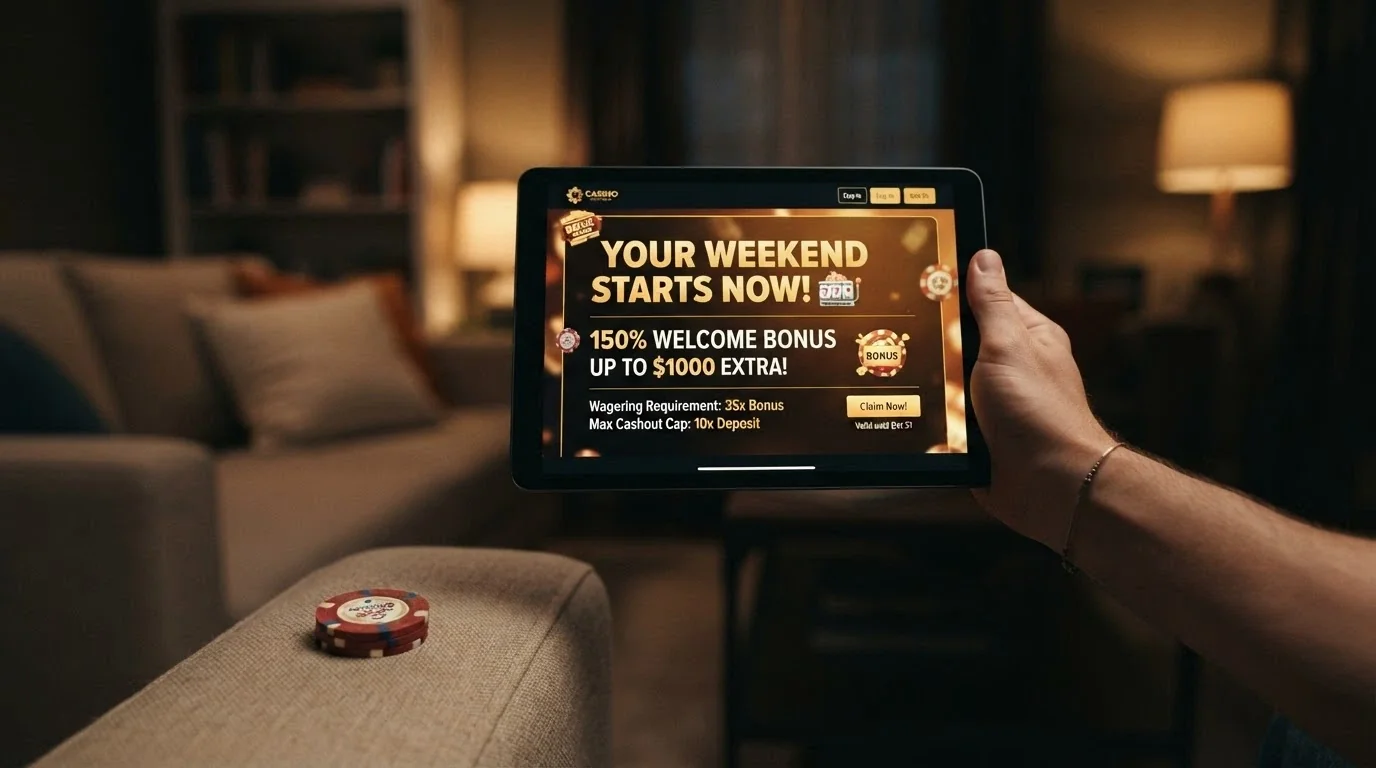
Typical no-deposit value sits between A$10 and A$25 in bonus cash or between 20 and 50 free spins. Some platforms go as high as 100 free spins, but that is the upper bound of what is reasonable to find. Anything pitched as “A$200 no deposit” is rare and almost always carries punishing terms.
Wagering on no-deposit offers is the rule, not the exception, and the rule runs hot. The market sits in a 40× to 60× wagering range on no-deposit bonus winnings — meaning if you win A$20 from a no-deposit free-spin bundle, you must wager A$800 to A$1,200 before that A$20 can be withdrawn. Reasonable wagering on no-deposit bonus winnings sits at 30× to 35×; anything above 50× on no-deposit winnings makes the offer practically unclearable for most players, because the variance of clearing several thousand dollars in turnover at a single bonus balance exceeds what a small bankroll can absorb.
Maximum cashout caps are the other half of the leash. Withdrawals are typically capped at A$50 to A$100 on Australian no-deposit offers, and some operators push the cap to A$150 or A$180 for free-money promotions. The cap means a no-deposit bonus is a chance to win a small, fixed payout — not a chance to win big. A player who hits a 200× line on a 50-free-spin no-deposit offer walks away with the cap, not the headline.
The leash on a no-deposit offer is the entire business model. The casino gives you bonus play, you grind through the wagering, and a small fraction of players reach the cashout cap with money left after the house edge. The rest walk away with nothing. That is not a complaint. It is how the product is built.
Deposit-match bonus codes — bigger headline, more strings attached
A deposit-match code credits bonus cash as a percentage of your deposit, up to a stated ceiling. A 100% match up to A$1,000 credits an additional A$1,000 as bonus cash, while a 300% match up to A$3,000 triples your starting deposit. The percentage is the marketing number; the turnover obligation is the real number.
The Australian-facing offshore market in 2026 pitches match packages at 100% to 300% on the headline, with ceilings between A$3,000 and A$5,000. The most aggressive packages stack a free-spin bundle on top of the matched cash: the headline becomes “A$5,000 plus 400 free spins”, and the free-spin winnings carry their own wagering and cashout terms on top of the cash bonus.
The turnover obligation behind a A$5,000 headline runs like this. On a 35× wagering multiple, A$5,000 of bonus funds means A$175,000 of required play. On a 50× multiple, that rises to A$250,000. The expected cost of clearing the bonus — the house edge over the turnover — is the figure most players never calculate. The arithmetic matters, and the section on wagering requirements runs it.
A deposit-match bonus is not bad value if you were going to play that volume anyway and the wagering multiple is at the low end of the market. The same package pitched at a player who would otherwise deposit A$200 and play A$500 is a much worse deal: you are committing tens of thousands in turnover for a bonus that pays out, after the house edge, a fraction of its headline.
The strings that come with deposit-match offers tend to concentrate in three places. First, the wagering multiple, which may apply to the bonus alone or to deposit plus bonus combined. Second, the max-bet cap while the bonus is active — typically A$10 per spin or hand, which prevents high-variance play from clearing the bonus quickly. Third, the game eligibility, which often restricts the bonus to pokies and excludes table games or live-dealer play from the wagering count.
Free-spin offers and free chips — what they are really worth
Free spins and free chips are the same promotional building block dressed in two outfits. A free-spin bundle gives you N spins on a named slot at a fixed stake. A free chip gives you a credit of bonus cash to play on the slot or table of your choice. The wagering and cashout terms look the same underneath.
Free-spin counts on no-deposit bundles usually sit between 20 and 50 spins, with some platforms going as high as 100. The per-spin stake is usually fixed at a low value — A$0.10 to A$0.20 — so the headline value of a 50-spin bundle is A$5 to A$10 before any winnings. The real value of the bundle is the winnings it produces, and the real value of the winnings is what survives the wagering and the cashout cap.
A representative free-spin offer running in 2026 pitches 20 free spins on Zeus the Thunderer, with 30× wagering on winnings and a A$150 max cashout. The headline is “20 free spins”; the practical shape is “20 chances to win, with a ceiling of A$150 once the wagering clears”. Wagering on free-spin winnings often sits between 40× and 50×, sometimes with a 5-day window in which to clear it — a deadline that catches players who treat the bonus as background play.
Free chips work the same way. A A$10 free chip credited on registration is, in real terms, A$10 of bonus money with a wagering multiple and a cashout cap. The chip gives you more flexibility than a free-spin bundle because you choose the game, but the wagering terms travel with the credit wherever you spend it.
The per-spin value cap is the figure that limits total return. If the operator caps free-spin stake at A$0.20, then 50 free spins at the slot’s theoretical maximum payout is bounded by the slot’s volatility profile and the cap. A high-variance slot can produce a single 200× line that dwarfs the rest of the bundle — and the cashout cap determines whether that line reaches you in cash.
Register-time bonus codes — the sign-up sweetener
A register-time bonus is the offer you claim before depositing a cent. It is the same product as a no-deposit bonus, but it lives on the registration page rather than the promotions page, and it usually sits behind a verification gate.
The gate that catches most players is the phone-verification step. Some operators do not credit a register-time bonus until you verify a working phone number. The verification is quick — an SMS code or a short phone call — but it is a step that has to happen before the bonus credits. A player who registers and walks away without verifying waits indefinitely for a credit that does not arrive.
What a register-time bonus costs in wagering tracks the no-deposit market: 30× to 60× on bonus winnings, with a cashout cap in the A$50 to A$180 range. The wagering commitment is the same shape as a no-deposit free-spin bundle, because mechanically the offer is a no-deposit bonus presented on the registration line.
The cashout ceiling on register-only claims is the most-consulted figure on the page for cautious players. A A$10 no-deposit bonus after phone verification, with 35× wagering on free-spin winnings and a A$150 max cashout, is the typical offering. A player who clears the wagering walks away with whatever sits under the cap. A player who does not clear the wagering walks away with nothing.
Wagering requirements — what the multiple really costs you
A wagering multiple is the number of times you must play through a bonus before its winnings become withdrawable. A 35× multiple on A$100 of bonus funds means A$3,500 of required play. A 50× multiple on the same bonus means A$5,000. The multiple is the single most-loaded number on the offer, and it is the number most players underestimate.
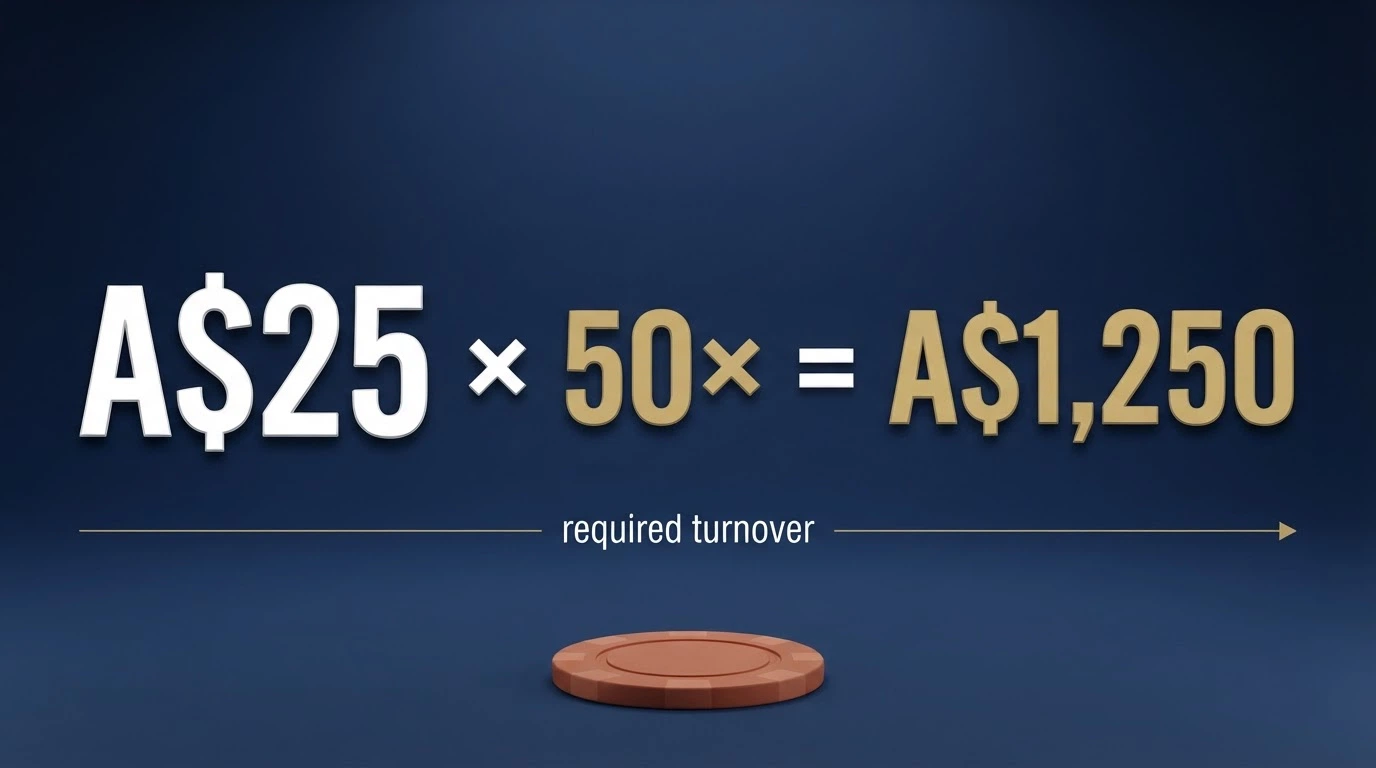
Reasonable wagering on no-deposit bonus winnings sits at 30× to 35×. The market, however, clusters at 40× to 60× — meaning most no-deposit offers sit at the high end of what is still legally clearable. Anything above 50× on no-deposit winnings makes the offer practically unclearable for most players, because the variance of clearing the turnover at a single bonus balance exceeds what a small bankroll can absorb.
The arithmetic behind a 50× no-deposit offer runs like this. Take a representative offer: a A$25 no-deposit bonus, the midpoint of the AU-facing market’s cash range, with the 50× wagering that sits in the middle of the standard 40× to 60× band. That offer commits a player to A$1,250 in required turnover before any winnings can be withdrawn. On a representative pokie returning 96.71% — Big Bass Bonanza’s published RTP — the expected loss over the clearing cycle comes to about A$41.13, assuming only the bonus amount is wagered. The A$25 bonus is therefore a net-negative proposition on average: the house edge over the turnover exceeds the face value of the credit.
On the deposit side, the same arithmetic stretches further. A A$1,000 bonus at the lower 30× wagering band means A$30,000 in turnover. The expected loss on a representative 96.71% RTP pokie works out to roughly A$987 over the clearing cycle, again assuming only the bonus amount is wagered. The expected loss scales with the turnover, and the turnover scales with the bonus size.
The max-bet cap while a bonus is active is the third figure that matters. The maximum allowed bet while a bonus is active is A$10 per spin or hand on the operators reviewed here. The cap prevents a player from clearing a A$1,250 turnover in ten spins at A$125 each; it forces a slower, more volatile clearing process where the house edge has more time to bite.
Maximum cashout caps — the withdrawal ceiling most players miss
A maximum cashout cap is the upper bound on what you can withdraw from bonus winnings, even after the wagering clears. The cap is the figure that turns a big win into a fixed payout. It sits in the terms in small print, and it is the single most important number on the page for any player considering a no-deposit or free-money offer.
Typical no-deposit caps sit at A$50 to A$100 on Australian no-deposit offers, and some operators push to A$150 or A$180 for free-money promotions. The cap is independent of the wagering multiple. You can clear the wagering on a A$25 no-deposit bonus, walk away with A$400 of bonus-balance winnings after the playthrough, and have the operator cut the withdrawal to A$100. That is how the cap works, and that is why a player who has done the wagering can still walk away with less than the win.
Free-spin winnings often carry their own cap. A 35× wagering welcome on a free-spin bundle with a A$100 max cashout means the free-spin portion of the welcome has a hard ceiling of A$100 — irrespective of how much the spins produced. A welcome package that bundles free spins with deposit-match cash has two caps: one on the free-spin winnings, one on the cash bonus (if any).
Deposit-bonus offers sometimes carry no cashout ceiling, and that absence is the most valuable feature a deposit welcome can carry. A welcome bonus with no max cashout lets a high-variance spin actually pay out at the slot’s theoretical maximum, capped only by the operator’s withdrawal rules outside the bonus. The presence or absence of a cap is worth more than the size of the match percentage.
Bonus validity — how long your code actually lasts
A bonus code carries two clocks. The first is the code’s own shelf life: many codes expire 24 to 72 hours after credit if unused. A code you were emailed last Tuesday and never redeemed may not register by Friday. The second is the bonus validity window: the period during which you must clear the wagering after the bonus is credited.
The wagering-validity window is where bonuses are won and lost. Free-spin bundles typically carry a 5-day window in which the wagering requirement on free-spin winnings must be met. A deposit-match welcome may carry a 30-day window, sometimes shorter. The window does not pause when you log out. The clock runs against you from the moment the bonus credits.
What happens when a bonus expires mid-play: the bonus balance is removed, the wagering progress is reset, and any winnings tied to the bonus are forfeited. There is usually no grace period. The operator does not notify you when the bonus is about to expire; the small print is the only warning.
Players who treat a bonus as background play — deposit, claim, log in for an hour a day — often lose the bonus to expiry. Players who front-load their clearing sessions — concentrated play in the first 24 to 48 hours — clear more bonuses but at a higher variance cost. The honest trade-off is between time and risk, and the validity window is the field on which that trade-off plays out.
Bonus types at a glance
| Bonus type | Typical value | Typical wagering | Typical max cashout | Typical validity |
|---|---|---|---|---|
| No-deposit bonus | A$10–A$25 cash or 20–50 free spins | 40×–60× on winnings | A$50–A$100 | 24–72 hours for unused codes; 5 days to clear |
| Deposit-match welcome | 100%–300% match, A$3,000–A$5,000 ceiling | 30×–35× on bonus or deposit+bonus | Varies — often no cap on deposit bonus | 30 days to clear |
| Free-spin bundle | 20–50 spins at A$0.10–A$0.20 | 40×–50× on winnings | A$100–A$150 | 5 days to clear |
| Free chip / register-time bonus | A$10–A$50 chip | 35×–60× on winnings | A$100–A$180 | 5–30 days to clear |
The table reads one direction: the larger the headline, the more leverage the operator is keeping through wagering and cashout terms. The no-deposit column is the tightest leash. The deposit-match column is the largest commitment, with the most variance between offers.
The Bonus Codes Available to Australians — and the Offshore Operators Behind Them
Every operator on this page is offshore. None holds an Australian gambling licence. The Interactive Gambling Act 2001 prohibits providing an online casino to a person in Australia, and the Australian Communications and Media Authority has enforced that prohibition against more than 230 services since 2017 and blocked more than 1,700 illegal gambling and affiliate websites since its first blocking request in 2019. The brands below operate outside that system. They accept Australian players, run bonus-code promotions marketed at Australian traffic, and answer to regulators in other jurisdictions — Curaçao, Anjouan, Malta — none of which extend Australian consumer protections to the account.
This is the ranking’s central fact. It is not a comparison between licensed and unlicensed. It is a comparison within the unlicensed set.
| Operator | AU licence status |
|---|---|
| Skycrown | Offshore / not AU-licensed |
| Fair Go | Offshore / not AU-licensed |
| Royal Reels | Offshore / not AU-licensed (blocked by ACMA) |
| Rocket Play | Offshore / not AU-licensed |
| WinSpirit | Offshore / not AU-licensed |
| Stake | Offshore / not AU-licensed |
| Rainbet | Offshore / not AU-licensed |
| Scream Casino | Offshore / not AU-licensed |
| Bizzo Casino | Offshore / not AU-licensed |
| Rocket Casino | Offshore / not AU-licensed |
Skycrown
Skycrown’s welcome is the largest headline in the ranking. The package runs up to A$5,000 in deposit-match funds plus 400 free spins, with 35× wagering on the bonus portion. The free-spin winnings are capped at A$100, which is the ceiling that matters in practice: a player who runs hot on the free-spin portion walks away with A$100, not the headline.
Skycrown operates under Hollycorn N.V., a Curaçao-licensed operator. It is not licensed in Australia. It is not connected to BetStop. A player who self-excludes through the Australian national register remains eligible to open an account at Skycrown and claim the welcome. The trade-off is access to a larger bonus ecosystem in exchange for the loss of every Australian consumer protection.
For a player with a bankroll of A$1,000 or more and the time to clear the 35× wagering on the matched portion, Skycrown’s headline is the largest on the ranking. The free-spin ceiling is the price. The 400-spin count is the marketing.
Fair Go
Fair Go is the longest-running AU-facing brand on the ranking. Its welcome pitches 300% up to A$3,000 plus 50 free spins, with 30× wagering on deposit plus bonus. The deposit welcome has no maximum cashout ceiling, which is the most valuable structural feature on the offer: a high-variance spin can pay out at the slot’s theoretical maximum without the operator clipping it back to a fixed payout.
The split wagering regime is what sets Fair Go apart. Free bonuses — the no-deposit and free-money side of the lobby — run at 60× wagering with a A$10 max bet. The deposit welcome runs at 30×. The two regimes do not mix: a player moving from the deposit welcome to the free-bonus side will see the multiplier change, and the change is the central mechanic of the offer.
Free-money withdrawals are capped at A$180, while the deposit welcome has no max cashout. The 25% cashback on busted deposits of A$10 or more, with 10× playthrough, is the backstop: a player who loses their first deposit can recover a quarter of it through cashback, with a much softer playthrough than the welcome itself.
Fair Go’s value to the right reader is the combination of a no-cap deposit welcome and a long-running AU-facing track record. Its weakness is the 60× free-bonus wagering, which is at the high end of the market. For a deposit-bonus reader, this is the standout offer. For a no-deposit reader, look elsewhere.
Royal Reels
Royal Reels offers the cleanest no-deposit entry point on the ranking. The brand credits A$10 in bonus funds after a phone-verification step, with 35× wagering on free-spin winnings. The bonus is the smallest headline on the page and the most clearly defined in terms.
The Royal Reels game library runs over 5,400 pokies from 40-plus software providers, and the average wagering across the brand’s reviewed bonuses is 31× — the lowest average in the ranking, and the closest the AU-facing market comes to a fair-play welcome.
Royal Reels has no Australian gambling licence and is blocked by ACMA. The blocking does not prevent the brand from accepting Australian players; it prevents Australian ISPs from carrying the site without a circumvention. A player reaching the site from Australia does so via an offshore path, and the absence of an AU licence means the absence of AU consumer protections. A player with a dispute has recourse to the operator’s licensing regulator, not to ACMA or the Australian Financial Complaints Authority.
A small-bankroll player who wants the lowest wagering on the AU-facing market will find Royal Reels the most rational pick. The brand does not clear the bar on Australian consumer protections — because no brand on this page does.
Rocket Play
Rocket Play reaches Australian players through an offshore operation. Its current bonus-code terms were not surfaced in the available AU-facing review snippets, which means the wagering multiple, the max cashout cap, and the validity window for any current offer are not pinned down here. The brand has a presence in the AU-facing market and a game library typical of the offshore segment.
Players considering Rocket Play should check the operator’s own site for the current bonus-code terms before claiming any offer. The framework in this article applies — wagering multiples in the 30× to 60× range, max cashout caps in the A$50 to A$200 band, validity windows between 24 hours and 30 days — but the exact figures for Rocket Play’s current welcome were not confirmed in this review.
The verdict for Rocket Play: a player can evaluate the offer on the same terms as any other AU-facing offshore brand, but should not rely on a headline read. The terms are where the offer lives.
WinSpirit
WinSpirit appears in the AU-facing market with a game library typical of the offshore segment and a brand identity pitched at the same audience as the rest of the ranking. Its current bonus-code terms were not surfaced in the available AU-facing review snippets.
The honest read on WinSpirit is the same as the read on Rocket Play and the other no-data operators: the headline is the marketing, and the small print is the offer. The terms that govern any welcome package — wagering multiple, max cashout cap, validity window, eligible games, max bet while a bonus is active — should be confirmed on the operator’s own site before any code is entered.
WinSpit’s positioning in the AU-facing market is mid-tier. There is no current evidence on this page to suggest the brand is either better or worse than its peers in the same segment. Players who already have a WinSpirit account can evaluate the welcome on the standard offshore framework; players choosing between brands should treat the absence of surfaced terms as a reason to look at operators whose terms are documented.
Stake
Stake is the highest-profile international operator on the ranking. The brand runs a global sportsbook and casino, accepts cryptocurrency natively, and operates under a Curaçao licence. The operator’s promotional model is built around sports-betting reload offers and a VIP rakeback structure rather than the casino welcome package the rest of this ranking is built around.
The promotional mismatch matters. A player looking for a casino welcome package with a code-gated deposit match and a free-spin bundle is not the player Stake is built for. A player looking for a high-volume sports-and-casino operator with cryptocurrency rails and ongoing reloads is closer to the brand’s core market.
For the typical AU-facing player reading this page, Stake is a presence rather than a fit. The brand is on the ranking because it reaches Australian traffic and offers casino play; it is not on the ranking because the bonus-code terms that govern a casino welcome package are not the headline product.
Rainbet
Rainbet operates an offshore casino with cryptocurrency deposit rails and a sportsbook alongside the casino floor. The brand’s offer set is built around sports reloads and rakeback rather than the casino welcome package the rest of this ranking is built around.
The honest read: Rainbet is on the ranking because it reaches Australian players, not because it runs the kind of casino welcome package most readers of this page are evaluating. A player comparing casino welcome packages should weigh Rainbet on the same terms as the other operators — wagering, max cashout, validity — but should expect to find a sports-led promotional structure rather than a casino-led one.
A punter whose interest is casino-only play will find Rainbet peripheral. A punter who splits time between sports and casino has more reason to look closer once current terms are surfaced.
Scream Casino
Scream Casino reaches Australian players through an offshore operation under a Curaçao-class licence. The operator’s welcome bonus terms are typical of the offshore segment, with the framework described in this article applying to any offer the brand runs.
The brand’s positioning in the AU-facing market is similar to the other no-data operators on this ranking: a presence in the market, a game library typical of the offshore segment, and a welcome package whose terms need to be confirmed before claiming. The framework in this article applies — wagering in the 30× to 60× range, max cashout caps in the A$50 to A$200 band — but the exact figures for Scream Casino’s current welcome were not pinned down here.
A player who already plays at Scream Casino can apply the standard offshore framework directly. A player choosing between brands has no reason to elevate Scream Casino over a competitor whose terms are documented.
Bizzo Casino
Bizzo Casino reaches Australian players through an offshore operation with a game library typical of the offshore segment. The terms for any welcome offer are consistent with the offshore framework described in this article.
The brand’s market presence is real but its welcome structure was not pinned down in this review. The framework in this article applies, but the specific numbers for Bizzo Casino’s current offer — wagering multiple, max cashout, validity window — should be confirmed on the operator’s own site before any code is entered.
The honest verdict: Bizzo Casino is on the ranking because it reaches Australian players and runs a casino operation in the offshore segment. It is not differentiated from the other no-data operators in this set on the basis of terms, because its terms were not surfaced. A player evaluating the brand should treat the welcome on the same framework as the rest of the page and should not rely on a headline read.
Rocket Casino
Rocket Casino reaches Australian players through an offshore operation with a casino floor typical of the segment. The brand’s welcome package follows the standard offshore framework described in this article.
The framework in this article applies to Rocket Casino as it does to every other operator on the ranking: wagering in the 30× to 60× range, max cashout caps in the A$50 to A$200 band, validity windows between 24 hours and 30 days. The exact figures for Rocket Casino’s current welcome were not confirmed in this review.
Bottom line on Rocket Casino: a peripheral option for a player comparing casino welcome packages on terms. For a player with an existing account, the standard offshore framework is the right lens. The brand does not differentiate itself from the no-data set on this page, because the data was not surfaced.
Is It Legal? Why Australia’s Casino Rules Make Every Bonus Code a Calculated Risk
Australia’s federal law on online gambling is the Interactive Gambling Act 2001. The Act prohibits providing an online casino — including online pokies and in-play sports betting — to a person in Australia. It does not prohibit the player; it prohibits the provider. The licensed-permitted products under the IGA are wagering before the event, lotteries, and keno. Online casino is not on that list, and the provider of an online casino reaching Australian players is the party the regulator pursues.
That structure is what makes every bonus code on this page an offshore proposition. The brand offering the code is the regulated party, and the regulation it answers to is not Australian.
The Interactive Gambling Act and what it actually prohibits
The Interactive Gambling Act 2001, strengthened by the Interactive Gambling Amendment Act 2017, prohibits the provision of online casino, online pokies, and in-play sports betting to persons in Australia. The licensed-permitted products under the regime are wagering before the event, lotteries, and keno. The prohibition targets the provider; the individual player is not prosecuted for placing a bet.
The credit card and crypto payment ban that commenced on 11 June 2024 is part of the same regulatory architecture. Australians can no longer use credit cards or crypto assets to fund online wagering on AU-licensed platforms. The ban does not extend to offshore casinos, which are not bound by AU payment restrictions — meaning the same payment methods that are banned on the licensed side are the rails that an offshore casino typically runs on.
The minimum gambling age in Australia is 18. Player winnings from gambling are generally not assessable income under section 6-5 ITAA 1997, and losses are not deductible under section 8-1 unless the person is carrying on a business of betting or gambling. The tax treatment is incidental to the legality of the offer, but it is the question most players ask after the wagering is done.
There is no federal deposit, loss or stake ceiling for online gambling, because online casino is prohibited. The cap on payment methods is the proxy for a deposit cap: with credit cards and crypto out of the licensed picture, the remaining funding rails (debit cards, BPAY, PayID, Osko) carry their own transaction limits and the operator’s own deposit ceilings. A federal loss ceiling would require a licensed product to cap.
The prevalence data puts the prohibition in context. ACMA’s own research found that 11% of Australians had gambled online in the previous six months in 2022, up from 8% in 2020. The Australians who reach offshore casinos with a bonus code are not a fringe population. They are a measurable slice of the market that the licensed system does not accommodate.
ACMA enforcement — site blocking, investigations, and market exits
The Australian Communications and Media Authority is the federal regulator that enforces the online prohibition. ACMA investigates complaints, issues formal warnings, pursues civil penalty proceedings, and directs ISPs to block illegal sites. The enforcement record over the last several years is the largest dataset available on the scale of the offshore market reaching Australian players.

ACMA said that as of August 2026, 1,788 illegal gambling and affiliate websites had been blocked since its first blocking request in November 2019. The same enforcement record said more than 230 illegal services had pulled out of the Australian market since 2017. The numbers are cumulative — they represent years of blocking and voluntary exits — and they show the scale of the offshore market ACMA is working against.
The most recent reporting period, October to December 2025, gives a quarterly snapshot. ACMA looked into 483 enquiries and complaints. It completed 23 investigations that involved 45 gambling sites. It recorded 69 findings of breaches of the Interactive Gambling Act 2001. It blocked 133 websites in that three-month window. The quarterly run-rate is consistent with the cumulative record: roughly 500 blocking requests and several hundred investigations a year, against an offshore market that refreshes its domains as fast as ACMA blocks them.
The blocking does not prevent a determined player from reaching an offshore casino. It makes the default path harder, raises the friction for casual reach, and signals which operators ACMA has decided are priorities. A player who wants to play at an offshore casino can do so; the regulator is targeting the provider, not the player.
BetStop and why offshore casinos cannot connect to it
BetStop is the National Self-Exclusion Register, launched on 21 August 2023. BetStop excludes a person from every Australian-licensed online and phone wagering service in a single step. By the end of Q3 FY 2025–2026, 59,830 people had registered on BetStop. As of 31 March 2026, 37,247 people had active exclusions.

The gap is the offshore market. Offshore casinos are not licensed in Australia and are not connected to BetStop. A player who self-excludes through BetStop is excluded from every AU-licensed wagering service. The exclusion does not extend to a single operator on this page. A self-excluded player can open an account, claim a bonus code, and play at any of the ten operators reviewed here.
The gap matters for one specific reader. Anyone who has self-excluded through BetStop — or who is considering it — needs to know that the exclusion stops at the Australian border. The offshore casinos carry their own self-exclusion tools, but those tools are voluntary, operator-by-operator, and reset the moment the player opens a new account at a different brand.
The 2026 advertising and inducement reforms — what changes for players
The Interactive Gambling Amendment (Gambling Reform) Bill 2026 passed both Houses of Parliament on 19 August 2026, with substantive reform schedules commencing on 1 January 2027. The reform package rewrites how wagering is marketed in Australia, and the changes reach the licensed side of the market — not the offshore side.
From 1 January 2027, TV wagering advertising is capped at no more than three ads per hour between 6:00 am and 8:30 pm. Wagering advertising is banned during live sporting-event coverage from 15 minutes before the event until 5 minutes after it ends. Direct marketing of inducements is banned for 14 days after a customer signs up, and for 3 months after a person deregisters from BetStop. Radio wagering ads are barred during school drop-off and pick-up times. Broadcasting sporting odds is banned outright. Online wagering ads will only be served to logged-in 18+ users with opt-out. Athletes, celebrities and influencers are barred from promoting wagering products.
The reform package is wide. It does not change the offshore reality that produces every bonus code on this page. The new rules apply to AU-licensed operators and to advertising reaching Australian audiences through licensed channels. An offshore casino running a bonus-code promotion to an AU-facing audience sits outside the reform’s reach, which is the same place it has always sat: outside the Australian regulatory system.
The 14-day post-signup inducement ban and the 3-month post-BetStop-deregistration ban are the two provisions closest to the bonus-code mechanic on this page. Both reach the licensed side. Neither reaches the offshore side.
Responsible Gambling — The Tools That Protect You Before You Claim Anything
The Responsible Gambling section sits at the end of the ranking for a reason. Every figure on this page — the wagering multiples, the cashout caps, the offshore licence statuses — describes a market that is built without Australian consumer protections. The tools that protect a player exist, and the harm prevalence data shows how many Australians need them.
Roy Morgan’s Gambling Harm Index reported that 13.0% of Australians experienced some form of gambling harm from their own gambling behaviours as of March 2026, an estimated 2,857,000 people. A further 5.4% experienced harm from other people’s gambling, an estimated 1,177,000 Australians. Some 15.1% of Australian adults — an estimated 3.32 million people — were experiencing some level of gambling harm from their own gambling or that of people close to them.
The numbers are the case for the section that follows.
Deposit limits and reality checks — set them before you deposit
Deposit limits are the first line of self-protection. They are settings on the account that cap the amount a player can deposit over a stated period — daily, weekly or monthly. On AU-licensed wagering platforms, deposit limits are a regulatory expectation. On offshore casinos, the picture is uneven: some operators offer deposit-limit tools as a feature, others do not surface them in the account menu at all.
Reality checks are the second line. A reality check is a session timer that pops up at set intervals — every 15 minutes, 30 minutes, or hour — and tells the player how long they have been in the session and what they have won or lost. The pop-up does not stop the session; it asks the player to confirm they want to continue. AU-licensed platforms are required to offer reality checks; offshore platforms vary.
The credit card and crypto payment ban on AU-licensed wagering is the third protective layer, but it cuts both ways for the offshore reader. On the licensed side, the ban removes two funding rails that correlate with problem play. On the offshore side, the ban does not apply — meaning an offshore player can fund with crypto, which carries no daily limit and no merchant-side cooling-off.
The honest pre-deposit sequence: set a deposit limit before depositing, set a session-timer reality check before playing, and keep the help-line number — 1800 858 858 — in your phone before you claim a bonus. The settings take a few minutes. They cost nothing. They are the only consumer protection that travels with you onto an offshore platform.
Self-exclusion — BetStop, cool-off periods, and what offshore lacks
BetStop is the national self-exclusion register, covering every Australian-licensed online and phone wagering service. A BetStop registration excludes the player from those services for a chosen period — three months, six months, or up to five years — and the exclusion cannot be reversed early.
Cool-off and take-a-break periods on individual platforms sit one level below BetStop. A cool-off is a short self-exclusion — typically 24 hours to 30 days — applied at the operator level. A take-a-break is a longer suspension on a single platform, often up to six months. Both are reversible at the end of the period; BetStop is not.
The gap is the offshore market. None of the operators on this page are connected to BetStop. A player with an active BetStop exclusion can open an account at Skycrown, Fair Go, Royal Reels, or any other brand on the ranking and claim a bonus code. The exclusion does not travel. The offshore operators carry their own self-exclusion tools, which a player can opt into at any operator, but the tools are voluntary and reset the moment the player opens a new account at a different brand.
The 3-month post-BetStop-deregistration inducement ban (from 1 January 2027) is the one bridge between the two systems. It does not stop a deregistered player from playing offshore. It stops AU-licensed operators from marketing inducements to that player for three months after they deregister. The inducement ban closes one channel of marketing; it does not close the offshore door.
Recognising problem play and where to get help
The warning signs of problem gambling are well-documented and rarely in dispute. They include chasing losses, playing for longer sessions than planned, hiding play from family or friends, borrowing to play, neglecting work or relationships, and feeling anxious or irritable when not playing. None of those signs is unique to offshore casino play; they show up across every form of gambling. What is unique to the offshore market is the absence of mandated early-intervention tools, which raises the burden on the player to self-monitor.

The prevalence data is the scale of the issue. 13.0% of Australians — 2,857,000 people — experienced gambling harm from their own gambling in March 2026. 5.4% — 1,177,000 Australians — experienced harm from other people’s gambling. The combined figure of 15.1% of adults — 3.32 million people — experiencing some level of harm is the headline that frames the section.
Free, confidential help is available 24/7. The National Gambling Helpline is 1800 858 858. Gambling Help Online provides free 24/7 chat and email counselling with professional counsellors across Australia. Both services are free, confidential, and available without registering on a casino site or claiming a bonus.
For anyone reading this page who has self-excluded through BetStop, the offshore gap is the single most important thing to know. The exclusion stops at the Australian border. The helpline does not.
How We Evaluated These Operators
The ranking is built on five inputs and one hard rule. The rule: every operator on the page is offshore and not AU-licensed. The inputs are the ACMA enforcement register, the Interactive Gambling Act 2001 prohibition, the Roy Morgan harm-prevalence research, the trade publications covering the AU-facing market, and the operator bonus pages themselves where they surfaced terms.
For operators whose bonus-code terms were surfaced — Skycrown, Fair Go, Royal Reels — the evaluation drew on the operator’s own bonus page as quoted in the trade press. For operators whose terms were not surfaced — Rocket Play, WinSpirit, Stake, Rainbet, Scream Casino, Bizzo Casino, Rocket Casino — the evaluation drew on the operator’s market presence and the standard offshore framework, and the absence of surfaced terms was reported as such rather than papered over.
The evaluation criteria were AU licence status, bonus-code terms where surfaced (wagering multiple, max cashout, validity window), game-library scale and provider count, and the transparency of terms presentation. The criteria were weighted equally — no brand was promoted to a higher rank on a hidden dimension, and no brand was demoted on the absence of a term that the operator did not publish.
The ranking does not pick a winner. It ranks operators by the size of their headline welcome and the clarity of their terms, and it leaves the final call to the reader on the basis of the figures this page has surfaced.
Before You Claim That Code — What to Actually Do
Five steps, in order. None of them requires depositing a cent.
Check whether the operator is licensed in Australia. None of the ten operators on this ranking hold an Australian licence. If the operator is not on this ranking, the same question applies: any bonus-code promotion reaching Australian players from an offshore casino is operating outside the Australian regulatory system. The check is one search — the operator’s terms page or its licence footer.
Read the wagering multiple. A 35× multiple on a A$1,000 bonus means A$35,000 of required turnover. A 50× multiple on the same bonus means A$50,000. Find the figure, multiply by your expected bonus, and decide whether the turnover is something you would have played anyway.
Find the max cashout cap. If the cap is on the offer, the offer’s headline is the marketing. A 50-free-spin bundle with a A$100 cashout cap returns at most A$100, regardless of the headline. The cap is the upper bound on what is yours at the end.
Confirm the bonus validity window. A 5-day window on free-spin wagering is tight; a 30-day window on a deposit welcome is generous. The window is the time you have to clear the wagering after the bonus credits. If the window is shorter than your planned clearing schedule, walk away.
Set your deposit limit and know the help number before you deposit. The deposit limit is the only consumer protection that travels to an offshore casino. The help number — 1800 858 858 — is the line a player calls before the limit is reached. Both should be in place before a cent is moved.
Frequently Asked Questions
What is a casino bonus code and how do I use it in Australia?
A casino bonus code is a short alphanumeric string you enter at registration or in the cashier to unlock a specific promotion. In Australia the bonus-code market sits offshore — no AU-licensed online casino exists — so the code routes you to a brand operating under another jurisdiction’s licence. The bonus credits to a separate balance, and the wagering must clear before winnings become withdrawable.
Can I get in trouble for using an online casino bonus code in Australia?
No. The Interactive Gambling Act 2001 prohibits the provider, not the player. Australians placing bets with offshore casinos are not prosecuted; the regulator pursues the operator. The practical consequences fall on the player side: no Australian consumer protection, no BetStop coverage, and any dispute is handled by the operator’s licensing regulator rather than ACMA.
How much can I withdraw from a no deposit bonus or free spins offer?
It depends on the cap. No-deposit offers in the AU-facing market typically cap withdrawals at A$50 to A$100, and some operators push the cap to A$150 or A$180 on free-money promotions. The cap applies after wagering clears. A player who hits a large line on a 50-free-spin bundle walks away with the cap, not the headline figure.
Do offshore casinos connected to bonus codes cover BetStop self-exclusion?
No. BetStop, the National Self-Exclusion Register, covers every Australian-licensed online and phone wagering service. None of the operators on this page are licensed in Australia, and none are connected to BetStop. A player who self-excludes through BetStop can still open an account and claim a bonus code at any offshore casino.
Are PayID or crypto payouts faster for Australian casino bonus offers?
PayID and Osko settle in seconds on AU-licensed wagering platforms, but casino bonus-code offers run offshore and do not use PayID rails. Crypto payouts can be fast on the blockchain side, but the operator’s internal processing queue — often 24 to 72 hours — sits in front. Faster funding does not mean faster withdrawal on bonus winnings.
What responsible gambling tools should I set before using any bonus code?
Set a deposit limit on the account before depositing. Set a session-timer reality check before playing. Save the National Gambling Helpline — 1800 858 858 — and the Gambling Help Online 24/7 chat link. Offshore casinos do not carry AU-mandated self-exclusion tools, so the burden of pre-commitment falls on the player.
What is a casino bonus code?
A casino bonus code is an alphanumeric string — often a short sequence of letters and numbers — that you enter into a casino’s cashier or registration form to unlock a specific promotional offer. The code is the only thing that distinguishes one promotional package from another at the same casino, and it is the line of text that ties your account to the terms attached to that particular deal.
In AU-facing offshore lobbies, codes appear in three main places. They appear on a casino’s own promotions page, advertised alongside a deposit-match headline or a free-spin package. They appear in email and SMS offers sent to existing customers, where a unique code may route a returning player to a reload deal or a free-chip offer with terms that differ from the headline welcome. And they appear on affiliate sites and comparison hubs, where a code is the bridge that lets the affiliate claim the player and lets the casino track which channel delivered the signup.
A code unlocks specific things. It can unlock bonus cash on top of a deposit, free spins on a named slot, a free chip that lets you play without depositing, or a cashback line on a loss. The code does not change the underlying house edge of the games the bonus is played on. It changes the wrapper around the money — what you must wager, what you may withdraw, and how long you have to do it.
What the code costs you is the wagering commitment that attaches once it is redeemed. A code does not give you free money. It gives you bonus money that must be played through a stated multiple of times before any winnings become withdrawable, and most often those winnings are subject to a maximum cashout cap. That combination — wagering multiple plus cashout ceiling — is the real shape of the offer, and the code is the door into it.
Mobile vs desktop — does it matter where you redeem?
The redemption flow looks the same on a phone browser and on a desktop. The code field, the bonus credit, the separate bonus balance — none of that changes between platforms. What does change is the surrounding experience.
A mobile browser session gives you a smaller screen and a tighter cashier form. Some operators fold the promo-code field into a settings sub-menu on mobile, behind two taps rather than the single click a desktop player gets. That extra step does not change the offer, but it raises the chance that a mobile player enters a deposit without first entering the code, claims the wrong bonus, or misses the field altogether and ends up playing under no offer at all.
App-exclusive codes exist in pockets of the market. Some operators offer a different welcome package through their iOS or Android app — typically a small additional free-spin bundle or a no-deposit chip you cannot get on the desktop site. The trade-off is that the app install often commits you to the app-only welcome, with the desktop welcome no longer available once the app is linked to your account. Terms on app-exclusive bonuses follow the same wagering and cashout rules as the desktop equivalent; the exclusivity is on the entry point, not on the conditions.
Usability differences show up in three places. Mobile users tend to deposit faster and in smaller amounts, which is the natural territory of no-deposit and low-deposit bonus offers. Mobile users also tend to claim bonuses without reading the terms — the screen is small, the conditions are tucked behind a link, and the temptation to skip is real. And mobile users play shorter sessions, which sits awkwardly against the multi-day wagering commitments most bonuses carry.
Whether mobile players face different terms is the honest question. The answer, for the operators reviewed on this page, is no: terms are typically platform-agnostic. The same wagering multiple and the same cashout cap apply whether you redeemed on iOS, Android or desktop. What differs is the claim path, and the claim path is where mistakes happen.
Mobile no-deposit claims — app-exclusive or just marketing?
Mobile no-deposit claims live in a thin slice of the AU-facing market. Most operators offer the same welcome package on mobile and desktop, with the only difference being the claim path. A handful of operators run app-exclusive bundles — typically a small additional free-spin package credited after the first mobile-app deposit.
The question to ask is whether the app-exclusive offer carries better or worse terms. The honest answer: the wagering and cashout terms on app-exclusive bonuses follow the same rules as the desktop equivalent, because the bonus terms live at the operator level, not the platform level. What app-exclusive offers tend to add is a small top-up — an extra 20 free spins on a named slot — at the cost of locking your account to the app-only welcome.
For most Australian players, the mobile versus desktop choice is not a terms decision. It is a usability decision: do you prefer a phone browser or a desktop browser, do you already use a password manager, do you want to install yet another app. The bonus is the same either way.
The marketing claim that mobile players get a better deal should be read with caution. The extra 20 free spins on the app are real, but they sit on top of the same wagering and cashout rules. The net gain is the value of the extra spins after the house edge, which is small relative to the rest of the welcome.