
The Solana Casino Landscape for Australian Players in 2026
Current as of 29 October 2026 · licence claims verified against the ACMA register framework

Every Australian who has compared casino banking rails in the last twelve months has hit the same wall. PayID and Osko work brilliantly for licensed sports bookmakers. They do not reach offshore online casinos. The crypto rails were always going to fill that gap first. Solana has filled it fastest.
This page ranks ten offshore casinos that accept SOL from Australian players, lays out the bonus terms the marketing material skips over, and walks through the legal and consumer-protection trade-off nobody selling you a bonus is going to mention. The first question is not ‘which casino pays fastest’ — it is what you give up for that speed.
Table of Contents
- Why Australian Players Are Turning to Solana Casinos in 2026
- The Best Solana Casinos We Reviewed for Australian Players in 2026
- How SOL Deposits and Payouts Actually Work at These Casinos
- The Games You Can Play with SOL at These Casinos
- The Legal Reality of Playing at Solana Casinos from Australia
- Staying in Control When Playing at Offshore Solana Casinos
- How We Selected and Ranked These Solana Casinos
- What Australian Players Should Actually Do About Solana Casinos in 2026
- Frequently Asked Questions
Why Australian Players Are Turning to Solana Casinos in 2026
The shift is not subtle. Offshore casino search results in Australia have tilted hard toward crypto-native brands in the last two years, and SOL has become the default rail for players who want deposits to land in seconds and withdrawals to clear the same evening. The reason is structural. Australian bank rails were built for licensed wagering providers. Crypto rails were not, and they reach the offshore sites the licensed rails do not.
The price of that reach is the subject of the rest of this page.
What a Solana casino actually is
A Solana casino is an online casino that accepts SOL as a deposit and withdrawal currency. The casino itself is not built on the Solana blockchain — it is a conventional gambling platform that has added a crypto cashier. The blockchain sits in the middle of the transaction, not underneath the games.
That distinction matters. It explains why SOL deposits confirm on-chain in under five seconds with fees that usually come in under one Australian cent, while withdrawals still pass through a human review queue at the casino. The blockchain is fast. The casino is not. The speed advantage at the deposit end is real. The asymmetry at the withdrawal end is real too.
What makes SOL specifically attractive compared to BTC and ETH is the fee-to-speed ratio. A SOL transfer confirms in well under a second on average, and the network fee averages around 0.000005 SOL — a fraction of a cent at typical SOL prices. For Australian players moving small deposits and partial withdrawals, that is the difference between a viable rail and one eaten alive by network fees.
How Solana casinos differ from regular online casinos
Three differences do the work. Speed, fees, and friction at withdrawal.
On speed, a SOL deposit lands in a casino balance within seconds of being signed. PayID transfers to licensed Australian wagering providers typically settle in under a minute, but those transfers are not available at offshore casinos. The relevant comparison is bank-wire to an offshore account — which takes one to five business days — versus SOL, which is essentially instant at the network layer. Fast-payout guides tend to define ‘instant’ crypto payouts as under fifteen minutes and ‘same-day’ as under twenty-four hours; SOL sits comfortably inside the instant band at the network layer.
On fees, the gap is wider. Bank wires attract flat fees that punish small transfers. SOL network fees are negligible per transaction. Crypto networks do not enforce minimum transfer limits either, which means a player can withdraw the exact amount of their balance rather than rounding up to clear a threshold.
On friction, this is where SOL stops looking like a clean win. Blockchain confirms Solana transactions in seconds, but casinos still manually review withdrawals for security and compliance. The 43-second on-chain average one testing outlet measured across fifteen platforms between 15 and 22 January 2026 is the easy part of the withdrawal. The one-to-twenty-four-hour casino-side queue is the part that decides when the money actually lands in the player’s wallet.
For an Australian punter, the honest summary is that SOL is faster on the rails than any banking option that reaches an offshore site, and that difference is real. It is also the only difference SOL provides. The games, the licence status and the regulatory cover look exactly like any other offshore casino.
How the AU Solana casino market works in practice
Every Solana casino an Australian can reach is offshore. The legal section of this page covers the prohibition in full; the headline here is that no operator in the comparison set is licensed to take Australian online-casino customers, and no operator in the set is bound by Australian consumer law.
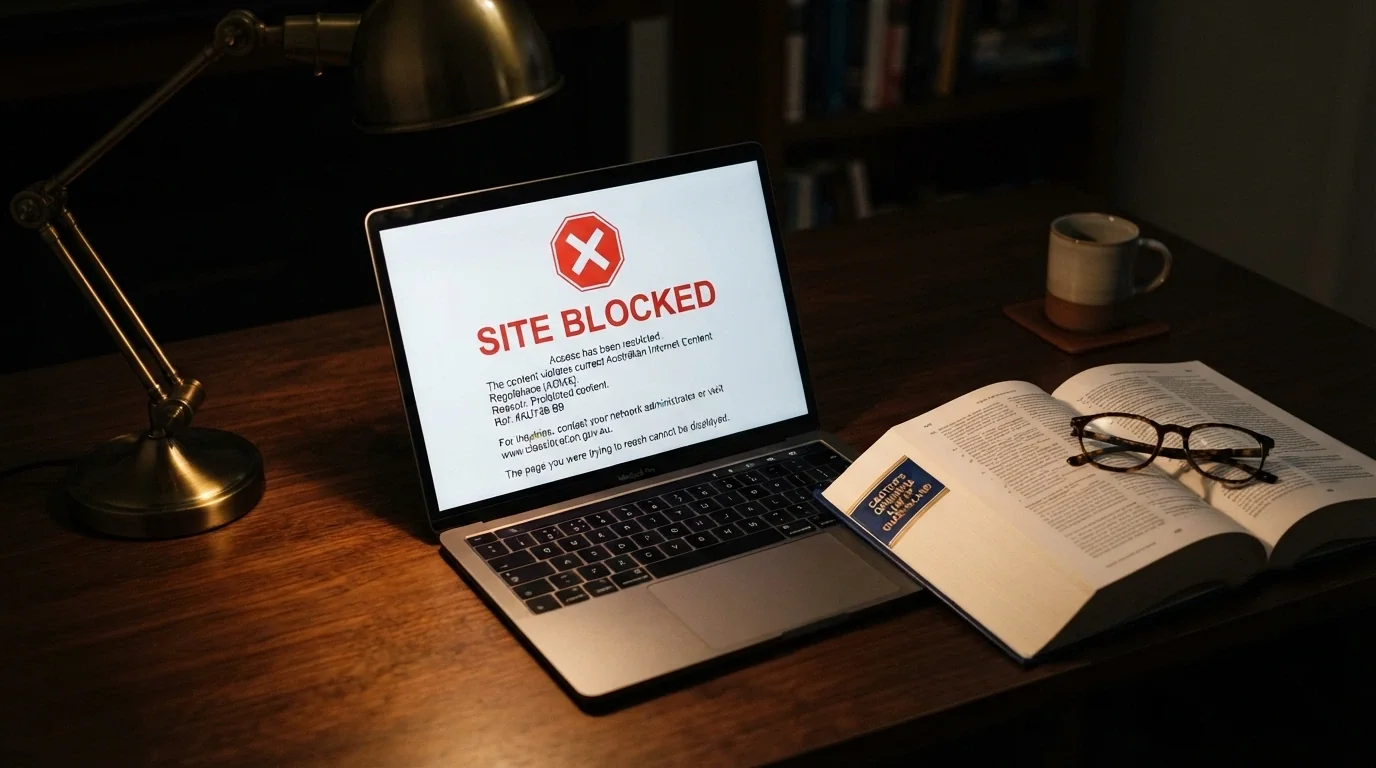
Australian players reach these sites directly. ACMA has been working to make that reach harder: in the April-to-June 2025 quarter alone, the regulator requested blocking action against 73 illegal gambling websites. The blocks are effective for casual users but not for players who know how to work around them.
The 11 June 2024 amendment to the Interactive Gambling Act closed a related gap: from that date, no Australian-licensed wagering operator can legally accept digital currencies, including SOL, as a payment method. The amendment does not stop an Australian player from sending SOL to an offshore wallet — it stops the licensed side from ever processing that SOL in the first place. The licensed AU wagering system is now structurally closed to crypto deposits, which is one of the reasons the offshore crypto casino market in Australia has continued to grow.
The market mechanics matter for the rest of this page. Every bonus number, every wagering multiple, every withdrawal promise that follows is delivered by an operator that has no Australian licence, no statutory obligation under Australian consumer law, and no obligation to honour its published terms if it chooses not to. That is the context the comparison sits inside.
The Best Solana Casinos We Reviewed for Australian Players in 2026
Ten offshore casinos sit in the comparison set. Every one of them accepts SOL from Australian players, every one of them is unlicensed for AU online casino use (the legal section below covers why), and every one of them was assessed against the same five-criteria framework: licence transparency, published bonus terms, payout speed, game range, and the availability of any AU-facing terms at all.
The featured set, ranked by the weight given to licence transparency and bonus terms, looks like this:
| Operator | Licence Status |
|---|---|
| Stake | Unlicensed (Offshore) |
| Bizzo Casino | Unlicensed (Offshore) |
| Casino Rocket | Unlicensed (Offshore) |
| Lucky Block | Unlicensed (Offshore) |
| CoinCasino | Unlicensed (Offshore) |
| Mega Dice | Unlicensed (Offshore) |
| Skycrown | Unlicensed (Offshore) |
| Royal Reels | Unlicensed (Offshore) |
| WinSpirit | Unlicensed (Offshore) |
| Rainbet | Unlicensed (Offshore) |
There is no licensed-AU alternative to put at the top. The ranking is therefore a ranking among offshore brands, and the differentiation is in the terms, not the regulatory cover.
Stake
Stake is the biggest headline in the set — a ‘200% welcome match up to $3,000’ against a 30-day clearing window — and it sits behind a 40x wagering requirement on the bonus. Forty times three thousand is $120,000 in required turnover, which is what a player actually has to run through the bonus-eligible games before any of the bonus balance becomes withdrawable.
That $120,000 figure is where the analytical work has to start. Using a midpoint RTP of 96% — Pragmatic Play, the dominant studio at Stake, runs at 95.5 to 96.5% — the expected cost of clearing the bonus is the turnover multiplied by the house edge. That is $120,000 times four per cent, or $4,800. That figure is the average the house keeps from a player who grinds the bonus through to completion across many sessions and many spins — a statistical estimate, not a guaranteed outcome for any single player. The advertised bonus pays out $3,000 on a successful clear. The expected cost is roughly $4,800. The bonus is a negative-expected-value proposition for the player by design, as every casino welcome offer is — but the size of the loss is not obvious from the headline.
Beyond the welcome package, Stake supports more than 20 cryptocurrencies including SOL, and runs a weekly reload bonus of 50% up to $500 against a 30x wagering multiple. The reload terms are lighter, the maximum is smaller, and the qualifying turnover sits at fifteen times $500 — $7,500 — for a comparable RTP, an expected cost around $300.
Stake is the right pick for a player who specifically wants the largest welcome package in the set and accepts the real cost of clearing it — an expected $4,800 against a $3,000 headline payout, on average over many spins.
Bizzo Casino
Bizzo runs a smaller welcome package than Stake — 100% up to €100 on the first deposit, expanding to €400 and 150 free spins across a two-deposit structure — but it undercuts Stake on the studio side, with more than 80 game providers reported. For Australian players who care more about game range than headline size, that swap is worth considering. Forty times €100 is €4,000 in required turnover on the first-deposit bonus, with a 14-day validity window that is half of Stake’s. The smaller bonus and shorter validity mean a player either clears quickly or loses the bonus — there is no realistic path of running it through slowly.
Bizzo accepts 22 cryptocurrencies including SOL. The bonus terms are published and clean. For a player who values game variety over bonus size and is happy to play a smaller bonus aggressively, Bizzo is a sensible pick — the trade is breadth of providers for a smaller headline number.
Casino Rocket
Casino Rocket’s headline is the largest in the set: a ‘415% welcome package up to 5 BTC’ plus 200 free spins, split across four separate welcome bonuses. The percentage is huge. The conditions are tighter than any competitor that publishes them — “45x wagering on the bonus amount and on free-spin winnings”, and a 14-day validity window. To put 45x in context, on the equivalent of a 1 BTC bonus at typical BTC prices, a player is looking at a required turnover figure that pushes toward the high five figures in AUD before any bonus funds unlock.
The cashout caps tell the rest of the story. From the reload bonus, “the maximum winnings convertible to withdrawable balance is 5,000 USDT per reload bonus, and 250 USDT per free-spin bonus.”
Casino Rocket is a brand for players who want the largest headline bonus possible and who are willing to grind through tight terms with hard ceilings on what the bonus can pay out. The 14-day validity window means the bonus is realistically only clearable by players who play heavily, and the cashout caps mean a hot free-spin session can disappear into a 250 USDT ceiling.
Lucky Block
Lucky Block markets a ‘200% welcome bonus up to $25,000’ plus 50 free spins. That is by some distance the largest maximum bonus in the featured set. The wagering requirement and validity window are not published in the source material consulted for this comparison — and that absence is the central fact for an Australian player weighing Lucky Block against the rest of the set.
A $25,000 headline bonus with no published wagering multiple is, in practical terms, an offer whose cost cannot be calculated. The expected-loss calculation that runs cleanly for Stake and approximately for Casino Rocket cannot be run for Lucky Block without that input. A player who deposits on the strength of the headline is taking a position with incomplete information.
The headline is the largest in the comparison set. The actual cost is unknown until the small print is read.
CoinCasino
CoinCasino is a crypto-native brand in the featured set whose current bonus terms, wagering requirements, and supported cryptocurrencies were not confirmed in the source material for this comparison. What can be said is that the brand positions itself in the crypto-casino space and is accessible to Australian players.
CoinCasino sits in the comparison as a name, not as an offer. The current terms have to be read on the operator’s page before any comparison to the rest of the set is meaningful.
Mega Dice
Mega Dice differentiates itself through a Telegram-integrated casino model — play is accessible through a Telegram bot rather than only through a conventional web lobby. That positioning is unusual in the comparison set and may matter to a player who values a chat-native interface. AU-facing bonus terms, wagering requirements, and confirmed SOL support were not confirmed in the source material consulted.
For a player who values a Telegram-native interface, Mega Dice has a real differentiator; the comparable terms have to be confirmed directly before any bonus-size comparison with the rest of the set is fair.
Skycrown
Skycrown appears regularly in Australian-facing casino search results and sits in the comparison set as a known offshore brand. No specific bonus terms, wagering requirements, or SOL-specific conditions were confirmed in the source material consulted for this page.
Skycrown has brand recognition in the offshore space; the current SOL offer has to be confirmed before any of that recognition counts as comparable value.
Royal Reels
Royal Reels is a familiar name in Australian-facing casino search. Its Solana-specific terms — bonus structure, wagering requirement, validity window — were not confirmed in the source material consulted for this comparison. The general brand recognition suggests an operator with Australian traffic, but traffic is not the same as terms.
Royal Reels has Australian traffic. Traffic is not terms. The current SOL bonus has to be read directly before this brand enters a comparison on equal footing.
WinSpirit
WinSpirit is an offshore brand in the comparison set whose SOL bonus terms were not confirmed in the source material consulted for this page. Its presence in the set reflects brand visibility rather than confirmed offer value.
WinSpit’s place in the comparison reflects visibility in the offshore market. The offer value itself is not established by the source material used here.
Rainbet
Rainbet rounds out the comparison set as a newer offshore name. No specific SOL bonus terms or wagering requirements were confirmed in the source material consulted. Newer does not mean worse, but it does mean fewer published references for an Australian player to cross-check.
Rainbet’s position at the bottom of the comparison reflects a thinner published footprint, not a judgment on the brand’s quality.
How SOL Deposits and Payouts Actually Work at These Casinos
The SOL token handles the easy half of the journey. Deposits land in seconds, network fees are sub-cent, and there are no minimum network-level transfer limits. The hard half is the casino’s own processing, and the casino is where the timeline actually plays out.
The SOL token and how casino transactions settle
SOL is the native token of the Solana blockchain. Transactions settle in under five seconds on average and the network fee per transaction is in the order of 0.000005 SOL — at typical SOL prices, that comes in under one Australian cent per transfer. By comparison, BTC fees vary with network congestion and ETH fees have historically run several dollars during peak activity. For an Australian player moving modest sums, the difference between SOL and BTC or ETH is the difference between a fee that is invisible and one that is not.
The other network-level advantage is the absence of a minimum transfer. Crypto networks do not enforce minimum transfer limits, which means a player can deposit or withdraw the exact amount of their balance rather than rounding to a wire threshold. Australian players who are used to $20 minimum withdrawals at fast-payout sites will find SOL’s threshold freedom more permissive — most Solana casinos set their own minimums in the 0.1 to 1 SOL range, which at typical SOL prices sits comfortably below the equivalent of $20.
What SOL does not do is bypass the casino. Once the SOL arrives at the casino’s deposit address, the credit is internal to the casino. Once a withdrawal is requested, the casino’s own queue decides when the SOL is signed and broadcast. That queue is the bottleneck the rest of this section covers.
Deposit and withdrawal steps for Australian players
The mechanics of a SOL deposit and withdrawal at an offshore casino are short enough to fit in three steps, with the friction showing up at predictable points.
- Acquire SOL in a self-custody wallet. Australian players typically buy SOL on a local exchange, then withdraw to a self-custody wallet such as Phantom or Solflare. The exchange handles the AUD-to-SOL conversion; the wallet holds the token until the player is ready to deposit.
- Deposit from the wallet to the casino. The casino generates a deposit address. The player sends SOL from their wallet, the transfer confirms on-chain in under five seconds, and the casino credits the balance after a small number of confirmations.
- Withdraw back to the wallet. The player requests a withdrawal at the casino cashier. The casino processes the withdrawal — typically one to twenty-four hours, depending on internal verification — and broadcasts the SOL to the player’s wallet address. Once broadcast, the SOL lands in under a minute.
The on-chain legs of this flow are essentially free in both time and money. The casino-side processing is where the hours come from, and that is also where Know Your Customer checks are most likely to interrupt the flow (covered in the privacy-versus-KYC section below).
Welcome bonuses and reload offers — what depositing with SOL actually unlocks
The headline percentages at these casinos — 200%, 415%, 100% — are eye-catching by design. The wagering multiples are where they stop being eye-catching and start being arithmetic. The table below covers the four operators in the featured set whose published bonus terms were confirmed in the source material for this comparison.
| Operator | Welcome Offer | Wagering Requirement | Validity | Free Spins |
|---|---|---|---|---|
| Stake | 200% up to $3,000 | 40x | 30 days | — |
| Bizzo Casino | 100% up to €100 | 40x | 14 days | 100 |
| Casino Rocket | 415% up to 5 BTC | 45x | 14 days | 200 |
| Lucky Block | 200% up to $25,000 | — | — | 50 |
A few patterns stand out. Wagering requirements in the 40x to 45x range are the market norm for the larger offers, which means a player who accepts a $3,000 bonus is committing to $120,000 of turnover before the bonus clears. At the smaller end of the table, Bizzo’s €400 package carries a 14-day validity that is half of Stake’s, so the bonus is realistically clearable only by players who play heavily and immediately.
Cashout caps matter as much as wagering in some cases. Casino Rocket, the operator with the largest percentage bonus, also carries the tightest caps — 5,000 USDT per reload bonus and 250 USDT per free-spin bonus. A player who hits a large multiplier on a free-spin bonus can see the bulk of the win disappear against the cap.
Reload bonuses at the operators that publish them tend to be lighter on both percentage and wagering. Stake’s weekly reload at 50% up to $500 with 30x wagering is the clearest example in the set — the percentage is smaller, the wagering multiple is smaller, and the implied expected cost is correspondingly lower.
Privacy vs KYC — what you give up for speed
SOL deposits are commonly marketed as anonymous. They are not, in any meaningful sense, at the operators in this comparison.
The deposit stage typically requires no ID — the player sends SOL from their wallet to the casino’s address, and the casino credits the balance. That is as close to anonymous as the journey gets. The withdrawal stage is where Know Your Customer almost always enters the picture. Casinos manually review withdrawals for security and compliance, and at the operators in this comparison that review routinely includes a request for ID documentation before a first withdrawal is approved.
The pattern is consistent across offshore crypto casinos. The deposit rail is permissive by design. The withdrawal rail is gated by the operator’s compliance obligations, which vary by the licence the offshore operator holds (where it holds one) and by the payment partners it works with. For an Australian player, the practical implication is that the privacy advantage of SOL exists at the deposit end and largely evaporates by the time winnings are withdrawn.
There is no anonymous end-to-end SOL casino in this comparison set. The players who think there is one have not yet tried to withdraw.
The Games You Can Play with SOL at These Casinos
The deposit currency does not change the lobby. A player who deposits with SOL at an offshore casino plays the same slots, dice games, and live-dealer tables that any other deposit method unlocks. What differs is the speed of moving money into and out of the lobby, not what is inside it.
That is the right framing for the rest of this section: the games are conventional online casino games, the SOL deposit is a payment rail, and the analytical work is on RTP and volatility, not on the choice of currency.
Slots and pokies at Solana casinos
The slot libraries at the operators in this comparison carry the same studio names Australian players will recognise from licensed international sites — Pragmatic Play, Hacksaw Gaming, Play’n GO, with a long tail of providers. RTP ranges cluster in a tight band: Pragmatic Play sits around 95.5 to 96.5%, Play’n GO around 96 to 96.5%. Crypto-native studios push those numbers slightly higher in individual titles, but the band is the band.
The table below lists the slots with confirmed RTP data in the source material consulted for this comparison.
| Slot Title | Provider | RTP | Volatility | Max Win |
|---|---|---|---|---|
| Wanted Dead or a Wild | Hacksaw Gaming | 96.38% | 4/5 | 12,500x |
| The Crypt | — | 96.05% | High | 27,000x |
| The Crypto | KA Gaming | 96.00% | Medium | 5,000x |
Two patterns are worth noting. The Wanted Dead or a Wild volatility rating of 4 out of 5 sits in the high-volatility end of the spectrum — a player can expect longer losing runs punctuated by larger wins, with a 12,500x maximum ceiling on the headline bonus structure. The Crypt carries an even higher maximum at 27,000x with high volatility, which means even longer quiet stretches between feature hits. The Crypto by KA Gaming is the calmer title in this set at medium volatility and a 5,000x maximum.
For an Australian player choosing a slot, the practical split is between titles like Wanted Dead or a Wild, which demand a bankroll that survives the variance, and titles like The Crypto, which give back more frequently and pay less dramatically. The crypto-casino feature that genuinely helps here is on-chain provability of RTP — Hacksaw publishes its RTP and the result can in principle be audited by the player — but the underlying math is the same math.
Dice, crash games and instant-win titles
Crash games and dice are the casino formats most native to the crypto-gambling audience, and they appear across the operators in this comparison. The mechanics are simple — a multiplier climbs, the player decides when to cash out, and the game ends either at the cash-out or at the bust — and the appeal is the speed of decision and the verifiable fairness of the outcome.
Provably fair is the relevant technical claim. Crypto casinos publish a server seed, a client seed, and a nonce for each round, and the player can verify after the fact that the result was generated from those inputs. That is a genuine improvement over the closed-box RNG of a conventional online casino. It does not change the house edge of any individual game.
No per-title RTP or house-edge figure for crash or dice games was confirmed in the source material consulted for this comparison. The general pattern across crypto casinos is a 1 to 4% house edge on dice and similar bands on crash, but those numbers are not title-specific and should be confirmed on the operator’s published terms before any player assumes them.
NFT-based games and crypto-native titles
NFT integration in casino gaming has been a marketing theme since the last cycle. In practice at the operators in this comparison, NFT-native casino games are not yet a meaningful share of the lobby. A handful of titles have NFT-tinged bonus mechanics or provably-on-chain payout structures, but the bulk of any operator’s game count is still conventional slots, live dealer tables and the crash-and-dice formats covered above.
For an Australian player, NFT casino games are a marketing layer rather than a product category worth choosing on. The marketing will continue to push them. The actual gameplay and the underlying RTP look much like the rest of the lobby.
The Legal Reality of Playing at Solana Casinos from Australia
This section is the part of the comparison the marketing pages skip. The Interactive Gambling Act 2001 prohibits online casino and online pokies in Australia. The 2024 amendment that took effect on 11 June 2024 extended that prohibition to digital currencies as a payment method for licensed wagering. From 1 January 2027, Australian banks and payment providers gain express authority to block transactions to illegal gambling operators.
Every Solana casino in this comparison sits inside that framework. None of them is licensed for Australian online casino use, and none of them can be.
What the Interactive Gambling Act actually says
The Interactive Gambling Act 2001 prohibits the provision of banned online gambling services to people in Australia. The prohibited services are online casinos, online pokies and in-play online sports betting. The Act targets the provider, not the individual player — which is why offshore operators can still reach Australian screens without their customers committing an offence under the Act itself.
The 2024 amendment that took effect on 11 June 2024 closed a payment-rail gap. Before that date, a licensed Australian wagering provider could in principle accept digital currencies. The amendment removed that option. From 11 June 2024, no Australian-licensed wagering operator can legally process a SOL deposit or any other digital-currency payment.
The Interactive Gambling Amendment (Gambling Reform) Bill 2026 passed on 19 August 2026 and commences on 1 January 2027. The bill extends advertising and inducement restrictions around sign-up windows and BetStop deregistration, and — relevant to the payment corridor — gives banks and payment providers express authority to block transactions to illegal operators. Until 1 January 2027, that authority exists informally. After that date, it is on the statute.
The implication for the comparison set is direct. The operators in this ranking will be harder to pay from Australia after 1 January 2027 than they are now, because the payment infrastructure that currently reaches them can be cut off at the bank level. That is not a hypothetical. It is the next scheduled change to the regime.
KYC, identity checks and what they mean for you
The Interactive Gambling Act does not require Australian players to verify their identity before depositing with an offshore casino. The offshore operators do, on their own terms, and almost always at the withdrawal stage.
The typical flow is deposit without ID, play, request withdrawal, then a Know Your Customer review that requests a passport or driver’s licence plus proof of address. Some operators run the review on the first withdrawal only. Others run it again at threshold amounts or when a withdrawal pattern looks unusual. The review is performed by the casino’s own compliance team, sometimes by a third-party verification vendor, and the timeline runs from hours to several days depending on the operator and the documentation provided.
For an Australian player, the practical implication is that the ‘anonymous SOL deposit’ stops being anonymous at the moment winnings are requested. The casino does not need the ID to process the SOL transfer — it can broadcast to any wallet — but it will withhold the withdrawal until the documentation is provided.
This is the second privacy compromise sitting underneath the SOL pitch. The first is the public ledger: SOL transactions are traceable on-chain indefinitely. The second is the KYC queue. Together, they mean an Australian player using an offshore Solana casino has less financial privacy at the withdrawal end than they would using a licensed Australian wagering provider, where the identity is already on file.
Offshore vs licensed — the protections you lose
A licensed Australian wagering provider operates inside a framework that includes a National Self-Exclusion Register, an Australian dispute resolution pathway, and statutory harm-minimisation obligations. None of those protections travel with a player to an offshore Solana casino.
BetStop is the most concrete example. BetStop is Australia’s National Self-Exclusion Register and covers all approximately 150 licensed wagering providers in Australia. Self-exclusion periods range from a minimum of three months up to a lifetime. A BetStop registration blocks the player from every licensed Australian wagering operator. It does not block the player from any offshore operator — there is no mechanism by which an offshore casino would know, and no obligation on the offshore casino to honour an Australian self-exclusion.
The other losses are structural. There is no Australian ombudsman route for disputes with an offshore casino. There is no statutory deposit or stake ceiling that an offshore casino is required to apply. There is no requirement on an offshore casino to publish game RTPs in any particular form or to honour a withdrawal request within any particular timeframe. The published terms are the only terms.
For an Australian player who has decided to play offshore anyway, the practical question is not ‘do I keep my BetStop protection’ (no, that protection is licensed-only) but ‘what is my own self-imposed limit’. The licensed-system tools do not reach the offshore site. The tools the offshore site offers, where it offers any, are voluntary on the operator’s side and enforceable only on the player’s side.
Recent ACMA enforcement and the 2027 payment-blocking powers
ACMA’s enforcement activity has been steady through 2025 and into 2026. The regulator requested blocking action against 73 illegal gambling websites in the April-to-June 2025 quarter alone. The blocks are directed at Australian ISPs and work for casual users; they do not stop a player who knows how to change DNS settings or use a VPN.
What changes in 2027 is the payment corridor. From 1 January 2027, banks and payment providers in Australia have express statutory authority to block transactions to illegal gambling operators. The technology for that is not new — Australian banks have long had the discretion to decline suspicious transactions — but the statutory cover is. The practical effect is that a SOL deposit funded from an Australian bank account, exchange, or card may be declined or reversed when the payment is identified as flowing to an illegal gambling operator.
For an Australian player using SOL at an offshore casino, the 2027 payment-blocking powers are a stronger constraint than ACMA’s website blocks. Website blocks work against casual access. Payment blocks work against actually funding the account. The combination of the two, and the rising enforcement tempo underneath both, is the trajectory the legal section of this comparison is on.
Staying in Control When Playing at Offshore Solana Casinos
Offshore casinos are not bound by Australian harm-minimisation rules. The responsible-gambling tools they offer, where they offer any, are voluntary on the operator’s side and enforceable only on the player’s side. The Australian support services still apply to anyone in the country, regardless of where the gambling took place, and that is where the safety net lives.
Deposit limits, self-exclusion and the tools offshore casinos offer
Offshore crypto casinos vary widely on the responsible-gambling tools they publish. The set that appears most often looks like this:
- Deposit limits — a player-imposed daily, weekly or monthly cap on the amount that can be funded into the casino account. Usually set in the account settings and adjusted downward immediately, upward after a cooling-off period.
- Session time reminders — pop-up or email notifications at fixed intervals during play. Common at most major operators; inconsistently implemented at smaller ones.
- Time-out periods — short self-exclusion windows of 24 hours to several weeks during which the account cannot be accessed.
- Longer self-exclusion — six months to several years, sometimes permanent, through the operator’s own exclusion programme. Not connected to BetStop and not enforced outside the operator’s own platform.
- Reality checks — periodic balance-versus-time displays that show the player how long they have been in session and what their net position is.
The enforceability gap is the central fact. A deposit limit set at an offshore casino is enforced by the operator’s own software. If the player disputes a withdrawal or feels the limit was not applied, the dispute resolution pathway is whatever the operator publishes — there is no Australian ombudsman, no statutory regulator, and no escalation beyond the casino’s own terms. The tool works only as long as the operator chooses to honour it.
The honest summary for an Australian player is that offshore responsible-gambling tools are better than nothing and worse than the licensed-AU equivalent. BetStop covers approximately 150 licensed wagering providers and is enforceable at the network level. The same cannot be said of any offshore casino’s own self-exclusion programme.
Where to get help — Australian support services that still apply
The Australian support services for gambling harm do not depend on where the gambling took place. They are free, confidential and available to anyone in the country.
The National Gambling Helpline is 1800 858 858 and operates 24 hours a day, 7 days a week. It is the front line for anyone whose own gambling, or the gambling of someone close to them, has become a problem. The helpline routes to counselling, peer support and financial advice services in the caller’s state or territory.
Gambling Help Online provides free, confidential support through both phone and online chat. The chat interface is the right starting point for anyone who would rather type than talk. The service is staffed by trained counsellors and operates the same 24/7 coverage as the phone line.
BetStop is the National Self-Exclusion Register and covers all approximately 150 licensed wagering providers in Australia. Self-exclusion periods range from a minimum of three months up to a lifetime. BetStop is the strongest single tool available to an Australian who wants to stop wagering through licensed operators; it does not extend to offshore casinos, and registration with BetStop does not block offshore access on its own.
For an Australian player who has decided to use offshore Solana casinos anyway, the practical recommendation is to register with BetStop for the licensed side, set firm self-imposed limits on the offshore side, and keep the helpline number handy. The tools do not substitute for one another. BetStop is the licensed-wagering lever. The 1800 number is the human lever, available regardless of which platform the harm originated on.
How We Selected and Ranked These Solana Casinos
Every operator in this comparison was assessed against the same five-criteria framework. The criteria, in order of weight, were licence transparency, published bonus terms, payout speed, game range, and the availability of any AU-facing terms at all.
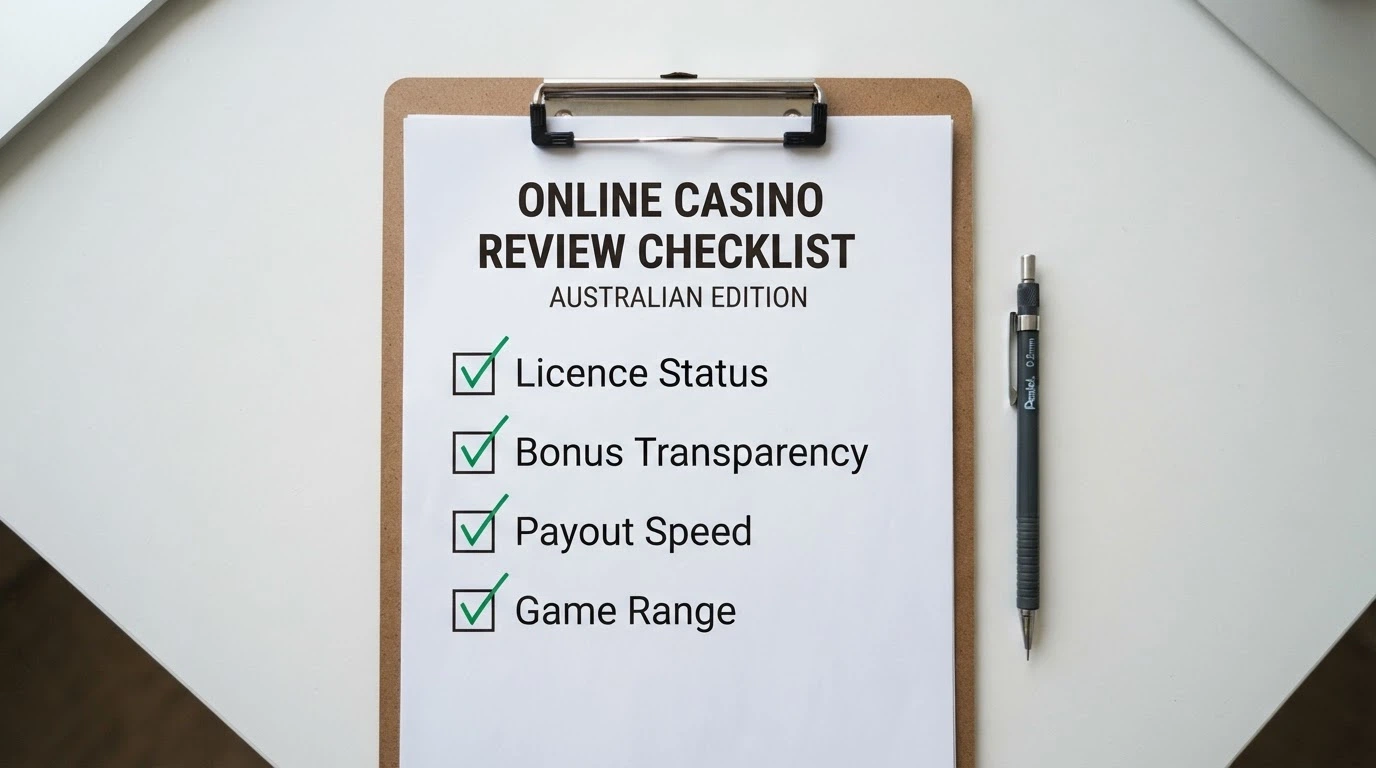
Licence transparency came first because it is the most material fact for an Australian player. Every operator in the set is offshore and unlicensed for AU online casino use — that is the regulatory floor and it is uniform across the set. What varies is how clearly each operator publishes its offshore licence and how visibly that licence is checked against a recognised register. Operators with no published licence, or with a licence that did not surface under any of the consulted sources, were ranked lower on this criterion regardless of how attractive their bonus terms looked.
Published bonus terms came second. A bonus that cannot be read on the operator’s own page is a bonus whose real cost cannot be calculated, and a bonus whose cost cannot be calculated was ranked lower than a smaller bonus whose cost can. The expected-loss calculation in the Stake section is the worked example of what ‘published terms’ makes possible.
Payout speed came third. Where confirmed, the speed data was drawn from multi-platform testing — one outlet’s 43-second on-chain average across fifteen platforms between 15 and 22 January 2026 is the most-cited single figure. Casino-side processing times of one to twenty-four hours were the consistent range across the consulted sources.
Game range came fourth. The set has a wide spread on this criterion, with operators reporting 80+ game studios at the top end and not publishing a number at the bottom end. Game range is rarely the deciding factor for an Australian player comparing offshore casinos, but it is a tie-breaker between operators that match on the three higher-weighted criteria.
AU-facing terms came fifth. The set of operators with no published terms page that addresses Australian players specifically was ranked lower, because the absence of any AU-facing disclosure is itself information.
The consulted sources were the offshore-casino review outlets operating in the Australian market, the operators’ own published terms pages where available, and the ACMA register and enforcement updates for the legal context. Licence-status claims were checked against the ACMA framework. Where research did not surface a specific figure, the gap is reflected in the write-up rather than filled with a fabricated number.
What Australian Players Should Actually Do About Solana Casinos in 2026
The central trade-off of this comparison has been the same on every page. SOL is faster and cheaper than any banking rail that reaches an offshore site, and the offshore site is the only kind of online casino an Australian can reach. The marketing sells the speed. The legal reality sells the rest of the story.
The smart move is to know what is being bought.
For an Australian player who has decided to proceed, the practical checklist is short. Confirm the bonus terms directly on the operator’s page before depositing, because half the set does not publish them in the material used to build this comparison. Read the wagering multiple, the validity window and any cashout cap — those three numbers are the difference between a bonus that is clearable and one that is not. Confirm the SOL wallet address through the operator’s cashier, not through a search result or a support agent, to avoid address-spoofing scams. Withdraw a small test amount before committing a larger balance, so the KYC queue runs once on a small sum rather than on the full winnings.
The case for staying within the licensed Australian wagering system is the one the comparison does not make directly but the rest of this page has made for it. Online casino and online pokies are prohibited in Australia. The licensed alternative is wagering on racing and sport placed before the event, under state and territory licensing. The licensed system has BetStop, has an Australian dispute pathway, has the harm-minimisation obligations that do not travel offshore. The licensed system does not have SOL deposits — the 2024 amendment took that option off the table on 11 June 2024 — and it does not have the offshore casino games at all. What it has, that the offshore casinos do not, is recourse.
From 1 January 2027, the payment corridor tightens. Banks and payment providers gain express authority to block transactions to illegal gambling operators. The SOL deposit funded from an Australian bank account may be declined or reversed when identified as flowing to an illegal operator. The legal landscape of this comparison is moving toward closure, not toward openness, and the operator list of 2026 may look different from the operator list of two years’ time.
The National Gambling Helpline at 1800 858 858 is available 24/7. The line is the same regardless of where the gambling happened. That is the one piece of advice that holds whether the reader plays offshore or does not.
Frequently Asked Questions
Are Solana payments faster than PayID for casino withdrawals?
SOL transfers confirm on-chain in under five seconds with fees usually under one Australian cent. PayID and Osko settle in under a minute to licensed Australian wagering providers — but those rails do not reach offshore casinos. The honest comparison is SOL against bank-wire to an offshore account, where SOL wins by hours or days.
Why do Solana casino withdrawals still take hours if the blockchain confirms in seconds?
Casinos manually review withdrawals for security and compliance, and that review queue — typically one to twenty-four hours — runs after the player requests a withdrawal and before the casino broadcasts the SOL. The blockchain is fast. The operator’s compliance step is the bottleneck, and the KYC documentation request is the most common cause of the longer end of the range.
Can Australian banks block my SOL casino deposits?
From 1 January 2027, yes — banks and payment providers gain express statutory authority to block transactions to illegal gambling operators. SOL sits one step upstream of that authority, funded from an Australian bank account or exchange. Before 2027, the authority exists informally at the bank’s discretion.
Do I have to pay tax on Solana casino winnings in Australia?
No. Gambling winnings are not assessable income for ordinary Australian punters unless the gambling is carried on as a business. The ATO treats recreational gambling, including offshore casino play, as producing no taxable income for the player. Operators pay Point of Consumption Tax where the customer is, not where the licence sits.
What happens if ACMA blocks a Solana casino I use?
ACMA requests blocking action against illegal gambling websites through Australian ISPs. Casual access from Australia is interrupted — the player hits a stop page. A player using a VPN can typically still reach the site. Funds already in the casino account are not automatically confiscated by an ACMA block.