
How Australians Get Paid: Online Casino Withdrawals in 2026
The Australian online casino market in 2026 is not a market in any conventional sense. No licence for online casino exists — not federally, not in any state or territory — because the Interactive Gambling Act 2001 prohibits online casino games, online pokies and in-play betting outright. The result is a search results page that looks like a normal affiliate review, hiding the fact that every brand on it is offshore, unlicensed in Australia, and reachable only because the regulator has not yet blocked it.

Verified against the ACMA register and the Interactive Gambling Act 2001 as of 12 November 2026.
Table of Contents
- Online Casino Gaming in Australia: What the 2026 Landscape Actually Looks Like
- Why “Easy Withdrawal” Means Something Different for Australian Players
- How to Pick a Casino That Pays Out Without the Runaround
- Every Withdrawal Method, Ranked by Real Speed
- Bonuses That Won’t Hold Your Winnings Hostage
- Live Casino Withdrawals: Same Games, Same Delays
- The Law Isn’t on Your Side — And Here’s Exactly Why
- Offshore Casinos Australians Use — Real Withdrawal Times, Ranked
- Staying in Control: Tools That Actually Work
- How We Evaluated Every Casino on This List
- What You Should Do Before You Deposit a Dollar
- Frequently Asked Questions
Online Casino Gaming in Australia: What the 2026 Landscape Actually Looks Like
Every online casino an Australian can find is an offshore operation offering a product the country has prohibited. That is the framing fact the search results bury, and it is the reason a guide to easy withdrawal casinos Australia looks the way it does. The page delivers payment rails and withdrawal timeframes. The licensed market it pretends to rank against does not exist for this product.
The Interactive Gambling Act 2001, as amended most recently by the Interactive Gambling Amendment (Gambling Reform) Bill 2026 which passed Parliament on 19 August 2026 and commences 1 January 2027, makes it illegal to supply Australian players with online casino games, pokies, and in-play betting services. The law targets the provider, not the player — an Australian punter is not prosecuted for using these sites — but that is the only accommodation the framework offers. There is no Australian complaints body the punter can turn to if a withdrawal stalls, no consumer protection statute that covers an offshore operator, no guarantee the site will still resolve when the regulator adds it to the next blocking request.
The Australian Communications and Media Authority has had 1,564 illegal gambling and affiliate websites blocked by Australian ISPs since November 2019, with more than 225 illegal services withdrawing from the market since enforcement was strengthened in 2017. The mechanism is DNS-level: an Australian internet connection cannot reach the site once the ISP implements the order. There is no advance warning, no grace period for players with a balance, and no Australian body with the authority to recover funds from an offshore operator.
The 2026 reform adds teeth. From 1 January 2027, banks and payment providers gain express authority to block transactions to illegal gambling operators. A player who has been using a bank transfer or card to fund an offshore account today may find the route closed in eight months. The reform also caps wagering advertising to three ads per hour between 6:00 am and 8:30 pm, blackouts wagering ads in the 15 minutes before and 5 minutes after a live sporting event, and bars athletes, celebrities and influencers from promoting wagering products at all. The estimated net benefit is A$107.1 million per annum through reductions in gambling-related harm, per the PM&C Impact Analysis.
So the market an Australian punter actually navigates in 2026 is the offshore one. The licence to look for is overseas — most commonly Curaçao eGaming — and the consumer protections are whatever the operator chooses to honour. Withdrawal speed becomes the operational metric by which these operators are judged, and rightly so. The rest of this page is what those speeds actually look like, what they cost, and where the gaps are.
Why “Easy Withdrawal” Means Something Different for Australian Players
“Easy withdrawal” is the marketing word that does the most work on these pages. Strip it back and what the player really wants is a withdrawal that lands when the casino says it will, in the currency they deposited, with no surprise fees or rules attached. For an Australian punter in 2026 that promise lands differently, because the operator is offshore, the licence is foreign, and the rail that moves the money is one the player chose from a list that excludes the AUD-native options the licensed market would have offered.

The hard truth the affiliate pages do not lead with: no casino site is truly instant. Every legitimate operator runs account verification before your first withdrawal. A crypto withdrawal that takes four minutes from a verified account took days the first time — the account verification, not the rail, is the wall most players walk into unprepared.
Withdrawal friction is the offshore market’s defining pain point for one reason the licensed market does not have. AU-licensed wagering operators — the only licensable gambling product in the country — process withdrawals through regulated AUD rails: PayID via Osko on the New Payments Platform, debit cards, BPAY, with state and territory oversight and customer-set deposit limits and activity statements built into the product. An offshore casino offers none of that backdrop. Its payout policy is whatever its terms page says, its approval queue is its own, and the rail it offers is whatever works for an entity operating outside Australian payment rules.
The Difference Between AU-Licensed Wagering and Offshore Casino Withdrawals
The cleanest tell is the payment method. From 11 June 2024, under the Interactive Gambling Amendment (Credit and Other Measures) Act 2023, credit cards, credit-related products and digital currency (crypto) are banned as payment for online wagering in Australia, with penalties up to A$247,500 for non-compliance. An Australian who is asked for a credit card or a crypto deposit by a gambling site is being served by someone outside the Australian rules. The payment method is itself a tell.
The licensed wagering rail runs through PayID and Osko, both built on the New Payments Platform. An Osko transfer moves money between participating Australian bank accounts in under a minute, available 24/7, weekends included. Debit cards work too. BPAY works too. These rails exist because licensed wagering operators — concentrated under the Northern Territory Racing and Wagering Commission — are bound by state and territory conditions that include consumer protection, KYC obligations and dispute resolution pathways. The offshore casino bypasses all of that.
That is why the operator asking for a credit card deposit is the easy test. A licensed wagering operator will not accept one. An offshore casino will, often as the default. The choice of rail is the clearest single signal of which side of the law an operator sits on, and once that signal fires, the rest of the withdrawal experience follows: KYC handled by an offshore compliance team, dispute resolution in whatever jurisdiction the licence names, no BetStop coverage if a player wants to self-exclude, and no Australian complaints body if a withdrawal goes wrong.
How to Pick a Casino That Pays Out Without the Runaround
There is no shortcut here. A withdrawal that arrives in four minutes on Tuesday can take three working days on Wednesday, and the difference is rarely the casino being unfair — it is preparation that was skipped before the first deposit. Four checks run before a dollar leaves the account, and the time spent on them is paid back the first time a cashout is requested.

- Verify the licence. A Curaçao eGaming licence is the most common in the AU-facing offshore market. It does not give the player Australian consumer protection, and it does not bind the operator to BetStop, ACMA complaint handling or any AU dispute resolution body. What it does give is a regulatory address and a published complaints process. Read it. The licence is not a guarantee, but its absence is.
- Check the withdrawal methods the casino actually supports for AUD. PayID is the fastest AUD-native rail when the casino offers it. Crypto is the fastest rail overall. E-wallets work. Debit cards work. Bank transfer works, slowly. A casino that supports crypto and PayID but not a debit card to an Australian bank account is a casino built for offshore rails. Read the payments page before you deposit.
- Confirm the KYC requirements before you deposit. Incomplete KYC is the number-one cause of withdrawal delays, and the casino that demands a fresh utility bill, a selfie holding the ID, and a screenshot of the deposit method the day you request a payout is not playing games — every legitimate operator runs account verification before your first withdrawal. Get the documents in at sign-up.
- Check the weekly and monthly withdrawal caps. A casino with a A$10,000 weekly cap and a A$50,000 monthly cap is a different proposition from one with no published cap at all. A site that disappears after a regulator’s blocking request has no cap that matters; the balance left on it is gone. A site with a published cap has a queue the player can plan around.
These are not recommendations. They are the minimum preparation that turns “easy withdrawal” from a marketing promise into an outcome. The casino matters less than the method and the preparation the player does before depositing.
Real-Money vs Demo Mode: What Changes When Your Own Cash Is on the Line
A demo account is a sandbox. No KYC, no payment rail, no withdrawal pipeline, no approval queue — the player spins and the credits move on screen but no money moves behind it. The real-money account switches all of that on, and the player who learns what an “easy withdrawal casino” actually does by playing in demo mode has learned nothing useful about payouts.
The first withdrawal is where every operator runs its real test. Account verification — ID, proof of address, sometimes a payment method screenshot — happens before any money moves. The casino that approves a verified account in under an hour and routes the payout through PayID or USDT-TRC20 will look very different on the second withdrawal, the one without the KYC wait. The casino that makes the player resubmit documents every time is one to leave. There is no second chance to test the rail before the deposit is committed. A small first deposit, a small first withdrawal, and a look at what the process actually asks for is the cheapest lesson a player can buy.
Every Withdrawal Method, Ranked by Real Speed
The withdrawal method the player picks determines the speed more than the casino does. A casino that approves a verified account in five minutes and routes the payout through USDT-TRC20 will get the player paid in under five minutes from the moment the request hits the queue. The same casino, same approval speed, same player, but a bank transfer instead: one to five business days. The rail is the variable that matters.
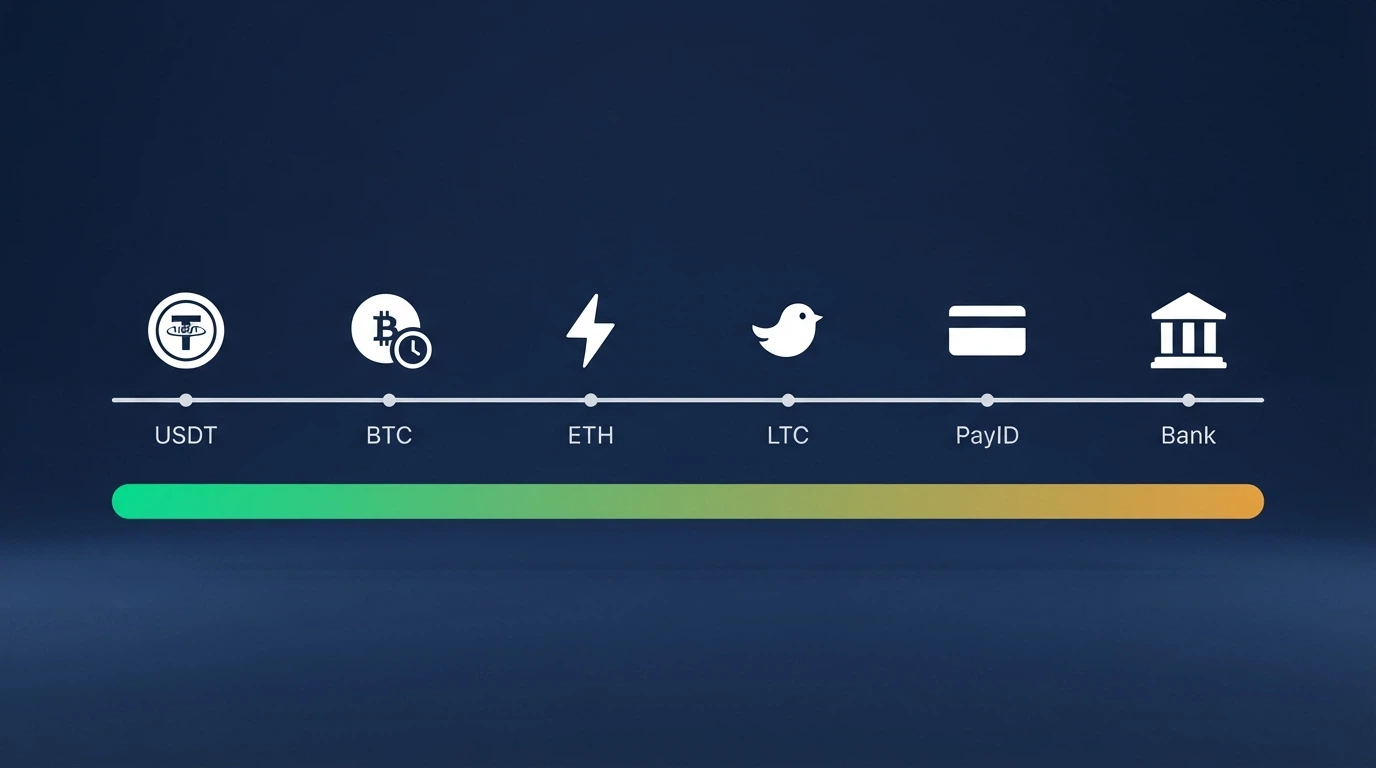
The table below orders the rails by what they actually deliver, with the casino approval queue stripped out so the comparison is rail-versus-rail.
| Method | Typical Processing Time | Fees | Best For |
|---|---|---|---|
| USDT-TRC20 | Under 5 minutes once approved | Near-zero (network fee) | Players comfortable with crypto who want the fastest possible payout |
| Bitcoin (BTC) | 30–60 minutes once approved | Variable, can be A$10+ during congestion | Players already holding BTC who do not mind a slower settlement for a more familiar rail |
| Ethereum (ETH) | 5–30 minutes once approved | Gas fees A$10–A$50 during busy periods | Players prioritising ecosystem support over fee predictability |
| Litecoin (LTC) | Under 30 minutes once approved | Often under A$0.50 | Players who want low fees and a faster confirmation than Bitcoin |
| PayID (Osko/NPP) | Minutes to 24 hours (transfer itself instant) | None from the rail; bank may charge | AUD-native players who do not want to hold crypto |
| Skrill / Neteller | 1–24 hours | Usually none from the e-wallet; some casinos charge | Players who already use an e-wallet and want a familiar buffer |
| Debit / credit card | 2–5 business days | None typically; some banks charge cash advance fees | Players with no other option, or those paying off a known card balance |
| Bank transfer | 1–5 business days | Possible intermediary fees | Large withdrawals where the rail’s daily limits are not a constraint |
Crypto is the fastest rail by a margin, and within crypto USDT on the TRC-20 network is the standout — under five minutes once approved, near-zero fees, available at the offshore operators that accept it. Bitcoin is the slowest of the major cryptos because of its three-to-six-block confirmation requirement. Ethereum is faster on settlement but unpredictable on fees. Litecoin is the low-cost fallback for players who want crypto speed without the Bitcoin wait.
PayID is the fastest AUD-native rail when an offshore casino offers it, because the Osko transfer itself clears in seconds via the New Payments Platform. The bottleneck is the casino’s own approval queue, not the rail — and that is the universal pattern. Skrill, Neteller and similar e-wallets clear within a day. Cards and bank transfers are the slow lane, taking up to a working week.
Crypto: The Fastest Route to Your Money
Crypto is fast, cheap, and the rail most AU-facing offshore casinos actually prefer — which is exactly why licensed AU wagering operators are banned from accepting it as of 11 June 2024. The speed difference is not subtle. The fastest single test withdrawal across a 217-cashout dataset was 1 minute 40 seconds — USDT-TRC20 from a verified account. Average times cluster in the 2–60 minute band once the casino has approved the payout, which is the rail’s promise: not instantaneous, but on a clock the player can read.
USDT on TRC-20 (the Tron network) is the standout option. Settles in under five minutes, network fee is near-zero, and the rail does not congest the way Ethereum does during peak demand. Bitcoin is the slowest of the major cryptocurrencies because it requires three to six block confirmations, which lands at 30–60 minutes under normal conditions and longer when the mempool is busy. Ethereum is faster on settlement — 5–30 minutes — but its gas fees can run A$10–A$50 per transaction during periods of network congestion, which is a hidden cost the rail does not advertise. Litecoin is the low-cost fallback, with transaction costs often under A$0.50 and confirmation times that sit comfortably under half an hour.
The constraint the player should know before choosing this rail: an Australian-licensed wagering operator cannot accept crypto. An offshore casino accepting it is, by definition, operating outside the AU payment rules that govern licensed wagering. That is not a problem for the rail itself — USDT-TRC20 does not care which country’s laws the casino is breaking — but it is the same operator profile that brings every other risk the AU framework is designed to address. There is no BetStop coverage on these sites. There is no ACMA dispute path. There is no guarantee the site will not be on the next ACMA blocking request.
PayID: The Best AUD-Native Option — When the Casino Supports It
PayID is the rail Australians already use. It runs on the New Payments Platform, with Osko transfers clearing between participating bank accounts in seconds, 24/7. For an Australian punter who does not want to hold crypto, PayID is the fastest path from a casino balance to a domestic bank account — provided the casino offers it.
The transfer itself is instant. The bottleneck, every time, is the casino’s approval queue. One operator, tested across 14 PayID withdrawals by an independent reviewer, averaged 9 minutes end-to-end — meaning the casino approved the payout and the Osko transfer cleared in under ten minutes. The fastest single PayID withdrawal on that operator was 4 minutes. Those numbers come from an automated queue that processes verified accounts under a published threshold without manual review, and they are not typical. Most offshore casinos that offer PayID do so as one option among many, with approval times that drift into the hours when the queue is busy.
Not every offshore casino offers PayID. Those that do usually cap the PayID withdrawal well below the bank’s daily transfer limit, and a player who needs to move A$15,000 in one hit will find PayID capped, bank transfer offered instead, and the clock reset to a working week. PayID is the best AUD-native option for withdrawals up to the casino’s per-transaction cap. Above that, the rail drops to bank transfer.
E-Wallets, Cards and Bank Transfers: The Slow Lane
Skrill and Neteller clear withdrawals in 1–24 hours, which makes them a meaningful step up from cards and bank transfers while staying well behind crypto and PayID. The e-wallet adds a buffer the player controls: the casino pays the e-wallet, the player holds the balance in the e-wallet, and the move from e-wallet to bank account happens on the player’s schedule. The downside is the cost of the buffer — fees on the e-wallet side, fees on the conversion side if the casino pays in a currency other than AUD, and an extra step that delays the payout.
Cards take 2–5 business days. Bank transfers take 1–5 business days. Both move money through traditional rails that do not have a 24/7 settlement layer underneath them, and both run on banking hours that close the queue at 5 pm on a Friday. A player who requests a bank transfer at 4 pm on a Friday will not see the money move until Monday or Tuesday, with another day or two to land depending on the receiving bank. Cards are marginally faster because the card rails are tighter, but a card withdrawal at an offshore casino is also the rail most likely to draw attention from the bank’s fraud team — and from January 2027, banks gain express authority to block transactions to illegal gambling operators.
The slow lane is not wrong. It is the right rail for a large withdrawal where the per-transaction cap on PayID or crypto is the constraint, or for a player who wants the bank statement to record the transaction. It is the wrong rail for a player who wants their money quickly and has chosen a casino that offers faster options.
Why Your Withdrawal Is Stuck: KYC, Pending Periods and the Approval Queue
The casino, not the rail, is usually the delay. The two factors that decide how long a withdrawal actually takes are the operator’s approval queue and the player’s KYC status, and only one of those is outside the player’s control.
KYC — Know Your Customer — is the verification every legitimate operator runs before a first withdrawal. ID, proof of address, sometimes a payment method screenshot. A player who completes KYC at sign-up, before depositing, will skip the queue when the first withdrawal is requested. A player who waits until cashout time is asking for the wall to be built around them. Incomplete KYC is the number-one cause of withdrawal delays at offshore casinos — not because operators are stalling, but because compliance teams cannot release funds to an identity they have not verified. Get the documents in early.
Pending periods are a separate lever. Some casinos impose a 24-to-72-hour hold between a withdrawal request and the approval queue starting. The hold is published in the terms; the player who reads the terms knows it is coming. The casinos that publish “automated withdrawals for verified accounts under a threshold” — one operator tested ran this for accounts under A$2,000 — skip the hold for that cohort, and the result is the 9-minute PayID average cited above. Most cashouts at that operator skip manual review entirely. The player who wants this experience looks for the automation, not the brand name.
The single most effective move a player can make: complete KYC at sign-up, choose a casino with an automated approval queue for verified accounts, and pick a rail that suits the size of the cashout. Everything else is detail.
Bonuses That Won’t Hold Your Winnings Hostage
A bonus that takes six weeks of wagering to clear makes “easy withdrawal” meaningless — the cash is on the casino’s terms until the turnover is done, and the player who chases the headline figure spends the bonus clearing it. The wagering requirement is the real withdrawal blocker, and the math on what a bonus actually costs the player is not what the marketing page shows.
The expected-loss calculation is what the marketing page does not run. A no-deposit bonus of AU$20 — the representative mid-range figure from the AU-facing market — with a 40x wagering requirement means the player must turn over AU$800 before any of the bonus becomes withdrawable. Assuming the player wagers only the bonus amount across that turnover (the standard assumption for bonus cost calculations), at a 96.42% RTP — the platform average across 50 sampled pokies at one Curaçao-licensed AU-facing operator, the only independently measured figure in this guide — the house edge is 3.58%. Expected loss on AU$800 turnover is AU$28.64. The player is paying AU$28.64 in expected losses to clear a AU$20 bonus, before any max cashout cap is applied. This is a statistical estimate over many spins, not a guaranteed outcome for any single session — and it is the arithmetic behind every “free” offer on this market.
The wagering multiple is the other number that decides whether a bonus is worth claiming. No-deposit free spin wagering in the AU market runs from 30x to 50x; deposit-linked spins sit lower, typically 25x to 40x. The bigger the bonus, the bigger the turnover hurdle. A AU$5,000 welcome package with a 40x wagering requirement is AU$200,000 of turnover before a dollar becomes withdrawable, and the expected loss along the way is what the offer actually costs.
Deposit-Linked Bonuses: Bigger Offer, Bigger Wagering Trap
A AU$5,500 welcome package with 125 free spins is the size of offer the AU-facing offshore market uses to compete for sign-ups. The headline figure is contingent on multiple deposits — typically a first deposit match, a second, sometimes a third — and the wagering requirement runs against the combined bonus amount. At a 40x wagering factor, a AU$5,500 package requires AU$220,000 of turnover before any of the bonus becomes withdrawable, and the expected loss on that turnover at a 96.42% RTP is in the order of AU$7,876. The offer is large because the cost of clearing it is larger.
One competitor coverage example: Wolf Winner Casino lists a welcome package up to A$5,500 plus 125 free spins across 1,800+ games from 20+ providers. Another, JustCasino, lists up to A$5,000 plus 400 free spins across 9,500+ games. Both are deposit-linked packages with wagering requirements in the standard AU market band. The size of the games library is not the differentiator — the wagering factor, the max cashout cap, and the game weighting (table games often contribute less than slots) are. A bonus that pays 100% on pokies and 10% on blackjack is a bonus the player clears on pokies, or does not clear at all.
The wagering is the trap. A player who reads the headline figure and skips the terms page has misread the offer. A player who reads the terms page and skips the calculation has mispriced it. The calculation is the only thing that tells the player what the bonus actually costs in expected losses, and the cost is almost always larger than the face value.
No-Deposit Offers: Free Spins With Strings Attached
No-deposit bonuses in the AU-facing market come in two shapes: AU$10–AU$25 bonus cash, or 20–50 free spins. The wagering runs from 35x upward. The free spin stake is often fixed — A$0.10, A$0.20 or A$1.00 total bet equivalent — and the max cashout cap is the rule that decides whether the offer is worth claiming.
The arithmetic on a typical no-deposit bonus: AU$20 bonus cash at 50x wagering is AU$1,000 of turnover. Expected loss on that turnover at a 96.42% RTP is roughly AU$35.80. The player is paying AU$35.80 to clear a AU$20 bonus. A larger AU$50 no-deposit offer typically carries a max cashout cap of AU$50–AU$100 — the player cannot withdraw more than that regardless of how much they win — and a 35x+ wagering requirement that has to be cleared in a tight window.
A worked example from one AU-facing operator: 20 free spins no deposit on account verification, 10 awarded after phone verification and 10 after email verification, 50x wagering, 24-hour expiry. The free spins themselves may produce a small win — the exact figure depends on the game and the stake per spin — but the wagering must be completed within 24 hours, and any winnings are subject to the max cashout cap. A player who reads the terms before starting the clock knows what they are agreeing to. A player who finds the expiry in the small print has lost the bonus and the winnings with it.
No-deposit offers are not free. They are small marketing budgets dressed up as gifts, with the math already loaded against the player. The expected loss calculation, run honestly, says so.
Live Casino Withdrawals: Same Games, Same Delays
A live dealer table at an offshore casino does not get a faster payout lane than a slot machine. The withdrawal pipeline runs through the same payment rails, the same KYC checks, the same approval queue, and the same bank or crypto processor. Whether the player spent the session on blackjack, roulette, baccarat or a game show, the payout rules are the casino’s, not the table’s.
The implication for a player choosing between game types is straightforward: game choice has no effect on withdrawal speed. The variable that decides how fast the money lands is the payment method, and the method is the same across the lobby. A live casino specialist who has been promised “instant withdrawals on live games” is being sold a rail that exists on the payments page, not a privilege granted to live tables.
Live dealer availability at the AU-facing offshore set is standard — virtually every featured operator on this page runs live tables — but the table count, the provider mix and the operating hours vary by brand. None of those variations change the withdrawal experience. The KYC requirement fires on the first cashout regardless of which game the player spent the session on, and the approval queue processes the payout on the same schedule either way.
The Law Isn’t on Your Side — And Here’s Exactly Why
Online casino is prohibited in Australia. Every operator on this page is offshore, unlicensed in Australia, and operating outside the consumer protection framework the country applies to its own wagering operators. That is the framing fact this page does not soften, and it changes what a withdrawal dispute looks like, what a self-exclusion covers, and what an enforcement action means for a balance left on the site.
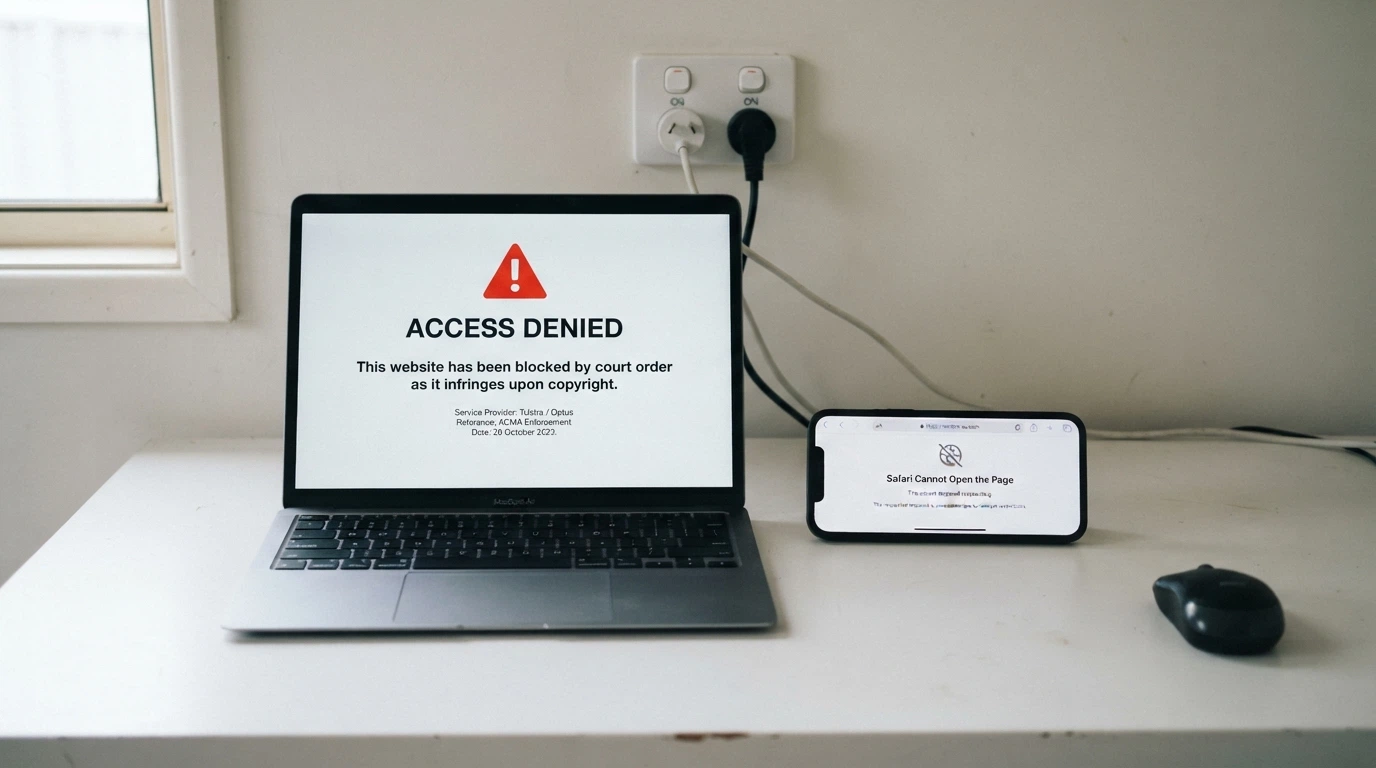
The Interactive Gambling Act 2001 prohibits the supply of online casino games, online pokies and in-play betting to anyone in Australia. The act was strengthened by amendments in 2017 that gave the ACMA its blocking and enforcement powers, and most recently by the Interactive Gambling Amendment (Gambling Reform) Bill 2026 which passed Parliament on 19 August 2026 and commences 1 January 2027. The individual player is not prosecuted — the act targets the provider. But the player is the one left with no Australian complaints body to approach when an offshore operator refuses a withdrawal, no Australian consumer protection statute to cite, and no Australian enforcement action that can recover funds.
What an Australian player gives up by playing offshore is the list the licensed market exists to provide. ACMA cannot recover a player’s money from an offshore operator — the regulator blocks sites, pursues civil penalties, and refers matters to the police, but it is not a dispute resolution service for individual players. BetStop, the National Self-Exclusion Register, does not cover offshore casinos — it binds Australian-licensed wagering services only. The state and territory gambling regulators do not have jurisdiction over a Curaçao-licensed entity operating outside Australian borders. The DNS-level blocking power ACMA has used since November 2019 can hit the site at any time, with no advance warning, and a balance left on it has no Australian recovery path.
The Interactive Gambling Act: What It Bans, What It Doesn’t, and Who It Targets
The IGA prohibits online casino games, online pokies and in-play betting on a sporting event once it has started. Permitted and licensable services under state and territory oversight include pre-event wagering on races and sport, lotteries and keno — concentrated under the Northern Territory Racing and Wagering Commission administered through Licensing NT, the de facto national licensor for online wagering, with licence terms of up to 20 years. The minimum age for any commercial gambling in Australia is 18.
The enforcement model targets the provider. The ACMA investigates complaints, issues formal warnings, pursues civil penalty proceedings, refers operators to the police, and — since the 2017 amendment — directs ISPs to block illegal sites at the DNS level. Providing a prohibited interactive gambling service to a person in Australia is illegal, and the ACMA pursues it. The 1,564 sites blocked since November 2019 and the 225+ services that have withdrawn from the market since 2017 are the visible record of that pursuit. The invisible record is the operators still accessible from an Australian connection because the next blocking request has not yet landed.
The IGA does not name the player as the target. An Australian punter using an offshore casino is not committing an offence. That is the limit of the protection the framework offers. The licensed product the IGA does permit — wagering on races and sport with operators like the major NT-licensed bookmakers — comes with consumer protection, KYC obligations, deposit limits, activity statements and BetStop coverage that the offshore product does not. The player who chooses offshore trades those for whatever the offshore operator chooses to honour.
The 2026 Reform: What Changes on 1 January 2027
The Interactive Gambling Amendment (Gambling Reform) Bill 2026 is law with a fixed start date. It passed Parliament on 19 August 2026 and its measures commence 1 January 2027 — three days into the new year, and a meaningful date for every offshore casino reachable from an Australian connection. The reform reshapes the offshore playing field from three directions at once.
Banks and payment providers gain express authority to block transactions to illegal gambling operators. A player funding an offshore account through a domestic bank transfer today may find the route closed on 2 January 2027. The reform’s advertising caps are tighter still: no more than three wagering ads per hour between 6:00 am and 8:30 pm on broadcast television, with a complete blackout from 15 minutes before a live sporting event until 5 minutes after it ends. Radio ads are barred during school times. Online ads are limited to logged-in, age-confirmed users with an opt-out mechanism. Broadcast odds are banned outright. Ads in venues and on uniforms are prohibited. Athletes, celebrities and influencers are barred from promoting wagering products entirely.
The inducement marketing restrictions are the third front. From 1 January 2027, direct marketing of inducements is prohibited for 14 days after a customer signs up with a licensed operator, for three months after a person deregisters from BetStop, and indefinitely for customers identified as at risk. The reform’s estimated net benefit is A$107.1 million per annum through reductions in gambling-related harm, per the PM&C Impact Analysis — a figure that captures the value of the rules the offshore market is not subject to, because the offshore market is not licensed in the first place.
For a player using an offshore casino in 2026, the reform’s practical effects will arrive in two waves. The advertising caps change what the licensed operators can say, not what the offshore operators can do — the offshore operators are already operating outside the regime. The bank transaction blocking authority is the more direct consequence: a player who has been moving money through a domestic bank account to an offshore casino may find the transfer declined starting in January. The casino is still reachable. The funding route may not be.
ACMA Site Blocking: What It Means for Your Balance
The ACMA’s blocking power operates at the DNS level. When the regulator directs an Australian ISP to block a site, the site becomes unreachable from an Australian internet connection. There is no advance warning to players. There is no grace period to withdraw a balance. There is no Australian body with the authority to recover funds from an offshore operator on a player’s behalf.
The 1,564 sites blocked since November 2019 and the 225+ services that have withdrawn from the market since 2017 are not abstract numbers. They are operators Australians reached, used, and lost access to. A blocked site with a balance on it is a real scenario that has played out over a thousand times, and the only practical lesson from it is to choose operators with a published track record, to withdraw winnings promptly, and to understand that no offshore casino is immune from the next blocking request.
ACMA’s role is enforcement, not dispute resolution. The regulator investigates, warns, blocks and pursues civil penalties. It does not chase balances. It does not mediate withdrawal disputes. It does not guarantee that an operator it has not yet blocked will pay out tomorrow. An Australian player who has a withdrawal complaint against an offshore casino has, in practical terms, no Australian recourse beyond the operator’s own complaints process and whatever licence jurisdiction the operator operates under.
Offshore Casinos Australians Use — Real Withdrawal Times, Ranked
Ten offshore operators are listed below in the priority-set order they appear across the AU-facing review set, with the AU legal status confirmed against the Interactive Gambling Act 2001 and market position drawn from publicly available market-share data. Where independent withdrawal testing has been published, the figures are cited. Where it has not, the gap is marked — a casino whose payout speed is unverified is not the same as a casino whose payout speed is fast.

| Operator | AU Legal Status | Market Share Rank | Revenue (AUD) |
|---|---|---|---|
| SkyCrown | Offshore — Curaçao eGaming | — | — |
| Rocket Play | Offshore — licence not confirmed | #3 | A$632.69M |
| Royal Reels | Offshore — licence not confirmed | #9 | A$243.99M |
| Stake | Offshore — Curaçao | #12 | A$115.67M |
| WinSpirit | Offshore — licence not confirmed | #11 | A$110.3M |
| Fair Go | Offshore — Curaçao | #16 | A$69.11M |
| Rainbet | Offshore — licence not confirmed | #13 | A$83.13M |
| Scream Casino | Offshore — licence not confirmed | #14 | A$94.87M |
| Bizzo Casino | Offshore — Curaçao | #19 | A$51.38M |
| Rocket Casino | Offshore — licence not confirmed | #20 | A$43.22M |
Every operator on this list is offshore and unlicensed in Australia. None holds an Australian casino licence — no such licence can exist. Market share rank is provided as a signal of operator presence, not of payout reliability; the two are not the same thing. Withdrawal data below is sourced from independent testing where available, marked as unverified where it is not.
SkyCrown
SkyCrown is the most thoroughly tested operator in this set. Independent testing across 14 PayID withdrawals recorded an average payout time of 9 minutes, with the fastest single withdrawal at 4 minutes. Across 12 USDT-TRC20 crypto withdrawals the average was 4 minutes. The casino runs an automated withdrawal queue for verified accounts under A$2,000 — most cashouts skip manual review entirely — with a published weekly withdrawal cap of A$10,000.
The platform is Curaçao-licensed, runs 60+ game providers, and an independently measured platform RTP of 96.42% across 50 sampled pokies sits at the higher end of the offshore market. For an Australian player prioritising payout speed, this is the strongest evidence in the set: not a claimed timeframe, but a tested one, with the methodology published. The verdict for a player who values verified speed over brand familiarity: SkyCrown is the operator to anchor a comparison against.
Rocket Play
Rocket Play holds a 9.4% share of the AU market, with A$632.69M in revenue, marking it as a significant presence for players seeking an established name. Details on its licence jurisdiction and independent withdrawal performance remain unverified in current research.
The verdict for a player prioritizing market share: Rocket Play’s popularity reflects its reach, not guaranteed speed. A larger footprint doesn’t equate to faster cashouts. If verified withdrawal times are your priority, SkyCrown is the benchmark; Rocket Play is for those who prefer the largest operator by share, despite the lack of independent performance data.
Royal Reels
Royal Reels accounts for a 2.51% market share, generating A$243.99M in revenue. Information regarding its specific licence status and payout benchmarks was unavailable during this assessment. The operator occupies a mid-market position, offering neither dominance nor tested data to guide expectations.
The verdict for a player considering Royal Reels against the rest of the set: market presence at this level is not a payout signal. Royal Reels is one to test with a small first deposit and a small first withdrawal — the way a careful player tests any operator whose payout data has not yet been independently verified.
Stake
Stake is Curaçao-licensed and crypto-native, which is the operator’s defining feature and the reason it appears in the AU-facing set. AskGamblers verified crypto withdrawals at 1–4 hours — slower than the fastest crypto operators in this set, but consistent. Stake ranks twelfth in AU market share at 1.28%, with A$115.67M in revenue. No PayID or AUD-native rail was confirmed in the research for this guide.
The verdict for a player who values crypto-native design over AUD rails: Stake is the established crypto brand in the AU-facing set, with verified payout data, a Curaçao licence, and a platform built around the crypto rails rather than adapted to them. The 1–4 hour crypto window is slower than SkyCrown’s 4-minute average. The trade is a more familiar crypto product and a larger player base.
WinSpirit
WinSpirit holds a 1.55% market share, with A$110.3M in revenue. Its licence and withdrawal speed details have not been independently confirmed. WinSpirit maintains an upper-mid-market profile, visible in search results but lacking the transparency of tested operators.
The verdict for a player considering WinSpirit: market presence here is not an endorsement of speed or reliability. If you are already accustomed to the platform, proceed with the caution of a small initial test to verify performance yourself.
Fair Go
Fair Go is Curaçao-licensed, RTG-focused — RealTime Gaming is the dominant provider, which shapes the lobby — and one of the more transparent operators in the set about its withdrawal terms. The minimum withdrawal is A$100, the highest published minimum in the set. Crypto withdrawals (BTC, ETH, LTC) process during business hours and typically arrive in 15–45 minutes; weekends extend that to 2–4 hours. Bank transfers take 24–48 hours. There are no withdrawal fees on crypto transactions beyond standard blockchain network fees.
Fair Go ranks sixteenth in AU market share at 0.8%, with A$69.11M in revenue. The verdict for a player who values published terms over raw speed: Fair Go is the operator to read carefully. The A$100 minimum rules it out for small-balance withdrawals. The RTG focus narrows the games library. Within those constraints, the published crypto window is reasonable, the bank transfer window is reasonable, and the absence of withdrawal fees on crypto is a clean terms page the player can plan around.
Rainbet
Rainbet ranks thirteenth in AU market share at 1.28%, with A$83.13M in revenue. The licence jurisdiction was not confirmed in the research for this guide, and no independent payout speed testing was located. Rainbet sits in the middle of the AU-facing set by market position, with no published evidence on which to judge its withdrawal performance.
The verdict for a player considering Rainbet: the market position is a reach signal, not a payout signal, and a player who values tested withdrawal data should pick from the operators in this set that have it. The same small-deposit, small-withdrawal test applies.
Scream Casino
Scream Casino ranks fourteenth in AU market share at 0.99%, with A$94.87M in revenue. The licence jurisdiction was not confirmed in the research for this guide, and no independent payout speed testing was located. Scream sits in the middle of the AU-facing set by market position, present without a verified withdrawal story to point to.
The verdict for a player considering Scream Casino: no tested data, no confirmed licence, market presence at the lower-middle of the set. A player who has used Scream before and trusts the product can continue. A player shopping on verified payout data has better options in this set.
Bizzo Casino
Bizzo Casino is Curaçao-licensed, with Neteller withdrawals clearing in 0–24 hours per independent reviewer testing. The interesting finding is that PayID is slower on the same platform — a confirmation that even within one casino the payment method dictates the speed, not the operator. Bizzo ranks nineteenth in AU market share at 0.57%, with A$51.38M in revenue.
The verdict for a player who prefers e-wallets: Bizzo provides a verified Neteller withdrawal timeframe. Comparisons on this site highlight that the payment rail, not the casino’s queue, is the primary driver of payout speed. If you prioritize PayID or crypto, other options in this guide will be faster; if you are already a Neteller user, this remains a tested route.
Rocket Casino
Rocket Casino ranks twentieth in AU market share at 0.57%, with A$43.22M in revenue. The licence jurisdiction was not confirmed in the research for this guide, and no independent payout speed testing was located. Rocket Casino sits at the lower end of the AU-facing set by market position, with no published evidence on which to judge its withdrawal performance.
The verdict for a player considering Rocket Casino: the smallest operator in the set by market position, with no tested payout data and no confirmed licence. A player who has used it before and trusts the product can continue. A player shopping on verified data has better-tested options above it in this set.
Staying in Control: Tools That Actually Work
The offshore market has no BetStop coverage, no mandated deposit limits, and no AU consumer protection. Some offshore operators offer deposit limits, session time limits and reality-check tools voluntarily — but they are not required to, and the player should not assume they are in place. The tools that do work are the ones the player puts in place before a session starts, and the help lines that exist independently of any casino.

About 2.1% of Australian adults — roughly 430,000 people — experience problem gambling, with the Australian Institute of Health and Welfare putting high-risk gambling at 1.8% in 2022. Those numbers describe the population the responsible-gambling tools are designed for, and they describe the population that benefits most from setting limits before a session starts rather than after a loss.
Self-Exclusion and Help Resources That Actually Cover You
BetStop — the National Self-Exclusion Register — has 67,480 registrations as at 31 July 2026, with 41,290 exclusions still active. Seventy-eight per cent of registrants were under 40; thirty-eight per cent chose lifetime exclusion. One registration excludes a person from every Australian-licensed online and phone wagering service in a single step, with self-exclusion periods ranging from a minimum of 3 months to a lifetime.
BetStop covers approximately 150 licensed wagering providers in Australia. It does not cover offshore casinos. The single most concrete harm of the offshore route is that an Australian player who has registered with BetStop and self-excluded from every licensed wagering operator can still open an account at any offshore casino in this guide, because BetStop is not connected to those operators. The offshore operator has its own self-exclusion mechanism, often buried in the responsible gambling page, and the player who has self-excluded from licensed wagering should know that the offshore account is not covered.
The help lines that do cover the player are the ones run by the states and territories and funded federally. The National Gambling Helpline — 1800 858 858 — is free, confidential and staffed 24 hours a day, 7 days a week. Gambling Help Online runs 24/7 online chat and counselling. These services are independent of any casino, licensed or offshore, and they exist for the player who needs help before, during or after a session.
Setting Limits Before You Need Them
Deposit limits, session time limits and reality-check tools are the first line of defence. A player who sets a deposit limit at sign-up, before any money is committed, has built the wall in the right place. A player who sets the limit after a loss is building it behind the problem.
AU-licensed wagering operators offer customer-set deposit limits and activity statements under state and territory conditions that differ between jurisdictions. The licensed market is built around these tools. The offshore market is not. Some offshore operators offer deposit limits and session timers as a voluntary feature; many do not. The player who wants the limit in place should set it with the operator if the operator offers it, and should treat the absence of the option as a signal about the operator’s priorities.
The right moment to set a limit is at sign-up. The right amount is the amount the player can afford to lose and walk away from. The right response to a session that has crossed the limit is to stop, not to raise the cap. The help lines in the section above are the resource for any player who finds the limits they set are not enough.
How We Evaluated Every Casino on This List
The operators in this guide were drawn from the AU-facing affiliate review set, in the priority-set order those reviews present them. AU legal status was verified against the Interactive Gambling Act 2001 — every operator on the list is offshore, because no online casino licence exists in Australia — and against the ACMA register for current blocking status. Withdrawal data was drawn from independent testing where available: Slotspeak.net for SkyCrown’s PayID and crypto performance, AskGamblers for Stake’s crypto window, Casiwpto.com for Fair Go’s published terms, Oceanroadmagazine.com.au for Bizzo’s Neteller performance. Where independent testing was not available, the gap is marked in the operator write-up.
Market position was drawn from publicly available operators skill data, providing market share rank and revenue figures for each operator in the top-20 AU dataset. Where an operator does not appear in that dataset, the gap is marked. Licence jurisdictions were drawn from the operator’s own published terms page where confirmed; where not confirmed in the research for this guide, the gap is marked. Payment methods, minimum withdrawals and withdrawal caps were drawn from the same sources, with no figure presented without a source.
What this guide did not do is independently test every operator in the set. Independent withdrawal testing exists for a small number of brands, and the rest are presented with their market position as the only signal. A player who needs verified payout data should read the operator write-ups with that in mind. A player who needs the operator with the largest AU market presence has the market share data to choose from. Neither signal substitutes for a small first deposit and a small first withdrawal at any operator the player has not used before.
What You Should Do Before You Deposit a Dollar
Four steps that take ten minutes before a deposit save days of waiting when the time comes to cash out. The order matters.

Verify KYC at sign-up. Complete the identity verification, the address verification and the payment method verification before any money is deposited. Incomplete KYC is the number-one cause of withdrawal delays, and the casino that demands a fresh utility bill and a selfie holding the ID the day the payout is requested is not playing games — every legitimate operator runs account verification before the first withdrawal. Get the documents in early, and the first withdrawal skips the wall.
Check the withdrawal methods and caps before depositing. Read the payments page. Note the minimum withdrawal, the per-transaction cap and the weekly cap. A casino with a A$100 minimum rules out small-balance cashouts. A casino with a A$10,000 weekly cap is fine for most players and a constraint for high-rollers. A casino with no published cap has no published commitment, and that is its own signal.
Understand that no Australian body can recover money from an offshore operator. ACMA blocks sites; it does not chase balances. The state and territory gambling regulators do not have jurisdiction over a Curaçao-licensed entity. The Australian Competition and Consumer Commission cannot compel an offshore operator to pay. A player with a withdrawal dispute has, in practical terms, no Australian recourse beyond the operator’s own complaints process and whatever licence jurisdiction the operator operates under.
Watch the payment method. A casino asking for a credit card or a crypto deposit is being served by someone outside the Australian rules. From 11 June 2024, an Australian-licensed wagering operator cannot accept either. From 1 January 2027, an Australian bank has express authority to block the transaction to an illegal gambling operator outright. The payment method is the tell, and it is the test that takes ten seconds to run.
The conclusion the page’s evidence supports: the operator the player picks matters less than the method and the preparation done before depositing. The fastest rail — USDT-TRC20 — does not help a player who has not completed KYC. The largest welcome package — A$5,500 with 125 free spins — does not help a player who has not read the wagering factor. The most established brand by market share — Rocket Play at 9.4% — does not help a player who has not tested the withdrawal with a small first cashout. The four steps above are what turn “easy withdrawal” from a marketing word into an outcome.
Frequently Asked Questions
Are instant withdrawal casinos in Australia actually instant?
No casino site is truly instant. Every legitimate operator runs account verification before a first withdrawal, adding hours or days to the first payout. Once approved, the fastest routes are USDT-TRC20 in under five minutes and PayID via Osko, where the transfer itself clears in seconds. “Instant” describes the rail, not the operator.
Can I use crypto to withdraw from an online casino in Australia?
Yes — at every offshore casino on this page. Crypto withdrawals settle in 2 to 60 minutes once approved, with USDT-TRC20 the fastest. The catch: from 11 June 2024, credit cards and crypto are banned for online wagering in Australia, so any casino accepting crypto is outside the AU rules.
What is the minimum withdrawal amount at Australian online casinos?
It varies by operator. Fair Go publishes a A$100 minimum, the highest confirmed figure. Most offshore operators sit lower, in the A$20–A$50 range for crypto and PayID. The minimum applies per withdrawal, not per transaction, and a player below the threshold rolls the balance forward to the next cashout.
Do fast payout casinos charge withdrawal fees?
Most do not on crypto and PayID. The blockchain network fee is the only crypto cost — near-zero on USDT-TRC20, variable on Bitcoin and Ethereum, under A$0.50 on Litecoin. E-wallets sometimes charge a fee on the player’s side. Where the casino adds its own fee, it appears in the cashier page before the withdrawal.
What happens to my money if an offshore casino gets blocked in Australia?
The site becomes unreachable from an Australian internet connection at the DNS level. There is no advance warning, no grace period, and no Australian body that can recover funds from an offshore operator. ACMA has had 1,564 sites blocked since November 2019. Withdraw promptly and do not leave a balance on an unblocked site.
Does BetStop cover offshore casino sites?
No. BetStop binds Australian-licensed wagering services only — about 150 of them — and every operator on this page is offshore, not connected to the register. A player self-excluded from licensed wagering can still open an offshore account. The Helpline on 1800 858 858 is the 24/7 resource that covers the offshore route.