
What a $5 Deposit at an Offshore Casino Actually Buys an Australian Player — and What It Costs
A $5 minimum deposit at an online casino is the smallest real-money floor most offshore brands publish, and the threshold has become a kind of shorthand. Cheap to try, low commitment, easy walk-away. For an Australian player, the figure is also a marker for something else. Every casino that accepts a $5 AUD deposit from a person on Australian soil operates without an Australian licence. The Interactive Gambling Act 2001 makes that plain. There is no state or territory licence for online casino anywhere in the country, and no federal one either. The ten brands you are about to read about all sit on the other side of that line.

That does not make the offers worthless, and it does not make them safe. It means the picture needs reading differently. The first half of this page walks through what a $5 deposit actually buys in play-time and game access. The second half walks through the legal, regulatory and payment infrastructure around it. Both halves matter, and the page does not pull its punches about either.
Current as of 29 October 2026 and checked against the ACMA register, the Interactive Gambling Act 2001 and the Independent Gambling Authority’s published findings on the Australian market.
Table of Contents
- What a $5 Minimum Deposit Casino Actually Means for Australian Players
- The Offshore Brands Accepting $5 AUD from Australian Players — Ranked by Market Reach
- Rocket Play
- Skycrown
- Royal Reels
- Stake
- WinSpirit
- Rainbet
- Scream Casino
- FairGO
- Bizzo Casino
- Rocket Casino
- How Your $5 Gets In — and Back Out: Payment Methods That Work from Australia
- What a $5 Bankroll Actually Plays: Pokies, Table Games and the Small-Stake Reality
- $5 Deposit Play on Your Phone: Browsers, Apps and the Mobile Experience
- New $5 Deposit Casinos: Fresh Brands, Same Offshore Reality
- Why No $5 Deposit Casino Holds an Australian Licence — and What That Costs the Player
- Staying in Control When the Safety Net Doesn’t Reach Offshore
- How We Evaluated These $5 Minimum Deposit Casinos
- Is a $5 Deposit Worth It? What the Facts Say You Should Weigh
- Frequently Asked Questions
What a $5 Minimum Deposit Casino Actually Means for Australian Players
The $5 Threshold — What It Buys and What It Does Not
Five Australian dollars is not a bankroll. It is a ticket. The distinction matters because most players searching for a “$5 deposit casino” are not really shopping for a stake of $5. They are shopping for the smallest possible commitment that still gives them real-money play.
At minimum pokie bets of ten cents a spin, $5 buys fifty spins. At twenty cents, twenty-five. At fifty cents, ten. The session length is short in every case, and a bad variance run on a fifty-spin sample is the more common outcome than a good one. Pokies are built to entertain at volume, and $5 is not volume. It is a test drive. The player pays the casino’s minimum transaction cost in exchange for the experience of real-money play, not in exchange for a meaningful shot at a payout.
That is not a complaint. The $5 floor serves a real function. It is the deposit a curious player makes to see whether a casino’s software runs on their device, whether their payment method clears, whether the cashier UI is clean, and whether they trust the brand enough to return with more. Many $5 deposits are written off in the player’s mental ledger before the first spin lands. The brands that thrive at this end of the market know it. Their welcome packages are designed to convert curious first-timers into repeat depositors, not to entertain a five-dollar balance for a week.
The math the player should hold in mind: a $5 deposit, at any reasonable bet size, is roughly one to two minutes of full-attention play at standard spin speeds. After that, the balance is gone or close to it. The expectation of walking away ahead on a $5 session is the marketing version of the truth. The arithmetic version is that the house takes its edge on every spin, and a fifty-spin sample is far too small for variance to deliver the kind of swing that turns a $5 into a withdrawal.
Real-Money Play at the $5 Floor — AUD, Pokies and What “Real Money” Means
“Real money” at a $5 deposit casino means actual Australian dollars at stake, not play-money credits or demo-mode chips. Every spin wagered against the $5 balance carries the same mathematical expectation as a spin wagered against a $500 balance. The denomination is smaller. The house edge is the same.
This is where the AUD part earns its weight. Australians who deposit $5 are not converting into Bitcoin, tethering to a stablecoin, or accepting a USD balance calculated at a fluctuating exchange rate. They are putting five Australian dollars into an offshore cashier and getting five Australian dollars back out, in theory. Whether the cashier actually credits in AUD, whether withdrawals clear in AUD, and whether the cashier imposes a conversion fee on either side, is a per-brand question that the player should answer on the cashier page before the first deposit clears.
There is a tax consideration that does not apply at the $5 level but applies to anything the player withdraws. Gambling winnings are not assessable income for ordinary Australian punters. Section 6-5 of the ITAA 1997 carves them out, and section 8-1 blocks the offset of losses against other income. A $5 session that turns into a $5,000 withdrawal still does not need to be declared on a tax return. The ATO does not collect from the player. The ATO collects from the operator, and that is a different conversation.
What the $5 floor actually changes is the player’s willingness to absorb a bad session. At $5, a player who runs out of money in two minutes has lost what they would have spent on a coffee. At $500, the same session is a rent payment. The real-money mechanics are identical. The felt impact is not. That asymmetry is why the $5 deposit exists as a marketing product, and why the house edges are identical at every level.
Every $5 Deposit Casino Is Offshore — There Is No Australian One
The headline of this page could not be plainer. The Interactive Gambling Act 2001 makes it an offence to provide online casino games, online pokies or in-play sports betting to a person in Australia. The 2017 amendment closed the offshore loopholes the original Act left exposed and gave the ACMA the power to direct ISPs to block illegal services. The minimum age for any commercial gambling in Australia is 18, but the IGA does not only address age. It addresses the product itself, and the product is banned.
What is licensed in Australia is narrower than most newcomers expect. Wagering on horse races, harness races, greyhound races and sporting events, placed before the event begins, is licensed through state and territory regulators, with the Northern Territory Racing and Wagering Commission acting as the de facto national licensor for online wagering operators. Lotteries and keno are licensed too. Online casino and online pokies are not licensed in any jurisdiction in the country. There is no licence class for them. There is no fee schedule. There is no application form.
The consequence is mechanical, and it is the same for every brand on this page. The brand is licensed somewhere. It is not licensed in Australia. The brand accepts Australian players. The brand’s licence does not give it any standing under Australian consumer law. The brand operates in AUD for the convenience of deposits and withdrawals. The brand is still offshore.
For the player, the practical consequences are four. No BetStop coverage — the National Self-Exclusion Register binds Australian-licensed wagering services, and an offshore casino is not connected. No Australian consumer protection — a refused withdrawal, a voided bonus, a closed account cannot be appealed to an Australian complaints body, because no Australian body has jurisdiction over the brand. No recourse if the site is blocked with a balance on it — the ACMA has had 1,564 illegal gambling and affiliate sites blocked by Australian ISPs as of March 2026, and a blocked domain is a domain the player cannot reach to withdraw from. No guaranteed access — from 1 January 2027, banks gain new blocking powers for transactions to illegal gambling operators, and the offshore casino reachable by PayID today may not be reachable by PayID next year.
The IGA does not prosecute the player. The Act targets the provider, and the ACMA’s enforcement record shows it. The player does not go to jail for spinning a pokie at an offshore casino. The offshore casino gets blocked. That is a meaningful difference. The legal exposure falls on the operator, not on the player. It is not, however, a safety net. A player blocked from accessing a brand with a balance on the brand has not been prosecuted, but they have also not been paid.
That distinction — not prosecuted, but also not protected — is the spine of this page.
The Offshore Brands Accepting $5 AUD from Australian Players — Ranked by Market Reach
The ten brands below are ordered by their independently tracked share of Australian gambling traffic. The figures come from the same dataset, which means the percentages are comparable across rows, but they should not be read as endorsements. A few notes before the table.
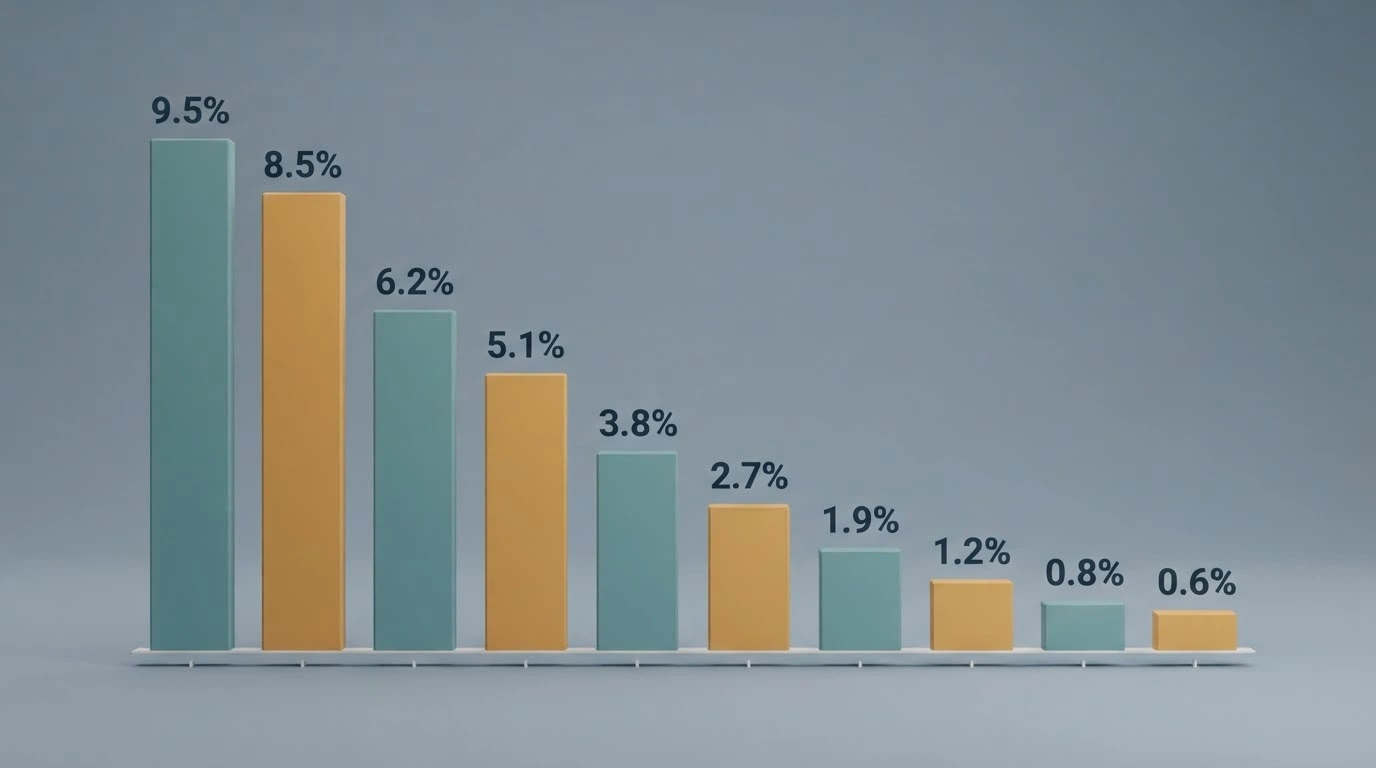
The market-share figures measure Australian player traffic to each brand — how much of the country’s gambling-related browsing lands on each operator’s site. They do not measure player satisfaction, payout speed, bonus generosity, game quality or safety. A brand with high traffic has high traffic because the marketing is working, the affiliate deals are landing, and Australian players are clicking through. That is a real signal. It is not a quality verdict. The ranking below tells a player where the AU audience is going, not where the AU audience should go.
Every operator in the table is offshore. Every operator in the table accepts Australian players without holding an Australian licence. The Offshore Status column exists so the reader does not have to scan ten rows and reach the same conclusion ten times.
| Operator | AU Market Share | AU Revenue AUD | Offshore Status |
|---|---|---|---|
| Rocket Play | 9.4% | $632.69M | Offshore — no AU licence |
| Skycrown | 8.55% | $436.07M | Offshore — no AU licence |
| Royal Reels | 2.51% | $243.99M | Offshore — no AU licence |
| Stake | 1.28% | $115.67M | Offshore — no AU licence |
| WinSpirit | 1.55% | $110.3M | Offshore — no AU licence |
| Rainbet | 1.28% | $83.13M | Offshore — no AU licence |
| Scream Casino | 0.99% | $94.87M | Offshore — no AU licence |
| FairGO | 0.8% | $69.11M | Offshore — no AU licence |
| Bizzo Casino | 0.57% | $51.38M | Offshore — no AU licence |
| Rocket Casino | 0.57% | — | Offshore — no AU licence |
Two rows sit at 0.57%. Bizzo carries a confirmed revenue figure; Rocket Casino does not. One row sits above this set in the wider Australian market — Sportsbet, at 19.57% with $1.13 billion in revenue — but Sportsbet is an Australian-licensed wagering operator, not a casino. It does not accept $5 casino deposits and does not belong on this list.
The distribution itself is more telling than any single percentage. The top two brands, Rocket Play and Skycrown, together carry close to 18% of tracked Australian gambling traffic, which means the top of the offshore market is not fragmented. It is concentrated. The long tail from WinSpirit down to Rocket Casino is where the differentiation actually lives, because each of those brands is fighting for the same marginal player.
How We Ordered These Ten Brands — and What the Numbers Do Not Say
The ranking above is built on a single dimension: tracked Australian traffic share. The dataset behind it sees a sample of Australian users browsing gambling domains and records where they land. That is a marketing signal, not a regulatory rating, and not a player-protection score. A brand with 9.4% AU market share has 9.4% of the AU audience’s clicks. It does not necessarily have 9.4% of the AU audience’s trust.
What the numbers do say is consistent. The ten brands here are not an arbitrary shortlist. They are the brands Australian players actually visit, ranked by how much of the country’s gambling traffic goes to each one. A player looking for “where are other Australians playing” gets a real answer.
What the numbers do not say is the part that matters more. They do not say which operator pays out fastest. They do not say which bonus carries the lightest wagering requirement. They do not say which cashier charges the smallest conversion fee. They do not say which site runs on a Curaçao licence versus a Kahnawake licence versus a regulator with a real enforcement function. Those questions belong to a different ranking, on a different page. The ranking here answers the one question the data can answer cleanly: where the AU audience goes.
And the universal fact that overrides every column in the table: no operator here holds an Australian casino licence. No operator here can. The licence class does not exist. The player should treat every row as a brand operating offshore, with the consequences that flow from that fact.
Rocket Play
Rocket Play carries the largest share of tracked Australian gambling traffic among offshore casino brands, at 9.4%, with $632.69 million in tracked revenue. That revenue figure is the highest in the ranking by a wide margin. The next brand down, Skycrown, sits at $436.07 million. Rocket Play is not just the AU traffic leader. It is the AU revenue leader by a factor of roughly one-and-a-half.
A market position that dominant does not happen by accident. The brand has had time to build an affiliate network, to seed Australian-facing content, to refine the welcome-offer package, and to accumulate the deposit and withdrawal volume that makes its cashier infrastructure worth running. The revenue figure suggests the brand is doing all of those things, at scale.
What the revenue figure does not say is where the money came from. A high-revenue offshore casino is, mechanically, a casino that has taken a lot from its players and paid out less than it took. That is the business model. The question is whether the brand runs the model cleanly, paying out what it owes, processing withdrawals in a reasonable time, honouring its bonus terms, and that is not a question the traffic data can answer. The 9.4% market share tells the reader the brand has Australian players in volume. It does not tell the reader whether those players come back or cash out.
For a player choosing where to put their first $5, Rocket Play sits at the top of the traffic ranking for a reason. It is the brand Australians visit most. That is worth knowing. The verdict: Rocket Play is the most-trafficked of the ten, with the revenue scale that comes with that position, and it pays to know the difference between being the biggest and being the safest.
Skycrown
Skycrown holds 8.55% of tracked Australian gambling traffic, with $436.07 million in revenue. It sits roughly one percentage point below Rocket Play on market share and roughly $200 million below on revenue. The gap is meaningful but not categorising. Both are top-tier offshore brands by AU traffic, and both are operating well clear of the rest of the ranking.
The brand has, on the strength of those figures, an Australian-facing product that has been built deliberately. That is not a small thing. Offshore operators vary widely in how much they invest in the Australian market. Some accept Australian players as a passive side-effect of running a global site. Others build payment rails, content and bonus structures specifically for the AU dollar. Skycrown’s revenue figure suggests the second pattern.
Skycrown is the second-largest offshore casino brand by AU traffic, and the same caveats apply as to the leader. The choice between Rocket Play and Skycrown is closer than the traffic figures suggest, and it is the kind of choice that comes down to the cashier terms on the day, not to market-share data from a third-party dataset.
Royal Reels
Royal Reels holds 2.51% of tracked Australian gambling traffic, with $243.99 million in revenue. The brand sits roughly a third of the way down the ranking by market share and roughly halfway by revenue. The revenue figure is what stands out. Royal Reels takes a smaller share of the AU audience than Rocket Play or Skycrown, but it pulls in more revenue per percentage point than either of them.
That can mean different things. A brand can generate higher revenue per visitor by holding players longer, by structuring bonuses that route more deposit into playthrough, by charging conversion fees on cashouts, or by running games with higher house edges. It can also mean the brand has a tighter, higher-value player base that returns more often. The dataset does not separate those readings. The revenue per market-share point is, however, a real number, and Royal Reels sits higher than the leaders on it.
Royal Reels is a mid-tier offshore brand with a material Australian following. For a player choosing where to put a $5 deposit, the brand has enough AU volume to suggest a working cashier and a tested withdrawal process. Those are not nothing. The caveat is the one every brand in this ranking carries: no Australian licence, no BetStop, no Australian complaints body. Royal Reels has earned its AU traffic. Whether that traffic is a quality signal is a separate question, and one the player answers with their own eyes on the terms page.
Stake
Stake carries 1.28% of tracked Australian gambling traffic, with $115.67 million in revenue. The brand is the most globally recognisable name on this ranking, and its AU traffic share understates its international footprint. Stake is a high-volume operation in multiple markets, not an Australia-first brand. The 1.28% AU figure is what remains after the global audience is stripped out, and it is enough to put Stake in the middle of the AU offshore casino ranking.
Stake started as a crypto-native casino, which is worth naming because the Australian payment landscape has moved against that origin. As of 11 June 2024, the use of credit cards, credit-related products, and cryptocurrency is banned for all online wagering in Australia. A crypto-native brand that wants to keep Australian players has had to build a fiat on-ramp, and that is a non-trivial exercise. Whether the brand the AU player encounters at the cashier page is still the crypto-only Stake of a few years ago, or a hybrid product with AUD support, is a per-brand question that the player should answer before depositing.
Compared to the more traditional offshore brands on this page, Stake is the only one with a crypto-native origin. That history shapes what the cashier looks like today, and the offshore caveats apply in full. Stake is not licensed in Australia, BetStop does not reach it, and any complaint about a refused withdrawal is a complaint the player takes to the licence jurisdiction the brand actually operates under, not to an Australian regulator.
WinSpirit
WinSpirit holds 1.55% of tracked Australian gambling traffic, with $110.3 million in revenue. The brand sits one row above Stake in the ranking and one row below Royal Reels, in the mid-tier of the AU offshore casino market. The $110.3 million revenue figure is close to Stake’s $115.67 million, despite WinSpirit carrying a slightly higher market share — a small difference that points to similar per-player economics on both brands.
What the 1.55% figure measures is consistent Australian player interest over the dataset’s tracking window. A brand at this level of AU share has had enough players cycle through to give the cashier, the game integration and the withdrawal process a real workout. The mid-tier is where offshore operators either establish themselves or fail quietly, and WinSpirit is in the established column.
WinSpirit carries enough AU volume to suggest the cashier works, the AU payment rails are in place, and the brand has had enough Australian cycles to test its withdrawal process. That is a baseline, not a recommendation. What WinSpirit actually pays out, and how it handles the borderline case, the player will only see on the cashier terms page.
Rainbet
Rainbet holds 1.28% of tracked Australian gambling traffic, with $83.13 million in revenue. The brand sits in the lower mid-tier of the ranking, alongside Stake on market share but well below on revenue. Rainbet’s per-market-share-point revenue is the lowest of the brands tracked so far. That can mean the brand converts less of its AU traffic into deposits, runs smaller average deposits, or holds players for shorter sessions. It does not have to mean anything about payout speed or bonus generosity.
Rainbet is one of two brands on the ranking tied at 1.28% market share, and the difference between it and Stake, same share, very different revenue, is the kind of detail a player should pay attention to when comparing two brands that look similar on paper.
Rainbet is a lower mid-tier offshore brand with a stable Australian audience. The brand has enough AU traffic to suggest a working product. The lower revenue-per-share-point figure is a data point that asks questions rather than answering them, and the player who wants answers has to read the cashier terms before depositing.
Scream Casino
Scream Casino holds 0.99% of tracked Australian gambling traffic, with $94.87 million in revenue. The brand is the first sub-1% entry in the ranking, and its revenue figure is interesting. Scream Casino takes in more revenue than Rainbet, despite carrying less market share. The same revenue-per-share-point inversion that applied to Royal Reels applies here: Scream Casino is converting more of its smaller AU traffic into revenue than the mid-tier brands above it.
A 0.99% AU share is a niche position. Scream Casino is not a brand an Australian player encounters by accident. The player has to go looking for it, follow an affiliate link, or see it recommended in a comparison piece. That is a smaller volume of inbound clicks, but the players who land are the players who chose to be there.
Scream Casino is a sub-1% brand with a higher revenue-per-share-point ratio than its larger peers. The brand is small, by design or by accident, and a player who values brand recognition should look up the ranking. A player who has already decided to play at a niche offshore casino is looking at a brand that has been running long enough to record a meaningful revenue figure, and that is at least a baseline.
FairGO
FairGO holds 0.8% of tracked Australian gambling traffic, with $69.11 million in revenue. The brand’s name is worth pausing on. “FairGO” is an Australian-English construction. The word “fair go” is a common Australian colloquialism for a reasonable chance or a level playing field. The branding reads as Australian-facing, even though the brand itself is, like every other brand on this page, an offshore operator with no Australian licence. The naming choice is a marketing decision, not a regulatory one.
The 0.8% AU market share and $69.11 million revenue place FairGO in the lower tier of the ranking. The brand has enough Australian traffic to suggest a working product and enough revenue to suggest a functioning cashier, but neither figure is at the scale of the brands above it.
FairGO’s Australian-coded branding contrasts with the offshore reality, and a player who notices the colloquialism should also notice the licence page. A name that reads as Australian does not change the legal position of the brand it describes.
Bizzo Casino
Bizzo Casino holds 0.57% of tracked Australian gambling traffic, with $51.38 million in revenue. The brand sits at the bottom of the ranking alongside Rocket Casino on market share, and its $51.38 million revenue figure is the lowest confirmed number in the table. Bizzo Casino is a small-traffic, small-revenue offshore brand, and the ranking position reflects that.
A 0.57% share is the floor of what an offshore brand can carry and still appear in the ranking. The player traffic to Bizzo Casino is real, but it is thin. The brand has had enough Australian cycles to build a tracked presence, and not enough to push it up the ranking.
A player who picks Bizzo over a higher-ranked brand is doing it for reasons the traffic data does not capture — a specific bonus offer, a game the player wants, a payment rail only this brand supports. Those are reasons. They are not endorsements.
Rocket Casino
Rocket Casino holds 0.57% of tracked Australian gambling traffic, the same market-share figure as Bizzo Casino, and is the final entry in the ranking. The brand’s revenue figure was not separately tracked in the dataset, which is the kind of detail a player should know before drawing conclusions about a brand’s scale.
A 0.57% share ties Rocket Casino with Bizzo Casino at the floor of the ranking. The tie does not mean the brands are equivalent. It means the dataset measures them at the same level of AU player traffic, which is the thinnest slice of the ten brands on the page.
Rocket Casino is the smallest brand in the ranking by AU market share. A brand at this level of AU traffic is one the player has chosen deliberately, not one they have stumbled into, and the choice should be a real one, backed by a bonus offer the player has read, a cashier page the player has checked, and a withdrawal process the player understands before the first $5 clears.
How Your $5 Gets In — and Back Out: Payment Methods That Work from Australia
The payment rails for an Australian player at an offshore casino split cleanly into three groups: the legal rails for licensed wagering, the banned rails for any online gambling, and the rails that exist in practice at offshore casinos but not in any Australian consumer-protection framework. The split is more important than the list of methods. A player who can name which rail they are on, and what law it sits under, is a player who has read the cashier page rather than the bonus page.
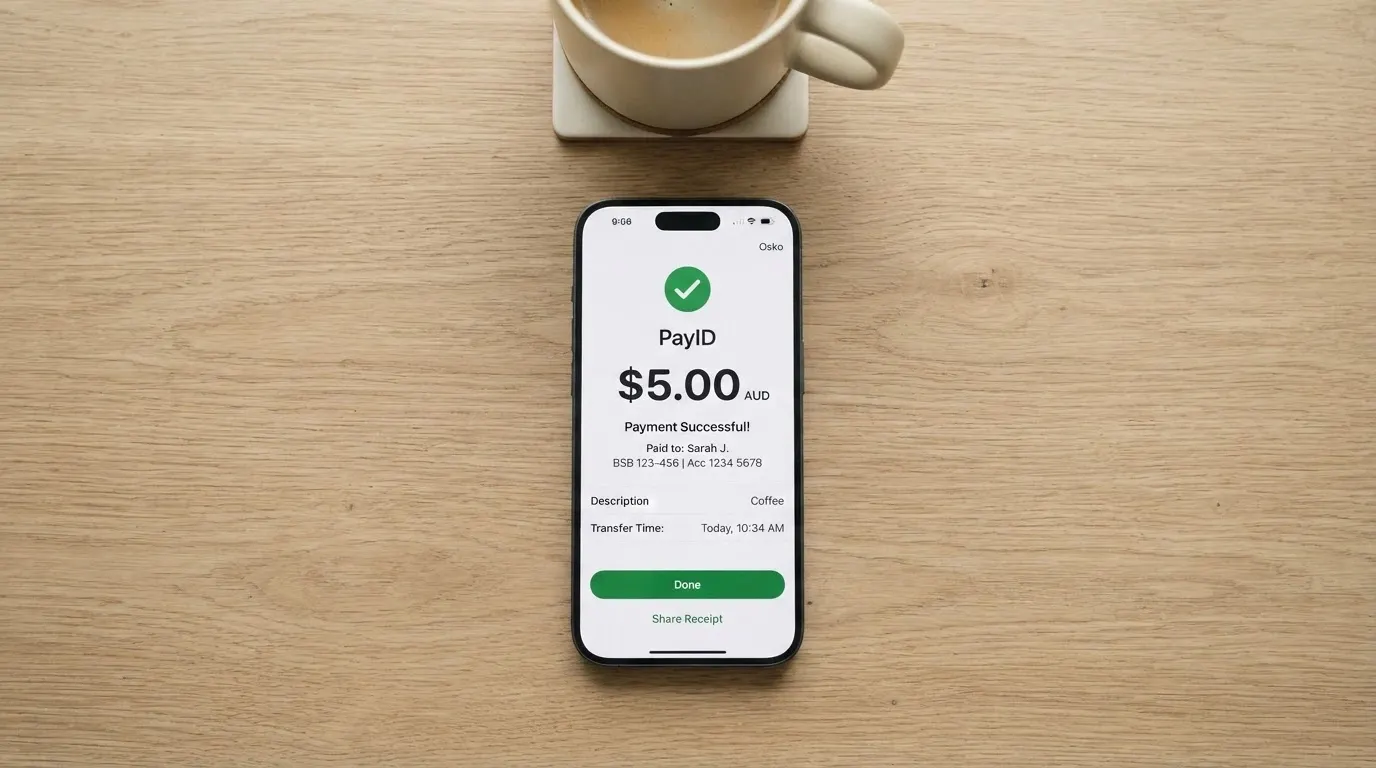
The headline numbers to hold in mind. From 11 June 2024, credit cards, credit-related products and cryptocurrency are banned as payment for online wagering in Australia. An operator that fails to enforce the credit card ban faces penalties of up to $247,500. From 1 January 2027, banks and payment providers gain express authority to block transactions to illegal gambling operators. Those are the rails that are off, the rails that are at risk, and the rails that are on.
| Method | Type | Processing Speed | AU Legal Standing |
|---|---|---|---|
| PayID / Osko | Instant bank transfer | Seconds, 24/7 | Legal for AU-licensed wagering |
| Debit card | Card | Instant to 1 day | Legal for AU-licensed wagering |
| Bank transfer | Direct account transfer | 1–3 business days | Legal for AU-licensed wagering |
| BPAY | Bill payment | 1–3 business days | Legal for AU-licensed wagering |
| Credit card | Card | Instant | Banned for online wagering since 11 June 2024 |
| Cryptocurrency | Digital currency | Variable | Banned for online wagering since 11 June 2024 |
PayID and Osko — The Instant Bank Transfer That Works at the $5 Floor
PayID is the Australian instant bank-transfer system, layered on top of the Osko instant-payment rail operated by BPAY Group. It moves money between Australian bank accounts in seconds, twenty-four hours a day, including weekends and public holidays. For a $5 deposit at an offshore casino, it is the closest thing to an ideal rail. The transfer clears before the cashier page has time to load the next screen, the fees are zero on the consumer side, and the transaction is denominated in AUD.
PayID and Osko are listed among the legal deposit routes for Australian-licensed wagering. The offshore casino accepting a PayID deposit from an Australian player is operating on the same rail an Australian bookmaker uses. The difference is the destination account, not the payment method. The rail itself is fast, cheap, and bank-grade. The brand on the receiving end is the variable.
A $5 deposit suits PayID better than almost any other rail. The transaction is large enough that a wire-transfer fee would be disproportionate, small enough that a card pre-authorisation hold would be a noticeable percentage of the balance, and time-sensitive enough that the player wants to play now, not in three days. PayID clears it. The bank-side confirmation is the receipt.
Whether a specific offshore casino accepts PayID is a per-brand question, and one the player has to answer on the cashier page. The rail is universal in the Australian banking system. The brand’s willingness to expose its receiving account to Australian bank scrutiny, by listing a PayID-enabled BSB and account number on the deposit page, is the variable that decides whether the rail is available. A brand that lists a PayID has chosen to be visible to Australian banks. A brand that does not, has not.
Debit Cards, Bank Transfers and BPAY — The Standard Routes
The three remaining legal deposit rails for Australian-licensed wagering are debit card, bank transfer and BPAY. Each has a different profile at the $5 floor.
Debit card deposits are the most familiar to most players. They process quickly, usually instantly, and carry the lowest friction. The card processor routes the deposit through the merchant account the offshore casino has set up, which may or may not be in AUD. The player’s bank statement records the charge in the currency the processor settled in. A $5 deposit on a debit card can attract a small processor fee, but more often it clears flat. The card processor the brand uses is the variable, and some offshore processors are more transparent about their fees than others.
Bank transfers, meaning direct transfers from an Australian bank account to the casino’s nominated account, are the slowest of the legal rails. The transfer takes one to three business days to clear, and the player who deposits $5 by bank transfer is paying the cost of waiting. The advantage is that a direct transfer avoids the card-processor fee layer entirely, and the player has a bank statement entry that names the receiving account. That visibility is the rail’s value: it makes the transaction auditable on the Australian side.
BPAY is the slowest of the legal rails, but it is also the most familiar to Australian bill-payers. The player logs into their bank, enters the casino’s BPAY biller code and a reference, and the deposit clears in one to three business days. BPAY at the $5 floor is not a great rail. The time cost is high relative to the deposit size. It is available at any brand that lists a BPAY biller code on the cashier page, and that availability is itself a signal about the brand’s Australian-facing infrastructure.
The three rails together cover most of what an Australian player will encounter. The question at each brand is which of the three is exposed on the cashier page, and at what minimum deposit. A $5 deposit sits inside the minimum for all three.
What Is Banned — Credit Cards and Cryptocurrency Since Mid-2024
From 11 June 2024, credit cards, credit-related products and digital currency, meaning cryptocurrency, have been banned as payment for online wagering in Australia. The Interactive Gambling Amendment (Credit and Other Measures) Act 2023 put the ban in place, and the ACMA enforces it through the operators that hold Australian wagering licences. The operator that fails to enforce the ban faces penalties of up to $247,500.
The ban is targeted at licensed wagering operators. An offshore casino is not subject to the ban in the same way. It is not licensed in Australia, and the ACMA does not have jurisdiction over its cashier. The ACMA can direct Australian ISPs to block the brand’s domain, which it has done for 1,564 illegal gambling and affiliate sites as of March 2026, but it cannot directly prevent the brand from accepting a credit card payment from an Australian cardholder. That is the practical gap.
The practical effect for an Australian player is the litmus test. Any gambling site accepting credit cards or cryptocurrency deposits from Australians is, by definition, operating outside Australian rules. A licensed Australian wagering operator cannot offer those rails. The site offering them is either an offshore operator that has chosen to ignore the ban, or a licensed operator that has chosen to break the conditions of its licence. Neither is a brand a player should deposit with.
The credit-card ban is the cleanest signal the Australian market has. The cryptocurrency ban is the second-cleanest. A brand that takes a credit card deposit from an Australian player has decided that the $247,500 penalty, or the ACMA’s enforcement risk, is a cost it is willing to bear. That is information. The player should treat it as such.
Getting Winnings Out — The Withdrawal Path for a Small-Stake Player
Withdrawing from an offshore casino is where the offshore reality shows its teeth. The deposit rails are friction-free because the brand wants the player to deposit. The withdrawal rails are where the brand tests its own rules, and the player discovers whether those rules are favourable.
The standard offshore withdrawal process runs through three steps. First, the player requests a withdrawal from the cashier page, selecting a method. Usually the same method used to deposit, sometimes a different rail for the cash-out. Second, the brand runs an identity check. The player submits a copy of a government ID, a proof of address, and sometimes a copy of the card used to deposit. Third, the brand approves the withdrawal, and the money moves.
The identity check is the step that catches most small-stake players by surprise. The brand does not care whether the player deposited $5 or $5,000 — the verification process is the same. A player who deposited with a PayID may be asked for a bank statement showing the PayID. A player who deposited with a card may be asked for a card photo with the middle digits obscured. The verification is the brand’s anti-fraud layer, and it is the layer that decides whether the player gets the withdrawal.
The offshore reality applies in full. A player who is told the verification has failed has no Australian complaints body to appeal to. A player who is told the bonus terms were not met has no Australian regulator to adjudicate. A player whose account is closed after a withdrawal request has no recourse under Australian consumer law, because the brand is not subject to Australian consumer law. The 1,564 sites blocked by ISPs as of March 2026 are a reminder that this is not a hypothetical. Every blocked site is a domain the player can no longer reach to withdraw from.
The verification step is the player’s only leverage. Submit the requested documents promptly, keep copies, and read the bonus terms before requesting a withdrawal. Bonus terms are where most contested withdrawals get stuck. The brand has more resources than the player. The verification process is where that asymmetry shows.
What a $5 Bankroll Actually Plays: Pokies, Table Games and the Small-Stake Reality
A $5 bankroll at an offshore casino opens the door to pokies, RNG table games, live-dealer tables, and the demo-mode versions of each. What it does not open is a long session at any of them. The game’s job at the $5 level is to give the player a real-money experience of the format. The session’s job is to be over before the house edge compounds into something the player notices.

The games themselves are not exotic. They are the same games an Australian player would find at any offshore casino, denominated in AUD for the cashier’s convenience and run on software the player has seen before. What is exotic is the structural position. Online pokies, online blackjack, online roulette, online baccarat — all of these are provided to Australians exclusively by offshore operators. The Australian-licensed product set is wagering, lotteries and keno. Everything else on the casino floor is offshore.
Pokies at Minimum Bet — What 25 Spins of a $5 Deposit Actually Buys
Pokies at minimum bet are the default destination for a $5 deposit, and the arithmetic is straightforward. At ten cents a spin, $5 buys fifty spins. At twenty cents, twenty-five. At fifty cents, ten. The minimum bet on most AU-facing offshore pokies sits somewhere between ten cents and fifty cents, with twenty cents being the most common floor.
A fifty-spin sample is not enough to test variance. A twenty-five-spin sample is less. A ten-spin sample is barely a glance. The player who puts $5 into a pokie is buying the right to spin, not the right to evaluate the game. They are testing the software, the theme, the bonus-round trigger, the bet-size interface, and whether they enjoy the experience on their device. The session is entertainment at the cost of a coffee, and the expectation of any meaningful payout is the marketing framing of what the math actually does.
The math does what the math does. Pokies have a house edge built into their return-to-player percentage, typically somewhere in the mid-90s for mainstream titles, lower for some jackpot-format games. The house edge compounds on every spin. A fifty-spin sample at a 96% RTP game returns, on average, $4.80 of the $5 wagered. That is the average. The actual outcome on a fifty-spin session is the average plus or minus a variance term that can swing from $0 to $50 and back. Variance is the rule at this stake level, not the exception.
The honest framing for a $5 pokie session: the player is paying for the experience of real-money play, and the bonus terms of any welcome package attached to the deposit are a separate question. The $5 itself is the ticket in. Whether it returns more than $5 to the player is a question the math answers across thousands of spins, not across fifty.
Table Games and Live Dealer at the $5 Floor — What You Can and Cannot Join
Table games at the $5 floor are a different proposition. RNG blackjack and roulette accept bets well below a dollar per hand, and a $5 balance buys a meaningful number of hands — fifty hands of ten-cent blackjack, twenty-five hands of twenty-cent roulette. The minimum bet on most RNG table games sits at the same ten-to-fifty-cent range as pokie minimum bets, and the play experience is comparable in length.
Live dealer is where the $5 floor usually fails. Most live-dealer blackjack, roulette and baccarat tables set minimum bets of $1 to $5 per hand, and the upper end of that range puts a $5 buy-in through a single hand. A player who buys in for $5 at a $5-minimum live blackjack table is one hand from a zero balance. The live-dealer floor is built for stakes the $5 deposit does not reach.
A player who wants a table-game experience at $5 has two paths. The first is RNG table games, which are accessible but lack the social texture of a live dealer. The second is a smaller live-dealer table — some live studios run $1-minimum tables, and the $5 buy-in buys five hands. The player’s choice is between more hands without a dealer, or fewer hands with one. Both are legitimate. Neither is a long session.
The offshore reality applies in full. Every blackjack hand, every roulette spin, every live-dealer baccarat round is run by an offshore provider, on an offshore licence, with offshore house rules. The Australian player does not have an Australian regulator to complain to if the deck feels off. The player has the brand’s own terms page, and their own read of whether the brand is trustworthy. That is the full toolkit.
Demo Mode — Try Before You Deposit a Cent
Demo mode is the under-used tool at the $5 floor. Every reputable offshore casino runs its pokies and table games in a demo or play-money mode that lets a player load the game, spin the reels, and play the hands without risking a real balance. The demo balance is fake. The game mechanics, the bonus triggers, the volatility profile, the RTP — those are the real ones.
A player who is evaluating a brand has the option to load ten games in demo mode, spin each for fifty rounds, and form a view of the software, the themes, and the session experience without depositing a cent. The demo session is the right tool for the evaluation. The $5 deposit is the wrong one.
The $5 deposit is the right tool for the next step, once the player has chosen a brand, decided on a game, and wants to play for real. The order matters. Demo first, deposit second. The player who deposits first and demos second has paid $5 for information the demo would have given them for free.
The offshore reality applies in full. Demo mode is run on the same offshore infrastructure as real-money mode. The game provider is the same. The verification process does not apply in demo mode, which is one of its advantages. The player should treat demo mode as a real test of the brand’s software, not as a different product, because the brand’s product is the only thing the demo can show.
$5 Deposit Play on Your Phone: Browsers, Apps and the Mobile Experience
The mobile experience at an offshore $5 deposit casino is, in almost every case, the desktop experience resized. The browser is the same. The cashier is the same. The games are the same. The difference is the screen, the input method, and the player’s patience for a small UI.

What is rare is the native app. Most offshore casino brands do not maintain a dedicated iOS or Android app for the Australian market, because the App Store and Google Play restrictions on real-money gambling apps are tight, and the work-around of distributing an app through a brand’s own website is fragile and brand-damaging when it fails. The mobile experience at almost every brand on this ranking runs in a browser, not an app.
Mobile Browser vs Casino App — What Australian Players Actually Get
The browser-based mobile casino is the dominant format at offshore casinos, and the format is good enough that most players do not notice the absence of an app. The cashier loads in a mobile browser. The pokies run in HTML5. The live-dealer stream plays through the browser’s video stack. The verification upload accepts a photo from the phone’s camera. The withdrawal request works the same way it does on desktop.
The experience that does not translate perfectly is the multi-window workflow. A player who likes to have a cashier tab open, a pokie tab open, and the live-dealer stream in a third window finds the mobile browser limiting. The player who plays one game at a time, which is the common pattern at the $5 floor, finds the mobile browser perfectly adequate.
A dedicated casino app, where one exists, is usually a wrapper around the mobile website — a thin native shell that loads the same HTML5 games in a WebView, with the app’s icon on the home screen and a slightly faster launch. The player does not get a different game experience. The player gets a slightly faster launch.
For an Australian player depositing $5 at an offshore casino on a phone, the browser-based mobile casino is the format to expect. The cashier will work. The games will load. The verification upload will use the phone’s camera. The withdrawal will request the same documents the desktop cashier requests. The mobile experience is the same experience, with a smaller screen and a touch interface.
Mobile Pokies at a $5 Deposit — The Phone Experience
Mobile pokies at the $5 deposit level are the most common interaction format for an Australian player at an offshore casino. The games are built mobile-first. The HTML5 spec for casino games was developed with touchscreen in mind, and the bet-size controls, the spin button, the autoplay menu, and the bonus-round interface all read better on a phone than they do on a desktop monitor.
The $5 bankroll plays identically on mobile. Twenty-five spins at twenty cents is twenty-five spins at twenty cents, whether the screen is six inches or twenty-four. The session length is the same. The variance profile is the same. The math is the same. What is different is the player’s attention. A $5 session on a phone, between other tasks, is a different kind of session from a $5 session at a desktop, and the player should expect to feel the difference even if the math does not show it.
A mobile-specific bonus is rare at the $5 floor. Most offshore casinos run the same welcome offer regardless of the device the player uses to claim it. A mobile-only free-spin drop exists at some brands, but it is a marketing add-on, not a structural feature, and the wagering requirements on mobile bonuses are the same as on the desktop equivalent. The player who sees a mobile-only offer should read the terms on the desktop site. The two are usually the same.
New $5 Deposit Casinos: Fresh Brands, Same Offshore Reality
A new offshore casino launching with a $5 deposit floor and an Australian-facing campaign is a regular event in the market. The launches happen every month. The marketing pitch — bigger welcome bonus, fresher interface, no legacy baggage, more games — is the same pitch every new launch uses. The legal position does not change with the launch date.

What changes with a launch is the data the player has to work with. An established brand has a player-feedback history, an affiliate-review footprint, a track record of payouts, and a community of Australian players who have already tested the cashier. A new brand has none of that. The player is the test case.
What “New” Means When Every Casino Is Offshore
A new offshore casino is, structurally, the same as an established one. It is licensed somewhere — Curaçao, Kahnawake, Anjouan, the specific jurisdiction varies and is not always disclosed cleanly on the landing page. It accepts Australian players. It has no Australian licence, because no Australian casino licence exists. It runs games from offshore game providers on offshore game-aggregation platforms. It processes deposits and withdrawals through the same payment rails.
What is different is the trust posture. An established brand has a track record. A new brand has a launch announcement and a marketing budget. The player who picks the new brand over the established one is making a bet that the launch turns into a track record, and that the track record is favourable.
The new-brand bonus is usually larger than the established-brand equivalent — that is the marketing budget talking. The bonus is also usually attached to heavier wagering requirements and tighter terms, because the brand is trying to convert curious first-timers into committed depositors before the launch marketing budget runs out. The player should read the terms on the new-brand bonus more carefully than the terms on the established-brand bonus, because the gap between marketing and terms is wider on a fresh launch.
A new offshore casino targeting Australian players at the $5 deposit level is offering the same product an established brand offers, on the same rails, with no Australian licence, no BetStop coverage, and no Australian consumer recourse. The launch date is the only thing that is new. The legal position has not moved.
Why No $5 Deposit Casino Holds an Australian Licence — and What That Costs the Player
The reason no $5 deposit casino holds an Australian licence is not that no Australian licence has been issued to one. The reason is that no Australian casino licence exists, in any state, in any territory, at the federal level. The licence class is not in the regulatory framework. The application form does not exist. The fee schedule does not exist. There is no Australian casino licence because the Interactive Gambling Act 2001 prohibits the activity the licence would authorise.
This is the section that says, plainly, what the offshore route costs an Australian player.
The Interactive Gambling Act — What It Prohibits and Who It Targets
The Interactive Gambling Act 2001 makes it an offence to provide online casino games, online pokies or in-play sports betting to a person in Australia. The Act is provider-targeted. The casino that accepts an Australian player commits the offence. The Australian player does not. The 2017 amendment to the Act strengthened the prohibition, closed the offshore loopholes the original text left exposed, and gave the ACMA the enforcement and blocking powers it now uses.
The product set the Act prohibits is online casino games — blackjack, roulette, baccarat, poker, craps, sic bo, and every other table game run over the internet — and online pokies, the Australian word for slot machines. In-play sports betting, where a player wagers on an event that has already started, is also prohibited. What is licensed and permitted is wagering on horse races, harness races, greyhound races and sporting events placed before the event begins, plus lotteries and keno. The Northern Territory Racing and Wagering Commission, through Licensing NT, is the de facto national licensor for online wagering operators.
The Act targets the provider. The Australian player who spins a pokie at an offshore casino does not face prosecution under the IGA. The Act is structured to put the legal exposure on the operator, and the ACMA’s enforcement record reflects that structure. The regulator’s actions are against offshore brands and the ISPs that route traffic to them, not against Australian residents who use the brands. That distinction is real. It is not a safety net. The distinction between avoiding prosecution and gaining protection remains the most critical lesson for an Australian offshore player.
ACMA Enforcement — 1,564 Blocked Sites and What That Number Means
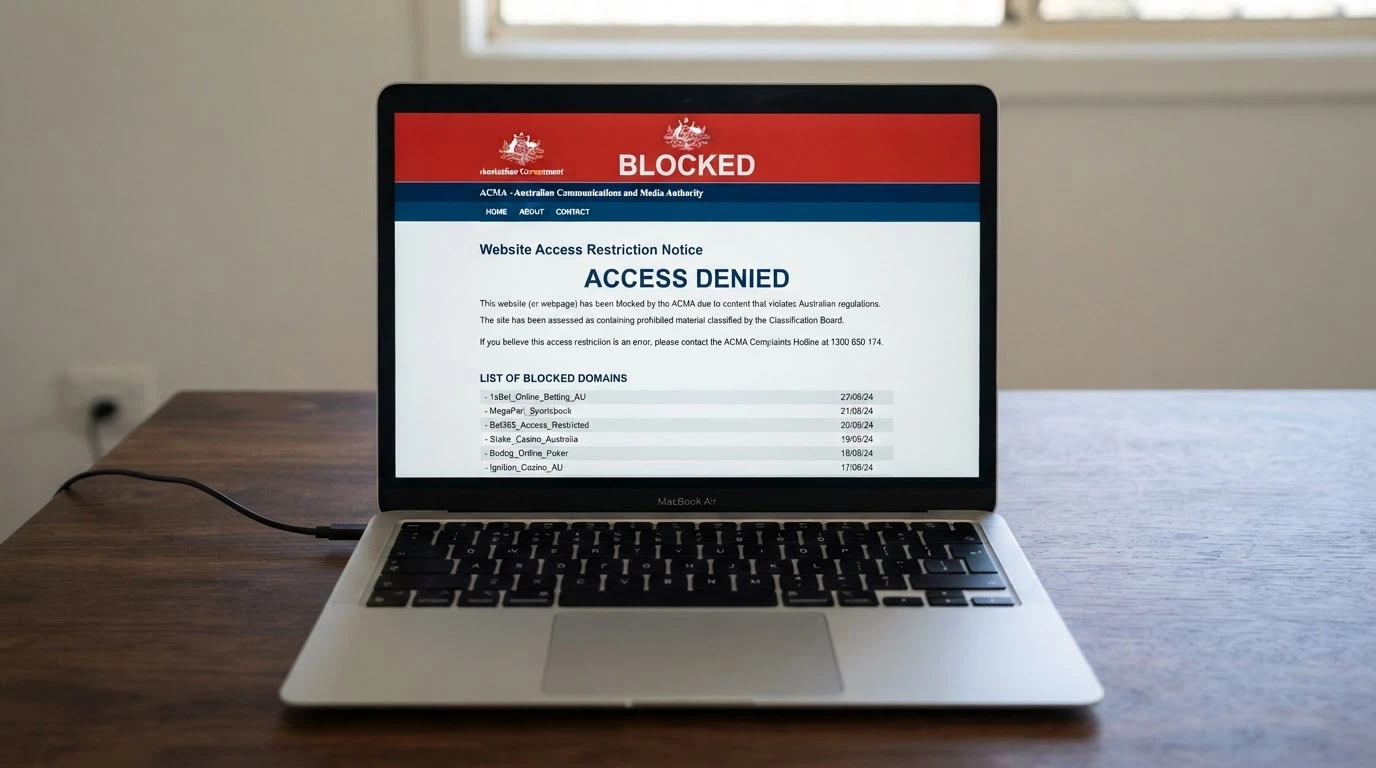
The ACMA has directed Australian ISPs to block 1,564 illegal gambling and affiliate websites as of March 2026. The first blocking request was issued in November 2019. The 1,564 figure covers both gambling brands and the affiliate sites that promote them — review pages, comparison pages, bonus-aggregator pages, and the like. More than 225 illegal services have withdrawn from the Australian market since the 2017 strengthening of the IGA, which means the ACMA’s enforcement record combines blocking actions with voluntary withdrawals, and the total of illegal services the regulator has touched is higher than the blocking figure alone.
A blocking notice means the Australian ISP’s customers can no longer reach the domain by typing it into a browser. The brand’s URL is on the ACMA’s blocked list, the ISP enforces the block at the DNS level, and the player who tries to log in to play sees an error page. A player who has a balance on a blocked site has a balance they cannot reach to withdraw from. The ACMA does not refund balances. The brand does not refund balances, because the brand’s withdrawal process runs on the blocked domain.
The 1,564 figure is a measure of illegal supply, not a measure of enforcement success. The ACMA’s blocking actions are reactive — a brand surfaces, the regulator investigates, the regulator issues a notice, the brand gets blocked. The supply is dynamic, and the blocking figure has grown steadily over the six years since the first notice. The supply is fluid, and a player who chooses an offshore brand today may find that domain unreachable tomorrow.
What You Lose Playing Offshore — No BetStop, No Recourse, No Safety Net
The player-protection gap between an Australian-licensed wagering operator and an offshore casino is the concrete cost of the offshore route. The four items below are not theoretical. Each one is a protection an Australian player gives up by depositing $5 at an offshore casino, and each one has a real-world consequence.
- No BetStop coverage. BetStop is the National Self-Exclusion Register, live since August 2023, with 67,480 registrations and 41,290 active exclusions as at 31 July 2026. BetStop binds Australian-licensed wagering services. An offshore casino is not connected. A self-exclusion registered with BetStop does not stop a player from depositing at an offshore casino, and an offshore casino does not check the register before accepting a deposit. The most concrete single harm of the offshore route is that the strongest self-exclusion tool in the Australian market does not reach it.
- No Australian consumer-protection recourse. A refused withdrawal, a voided bonus, a closed account, a withheld balance — none of these can be appealed to an Australian regulator, because no Australian regulator has jurisdiction over an offshore casino. The player’s only recourse is the licence jurisdiction the brand actually operates under, which is usually Curaçao, Kahnawake, Anjouan, or another small-island regulator with a thin enforcement record and a slow complaint process.
- No guaranteed access. A balance on an offshore casino is a balance on a brand the ACMA can block. The 1,564 blocked sites as of March 2026 are a record of what has already happened. From 1 January 2027, banks and payment providers will gain express authority to block transactions to illegal gambling operators, which adds a second blocking layer. The player cannot reach the brand’s domain, and cannot move money to or from the brand through Australian banks. A $5 deposit that turns into a $50 balance is still at risk.
- The credit-card and crypto litmus test. The ban on credit cards and cryptocurrency for online wagering in Australia since 11 June 2024 is a marker for compliance. A licensed Australian wagering operator cannot accept credit cards or crypto. An offshore casino that does accept them is operating outside Australian rules. The operator penalty for non-compliance is up to $247,500. A brand that takes a credit card deposit from an Australian player is a brand that has decided the penalty is a cost it will wear. That is information. The player should treat it as such.
The 2027 Reforms — What Changes on 1 January and What Does Not
The Interactive Gambling Amendment (Gambling Reform) Bill 2026 passed Parliament on 19 August 2026. Its measures commence 1 January 2027. The reforms do not legalise online casino. Online casino remains prohibited, and they do not change the offshore status of any brand on this page. What they change is the enforcement environment around the prohibition.
Starting 1 January 2027, banks and payment providers hold formal authority to stop all transactions to illegal gambling operators, building on the ACMA’s domain-blocking powers. An Australian player who deposits $5 at an offshore casino today, using PayID or debit card, may find the deposit rejected by their bank in 2027. The bank’s authority is the variable. The brand’s willingness to accept the deposit is the constant. The bank decides which side of the transaction it sits on.
The advertising and inducement reforms are also from 1 January 2027. Wagering advertising is capped at three ads per hour between 6:00 am and 8:30 pm, with a live-sport blackout from fifteen minutes before a live event until five minutes after it ends. Athletes, celebrities and influencers are barred from promoting wagering products. Direct marketing of inducements is prohibited for fourteen days after a customer signs up, three months after a person deregisters from BetStop, and indefinitely for customers identified as at risk.
The reforms tighten the environment for licensed Australian wagering operators. They do not touch the offshore casino prohibition. A player who deposits $5 at an offshore casino in 2027 faces the same legal position as a player who deposits $5 at an offshore casino in 2026. The 2027 changes add friction to the deposit rail. They do not add a licence.
Staying in Control When the Safety Net Doesn’t Reach Offshore
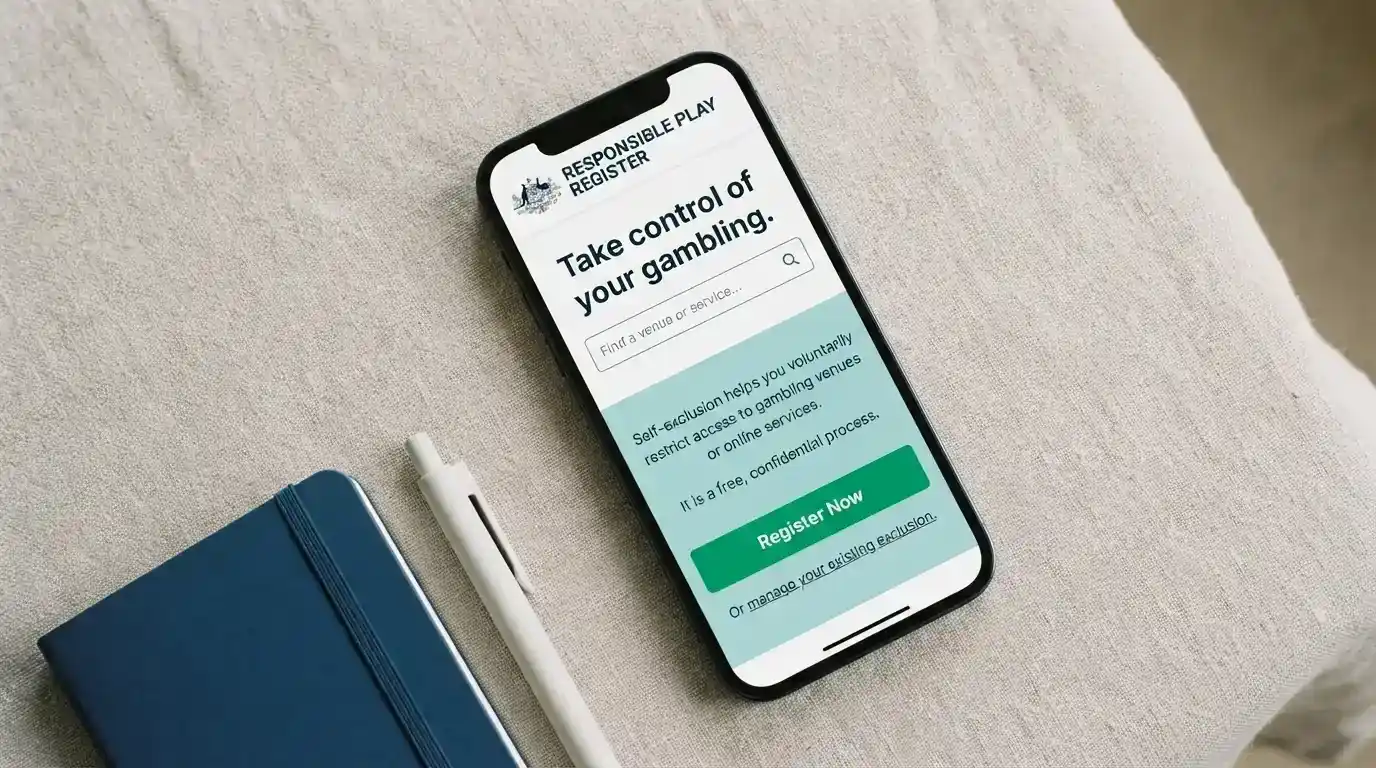
The responsible-gambling infrastructure available to an Australian player at an Australian-licensed wagering operator is real, and it does not reach an offshore casino. The player’s options at an offshore casino are the responsible-gambling tools the brand chooses to offer — deposit limits, session reminders, self-exclusion at the brand level — and those tools are not enforced the way Australian-licensed operator tools are. The Australian help infrastructure — BetStop, the National Gambling Helpline, Gambling Help Online — is available to every Australian regardless of where they gamble, and that availability is the part of the page the player should take seriously.
BetStop — What It Does and Why It Stops at the Australian Border
BetStop, the National Self-Exclusion Register, has been live since August 2023. As at 31 July 2026, the register carried 67,480 registrations, of which 41,290 exclusions were still active — more than sixty per cent of everyone who has ever registered. Seventy-eight per cent of registrants were under forty. Thirty-eight per cent chose a lifetime exclusion. The numbers are a record of how many Australians have asked the system to stop them from wagering, and how serious that ask has been.
BetStop binds Australian-licensed wagering services. A self-excluded player cannot open a new account with a licensed wagering operator, cannot deposit with one, and cannot place a bet through one. The licensed operator checks the register before accepting a customer. The mechanism works because the operator is licensed and the licence conditions require the check.
The mechanism does not reach an offshore casino. An offshore casino is not licensed in Australia, is not required to check the BetStop register, and is not required to honour a self-exclusion a player has registered. A player who has self-excluded through BetStop and then deposits $5 at an offshore casino has not been stopped by the register. The deposit will clear. The brand will accept it. The Australian side of the system does not see it.
This is the most concrete single harm of the offshore route. The strongest self-exclusion tool in the Australian market does not reach the product the offshore route offers. A player who has registered with BetStop and is using offshore casinos is using a system the register cannot help with.
Deposit Limits, Activity Statements and Self-Help at Offshore Rooms
An offshore casino may offer deposit limits, session-time reminders, cooling-off periods and brand-level self-exclusion. None of these are required. None are enforced. None carry the regulatory weight of an Australian-licensed operator’s deposit-limit framework.
A licensed Australian wagering operator sets customer-elected deposit limits as a condition of its licence, honours those limits at the cashier, and reports limit activity to the relevant state or territory regulator. An offshore casino sets deposit limits at its own discretion, enforces them through its own cashier, and reports them to no one. The customer’s experience is similar in both cases — the player sets a limit, the cashier enforces it. The regulatory backing is not similar. The Australian limit has the force of a licence condition. The offshore limit has the force of the brand’s own terms page.
Activity statements, the periodic statements a licensed wagering operator sends to a customer showing deposits, withdrawals, net position and time spent, are a condition of Australian wagering licences. The offshore casino may or may not offer them. The player should not assume they exist.
The honest framing is that an offshore casino’s responsible-gambling tools are brand-level tools, not regulatory-level tools. They are useful to the player who chooses to use them. They are not a substitute for the Australian framework. The player who wants Australian-level protection plays at an Australian-licensed operator. The player who plays offshore has the brand’s tools, and only the brand’s tools.
Help When You Need It — 1800 858 858, Gambling Help Online and the Numbers
The Australian help infrastructure is free, confidential, and available twenty-four hours a day to any Australian, regardless of where they gamble. The numbers below are the part of the page the player should keep.
- National Gambling Helpline: 1800 858 858. Free, confidential, staffed twenty-four hours a day. The line is the first call for any Australian who wants to talk to someone about a gambling concern. Calls are not traced to the player’s bank or their casino. The service is paid for by the Australian government and is independent of any gambling operator.
- Gambling Help Online: gamblinghelponline.org.au. Online chat and free counselling, available outside the helpline’s voice-call hours. The website carries self-help tools, information for family members, and referral to face-to-face counselling services in every state and territory.
- About 2.1 per cent of Australian adults — roughly 430,000 people — experience problem gambling. High-risk gambling prevalence is 1.8 per cent. Both figures come from the Australian Institute of Health and Welfare, 2022. The numbers are the reason the helpline exists and the reason this section is on the page.
The numbers are not there to alarm. They are there to make the helpline a real option. A player reading this page and wondering whether they should call has the answer in front of them. The call is free. The conversation is confidential. The help is real.
How We Evaluated These $5 Minimum Deposit Casinos
The ranking on this page is built on one dataset: independently tracked Australian traffic share for offshore gambling brands. The percentages in the table measure how much of the country’s gambling-related browsing lands on each operator’s site. They are a marketing signal, not a regulatory rating.
Two things were checked before any operator entered the ranking. First, the Australian Communications and Media Authority register and the Northern Territory Racing and Wagering Commission’s licence list were used to confirm that no operator in the ranking holds an Australian casino licence. None does. None can. The licence class does not exist. Second, the ACMA’s published list of blocked illegal gambling and affiliate sites was used to confirm that the operators are not already blocked at the domain level. A brand blocked since March 2026 is not a brand an Australian player can reach today, and a brand that cannot be reached should not appear in a ranking of brands the player can choose from.
Three things were not checked this run, because the data was not available. Per-operator bonus terms — the wagering multipliers, the free-spin counts, the validity windows, the max-cashout caps — were not retrieved for the brands on this page. Per-operator game-provider rosters were not retrieved. Per-operator licence jurisdictions — Curaçao, Kahnawake, Anjouan, or another — were not retrieved. The ranking reflects the data that was available. The reader should treat the missing data as missing data, not as a negative signal.
The page’s verdict on every brand is the same on one point: no operator in the ranking holds an Australian casino licence, every operator is offshore, and every operator is therefore operating outside the Australian consumer-protection framework. That verdict is consistent across all ten brands. The differences between them are the marketing differences, the revenue differences, and the AU traffic differences. The legal position is identical.
Is a $5 Deposit Worth It? What the Facts Say You Should Weigh
The $5 deposit at an offshore casino is a real product that costs the player a real thing. The cost is not the $5. The cost is the Australian consumer-protection framework the player steps outside of when the deposit clears.
The legal position is plain. The IGA 2001 prohibits the provision of online casino to a person in Australia. The provider is the target. The player is not. The 2017 amendment closed the offshore loopholes. The ACMA has blocked 1,564 illegal sites as of March 2026. From 1 January 2027, Australian banks gain express authority to block transactions to illegal gambling operators. The enforcement environment is tightening. The offshore status of the brands on this page is not changing.
The trade-off is the trade-off between access and protection. The player gets access — $5 in, real-money play, an offshore cashier, an offshore game library. The player gives up protection — no BetStop coverage, no Australian complaints body, no guaranteed access, no recourse if a withdrawal is withheld. The $5 deposit is the player’s choice, and the protection framework is what the player steps outside of.
Three checks before the deposit clears. First, the cashier page. Does the brand list PayID, debit card, BPAY, or bank transfer? A brand that lists only credit card or cryptocurrency is a brand that has chosen to ignore Australian rules, and that is information. Second, the responsible-gambling page. Does the brand offer deposit limits, session reminders, self-exclusion at the brand level? A brand with no responsible-gambling page has not built the tools. A brand with the tools has. Third, the helpline number. 1800 858 858, free, confidential, twenty-four hours a day. The number is for any Australian who wants to talk. The player should keep it before they keep the deposit.
A $5 deposit at an offshore casino is worth what the player decides it is worth. The page’s job is to make sure the decision is informed. The offshore status is the headline. The protection gap is the cost. The helpline is the safety net the offshore route does not reach.
Frequently Asked Questions
Is it legal to play at a $5 deposit online casino in Australia?
Playing at a $5 deposit online casino is not illegal for the Australian player. The Interactive Gambling Act 2001 targets the provider of online casino services, not the player. The Act makes it an offence to provide online casino games, online pokies or in-play sports betting to a person in Australia. The casino that accepts the deposit commits the offence. The player who makes it does not. The offshore status of every brand on this page reflects that legal position.
Are $5 deposit casino bonuses worth it — what are the wagering requirements?
A welcome bonus at a $5 deposit casino is usually a percentage match on the deposit, sometimes with free spins attached. The wagering requirement — the multiple of the bonus the player must turn over before withdrawing — is the term that decides whether the bonus is worth claiming. Lower multiples are better. Per-operator wagering figures were not confirmed for the brands on this page. Read the bonus terms on the cashier page before claiming.
Can I use PayID to deposit $5 at an online casino in Australia?
PayID is the Australian instant bank-transfer system layered on top of Osko, and is one of the legal deposit routes for Australian-licensed wagering. Whether a specific offshore casino accepts PayID is a per-brand question that sits on the cashier page. A brand that lists a PayID-enabled BSB has chosen to be visible to Australian banks. PayID clears instantly, twenty-four hours a day, in AUD.
Does BetStop protect me if I play at an offshore casino?
BetStop, the National Self-Exclusion Register, binds Australian-licensed wagering services only. An offshore casino is not connected to the register and is not required to check it. A self-exclusion registered with BetStop stops a player from depositing with a licensed Australian wagering operator. It does not stop a player from depositing at an offshore casino. The offshore route is outside the register’s reach.
What happens if an offshore casino blocks my withdrawal — do I have recourse in Australia?
If an offshore casino blocks a withdrawal, the player has no Australian regulator to appeal to. The brand operates under an offshore licence, and the only recourse is through the licence jurisdiction — usually Curaçao, Kahnawake or Anjouan, with slow complaint processes. The ACMA can block the brand’s domain, but blocking the domain does not refund the balance. A blocked site is one the player cannot reach to withdraw from.
Are credit card deposits banned at Australian online casinos?
Yes, since 11 June 2024. Credit cards, credit-related products and cryptocurrency are banned as payment for online wagering in Australia under the Interactive Gambling Amendment (Credit and Other Measures) Act 2023. The ban applies to Australian-licensed wagering operators. An operator that fails to enforce it faces penalties of up to $247,500. An offshore casino that still accepts a credit card deposit from an Australian player is operating outside Australian rules.