
How Tether Casinos Actually Work for Australian Players in 2026
An online casino that takes Tether is not an Australian casino. It is an offshore operator running outside the Interactive Gambling Act 2001 — because Australia has no licence for online casino, anywhere in the country, and never has. USDT acceptance is itself a tell: credit cards and crypto have been banned for licensed wagering since 11 June 2024, so any site asking for Tether is sitting outside the Australian rules by definition.
This page is an honest accounting of what those operators are, how USDT deposits and withdrawals actually work, what the bonuses cost once you run the arithmetic, and what protection an Australian player gives up by playing offshore. No operator on this page holds an Australian licence, because none can.
Data current as of 29 October 2026 and verified against the ACMA register.
Table of Contents
- What a Tether Casino Actually Is — and Why It’s Not an Australian One
- How USDT Deposits and Withdrawals Work at a Crypto Casino
- Australia’s Most-Used Offshore Casino Sites in 2026: Who Takes Tether
- Pokies, Blackjack and Live Dealer: What You Can Play with Tether
- Why Your 2026 Tether Casino Bonus Is Smaller Than It Looks
- Playing USDT Casino Games on Your Phone
- New Tether Casinos Worth a Look in 2026
- How to Tell a Trustworthy USDT Casino from a Risky One
- The Legal Reality: Why Every USDT Casino Is an Offshore Operator
- Staying in Control When Playing at an Offshore Crypto Casino
- How We Selected and Ranked These Tether Casinos
- What to Do Next: Your 2026 Tether Casino Playbook
- Frequently Asked Questions
What a Tether Casino Actually Is — and Why It’s Not an Australian One
A Tether casino is an offshore gambling site that accepts USDT as a deposit and withdrawal method. The “Tether” in the name is the payment rail, not the licence. The operator typically holds a Curaçao or Anjouan licence — sometimes none that a player can check. None of them hold an Australian licence, because Australia does not issue one for the product they sell.
The Tether Casino, Defined
USDT — Tether — is a stablecoin pegged to the US dollar, traded on several blockchains. When an offshore casino calls itself a “Tether casino”, it means the cashier accepts USDT (alongside, usually, Bitcoin, Ethereum, Litecoin and a handful of other tokens). Players move stablecoins from a crypto wallet into the casino balance, play, and cash out back to USDT. The casino converts nothing — the player carries the dollar peg in and out.
The product is online casino: pokies, table games, live dealer. In Australia, that product is prohibited under the Interactive Gambling Act 2001, reinforced by the 2017 amendments. No state or territory issues a licence for it. The ACMA enforces the prohibition provider-side, having directed ISPs to block 1,564 illegal gambling and affiliate websites since November 2019. More than 225 illegal services have withdrawn from the Australian market since 2017.
A Tether casino, then, is an offshore operator outside this framework — accessible from Australia, accepting Australian players, holding no Australian licence. The crypto acceptance is a marker of that offshore status, not a side feature.
Crypto Casino vs Card Casino: What the Payment Method Tells You
The deposit method is a signal. If a casino asks for a credit card or crypto, it is not the kind of operator the ACMA regulates. Licensed Australian wagering operators — Sportsbet, bet365, Ladbrokes, TAB — have been barred from accepting either since 11 June 2024. A card casino licensed in Australia cannot legally exist for online casino product, so the choice an Australian player faces is between a licensed wagering bookmaker (no casino games, no crypto) and an offshore casino (casino games, crypto, no Australian licence).
The practical differences run deeper than legality. Crypto deposits settle in minutes, not days — Tron-based USDT arrives in under three minutes for an average fee of A$1.20, against 0–2 hours for casino processing on top. Card deposits at a licensed bookmaker carry chargeback rights a player loses at a crypto cashier. The KYC burden sits differently too: a licensed wagering operator verifies every customer at deposit under Australian AML/CTF law; an offshore crypto casino may defer verification to cashout, and 90% do, asking for ID the first time a player tries to withdraw.
A crypto casino is faster and lighter at the front door. At the back door — when something goes wrong, when a withdrawal stalls, when a bonus term is disputed — the player has no ACMA to call.
How USDT Deposits and Withdrawals Work at a Crypto Casino
The mechanics are straightforward once the player has USDT in a wallet. Buy USDT on an Australian-registered exchange, send it to the casino’s deposit address on the right network, wait for confirmations, and play. The reverse path mirrors it. The complications live in the details — which network, what fee, whether identity gets demanded at the other end.
Deposit & Top-Up: Funding Your Account with USDT
The deposit flow runs from an exchange to a wallet to the casino. An Australian player buys USDT on an AUSTRAC-registered exchange (CoinSpot, Independent Reserve, Swyftx) using PayID or bank transfer, withdraws the USDT to a self-custody or exchange-hosted wallet, and sends it on to the casino’s deposit address. Casino deposits via USDT are typically free; the network fee is what the player pays.
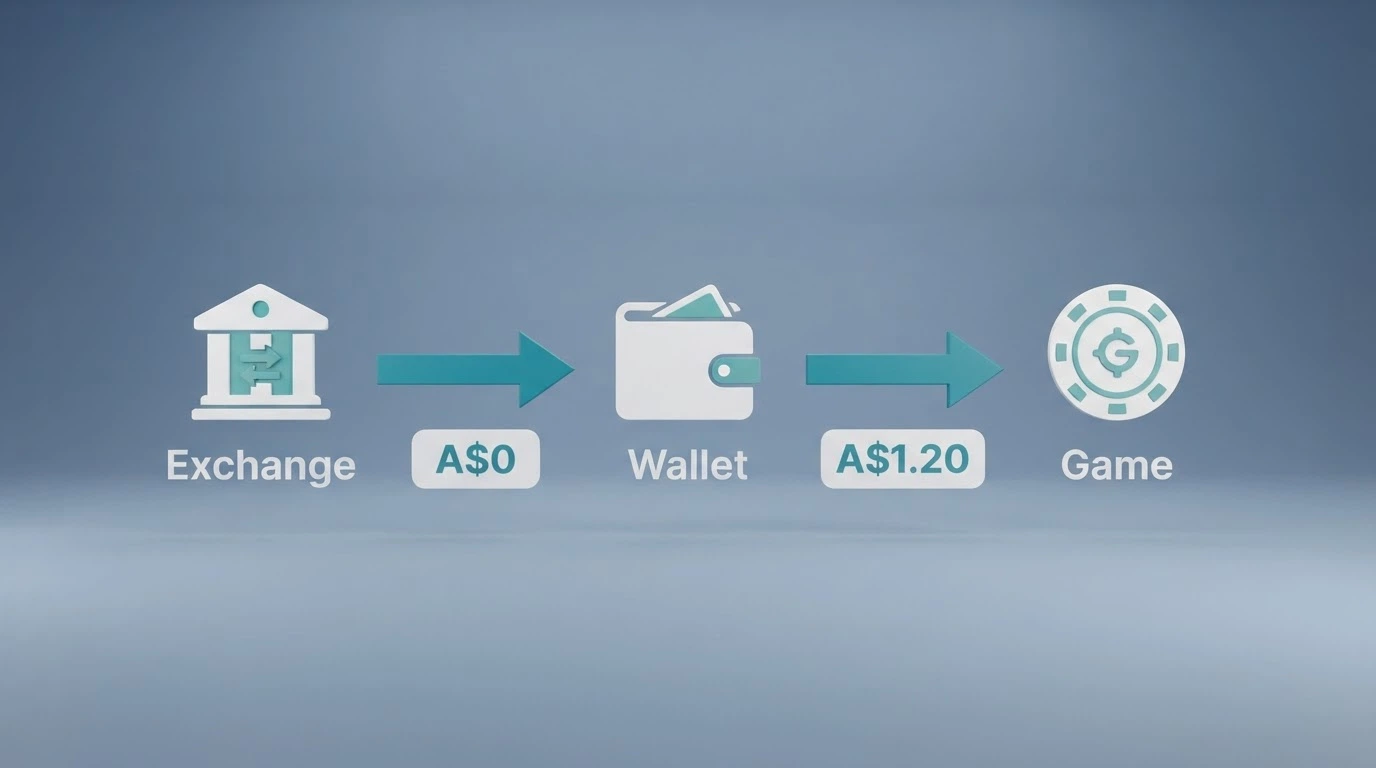
Network fees depend entirely on which blockchain carries the USDT. TRC-20 (Tron) is the cheapest at roughly A$1.20 per transaction, a flat Tron fee independent of congestion. ERC-20 (Ethereum) runs A$3–15 on a quiet day, USD$5–30 when the network is busy — gas, not the casino’s choice. BEP-20 (BNB Chain) is cheaper still at around A$0.15, but uses the same address format as Ethereum, creating a mis-send trap. Minimum deposits sit at US$10–50 depending on the operator. AUSTRAC’s Travel Rule kicks in at A$10,000 per transfer, meaning exchanges must collect counterparty details above that threshold.
The exchange-to-casino leg takes minutes once the network confirms. The bottleneck is usually the bank-to-exchange leg, not the blockchain.
Withdrawal Speed: How Fast Your USDT Payout Really Arrives
Crypto withdrawals are fast at the casino end. Tested crypto release times — Wild Fortune at 4 hours 47 minutes, Stake at 1 hour 50 minutes, Bitstarz at 4 hours 18 minutes, BC.Game at 3 hours 12 minutes — show casino-side processing measured in hours, not days. Most operators run 0–2 hour internal approval on crypto payouts, and many charge no withdrawal fee.
Door-to-door is a different number. The full chain runs casino release → USDT to player wallet → exchange conversion to AUD → PayID or bank transfer. Stake clears in roughly 2 hours total, BC.Game around 3.5 hours, Bitstarz about 4.5 hours, Wild Fortune close to 5 hours. Operators running PayID-only rails — common at fiat-only or hybrid sites — average 36–72 hours door-to-door.
Exchange conversion to AUD carries a 0.1%–1% fee plus the bid-ask spread. On a A$1,000 payout that is A$1–10 in fees plus a few dollars in spread — small relative to bank wire fees, but real. Crypto beats PayID at every tested speed benchmark this run.
Chain Variants, Network Fees and the No-KYC Reality
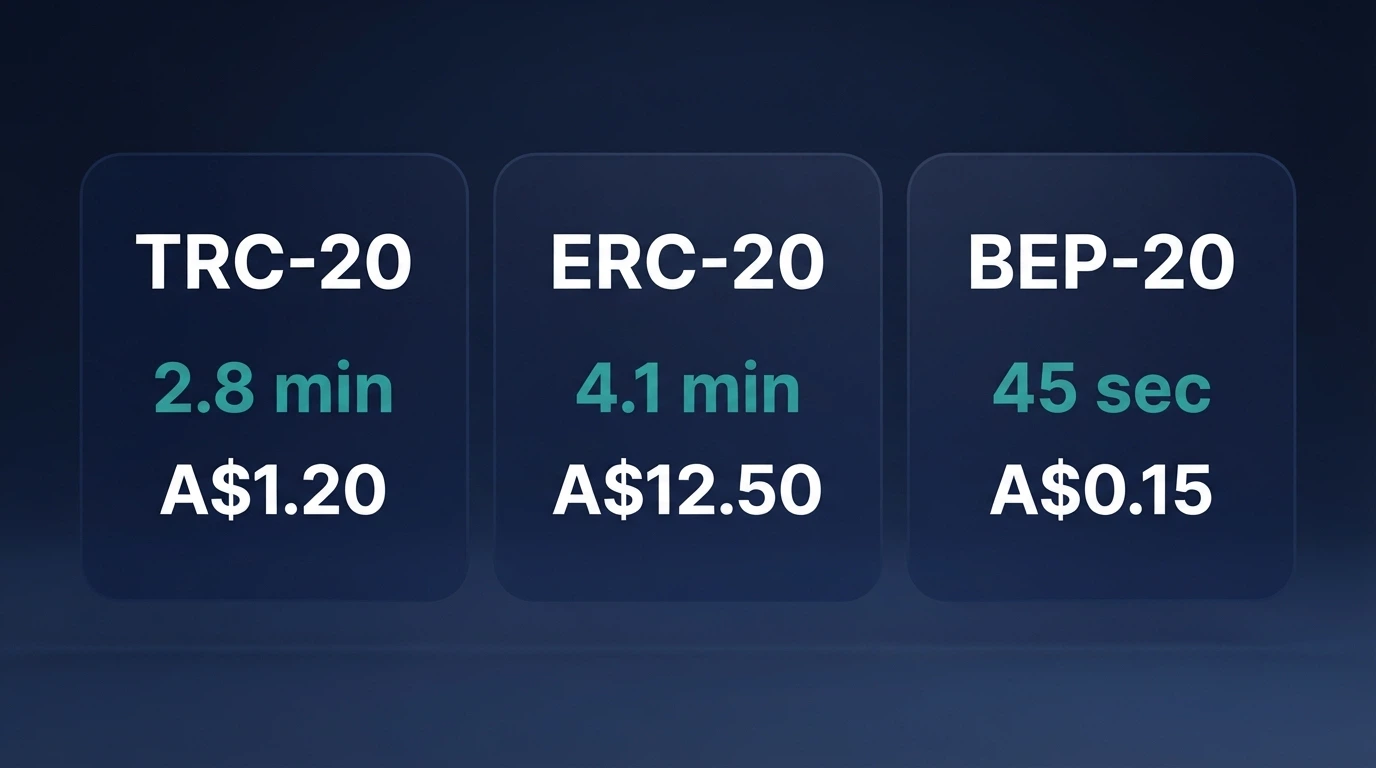
The network you pick sets both the fee and the speed, and choosing the wrong one can mean losing the funds entirely. Here is how the three common options compare:
| Network | Confirmation Time | Average Fee | Best For |
|---|---|---|---|
| TRC-20 (Tron) | 2.8 minutes | A$1.20 | Most deposits and withdrawals under A$2,000 |
| ERC-20 (Ethereum) | 4.1 minutes | A$12.50 | When only ERC-20 is accepted by the casino |
| BEP-20 (BNB Chain) | 45 seconds | A$0.15 | Only when the casino lists a BEP-20 deposit address |
The address trap is where players lose money. TRC-20 and ERC-20 addresses use different formats; sending TRC-20 USDT to an ERC-20 address means the funds vanish — confirmed lost, unrecoverable. BEP-20 (BNB Chain) and ERC-20 share the 0x address format, which is convenient for copy-paste but creates a second trap: a wallet may auto-detect 0x as Ethereum when the casino is actually expecting BEP-20.
“No KYC” is the other gap between marketing and reality. 90% of casinos claiming crypto-friendliness will still request identity documents at the first withdrawal — and additional KYC is triggered above USD$2,000 at most operators reachable from Australia. First-time verification adds 24–72 hours to processing if it was not completed at deposit. True no-KYC play exists only at small-amount thresholds, and even then is the exception.
Australia’s Most-Used Offshore Casino Sites in 2026: Who Takes Tether
The table below ranks the ten operators Australian players are most often turning to. All are offshore; none hold an Australian licence. USDT acceptance is confirmed for five of the ten this run; the rest appear on AU market-share data but did not surface public crypto terms during research.
| Operator | USDT Accepted | Welcome Bonus |
|---|---|---|
| Rocket Play | Yes (TRC-20, ERC-20) | 100% up to A$1,000 + 100 FS |
| SkyCrown | Yes (ERC-20, TRC-20) | 4-deposit ladder up to A$8,000 |
| Stake | Yes (TRC-20) | VIP/rakeback model, no standard welcome |
| Royal Reels | — | — |
| WinSpirit | Yes (ERC-20, TRC-20 + 11 other tokens) | 100% up to A$300 + 100 FS, 2nd 200% up to A$1,000 |
| FairGO | — | — |
| Rainbet | — | — |
| Scream Casino | — | — |
| Bizzo Casino | — | — |
| Casino Rocket | Yes (crypto package confirmed) | Crypto: up to 1 BTC, 45× wagering |
Rocket Play
Rocket Play accepts USDT on both TRC-20 and ERC-20, and runs a straightforward 100% match up to A$1,000 plus 100 free spins (20 a day for five days) on the first deposit. Minimum deposit is A$30. The wagering requirement is 40× the bonus — meaning a A$1,000 bonus requires A$40,000 in qualifying turnover before any winnings are withdrawable. The validity window is five days, which is the tightest in the comparison set: a player wagering A$7.50 per spin (the maximum allowed while a bonus is active) gets through roughly A$40,000 in about 22 hours of continuous play, but the calendar constraint means missing a day costs progress. Maximum win from the free spins is capped at A$300. No-deposit free spins carry 35× wagering. Game providers confirmed: BGaming and Pragmatic Play.
For a player with a weekend-sized bankroll, Rocket Play’s 5-day validity makes the bonus harder to clear than its 40× multiple alone suggests. The 100% match is competitive; the clock is not.
SkyCrown
SkyCrown’s welcome package stretches across four deposits, with the largest total bonus pool in the comparison set: A$8,000 across the four stages plus 400 free spins. The structure runs 120% up to A$1,200 + 125 FS on the first deposit, 100% up to A$1,300 + 75 FS on the second, 80% up to A$1,500 + 50 FS on the third, and 150% up to A$4,000 + 150 FS on the fourth. Minimum deposit A$30 per stage, wagering 40× on bonus and free-spin winnings, 14-day validity per stage. Table game contribution rates — 5% for classic table games, 10% for blackjack, baccarat, roulette and live dealer — mean the bonus clears far slower on non-slot play. USDT accepted on ERC-20 and TRC-20.
The 14-day window is workable; the 5%/10% contribution rates are a sharper constraint for any player who wants to mix blackjack or roulette into their clearing. SkyCrown suits a slots-first player who plans to deposit four times.
Stake
Stake runs a VIP and rakeback model rather than a traditional welcome bonus, which makes the comparison-table cell empty for a reason: there is no match-rate to quote. What Stake offers instead is the fastest tested crypto withdrawal in the comparison set — 1 hour 50 minutes average for casino release, roughly 2 hours door-to-door including exchange and PayID. USDT is confirmed on TRC-20.
For a player who values cashout speed over upfront bonus value, Stake’s structure rewards ongoing play rather than first-deposit size. The rakeback model returns a percentage of house edge or wagering volume to active players, which compounds over time but never shows up as a headline number on a comparison page.
Royal Reels
Royal Reels holds a measurable slice of the Australian market — 2.51% share — but this run did not surface public Tether terms, bonus specifics, or a confirmed licence date for the brand. The operator exists in AU market-share data and appears in affiliate listings. What a player cannot check from research alone is whether the cashier accepts USDT, on which network, and at what limits.
The honest position: this is an operator Australians play at, but the specific data a USDT-focused reader needs — crypto acceptance, bonus terms, providers, licence verification — was not confirmed. Before depositing, verify USDT acceptance directly on the operator’s cashier page.
WinSpirit
WinSpirit is the most crypto-diverse operator in the featured set, accepting USDT on ERC-20 and TRC-20 alongside Bitcoin, Ethereum, Litecoin, Dogecoin, Solana, Bitcoin Cash, USDC, DAI, TRON, BNB and XRP. The welcome package runs two deposits: 100% up to A$300 + 100 free spins on the first, 200% up to A$1,000 on the second. Wagering 40×, validity 7 days, maximum win A$3,000 from the deposit bonus and A$300 from free spins. Minimum deposit A$30 first stage, A$60 second. USDT limits are A$10 minimum and A$2,000 maximum per transaction, with instant processing; the monthly withdrawal ceiling is A$40,000.
The standout is the no-deposit offer: 20 free spins on Totem Mystique for installing the app, at A$0.10 per spin (A$2 total stake), with 40× wagering and a A$75 maximum cashout. It is the only confirmed no-deposit bonus in the featured set. Max bet while wagering is A$7.50.
WinSpirit suits a player who wants broad crypto choice and a small no-deposit trial before committing. The 7-day validity is tight but workable at the A$7.50 max-bet rate.
FairGO
FairGO stands out for one figure: 30× wagering on no-deposit free spins — the lowest in the comparison set. RocketPlay runs 35×, Bizzo runs 40×. Beyond that single confirmed number, this run did not surface USDT acceptance, welcome bonus terms, or game providers for FairGO.
The 30× no-deposit rate is meaningful for a player comparing free-spin offers across the market. The absence of confirmed crypto acceptance means a USDT reader cannot rely on the page for that answer — verify at the cashier.
Rainbet
Rainbet holds 1.28% of the Australian market, placing it in the middle of the featured set. This run did not confirm USDT acceptance, bonus terms, game providers, or a licence date. The brand appears in AU market-share data; the data a USDT reader needs was not surfaced.
A player interested in Rainbet should verify crypto support on the operator’s own cashier before depositing.
Scream Casino
Scream Casino is the smallest operator in the featured set at 0.99% Australian market share. USDT acceptance, welcome bonus terms, game providers, and licence date were not confirmed this run. Like Rainbet and Royal Reels, the brand exists in AU traffic data; the specifics a USDT reader needs were not surfaced.
Verify USDT acceptance at the cashier before depositing.
Bizzo Casino
Bizzo appears in bonus-comparison data with one confirmed figure: 40× wagering on no-deposit free spins, which sits in the middle of the comparison set (FairGO 30×, RocketPlay 35×, Bizzo 40×). Welcome bonus terms, USDT acceptance, and game providers were not confirmed this run.
The 40× no-deposit rate is the data point carried forward; the rest is a gap to verify at the operator’s cashier.
Casino Rocket
Casino Rocket offers a dedicated crypto welcome package alongside its standard fiat ladder. The crypto terms are explicit: minimum deposit 20 USDT, maximum bonus 1 BTC, wagering 45×, validity 14 days, max bet while wagering 5 USDT, maximum winnings from reload bonuses 5,000 USDT per bonus, from crypto free spins 250 USDT per bonus. The standard fiat ladder is a five-deposit structure — 100% plus free spins on each stage (10/15/20/25/30 free spins respectively), minimum deposit A$10, maximum bonus A$500 per stage, wagering 45×, validity 7 days, max bet A$7.50.
The 45× wagering multiple is the highest in the comparison set. A A$500 bonus requires A$22,500 in qualifying turnover at standard contribution rates; on a USDT crypto bonus the equivalent at 45× runs into the tens of thousands. The 14-day crypto validity gives more breathing room than the 7-day fiat window but the wagering multiple is steep either way. Casino Rocket suits a high-volume player comfortable turning over large sums.
Pokies, Blackjack and Live Dealer: What You Can Play with Tether
USDT casinos carry libraries that run into the thousands of titles. Two pokies dominate Australian review content: Sweet Bonanza and Big Bass Bonanza. Table games and live dealer are standard, though bonus contribution rates for non-slot play reshape the clearing maths considerably.
Pokies & Slots: The Titles That Dominate USDT Casinos
| Slot Title | RTP | Provider | Volatility | Max Win |
|---|---|---|---|---|
| Sweet Bonanza | 96.51% (FS) / 96.48% (base) | Pragmatic Play | High | 21,175× stake |
| Big Bass Bonanza | 96.71% | Reel Kingdom / Pragmatic Play | Medium-High (4/5) | 2,100× stake |
Sweet Bonanza runs a 6×5 pay-anywhere grid with high volatility and a maximum win of 21,175× the stake — the largest ceiling among the most-reviewed titles in Australian USDT casino content. Released June 2019, it offers a 96.51% return during the free-spins feature and 96.48% on the base game. Reduced-RTP configurations around 95.45% exist at some operators, so the exact figure depends on which version the casino runs. Big Bass Bonanza sits at the other end of the volatility spectrum: medium-high (4/5), 5×3 grid with 10 fixed paylines, RTP 96.71% adjustable by the casino, maximum win 2,100× the stake. Released December 2020. Both titles are independently certified by GLI for fairness.

The RTP gap between the two is small; the volatility gap is not. Sweet Bonanza pays rarely and large; Big Bass Bonanza pays more often and smaller. The max-win gap — 21,175× against 2,100× — means a Sweet Bonanza bonus round can deliver ten times what Big Bass Bonanza’s top end offers, but the variance is correspondingly steeper.
Table Games & Live Dealer: Beyond the Reels
Roulette, blackjack, baccarat and live dealer tables are standard at offshore crypto casinos. Evolution and Pragmatic Play Live are the most common live dealer providers in the segment, though specific provider confirmations per operator were not surfaced this run.
The catch sits in bonus contribution rates. At SkyCrown — and this benchmark is representative of the segment — classic table games contribute 5% toward wagering requirements, while blackjack, baccarat, roulette and live dealer contribute 10%. Slots contribute 100%. A A$1,000 bonus with 40× wagering requires A$40,000 in slot play; the same bonus cleared entirely on live blackjack needs A$400,000 in turnover. The math is not slightly different — it is an order of magnitude different.
A player who wants to mix table games into their clearing should expect the bonus to take far longer to unlock, or to clear it on slots first and play tables separately.
Why Your 2026 Tether Casino Bonus Is Smaller Than It Looks
A 100% match up to A$1,000 sounds like a A$1,000 gift. The wagering requirement, the validity window and the max-cashout cap are what the bonus actually costs. Run the numbers and the welcome offer at most USDT casinos is closer to a discount on expected losses than to a cash bonus.
Welcome & Deposit Bonuses: What the Match Rate Actually Costs You
Consider Rocket Play’s headline: 100% up to A$1,000, 40× wagering, 5-day validity, max bet A$7.50 while wagering. A A$1,000 bonus requires A$40,000 in qualifying bets. At A$7.50 per spin, that is 5,333 spins over five days — just over 1,000 spins a day, or roughly 14 hours of continuous play at a 5-second spin interval. The validity window is the binding constraint for most players, not the wagering multiple.

The expected-loss figure sits beneath the headline. Assuming the bonus amount is wagered once on a slot at 96.48% RTP (Sweet Bonanza base), the expected loss on A$40,000 turnover is A$40,000 × (1 − 0.9648) = A$1,408. The bonus paid A$1,000; the expected cost of clearing it is A$1,408. The player is, on average, A$408 worse off than if they had never taken the bonus — and that figure ignores the 5-day time pressure, the A$7.50 max-bet cap, and any game-restriction clauses. The “free” A$1,000 is, in statistical terms, a A$408 net cost.
SkyCrown’s four-stage ladder multiplies the structure but not the principle: 40× wagering across all stages, 14 days per stage, table games contributing a fraction of slots. WinSpirit’s 100% up to A$300 with 7-day validity runs the same calculation at smaller scale. Casino Rocket’s 45× wagering on its crypto package is the steepest in the comparison set. Tether.bet’s combined 35× deposit + 35× bonus structure (70× effective) is the harshest. Vave’s “up to 4 BTC” headline carries no max-bet restriction while wagering — a genuine concession in a segment where the cap is near-universal.
Free spins inside the welcome package carry their own cap. WinSpirit’s max free-spin win is A$300; RocketPlay’s is also A$300. The free spins look like extra value; the ceiling determines what they actually deliver.
Free Spins & No-Deposit Offers: The Real Value Behind the Number
No-deposit free spins are the closest thing to a genuine free offer in this market, and even they are constrained. WinSpirit gives 20 free spins on Totem Mystique for installing the app — A$0.10 per spin, A$2 total stake, 40× wagering, maximum cashout A$75. The expected value, assuming a reasonable slot RTP, lands somewhere in the A$5–15 range before the cashout cap clips any upside. Vave runs 40 no-deposit free spins on Lady Wolf Moon MEGAWAYS with winnings capped at 50 USDT, 40× wagering, and at least one successful deposit required before withdrawal.
The wagering rates on no-deposit spins vary more than on deposit bonuses. FairGO at 30× is the most player-friendly in the comparison set. RocketPlay sits at 35×. Bizzo and WinSpirit run 40×. No-deposit withdrawal caps typically land in the 50–100 USD equivalent range across the segment, so even a lucky outcome on a no-deposit spin is clipped well below what the slot’s max-win figure would suggest.
The trade-off: no-deposit offers cost the operator almost nothing and expose the player to a real-money wagering requirement with capped upside. They are useful as a trial of the cashier and the withdrawal process, less useful as a profit opportunity.
Playing USDT Casino Games on Your Phone
Most USDT casinos work in a mobile browser without any download. A handful have dedicated apps — WinSpirit is one, evidenced by its app-install no-deposit bonus — but dedicated iOS or Android apps from offshore crypto operators are uncommon, and where they exist they are often sideloaded rather than distributed through Apple or Google stores.
Mobile Browser vs Dedicated App: What Works in Practice
The browser experience is the norm. Offshore crypto casinos run mobile-responsive HTML5 sites that scale to phone screens without functional compromise — the game library, the cashier, the bonus terms page, all work the same way they do on desktop. Where a dedicated app exists, it is usually an Android APK from the operator’s site rather than a Play Store listing, and the iOS experience is typically browser-based.
The USDT deposit flow is identical on mobile. The player opens their crypto wallet app, scans or copies the casino’s deposit address, selects the network, and sends. The screen size changes; the steps do not.
New Tether Casinos Worth a Look in 2026
New crypto casinos launch regularly. A fresh operator can mean better bonus terms, a more modern game library, and sharper UX. The trade-off is a shorter track record and fewer independent reviews — the things that tell you whether a casino pays out on time.
This run did not surface specific new-operator launches, so the honest position is general. A new Tether casino is worth evaluating against the same criteria as any operator on this page: confirm USDT acceptance and the supported networks at the cashier, read the bonus terms before depositing, check independent withdrawal tests where available, and look for provably-fair implementation if game fairness matters to you. The novelty is not the signal; the verification is.
How to Tell a Trustworthy USDT Casino from a Risky One
Without an Australian licence, the player’s own due diligence is the only protection. The signals that matter are independent test data, player-forum reputation, bonus-term transparency, and the honesty of a casino’s KYC disclosure.
Review Signals & Test Verdicts: What to Look For
Independent withdrawal tests are the closest thing to a trust score in this segment. The PayoutVerdict benchmarks — Stake at 1 hour 50 minutes, BC.Game at 3 hours 12 minutes, Bitstarz at 4 hours 18 minutes, Wild Fortune at 4 hours 47 minutes — give a player a reference point for what “fast” looks like at a tested operator. A casino that claims instant crypto withdrawals but consistently takes 24+ hours in player reports is telling a different story than its marketing.
Bonus-term transparency is the second signal. A casino that publishes full wagering multiples, game contribution rates, max-bet caps and validity windows on the same page as the bonus amount is operating differently from one that buries the terms three clicks deep. The 90% figure for crypto-friendly casinos requesting ID at withdrawal is a useful filter: a site that is upfront about its KYC triggers is more honest than one that claims no-KYC play and springs verification at the first cashout.
Player-forum reports and consistent complaint patterns round out the picture. A single delayed withdrawal is noise; a pattern of voided wins on bonus play or stalled KYC is signal.
Provably Fair: The Verification That Matters
Provably fair is a blockchain-based verification system that lets a player check each spin or hand was not manipulated after the fact. The casino publishes a server seed, the player provides a client seed, and a cryptographic hash ties the outcome to both inputs. A player can verify the math independently after the round.
It only matters if the casino actually implements it and the player uses it. Provably fair covers the game outcome; it does not cover whether the casino pays out, honours bonus terms, or protects the account. It is a positive signal — and its absence on a casino that claims “provably fair” games is a negative one — but it is not a guarantee of overall operator integrity. This run did not confirm per-operator provably-fair support; the concept is the data point carried forward, and the verification is the player’s job.
The Legal Reality: Why Every USDT Casino Is an Offshore Operator
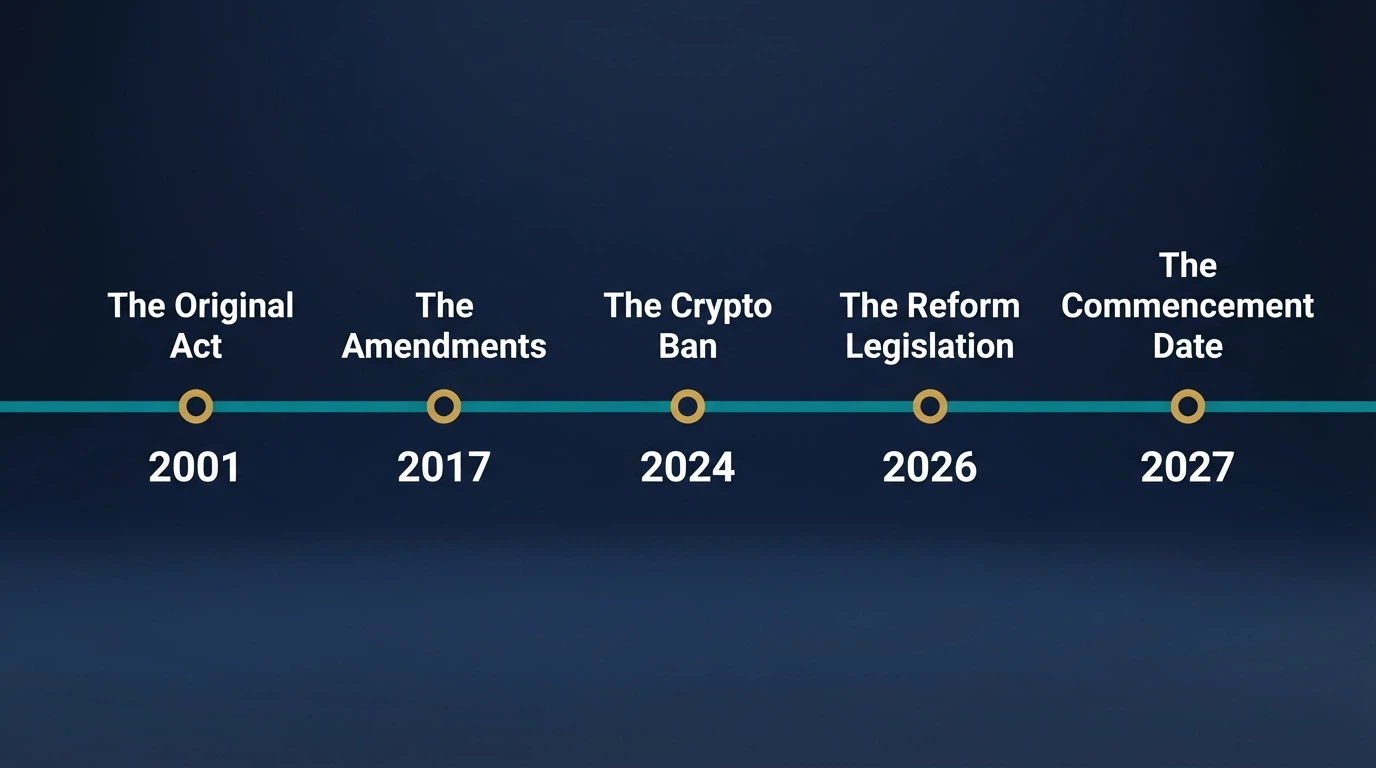
Online casino is prohibited in Australia under the Interactive Gambling Act 2001, strengthened by the 2017 amendments. There is no licence for the product, federally or in any state or territory. Every operator on this page is offshore. The IGA targets the provider, not the individual player — but the player gives up every protection the Australian framework offers.
The Australian Prohibition: What the IGA Actually Says
The Interactive Gambling Act 2001 makes it an offence to provide online casino games, online pokies and in-play betting to people in Australia. The ACMA enforces the prohibition, investigates complaints, issues formal warnings and civil penalty proceedings, and directs ISPs to block illegal sites. Since November 2019, 1,564 illegal gambling and affiliate websites have been blocked. More than 225 illegal services have withdrawn from the Australian market since 2017. The minimum age for any commercial gambling activity in Australia is 18.
The IGA is provider-side. Individual players are not prosecuted. The prohibition is enforced against the operator, not the person depositing USDT. That is the legal position of an Australian playing at an offshore crypto casino: not criminal, but also not protected.
Licensed Wagering vs Offshore Crypto Casino: The Gap That Matters
A licensed Australian wagering operator — Sportsbet, bet365, Ladbrokes, TAB — cannot accept USDT or a credit card. The Interactive Gambling Amendment (Credit and Other Measures) Act 2023 banned both for licensed online and telephone wagering from 11 June 2024, enforced by ACMA with penalties up to A$247,500. Crypto acceptance is, by definition, a marker of an unlicensed operator.
The protections a player gives up at an offshore casino are concrete: no ACMA recovery of funds, no Australian consumer law recourse, no BetStop coverage. If a withdrawal is refused, a bonus term is disputed, or an account is closed with a balance on it, the player has no domestic regulator to appeal to. The site can be blocked by ISPs at any time, and offshore operators have no obligation to notify players before doing so.
From 1 January 2027, the Interactive Gambling Amendment (Gambling Reform) Bill 2026 — passed 19 August 2026 — gives banks and payment providers express authority to block transactions to illegal operators. The direction of travel since 2001 is toward tighter restriction, and the offshore path is the path most exposed to it.
Staying in Control When Playing at an Offshore Crypto Casino
The tools Australian-licensed operators must offer — deposit limits, time-outs, activity statements, BetStop self-exclusion — are not guaranteed at an offshore crypto casino. The player sets their own boundaries, or the casino sets none.

Deposit Limits, Time-Outs and Self-Exclusion: What Works Offshore
Offshore casinos are not connected to BetStop. A self-exclusion through the National Self-Exclusion Register binds Australian-licensed wagering services only; an offshore casino will continue accepting deposits from a self-excluded person. By 31 July 2026, BetStop had 67,480 registrations, with 41,290 exclusions still active — 78% of registrants under 40, 38% choosing lifetime exclusion. None of that coverage extends to the operators on this page.
What does work: deposit limits set at the casino cashier where the operator offers them, session time-outs configured in account settings, and crypto-wallet-level controls (sending limits, address whitelists) that sit outside the casino entirely. The practical reality is that an unregulated operator is not bound by Australian responsible-gambling codes, and the player cannot assume any of these tools exist by default. Check the responsible-gambling page before depositing; if the casino does not have one, that absence is information.
Help When You Need It: Australian Resources That Apply
The Australian help infrastructure works regardless of where a person plays. The National Gambling Helpline — 1800 858 858 — is free, confidential and staffed 24/7. Gambling Help Online at gamblinghelponline.org.au offers chat and counselling. These services apply to offshore crypto play the same way they apply to licensed wagering.
About 2.1% of Australian adults — roughly 430,000 people — experience problem gambling, with 1.8% classified as high-risk in 2022 (Australian Institute of Health and Welfare). BetStop does not cover offshore casinos. If you self-exclude through BetStop, the operators on this page will still accept your deposits.
How We Selected and Ranked These Tether Casinos
The ten operators are drawn from Australian market-share data filtered for casino and pokies products, cross-checked against USDT acceptance where research surfaced public crypto terms. The ranking order prioritises confirmed USDT support, then bonus-term transparency, then independent withdrawal-test data where available, then Australian market share.
No official source ranks Tether casinos for Australian players — every page in the search results is an affiliate comparison listicle. The ranking on this page is an editorial ordering from the inputs available: confirmed crypto acceptance carries the most weight, then bonus terms where publicly available, then tested cashout speed, then market presence. Royal Reels, Rainbet and Scream Casino appear in the table on market-share grounds despite no confirmed USDT data; the gaps are stated plainly rather than papered over.
Every operator was checked against the ACMA framework. None hold an Australian licence, because the product they sell cannot be licensed in Australia. The ranking does not assess legal safety — it assesses fit for an Australian player who has already decided to play offshore.
What to Do Next: Your 2026 Tether Casino Playbook
The page has laid out the operators, the costs, the legal reality and the player-protection gaps. The decision that follows is the reader’s, and the page’s job is to make it an informed one.
Verify USDT acceptance on the operator’s own cashier page before depositing. The network — TRC-20, ERC-20 or BEP-20 — sets the fee and the speed; the address format sets whether the funds arrive at all. Read the bonus terms before claiming: the wagering multiple, the validity window, the max-bet cap and the game contribution rates determine what the bonus actually costs in time and turnover. A 100% match with 40× wagering is not a gift; on a A$1,000 bonus it requires A$40,000 in qualifying bets and roughly 14 hours of continuous play within the validity window.
Set a deposit limit at the cashier where the operator offers one, and consider wallet-level controls as a backstop. Know that BetStop does not cover the operators on this page — self-exclusion through the Australian register will not stop an offshore casino from accepting deposits. The National Gambling Helpline (1800 858 858) and Gambling Help Online are free, confidential and available 24/7 regardless of where you play.
The house always has an edge. Every welcome bonus is a discount on expected losses, not a path to profit. Play accordingly.
Frequently Asked Questions
Is it legal to play at an online casino that accepts Tether (USDT) in Australia?
Online casino is prohibited in Australia under the Interactive Gambling Act 2001, so no Australian-licensed casino accepts Tether. Every USDT-accepting casino is an offshore operator outside the Australian framework. The IGA targets the provider, not the player — individual Australians are not prosecuted for playing at offshore sites — but no Australian consumer protection or ACMA recourse applies if something goes wrong.
What is the difference between USDT TRC-20 and ERC-20 when depositing at an online casino?
TRC-20 runs on the Tron network and costs roughly A$1.20 per transaction with about 2.8 minutes confirmation time. ERC-20 runs on Ethereum and costs A$3–15 on a quiet day, up to USD$30 in gas fees when the network is busy, with around 4.1 minutes confirmation. TRC-20 is the cheaper, faster option when the casino supports both. The two use different address formats — sending TRC-20 USDT to an ERC-20 address results in permanent loss of funds.
Do I need to complete KYC verification to withdraw USDT from an online casino?
Most likely, yes. Around 90% of crypto-friendly casinos request identity documents at the first withdrawal, and additional verification is triggered above USD$2,000 at most operators. First-time verification can add 24–72 hours to processing if it was not completed at deposit. True no-KYC play is rare and typically limited to small withdrawal amounts. A casino that is upfront about its KYC triggers is more honest than one that claims no-KYC and springs verification at cashout.
What fees do I pay when sending USDT to an online casino from an Australian exchange?
The casino deposit itself is typically free. The network fee depends on the blockchain: TRC-20 costs roughly A$1.20, ERC-20 costs A$3–15 (or more when Ethereum is congested), BEP-20 costs around A$0.15. On the Australian exchange side, buying USDT with PayID or bank transfer is usually free or carries a small spread. Converting USDT back to AUD at cashout adds 0.1%–1% plus the bid-ask spread at the exchange.
Can I use Tether at a licensed Australian wagering operator like Sportsbet or bet365?
No. Credit cards and cryptocurrency — including USDT — have been banned as payment methods for licensed Australian online and telephone wagering since 11 June 2024 under the Interactive Gambling Amendment (Credit and Other Measures) Act 2023. Licensed operators face penalties up to A$247,500 for accepting either. Any casino accepting Tether is, by definition, operating outside the Australian regulatory framework.
Is the 2026 Interactive Gambling Amendment (Gambling Reform) Bill already in force?
No. The bill passed Parliament on 19 August 2026, but its measures commence on 1 January 2027. From that date, wagering advertising faces new caps and blackouts, athletes and influencers are barred from promoting wagering products, AdStop is established as an opt-out register, and banks and payment providers gain express authority to block transactions to illegal gambling operators. The current legal position remains as set by the IGA 2001 and the 2017 amendments.