
What the Best Casino Apps in Australia Actually Are in 2026
The “casino app” that an Australian downloads from a search result today is, almost without exception, a product offered by a company that holds no Australian licence — because no Australian licence to offer one exists. That single fact is the spine of everything below: ten offshore operators ranked by traffic, the statute that bans the product they sell, and the consumer-protection vacuum the absence of a regulator leaves behind. Market share is not legitimacy, and a brand Australians download at scale is not, on that evidence alone, a brand they should trust.

Data current as of 14 September 2026 and checked against the Australian Communications and Media Authority’s published register of blocked services.
Table of Contents
- What a Casino App Actually Means in Australia Right Now
- The 10 Casino Apps Australians Are Actually Using in 2026
- Why Nearly Every Casino App You Use Is Breaking Australian Law
- The Bonus That Looks Too Good to Be True (and Usually Is)
- Getting Paid — Why Withdrawals Are Where Offshore Apps Show Their True Colours
- Android vs iPhone — Does Your Phone Change Which Casino App You Should Pick?
- Pokies, Blackjack and Live Dealer — Without Leaving Your Couch
- If an App Asks for Crypto, It Is Telling You Something
- Free-Play Mode — The One Feature Every App Should Offer
- The Safety Net Offshore Apps Cannot Offer You
- How We Selected and Ranked These Casino Apps
- What You Should Actually Do About Casino Apps in Australia
- Frequently Asked Questions
What a Casino App Actually Means in Australia Right Now
The product a search engine returns when an Australian types “best casino apps” is, in legal terms, a prohibited interactive gambling service. The Interactive Gambling Act 2001 — strengthened by the Interactive Gambling Amendment Act 2017 — bans the provision of online casino games, online pokies and in-play sports betting to people physically in Australia. The ban targets the operator, not the individual punter, but it produces a simple market outcome: every real-money casino app an Australian can actually install is offered by an offshore company sitting outside Australian law. That distinction is the first thing any ranking on this subject has to keep in front of the reader. There is no “best licensed casino app” in Australia, because the licence the article would compare against does not exist. A page about it is describing a category that does not exist. The choice on offer is between offshore brands of varying size and reputation, with no Australian regulator sitting behind any of them.
Native App, Web App or Just a Browser — What You Are Actually Downloading
Three technical forms sit under the “casino app” label, and they are plumbing rather than legal status. A native app is a program downloaded and installed on the phone — usually via an APK file on Android or an enterprise-profile install on iOS, because no Australian-licensed real-money casino appears in Google Play or the Australian App Store. A web app, sometimes called a progressive web app (PWA), is a website designed to behave like an installed program: it gets a home-screen icon, opens full-screen, and skips the browser chrome. A mobile-browser casino is just the operator’s website loaded in Safari or Chrome, with no install step at all.
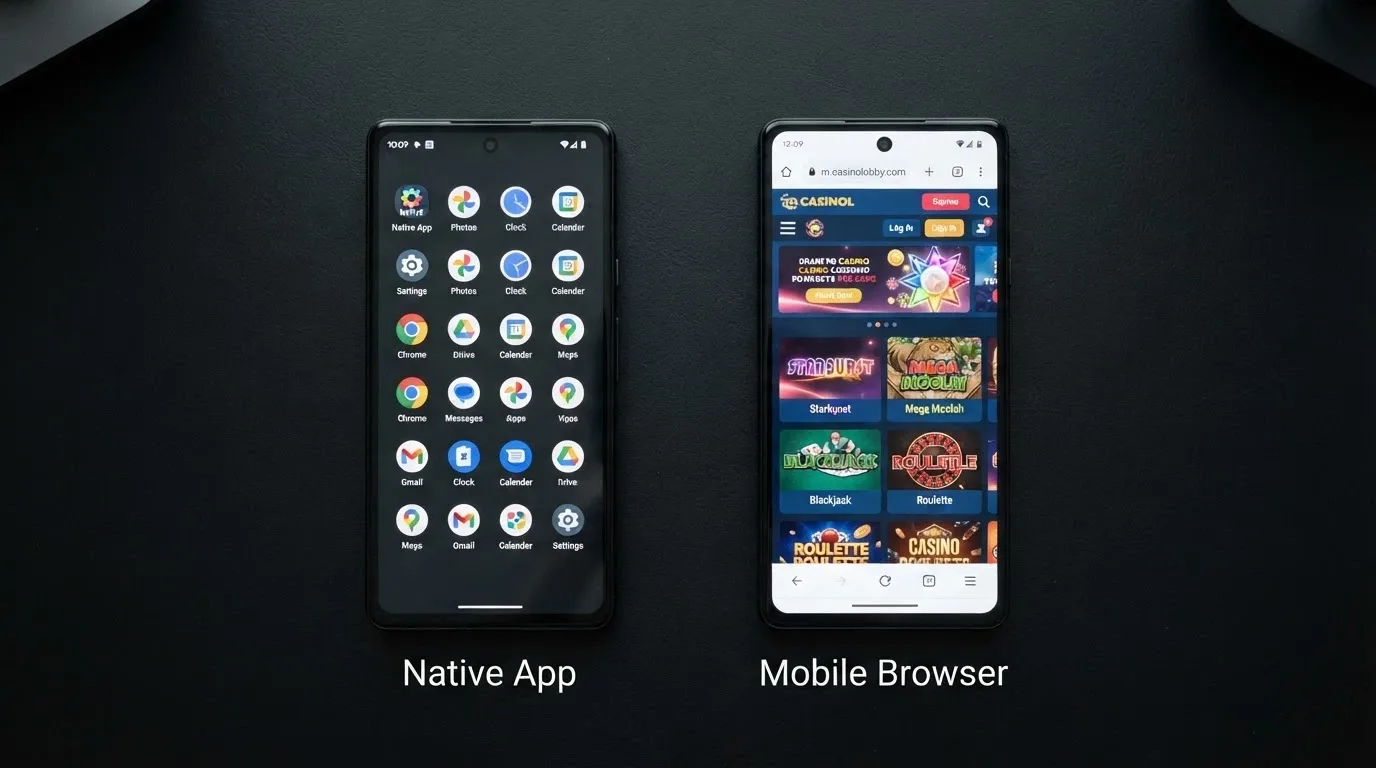
The delivery form matters less for game selection than for two things the reader actually feels. Native apps carry the security trade-off of a sideloaded program — they can request broader device permissions, push updates outside store review, and stay reachable even when ACMA has blocked the brand’s website at DNS level. Mobile-browser play carries no install risk but is the most exposed to ISP blocking, because the site itself is what gets blocked. PWAs split the difference. None of the three holds an Australian licence. The form is how the app arrives; it is not what it is.
Real-Money Stakes vs Free-Play Fun — Two Products Under One Label
The IGA prohibition covers real-money interactive gambling services — products where a player deposits Australian dollars, plays for stakes, and can withdraw winnings. It does not reach free-to-play social casino apps, where players buy virtual credits with in-app purchases and never cash out. The two are different products with different business models, different legal exposure and different player profiles, and a comparison page that does not separate them is comparing a casino to Candy Crush. Real-money play on the apps covered in this article means AUD in and AUD out, with all the friction that involves. Free-play apps mean entertainment spend with no cash-out promise — closer to a mobile game than to a wagering service. The offshore casino apps in this ranking are exclusively the real-money kind. The free-play category is a separate market, runs entirely under the rules of the app stores, and is not what most Australians looking for casino games are looking for — which is part of why so many of them end up on the offshore sites the IGA names.
New Casino Apps in 2026 — What Has Changed and What Has Not
The new-entrant pipeline in the offshore market is steady: brands launch, rebrand, switch parent companies, and disappear. The legal reality has not shifted. Since the Interactive Gambling Amendment Act 2017 closed the offshore-only carve-out and gave ACMA its enforcement powers, the prohibition has been the same statute, enforced by the same regulator, against the same product. The Interactive Gambling Amendment (Gambling Reform) Bill 2026 passed Parliament on 19 August 2026 and commences on 1 January 2027, but its measures tighten advertising, inducements and bank-blocking powers rather than legalise the underlying product. What “new” delivers, in 2026, is mostly cosmetic change — a new theme, a new bonus headline, a fresh welcome package for the same offshore wrapper. The brand may not have existed five years ago, but the legal exposure it asks the player to accept has not changed at all. The reader searching for a new season’s “best casino app” is, in nearly every case, choosing between older and newer members of the same unlicensed set.
The 10 Casino Apps Australians Are Actually Using in 2026
The table below ranks the ten offshore casino operators drawing the largest share of Australian traffic, by market-share percentage. Every one of them operates without an Australian licence, because no such licence exists. Market share measures reach, not legitimacy; revenue measures how much money the operator collects, not how safely it pays out. Both numbers are useful. Both are interpreted strictly. The licence column is the one that decides what category the brand sits in.
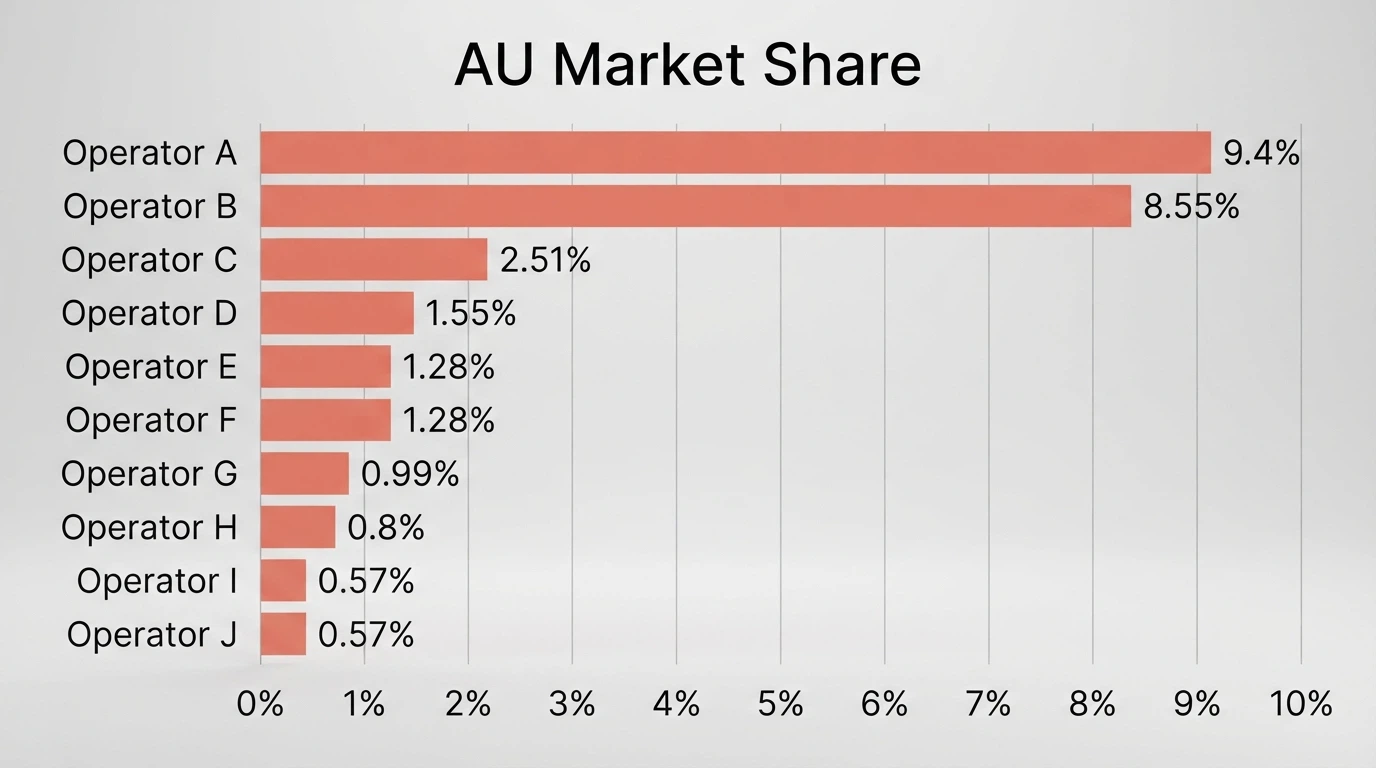
| Brand | AU Licence Status | Market Share | Revenue (AUD) |
|---|---|---|---|
| Rocket Play | Offshore casino — no AU licence | 9.4% | $632.69M |
| Skycrown | Offshore casino — no AU licence | 8.55% | $436.07M |
| Royal Reels | Offshore casino — no AU licence | 2.51% | $243.99M |
| Stake | Offshore casino — no AU licence | 1.28% | $115.67M |
| WinSpirit | Offshore casino — no AU licence | 1.55% | $110.3M |
| Rainbet | Offshore casino — no AU licence | 1.28% | $83.13M |
| Scream Casino | Offshore casino — no AU licence | 0.99% | $94.87M |
| FairGO | Offshore casino — no AU licence | 0.8% | $69.11M |
| Bizzo Casino | Offshore casino — no AU licence | 0.57% | $51.38M |
| Rocket Casino | Offshore casino — no AU licence | 0.57% | — |
The drop from the top two to the rest of the field is sharp: Rocket Play and Skycrown together hold 17.95% of the measured market, more than the remaining eight combined. The gap reflects how the offshore casino market concentrates around two well-marketed flagships, with a long tail of mid-share brands filling out the rest. What unites all ten is the column on the left — every one of them sits in the same legal category, regardless of how much Australian traffic they pull. The volatile fields — bonus terms, wagering multipliers, game providers, free-spin counts, payout caps, app platforms — could not be refreshed from live sources this round, so specific per-operator figures are marked as unavailable on this page. What follows is what can be said from the data that was available: brand identity, market position, revenue scale, and the legal status each one shares with every other.
Rocket Play
Rocket Play leads the offshore market for Australian casino apps by a clear margin — 9.4% of measured traffic share, against $632.69M in revenue. The brand is the largest single pool of Australian-facing offshore casino activity in the dataset, which puts it in the unusual position of being both the most-tested and the most-exposed. More Australian player reports circulate about Rocket Play than about any of the other nine operators, which is useful information for a reader researching the brand. It is not, on its own, evidence of safety. For a player who has decided to use an offshore casino app regardless of the legal status, Rocket Play is the operator with the largest Australian user base and therefore the largest body of public experience to weigh. The verdict on Rocket Play is the verdict on the category — it is the most-trafficked version of a product no Australian regulator oversees, and the size of its user base is the only thing that meaningfully distinguishes it from the operator ranked ninth.
Skycrown
Skycrown sits at 8.55% market share with $436.07M in revenue — the second-largest offshore operator in the Australian dataset and the natural point of comparison for anyone considering Rocket Play. The two brands operate the same product category under the same legal status, and the choice between them turns on factors this page cannot verify in detail this round: bonus terms, payout reliability, game providers, mobile-app stability. Skycrown’s profile is materially similar to Rocket Play’s at slightly smaller scale. It is the second-largest offshore brand Australians download and behaves accordingly — same product category, same absence of Australian recourse, materially smaller user base than the leader. For a player who values a slightly more varied welcome package over the largest player pool, Skycrown is the obvious alternative; for a player who values nothing about being offshore in the first place, neither brand is the answer.
Royal Reels
Royal Reels is the third-largest offshore casino app by Australian market share at 2.51%, with $243.99M in revenue. The drop from Skycrown’s 8.55% to Royal Reels’ 2.51% is the largest single step-down in the table — a useful reminder that the “top 10” the title of this article names is not a flat field. Royal Reels is mid-pack by every measure and the smallest brand by share in the upper half of the table. The revenue is real, the licence is not. That is the only sentence worth memorising about Royal Reels — and about every other brand on this list. Royal Reels is a serviceable example of the offshore casino app category at Australian-facing scale, suitable for a player who has already made the choice to use one and is comparing the third option against the first two.
Stake
Stake is a globally recognised brand whose Australian-facing operation sits at 1.28% market share with $115.67M in revenue. The wider brand recognition cuts both ways: it makes Stake easier to research for a player deciding whether to download, and it makes the absence of an Australian licence more striking. A brand this well-known cannot reasonably be mistaken for an Australian-licensed operator, but a reader unfamiliar with the offshore market may default to assuming otherwise. Brand familiarity does not change a brand’s licensing status. It does not. Stake is the clearest example on this list of why the size of a logo and the reach of a marketing budget say nothing about whether the regulator behind the operation is Australian or offshore.
WinSpirit
WinSpirit holds 1.55% market share — mid-pack — with $110.3M in revenue. The brand sits between Stake and Rainbet in the ranking and is one of the most anonymous operators in the table to a casual reader, which is itself a useful data point. A 1.55% share of the measured Australian offshore casino market is still millions of dollars per month in real-money play from Australian residents, processed by an operator with no Australian licence. $110.3 million in revenue from a brand sitting at 1.55% of the market is the clearest illustration on this list of how much money an unlicensed offshore operation can move at modest share. WinSpirit is the brand whose existence, more than Rocket Play’s or Skycrown’s, makes the case that the offshore casino market is a substantial Australian consumer market the IGA names as illegal — not a fringe activity.
Rainbet
Rainbet is a crypto-adjacent operator at 1.28% market share with $83.13M in revenue, sitting level with Stake in the ranking. The crypto positioning matters because of the Australian payment-method ban from 11 June 2024: crypto is not a permitted payment for online wagering in Australia, with operator penalties up to $247,500 for failing to enforce. Rainbet’s continued operation and Australian traffic share is direct evidence that the offshore market routes around the ban by operating from outside the country. For a player specifically looking for a crypto-deposit path, the niche is real. The same payment-method ban from 11 June 2024 applies whether the operator acknowledges it or not — and Rainbet, by definition, does not acknowledge it. Rainbet is the most direct example on this list of an offshore casino whose product is the workaround rather than the underlying game.
Scream Casino
Scream Casino holds 0.99% market share — just under 1% — and clears $94.87M in revenue, putting it at a higher revenue-per-share point than several larger-traffic brands on the list. The long tail of the offshore market is not a small-economy phenomenon. Even at sub-1% share, an unlicensed offshore casino can move nine-figure revenue from Australian players, which says something about the dollar value the prohibition is currently failing to capture. A 0.99% market-share brand clearing $94.87M in revenue is a useful reminder that “long tail” in the offshore market still runs into nine-figure annual numbers. Scream Casino is not the brand most Australian readers will have heard of, but the money moving through it from Australia is more than most Australian-licensed mid-tier operators see in a year.
FairGO
FairGO holds 0.8% market share with $69.11M in revenue, and its name is its most dangerous feature. The .au-style branding — capital letters, an abbreviation that reads as Australian — is a marketing choice that does not correspond to a regulatory fact. There is no AU-licence-issuing body called “GO”, and FairGO is offshore like every other brand on this list. The .au-style naming is marketing, not regulation. FairGO holds no Australian licence. The brand is the clearest single example on this list of an operator that trades on the appearance of local status without the substance, and the Australian reader who picks FairGO on the strength of the name alone has been misled by design.
Bizzo Casino
Bizzo Casino is one of the smallest operators in the featured set at 0.57% market share with $51.38M in revenue. The brand rounds out the table at the smaller end of the long tail. For a reader using this page to compare options, Bizzo is the test case for how much of the offshore market share actually matters at the lower end: at 0.57%, the brand is still a substantial revenue operation, still pulling Australian dollars, still operating outside Australian law. For a brand at 0.57% of the market clearing $51.38M, the takeaway is not the dollar figure — it is that even the smallest operators in this set operate at a scale most legitimate small businesses never reach. Bizzo Casino is the bottom of the top 10, and the bottom of the top 10 is still a nine-figure offshore operation by revenue.
Rocket Casino
Rocket Casino sits at 0.57% market share alongside Bizzo Casino, but with a notable caveat: the brand is distinct from Rocket Play despite the naming similarity, and its revenue figure was not carried in the data this round. That data gap is the kind a reader should know about — a brand at the bottom of the table with revenue undisclosed is a brand whose scale is harder to verify than any other on the list. Rocket Casino was not a brand on which revenue figures could be refreshed this round. What can be said is what can be said about every operator on this list: no Australian licence, no Australian consumer protection, no BetStop binding. The Rocket name on two of the ten operators in this ranking is itself worth flagging — they are not the same brand, and confusing them would be an avoidable mistake.
Why Nearly Every Casino App You Use Is Breaking Australian Law
The Interactive Gambling Act 2001 prohibits the provision of online casino games, online pokies and in-play sports betting to a person in Australia. The prohibition targets the operator, not the player — but that distinction matters far less than it sounds. There is no federal or state/territory licence for online casino anywhere in Australia. Not for pokies, not for table games, not for live dealer. The product category is unlicensed because the licence category does not exist, and every brand listed in this article operates in that gap. The activity-level picture is clearer than the brand-level picture. Australia regulates gambling by activity, not by operator, and the activities an Australian can lawfully access online sit in a different column from the activities on offer at the offshore apps.
| Activity | Legal Status Under IGA 2001 | Regulator |
|---|---|---|
| Online casino games | Prohibited | ACMA |
| Online pokies (slots) | Prohibited | ACMA |
| In-play sports betting | Prohibited | ACMA |
| Pre-event sports wagering | Permitted and licensable | State / territory (NT Racing and Wagering Commission as the de facto national online licensor) |
| Race wagering | Permitted and licensable | State / territory |
| Lotteries and keno | Permitted and licensable | State / territory |
| Land-based casinos | Permitted and state-licensed | State casino control boards |
The split is sharp: anything that looks like a casino on a phone screen is prohibited, and anything that looks like a bet on a horse race or a sports result placed before the event begins is permitted and licensed. The offshore casino apps fill the first column. SportsBet, Tab, Bet365 and the rest of the licensed wagering market fill the second — and they do not sell casino games, which is the entire reason an Australian looking for a “casino app” ends up on an offshore site.
The Interactive Gambling Act — What It Actually Prohibits
The IGA, as amended in 2017, draws a line around a small set of activities and prohibits their supply to Australians. Online casino games, online pokies and in-play sports betting fall inside the line. Wagering on races and sport placed before the event, lotteries and keno fall outside it, and each is licensed at state or territory level — typically through the Northern Territory Racing and Wagering Commission for online operators, since the NT regime is the de facto national licensor. Land-based casinos are licensed by state casino control boards (Crown, The Star and others) and are a separate, valid contrast — but they are not the licence under which any online casino operates. The wagering advertising rules illustrate how the boundary is enforced on the marketing side. Wagering advertising is legal but restricted, and inducements — sign-up offers, referral bonuses, the kind of headline-grabbing welcome package the offshore apps lean on — are prohibited or tightly limited by several states. The rules differ by jurisdiction. From 1 January 2027 the regime tightens further: no more than three wagering ads per hour between 6:00 am and 8:30 pm, a live-sport blackout from 15 minutes before to 5 minutes after an event, athletes and influencers barred from promotion, and a 14-day cooling-off on direct marketing of inducements after sign-up. None of this reaches offshore casinos, which operate under none of the rules.
ACMA’s Blocking Record — 1,564 Sites and Counting
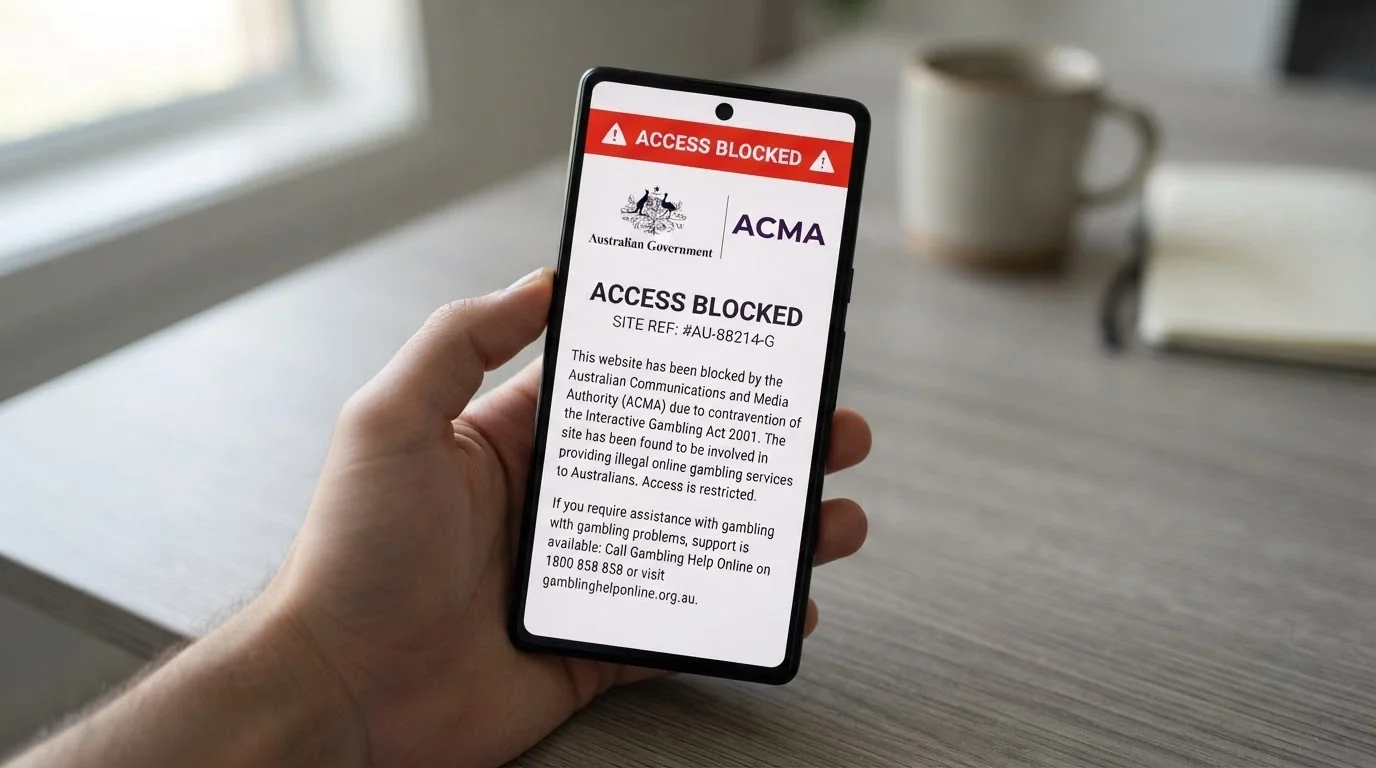
The Australian Communications and Media Authority is the federal regulator that enforces the IGA’s online prohibition. ACMA investigates complaints, issues formal warnings, brings civil penalty proceedings, and directs Australian ISPs to block illegal services at DNS level. Since its first blocking request in November 2019, ACMA has had 1,564 illegal gambling and affiliate websites blocked. More than 225 illegal services have withdrawn from the Australian market since enforcement was strengthened in 2017. The practical consequence of the blocking power is the one the offshore apps do not advertise. A site can be blocked with a player balance still on it. There is no statutory requirement for the operator to return that balance. The player loses access to the URL, often via the redirect page ACMA’s blocking direction produces, and is left to find the operator through alternative channels — mirror domains, email, sometimes VPN support. The legal status of the balance owed to them under those circumstances is closer to “unresolved” than “protected”.
“Not Illegal for You” Is Not the Same as Safe
The IGA targets the provider. The individual player is not prosecuted. That fact gets quoted by affiliate marketers as a green light, which is exactly the wrong reading of it. “Not illegal for you” means no criminal exposure under Australian law; it does not mean the offshore casino is regulated, that deposits are protected, that withdrawals will be processed, that a self-excluded player will be refused service, or that anything ACMA does can recover a player’s money. The distinction is worth carrying through the rest of this page. The Australian player on an offshore casino app is not a criminal. They are also not a consumer in any meaningful sense — no regulator has standing to act on their behalf, no ombudsman will hear their complaint, no BetStop registration stops them from depositing, and no chargeback process will recover crypto already sent. The legal position is technically permissive; the practical position is empty.
The Bonus That Looks Too Good to Be True (and Usually Is)
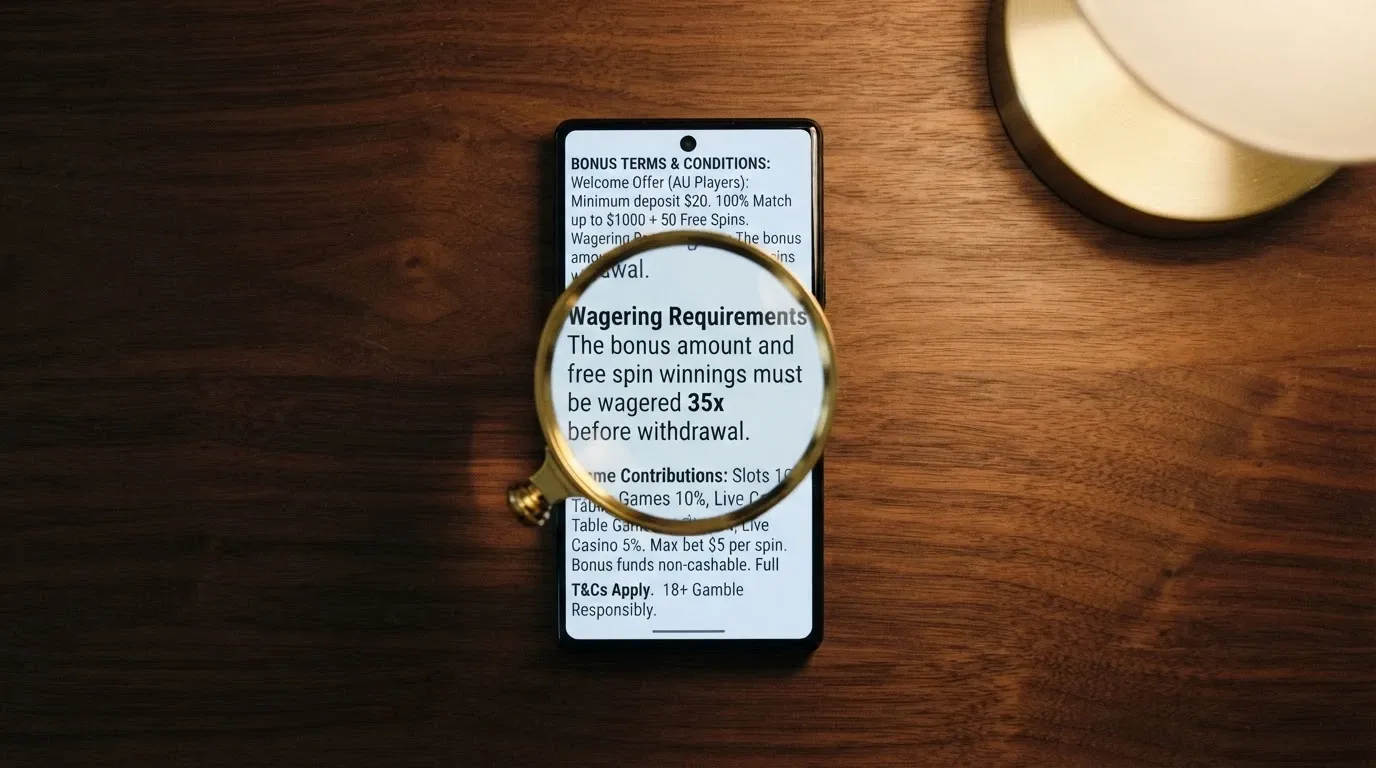
Welcome bonuses are the marketing backbone of the offshore casino app business. They are also the place the small print eats the headline. The structure of every casino welcome offer is the same four-part formula, and the four parts are the only four a player needs to read: a match percentage, a maximum cap, a wagering multiple, and a validity window. The first two are what the marketing shows. The second two are what decides what the bonus actually costs. The Australian regulatory context sharpens the point. For Australian-licensed wagering, inducements are prohibited or tightly limited by several states — the rules differ by jurisdiction, and from 1 January 2027 the regime tightens further, with direct marketing of inducements prohibited for 14 days after sign-up, for three months after deregistration from BetStop, and indefinitely for customers identified as at risk. Offshore casinos face none of these restrictions, which is why their welcome offers look the way they do. The lack of restriction is the reason the marketing exists, and the marketing is the reason the small print matters. The volatile figures — specific bonus amounts, wagering multipliers, game-contribution percentages, validity windows for the operators ranked above — could not be refreshed from live sources in this round. What follows is the structure of a typical offshore welcome offer and the traps inside it, drawn from the market-wide pattern. Specific per-operator terms should be requested from the operator and read in full before any deposit is made.
Welcome Bonuses — The Headline Number vs the Real Cost
A typical offshore welcome offer takes the form “100% match up to A$500 plus 200 free spins” — a number the player can see, paired with a number the player cannot easily evaluate. The match percentage (here, 100%) tells the player how much of their own deposit the operator will credit as bonus funds. The cap (A$500) sets the maximum bonus size. Free spins are bundled in. The wagering multiple — commonly 35x to 50x the bonus amount in this market — is the number that decides what the bonus costs the player to clear, and it is the one figure the marketing tends to bury. Game-weighting contributions are the second layer. Pokies typically contribute 100% to wagering; table games often contribute 0% to 10%, which means a A$500 bonus with a 40x wagering requirement on blackjack is essentially uncashable. The validity window — usually 7 to 30 days in this market — sets the deadline. A bonus the player cannot clear in time is a bonus the operator keeps. Read the four numbers before depositing. The marketing figure is the bait; the small print is the contract.
Loyalty Rewards and Ongoing Promotions — The Long Game
Beyond the welcome offer, offshore casino apps use reload bonuses, cashback offers, VIP or loyalty tier programmes, and tournament or prize-draw promotions to keep deposits flowing after the first one. The mechanics vary, but the structural pattern is the same: a credit offered in exchange for continued play, a tier ladder that rewards higher deposit volume, and tournament entries priced in bonus funds the player has not yet earned. None of these mechanisms are subject to Australian responsible-service-of-gambling obligations, because none of the operators offering them are licensed in Australia. State-level inducement rules, BetStop exclusion coverage, the activity-statement requirements that licensed wagering services must provide — none of it applies. The loyalty offer on an offshore casino app is whatever the operator’s terms page says it is, and the only authority reading that page is the operator’s own compliance team.
Getting Paid — Why Withdrawals Are Where Offshore Apps Show Their True Colours
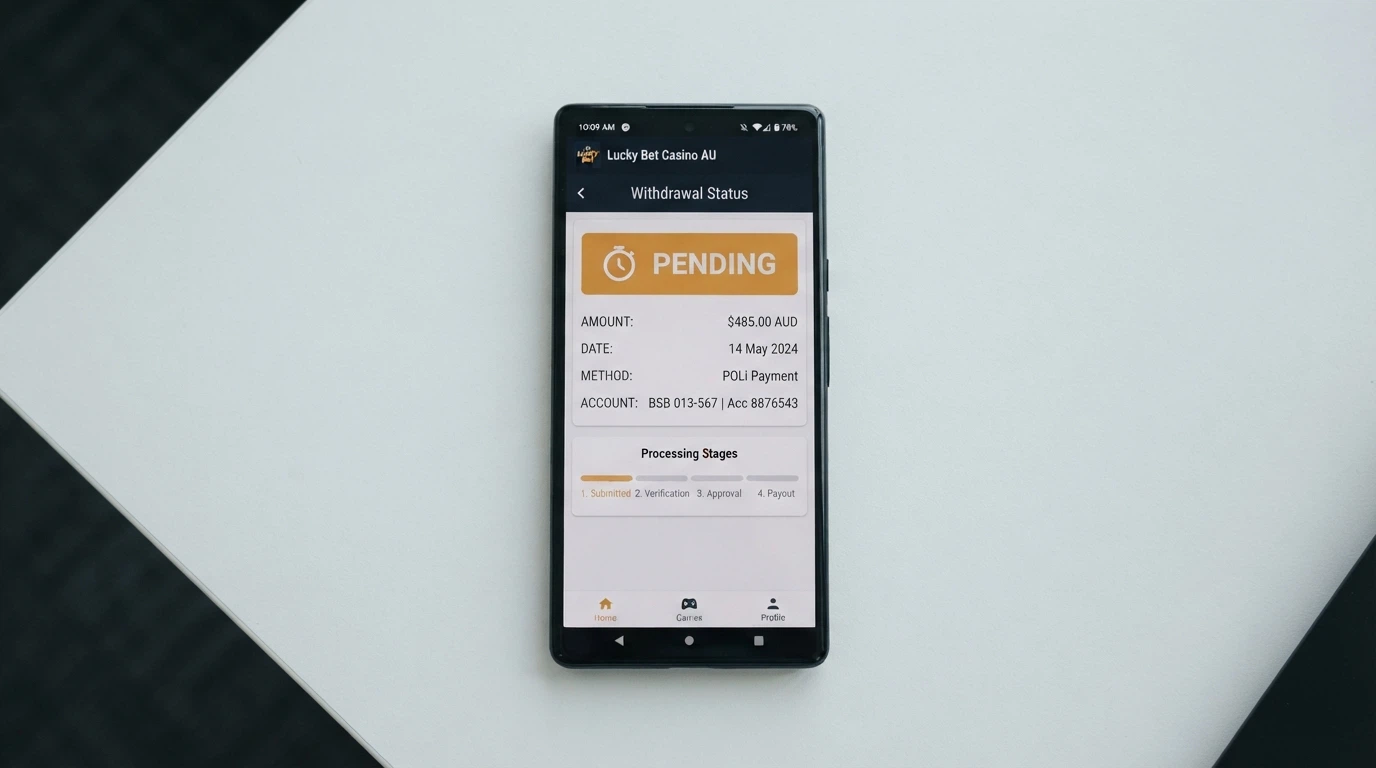
The deposit is the easy part. Every offshore casino app listed in this article accepts deposits through methods that range from legal to illegal under Australian law, and most push the illegal options hardest. The withdrawal is where the operator’s intentions become visible, and the Australian player has no regulator to call when the operator’s intentions turn out to be slow, partial, or absent.
| Payment Method | Legal Under IGA? | Offshore Casino Reality |
|---|---|---|
| Debit card | Yes | Often accepted at deposit; withdrawals can be slow or refused |
| Bank transfer | Yes | Sometimes accepted; sometimes discouraged for amounts over operator thresholds |
| PayID / Osko | Yes | Rarely accepted — most offshore casinos do not route NPP |
| BPAY | Yes | Rarely accepted — AU-specific, almost never offered offshore |
| Credit card | No (banned from 11 June 2024) | Frequently the first option offered at deposit |
| Cryptocurrency (Bitcoin, USDT, Ethereum) | No (banned from 11 June 2024) | Frequently pushed at deposit; irreversible once sent |
The table’s pattern is the point. The methods Australia has declared legal for online wagering are the methods offshore casinos are least likely to offer. The methods Australia has banned are the methods offshore casinos push hardest. From 1 January 2027, banks and payment providers gain express authority to block transactions to illegal gambling operators outright, which will reshape the table but not the underlying problem.
How Deposits Work — and Which Payment Methods Are Actually Legal
Legal deposit routes for Australian wagering are debit card, bank transfer, PayID/Osko and BPAY. From 11 June 2024, credit cards, credit-related products and digital currency are banned as payment for online wagering, with operator penalties up to $247,500 for failing to enforce. The offshore casino apps in this article operate outside Australian law and frequently offer the banned methods as their primary deposit option — the payment method the operator pushes first is the most reliable signal that the operator sits outside Australian rules. Identity verification is standard across the offshore market: a driver’s licence or passport, a proof of address, and increasingly a source-of-funds check at higher deposit volumes. These checks are not consumer protection — they are anti-money-laundering procedure run for the operator’s benefit, not the player’s. They protect the operator’s banking relationships, not the player’s right to withdraw what they have won.
The Withdrawal Problem — Delays, Refusals and Zero Recourse
The withdrawal screen on an offshore casino app is the place the absence of an Australian regulator becomes concrete. Operators run pending periods of 24 hours to several days before processing. They require fresh verification documents at withdrawal — sometimes documents that were already accepted at deposit. They impose minimum and maximum withdrawal amounts, often with daily, weekly or monthly caps that force a large balance out in slow tranches. They restrict which deposit methods can be used to withdraw (a Visa deposit must come back to a Visa, and a Visa refund can take longer than the original deposit). The Australian player’s position on the other side of those policies is empty. ACMA enforces the IGA against offshore operators but does not handle individual withdrawal disputes. There is no Australian ombudsman, no statutory right to payment, no chargeback route through the bank for crypto already sent, and no equivalent of the UK Gambling Commission’s complaints process. The only practical recourse when an offshore casino refuses a withdrawal is the operator’s own internal escalation, which is not a recourse. From 1 January 2027 banks can refuse to process transactions to illegal operators outright, which closes the deposit door but does not open a withdrawal door.
Android vs iPhone — Does Your Phone Change Which Casino App You Should Pick?
The short answer is no. The ten operators in this article’s ranking are the same ten whether the player uses a Samsung, a Pixel, an iPhone or an iPad. What changes between platforms is the path the app takes to reach the device, not which app it is. The set of operators is identical because the set of operators is determined by who accepts Australian players offshore, and that does not depend on the phone in the player’s hand. What does depend on the phone is the install experience. Android users install APK files outside Google Play or load operators’ progressive web apps through the browser. iPhone users install via enterprise certificates, TestFlight invitations, or browser-based home-screen shortcuts that sidestep the App Store. Both paths carry risks the official store would not allow. None of them confer an Australian licence on the app once installed.
Android Casino Apps — Sideloading, APKs and the Risks You Accept
Google Play prohibits real-money online casino apps in Australia because no Australian licence exists for the product. The Android path to the operators in this article runs through APK sideloading: the player visits the operator’s site, downloads an APK file, and grants the device permission to install from unknown sources. The install is a single action; the security trade-off is permanent. The APK runs outside Google Play’s review process, can request device permissions a Play Store app would not be allowed to ask for, and updates outside the store’s review loop. For a player who has already decided to use an offshore casino app, the practical implication is that any Android security issue with the operator falls on the player’s device, not on Google’s review team. Sideloading is a choice to take the operator’s word on what the app does. The risk is not theoretical — malware posing as casino apps is a known category — and the only mitigation is sticking to the operator’s own download link and treating any third-party APK source as compromised by default.
iPhone, iPad and iOS — The Apple Side of the Equation
Apple’s App Store applies a similar prohibition in Australia for the same reason — no AU-licensed online casino exists, so no AU App Store listing for one is possible. The iOS workaround the offshore operators use is a moving target. The most common current path is a mobile-browser web app added to the home screen, which behaves like an installed app without triggering App Store review. Some operators route through enterprise certificates, which Apple periodically revokes; some use TestFlight, Apple’s beta-distribution system, for limited invitations. None of these paths survive an iOS security update indefinitely. The iPad experience is the same as the iPhone experience on most offshore operators — the same mobile website, the same games, sometimes with a slightly different layout. There is no native iPad casino app from any of the operators in this ranking, because there is no licensed Australian casino product for Apple to stock. The walled garden does keep most low-quality malware out, but it does not keep the offshore casinos themselves out, and the methods they use to get in carry their own failure modes.
Pokies, Blackjack and Live Dealer — Without Leaving Your Couch
The game libraries on the offshore casino apps are large. Most carry thousands of titles across pokies (slots), table games and live dealer. The breadth is real, and it is one of the reasons Australian players keep using these apps despite the legal exposure — the licensed Australian wagering operators cannot sell casino games, so the offshore set is the only place this product is available on a phone. The lack of Australian regulatory oversight is the corresponding fact. RTP percentages, volatility classifications, payout-audit certifications and game-fairness testing all happen under the rules of the jurisdiction the operator sits in — Curaçao, Malta, occasionally the Isle of Man. None of those jurisdictions offer an Australian player recourse if a game turns out to be unfair, and none of them are subject to Australian Consumer Law. The breadth of the catalogue and the absence of consumer protection go together.

What the App Libraries Actually Hold — Thousands of Titles, Zero Australian Oversight
A typical offshore casino app library runs from 1,500 to 5,000+ game titles, supplied by a long tail of game studios — Pragmatic Play, Evolution, NetEnt, Microgaming, Play’n GO, BGaming, dozens of smaller providers. Pokies dominate the count, usually 80% or more of the catalogue. Table games — blackjack, roulette, baccarat, casino hold’em — fill out most of the rest, with live dealer rooms streamed from studios in Eastern Europe and Latin America taking a growing share of session time. Per-title RTP and volatility data was not verifiable in this round and is not published on this page. What can be said is that none of these titles is tested to an Australian standard, because no Australian standard for online casino game fairness exists — the IGA’s prohibition means there is no domestic regulator to set one. The player who wants to evaluate a title’s RTP has to read the operator’s own published number, which is whatever the operator’s game provider states, and trust that the version the operator ships to Australian players is the version that was tested. Demo or free-play mode is the safest way to test a title without staking real money; the offshore apps typically offer it on most of the catalogue.
If an App Asks for Crypto, It Is Telling You Something
A casino app that asks an Australian player to deposit Bitcoin, Ethereum, USDT or any other cryptocurrency is not offering a payment convenience. It is offering a payment method that has been banned for online wagering in Australia since 11 June 2024, alongside credit cards, with operator penalties up to $247,500 for failing to enforce the ban. The penalty applies to operators licensed in Australia. The offshore operators asking for crypto are not licensed in Australia, which is why the ban does not stop them and why the penalty does not reach them. The ban is what the payment-method choice reveals. When an offshore casino pushes a crypto deposit at the registration stage, the operator is signalling that it sits outside the Australian payment rules, outside the Australian identity-verification norms, and outside the Australian consumer-protection system. The KYC/AML gap that crypto creates is the point for some operators — players who prefer to deposit without involving a bank account find the offshore crypto-friendly apps attractive for exactly that reason — and the same gap is the structural reason a player has no Australian recourse if the balance disappears. Crypto transactions are irreversible once confirmed; once the player has sent the coins, there is no chargeback, no recall, no ombudsman. Rainbet at 1.28% of the Australian offshore market is the most direct example on this list of an operator whose deposit path is the workaround. From 1 January 2027, banks and payment providers gain express authority to block transactions to illegal gambling operators — which will slow fiat deposits but does not touch crypto, because crypto does not pass through a bank. The crypto path is, structurally, the path of last resistance for offshore operators facing Australian enforcement, and the most direct way for an Australian player to land on a brand that is operating openly outside Australian rules.
Free-Play Mode — The One Feature Every App Should Offer
Free-play or demo mode is the closest thing to a risk-free experience the offshore casino app market can offer. In demo mode, the player loads a pokies title or a table game with virtual credits instead of real AUD. There is no deposit, no withdrawal, no risk of losing money — and no possibility of winning any. The credits reset when the page is closed. Demo mode is what a player should use to test whether an app performs well on their phone, whether the game catalogue is what they want, and whether the user interface is something they can live with before handing over personal details and a deposit. The IGA prohibition does not reach free-play social casino games. The ban is on real-money interactive gambling services, which is what the operators in this article sell. Free-play inside a real-money app — the demo-mode toggle most offshore operators expose — is not the product the IGA prohibits, because no money changes hands and no wagering occurs. A standalone free-to-play social casino app is a different product again: an entertainment app where players buy virtual credits with in-app purchases and never cash out. Both are legal in Australia. Both are useful tools for the player deciding whether to use an offshore real-money app at all. The catch is that demo mode on an offshore real-money app is run by the same operator who would handle a real-money deposit and any subsequent withdrawal. Testing the games in demo mode does not test the operator’s payment reliability, KYC handling, withdrawal policy or dispute resolution — none of which can be tested without putting real money in. Free-play is the right place to evaluate the games. It is not a substitute for the operator-level due diligence the rest of this page describes.
The Safety Net Offshore Apps Cannot Offer You
Australian-licensed wagering services are required to connect to BetStop, the National Self-Exclusion Register. BetStop has been live since August 2023. As at 31 July 2026, 67,480 Australians had registered, of which 41,290 exclusions were still active. 78% of registrants were under 40. 38% chose lifetime exclusion. One BetStop registration excludes the person from every Australian-licensed online and phone wagering service. None of those services includes an offshore casino. BetStop does not bind a single offshore casino. An Australian who has registered with BetStop can still deposit, play, and lose money on any of the ten apps in this article’s ranking. Self-exclusion under the Australian system is a permission the operator enforces; on an offshore app, it is a courtesy the operator does not have to honour. The same gap covers the other consumer-protection features the Australian licensed market requires: customer-set deposit limits, activity statements, take-a-break tools, the responsible-gambling code of conduct. All of these exist for Australian-licensed wagering. None of them reaches an offshore casino. The wider prevalence picture makes the safety-net gap consequential. Approximately 2.1% of Australian adults — roughly 430,000 people — experience problem gambling. The Australian Institute of Health and Welfare put high-risk gambling at 1.8% in 2022. The minimum age for all commercial gambling in Australia is 18, including for offshore casinos that nominally accept Australians — though offshore age-verification is patchier than the licensed market’s.

BetStop, the Helpline and Where to Turn When Gambling Stops Being a Choice
The Australian help infrastructure for gambling harm is free, confidential and 24/7. The single concrete action a player who feels they are losing control should take is to call or go online — and to know that none of the offshore apps in this ranking will pick up on the other end.
- National Gambling Helpline: 1800 858 858 — free, confidential, staffed 24/7
- Gambling Help Online: gamblinghelponline.org.au — online chat, email and counselling
- BetStop: National Self-Exclusion Register — betstop.gov.au — one registration excludes the person from every Australian-licensed wagering service; does not reach offshore casinos
The honest framing is the one the data supports. The helpline and Gambling Help Online are useful and reachable. BetStop is useful for licensed wagering and useless for the offshore apps. The safety net exists. It has a hard edge that runs along the Australian licensing line, and the offshore casinos sit on the wrong side of it.
How We Selected and Ranked These Casino Apps
The ranking on this page is built from two data sources. The operator set and the market-share numbers come from an industry tracking dataset that measures brand-level traffic and revenue for the Australian online gambling market. The legal framework — what is permitted, prohibited and enforced — comes from the Australian Communications and Media Authority’s published guidance on the Interactive Gambling Act and the National Self-Exclusion Register. The threshold check was licence status. Every operator in the top 10 was filtered for Australian casino licence status before being ranked. No operator passed the filter, because no Australian licence for online casino exists. The top 10 is therefore the top 10 offshore operators drawing Australian traffic, not a comparison of regulated alternatives. There are no regulated alternatives to compare against. The sort is by market share. Revenue and brand identity are carried alongside. No weighting scheme, no scoring rubric, no proprietary scoring algorithm — the rank order is the market-share order from the underlying dataset, and the brand write-ups are positional summaries of what each operator brings to the same offshore casino market. The volatile fields could not be refreshed from live sources in this round. Specific bonus terms, wagering multipliers, game provider lists, free-spin counts, payout caps and app platforms are not published per-operator on this page. The market-share rankings and the legal-status determinations are the verifiable core. Live operator terms change; what is published on the operator’s site today may not match what is published there in a week, and the page does not pretend to a level of freshness it cannot demonstrate.
What You Should Actually Do About Casino Apps in Australia
The first decision a reader of this page faces is whether to use an offshore casino app at all. The legal framework has been laid out above: the product is prohibited in Australia, the operator faces the prohibition, the player does not, and the player gets no Australian consumer protection as a result. The convenience and the game variety are real. The absence of an Australian regulator is also real, and it bites at the two points that matter most — when a withdrawal stalls, and when a player wants the operator to stop taking their money. For readers who want to bet online without leaving the Australian regulatory perimeter, the licensed wagering operators — SportsBet, Tab, Bet365, Ladbrokes, PointsBet and others — offer sports and race betting with Australian licences, BetStop coverage, deposit-limit tools, activity statements and complaint pathways through state regulators. They do not offer casino games. That distinction is the whole story. The player who wants casino games cannot get them from an Australian-licensed provider; the player who wants Australian consumer protection cannot get it from an offshore casino. Free-play is the third route. Demo mode inside a real-money app, or a standalone free-to-play social casino app, gives the player the casino game experience with no money changing hands. It is not the same as real-money play — the volatility, the bet-sizing decisions, the loss of money — but it is the legal, harmless and structurally honest way to enjoy the casino game format on a phone in Australia. For readers who choose to use an offshore casino app regardless of the legal exposure, a short checklist. Check whether the operator holds an Australian licence (it does not). Check the payment methods asked for at deposit — credit card and crypto are banned for Australian wagering and signal an offshore operator. Read the full bonus terms before depositing, including the wagering multiple, the game-contribution rules and the validity window. Confirm the withdrawal minimums and caps before depositing, not after. Keep the National Gambling Helpline number (1800 858 858) where it can be found quickly. The single best protection any player has on an offshore casino app is the decision not to deposit, made with all the information available, before any money moves.
Frequently Asked Questions
What is the best casino app for Australian players in 2026?
No Australian-licensed casino app exists, so there is no regulated best. Of the offshore apps Australians download most often, Rocket Play leads traffic at 9.4%, Skycrown at 8.55%, and Royal Reels at 2.51%. The question is less which unlicensed operator to pick than whether to play on one at all.
How do I deposit and withdraw on an Australian casino app?
Most offshore casino apps take credit cards, e-wallets or crypto at deposit — methods banned for Australian wagering since 11 June 2024. Legal methods (debit card, bank transfer, PayID, BPAY) are rarer offshore. Withdrawals run on operator verification with no Australian consumer protection if they stall.
Do casino apps in Australia offer no-deposit bonuses or free spins?
Most offshore casino apps market no-deposit credit and free-spin offers, but the terms that decide what they cost — wagering multiples, game weighting, withdrawal caps — were not verifiable in this round. The market-wide pattern: a small headline number, a heavy turnover requirement, and a short validity window. Treat the “free” offer as paid in advance.
What can I do if a casino app will not pay out my winnings?
Practically nothing within the Australian system. ACMA enforces the prohibition against offshore casinos but does not handle individual withdrawal disputes. There is no Australian ombudsman, no statutory right to payment, and no chargeback route through your bank for a crypto deposit. The only real protection is choosing not to deposit in the first place.
Is BetStop connected to offshore casino apps?
No. BetStop — the National Self-Exclusion Register — covers every Australian-licensed wagering service, and 67,480 people had registered by 31 July 2026. It does not bind a single offshore casino. A self-excluded Australian can deposit and play on any of the ten apps in this ranking, because none is connected to the register.
Are crypto deposits accepted on Australian casino apps?
Yes on offshore apps, no under Australian law. Cryptocurrency has been banned for online wagering since 11 June 2024, alongside credit cards, with operator penalties up to $247,500. When an offshore casino pushes Bitcoin or USDT at you, the payment method itself tells you the operator sits outside Australian rules.
No-Deposit Bonuses and Free Spins — Do Any Actually Exist for Australians?
The no-deposit bonus — credit issued without a player depositing — and the free-spin offer are the most-searched bonus types in this category. Both are widely advertised by offshore casino apps, and both come with the same structural trap the welcome match does: wagering requirements on the winnings, game-contribution rules, maximum-cashout caps that cap the winnings the player can withdraw regardless of how much they actually win, and short validity windows. Whether the specific operators in this article’s top 10 currently carry no-deposit credit or free-spin offers is the kind of detail this page could not verify in this round. The pattern across the offshore market is consistent enough that the structural warnings travel: a small headline number (A$10 to A$50 of credit, 20 to 100 free spins), a heavy turnover requirement on any winnings, a tight game list that excludes the high-RTP titles, and a max-cashout cap well below the headline amount. The honest reading is that “no deposit” describes what the player does, not what the bonus costs.