
Best Casinos Not on BetStop in Australia: What the Trade-Off Actually Costs
 Available in AU
There is no Australian online casino licence. None exists federally, and none exists in any state or territory. The Interactive Gambling Act 2001 makes providing online casino games, online pokies and in-play sports betting to a person in Australia a prohibited interactive gambling service, and the Australian Communications and Media Authority has spent the last decade shrinking the offshore market by blocking websites, fining operators and pressing payment providers. Yet Australians still gamble online. They reach Curaçao-licensed sites, sign up with a PayID, take a “welcome offer” worth thousands, and discover — sometimes quickly, sometimes too late — that the protections they took for granted at home do not extend offshore. This guide is for the punter who has reached that gap and wants to know what is actually on the other side of it. Not a sales pitch, not a warning label. A description of the ten operators Australian players actually use, what their bonuses really cost, and what they give up by playing there.
Data current as of 18 October 2026, verified against the ACMA register, the BetStop statistics page and the terms pages of each featured operator.
Table of Contents
- Your Guide to Casinos Outside Australia’s BetStop Register in 2026
- Why Playing Outside BetStop Carries a Trade-Off Most Punters Miss
- The 2026 Offshore Lineup: 10 Casinos Australian Players Actually Use
- Skycrown
- RocketPlay
- Royal Reels
- Neospin
- GoldenCrown
- FairGO
- Stake
- Wild Tokyo
- Bizzo Casino
- FatFruit
- Getting Money In and Out When You’re Off the Register
- Why Your 2026 Offshore Bonus Isn’t the Free Money It Looks Like
- The Pokies You Can Actually Play — and What Their RTPs Really Mean
- Staying Safe When the Safety Net Isn’t There
- How We Selected and Ranked These Casinos
- The Verdict on Offshore Casinos in 2026: What the Trade-Off Really Costs You
- Frequently Asked Questions
Your Guide to Casinos Outside Australia’s BetStop Register in 2026
What This Guide Covers
The page works through the same questions any sensible player asks before clicking through to an offshore casino. What does BetStop actually cover, and what does it leave untouched? What is the legal status of the player, and what about the operator? Which sites are Australian players actually using in 2026, and how were they picked? What does a “free” bonus cost in turnover before a dollar becomes withdrawable? How do PayID, PayPal and crypto behave at an offshore cashier, and what are the limits? Which pokies can a player find, and what RTP is actually being run? Where does a player turn when something goes wrong, given that ACMA cannot recover money from a Curaçao-licensed brand? And finally, what is the trade-off really worth, and to whom?
The page also makes clear what it does not do. It does not encourage anyone in active BetStop self-exclusion to find ways around the register — the register exists because some people asked for the block, and that decision deserves to stand. It does not recommend any brand as a place to play, because every operator on this list is offshore, unlicensed in Australia, and prohibited from offering the product in the first place. What it does is describe each operator honestly, so the reader can make the call with eyes open.
Who Offshore Casinos Are For — and Who They Are Not
There are two audiences that search for this kind of page, and the right answer differs for each.
The first is the player registered with BetStop. The National Self-Exclusion Register has grown to 67,480 registrations in the three years since it launched on 21 August 2023; 41,290 of those exclusions are still active. Seventy-eight per cent of registrants are under 40. Thirty-eight per cent chose lifetime exclusion. Some of those people, on leaving the register’s exclusion period or before it ends, look for the games that licensed wagering operators do not offer. That is a real population with a real reason to be reading. What the page owes them is honesty: an offshore casino is not connected to the register, will keep accepting a self-excluded person’s money, and there is no Australian regulator who can make it stop. The harm in that gap is the one most concrete reason this market remains a problem.
The second is the punter who never registered with BetStop but wants casino games — pokies, live-dealer blackjack, roulette wheels — that licensed Australian wagering operators are prohibited from providing. For them the choice is not “register or play offshore”; it is “play at a licensed bookmaker that only offers pre-event sports and racing, or step outside the system to get the games the system doesn’t carry.” That is a different calculation, and the page is built around it.
The person who should not proceed is anyone who registered with BetStop because gambling was harming them, and who is still inside the exclusion period. The register blocks licensed operators; offshore operators do not honour it, and that is the single worst feature of the offshore route. If a reader is in that position, the Australian help lines at the end of this page are free, confidential and staffed around the clock.
Why Playing Outside BetStop Carries a Trade-Off Most Punters Miss
What BetStop Actually Is
BetStop is the National Self-Exclusion Register, run under ACMA supervision since 21 August 2023. A single registration bars a person from every Australian-licensed online and phone wagering service at once — sports bookmakers, racing operators, the licensed TABs. The exclusion periods run from three months to lifetime, and the person cannot apply for removal during the first three months. As at 31 July 2026 the register had 67,480 cumulative registrations and 41,290 active exclusions; 78 per cent of registrants were under 40 and 38 per cent chose lifetime exclusion.
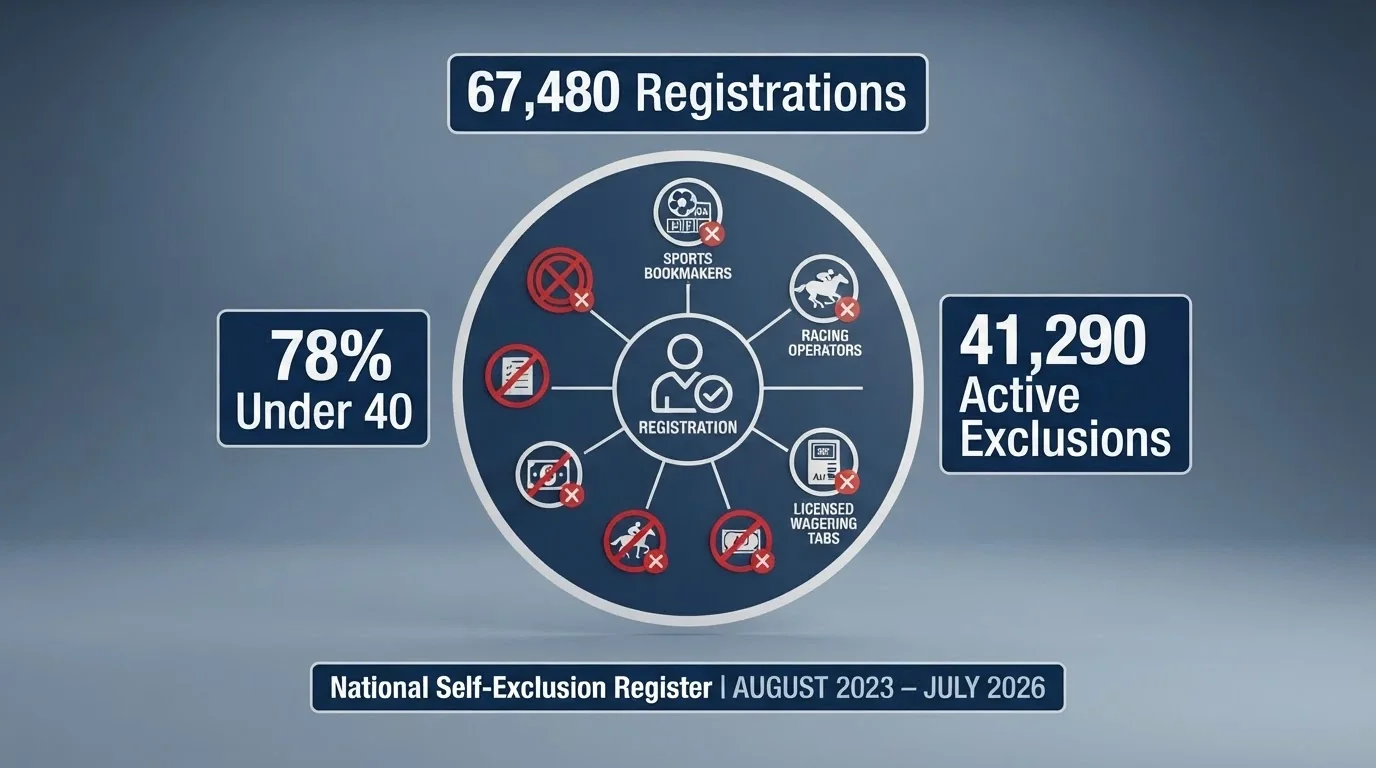
The register works because every Australian-licensed wagering operator is required to check it before accepting a new customer and to refuse business from anyone on it. That obligation is enforceable. The ACMA has had 1,564 illegal gambling and affiliate websites blocked by Australian ISPs as of March 2026, and more than 225 illegal services have withdrawn from the Australian market since 2017.
BetStop’s reach, however, ends at the border. An offshore casino is not licensed in Australia, is not connected to the register, and has no obligation — and no incentive — to honour an Australian self-exclusion.
What “Not on BetStop” Really Means
“Not on BetStop” sounds like a technical description. In practice it is a description of a gap. The offshore casino has no integration with the register, no block list to query, no compliance officer checking whether a deposit from Sydney is coming from a name on the file. The same feature that makes these sites reachable from Australia — they sit outside the local regulatory perimeter — is the feature that makes them unreachable for self-exclusion purposes. As ACMA’s own framing puts it, an offshore casino will keep taking a self-excluded person’s money, and that is the most concrete single harm of the offshore route.
Punters search for the term for two reasons, and they are not symmetrical. A registered self-excluder looking to keep playing is asking the offshore casino to fill in for the block they signed up to enforce. A punter who never registered but wants casino games the licensed market doesn’t carry is asking the offshore casino to fill in for a product Australia has chosen not to licence. Both end up at the same casino. The first is asking the casino to undo their own decision; the second is asking it to provide what the law forbids a licensed operator from providing. The page serves both, but the second is the more defensible position.
What the Player Gives Up Playing Outside the Register
A lot, and most of it quietly. There is no ACMA complaints body to recover money from an offshore operator that refuses a withdrawal. There is no Australian consumer law recourse — the operator is not in the country, the licence is Curaçao or similar, and the venue for any dispute is whatever the operator’s terms say it is, often Curaçao itself. There is no guarantee the site will be reachable next week: the ACMA has had 1,564 sites blocked since 2019, and a site can disappear overnight with player balances still on it. There is no BetStop coverage, which the previous section covered. And there is no equivalent of the credit-card and crypto ban that protects licensed-wagering punters, because that ban sits inside the Australian perimeter and the offshore operator sits outside it.
The Interactive Gambling Amendment (Gambling Reform) Bill 2026, passed on 19 August 2026 and commencing on 1 January 2027, tightens this further without legalising anything. Banks and payment providers gain express authority to block transactions to illegal gambling operators; inducement marketing is banned for three months after a person deregisters from BetStop; wagering advertising is capped at three ads per hour with a live-sport blackout; athletes, celebrities and influencers are barred from promoting wagering products. The intent of the reform is to reduce the flow of money and marketing into offshore gambling, not to licence it.
What does not change: the individual player is not prosecuted. The IGA targets the provider. Accessing an offshore casino is not an offence for the player; the operator is the one breaking the law. That is a real legal distinction, and it is not the same as “therefore it’s safe.”
The 2026 Offshore Lineup: 10 Casinos Australian Players Actually Use
The table below ranks the ten offshore operators Australian players reach most consistently, on the basis of confirmed bonus terms in AUD, payment-method support for Australian deposits, game-provider transparency and licence jurisdiction where verifiable. Several entries have gaps. Where the licence, bonus or provider list could not be confirmed at review time, the cell carries an em dash, and the operator write-up below the table explains what could and could not be verified. The headline reading of the table: every brand is offshore and unlicensed in Australia, because no such licence exists; Curaçao is the dominant jurisdiction among the confirmed set; and the bonus figures swing from a modest A$200 match to an A$11,000 multi-deposit package.

| Casino | Welcome Bonus (AUD) | Free Spins | Game Providers |
|---|---|---|---|
| Skycrown | Up to A$8,000 over 4 deposits | 400 | IGTech, BGaming, Pragmatic Play, Play’n GO |
| RocketPlay | 100% up to A$1,000 | 100 | Play’n GO, Pragmatic Play |
| Royal Reels | — | — | — |
| Neospin | Up to A$11,000 over 4 deposits | 300 | — |
| GoldenCrown | — | — | — |
| FairGO | 100% up to A$200 | 30 (no-deposit) | Realtime Gaming |
| Stake | Promo-based, no fixed welcome | — | Pragmatic Play, Evolution Gaming, Hacksaw Gaming |
| Wild Tokyo | — | — | Pragmatic Play, Play’n GO, Belatra, Gamebeat |
| Bizzo Casino | — | — | — |
| FatFruit | Up to A$10,500 | 550 | — |
How We Picked and Compared These 10 Casinos
Selection rested on a small set of checks rather than on the operators’ own marketing. The first pass looked at Australian-facing affiliate listings that publish bonus terms in AUD and named these brands consistently in their top-10 to top-15 rankings. The second pass went to each operator’s own terms page to verify the bonus, the wagering multiplier, the validity window, the maximum bet and any cashout cap on bonus funds. The third pass checked the licence claim against the Curaçao Gaming Authority register where the operator names a licence number, and against Antillephone’s validator for sub-licences. Where any of those steps came back blank — bonus terms not visible without an account, licence number not on the site, providers not disclosed — the cell reads as an em dash.
What is excluded from this list matters as much as what is on it. Operators that block Australian signups, that require a non-AU address to register, or whose domains resolve to a known phishing or copy site have been left out. A brand that is referenced in market-size figures or payout-speed benchmarks elsewhere on the web but not in any AU-facing affiliate ranking has been kept as an unnamed background data point rather than added as a reviewed row, because naming a casino that the reader then cannot find at the same terms would be a worse outcome than leaving it out.
The ranking reflects what was verifiable, not a claim of completeness. The ACMA blocking list is the de facto market map, and the operators on this page are the ones Australian players reach. That is not the same as saying these are the best; there is no neutral arbiter offshore. It is saying these are the ones whose terms, providers and payment methods could be checked rather than guessed.
Skycrown
Skycrown carries the heaviest confirmed welcome package in the featured set. Across four deposits the headline value is up to A$8,000 plus 400 free spins; on the first deposit alone it is a 120% match up to A$1,200 plus 125 free spins on Wolf Treasure (IGTech), with a A$30 minimum. The 400 free spins land in tranches — 125 plus 75 plus 50 plus 150 — one set per deposit.
The wagering requirement is 40x the bonus amount. On a A$1,200 first-stage bonus that is A$48,000 of turnover before the bonus funds convert to withdrawable cash. Each bonus stage carries a 14-day validity window, a A$7.50 maximum bet while wagering is active, a A$300 cap on free-spin winnings and a A$5,000 maximum cashout per stage. Provider mix on confirmed titles: IGTech, BGaming, Pragmatic Play, Play’n GO and Booming.
The honest read: the headline value is real, but the terms convert it into a long, expensive grind. A punter treating the A$8,000 as a target will be looking at four back-to-back 14-day cycles at 40x wagering, with the bonus reduced to A$5,000 of withdrawable cash per stage regardless of how the run goes. That is the difference between a marketing number and a real ceiling.
RocketPlay
RocketPlay is the cleaner mid-sized option. The welcome package is 100% up to A$1,000 plus 100 free spins on a single first deposit, with a A$25 minimum deposit, a 40x wagering requirement on the bonus and a 14-day validity window. The operator carries an Antillephone Curaçao sub-licence, 8048/JAZ2020-13, verifiable against the Antillephone validator. The provider mix is Play’n GO and Pragmatic Play among the names confirmed.
The read here is shape, not size. A A$1,000 match at 40x wagering means A$40,000 of required turnover in two weeks. There is no published maximum cashout figure on the bonus itself, and the terms could not be confirmed in full on no-deposit play. What the table shows is a single, traceable bonus structure rather than a four-stage staircase, which is easier to reason about: one deposit, one wagering requirement, one clock. For a punter who prefers knowing the entire cost of clearing the bonus before the first spin, that is the shape to choose.
Royal Reels
Royal Reels is a brand that appears across AU-facing affiliate rankings, which is why it earns a slot in this lineup. The honest position is that the bonus terms, licence details and game-provider list could not be confirmed at review time. The brand’s domain resolves, the Australian-facing affiliate lists cite it, but no terms page presented the wagering multiple, the cashout cap and the validity window in a way that could be transcribed reliably. No licence number was found on the site to validate against a register.
The reading: a name punters will see, presented here for transparency, and a brand to verify independently before depositing. What to check is the licence number against the Curaçao Gaming Authority register, the wagering multiple on the welcome bonus in the terms page rather than the marketing page, and the maximum cashout on bonus funds — which is often the difference between a generous-sounding bonus and a real one.
Neospin
Neospin carries the largest headline in the table: up to A$11,000 spread across four deposits plus 300 free spins. That is the number the marketing leads with. The confirmed record on this run does not extend to the wagering multiple, the bonus validity window, the cashout cap, the licence details or the game-provider breakdown.
The gap matters more than it usually does. A 30x wagering requirement on a A$11,000 multi-stage package is materially different from 50x; a 14-day window per stage is materially different from a 7-day window; a A$2,000 cashout cap per stage is materially different from no cap. The marketing figure is identical in all three cases. A punter considering this operator should be looking for the wagering multiple, the validity period, the cashout ceiling on bonus funds, the licence number and the provider list before claiming any of the four stages, because every one of those terms determines whether the A$11,000 is worth pursuing at all.
GoldenCrown
GoldenCrown shows up in AU-facing affiliate rankings with descriptions that call it a “best bonuses” pick, which is the marketing floor for the genre. Specific terms could not be confirmed this run: bonus amount and structure, wagering multiple, validity window, cashout cap, licence and provider list are all open.
The reasonable interpretation: the brand exists, it is being ranked by affiliates who earn commission on sign-ups, and it has not (yet) presented terms a third party could check. Same checklist as Royal Reels: confirm the licence, the wagering on the welcome bonus, the withdrawal conditions, the cashout cap. Where the affiliate ranking and the operator’s own terms disagree, the operator’s terms govern.
FairGO
FairGO is the only operator in the confirmed set that runs a no-deposit offer in this period: 30 free spins on Fu Long Treasures with a maximum cashout of A$180, valid through August 2026. The deposit match is small and honest by comparison — 100% up to A$200, 30x wagering, A$10 minimum deposit. The provider is Realtime Gaming (RTG), which keeps the catalogue narrow but consistent.
The no-deposit offer is what makes FairGO worth a separate look. The A$180 cashout cap on those free spins is roughly nine times the value of the match bonus, and a player who is testing an offshore casino for the first time can do it without moving money in. The deposit match is not large, but at A$10 minimum and 30x wagering the cost of clearing a A$200 bonus is A$6,000 of turnover, which is a weekend’s play rather than a fortnight’s. For a player with a small bankroll, FairGO is the operator whose terms match the budget.
Stake
Stake runs on a different model from the rest of the set. The licence is Curaçao. The provider mix is Pragmatic Play, Evolution Gaming and Hacksaw Gaming — a more live-dealer-heavy catalogue than the pokies-first brands above. The welcome package is not a fixed match-plus-spins formula; Stake typically runs promotions rather than a one-off sign-up deal. In the comparison table the welcome bonus column reads n/a for Stake, because the page is ranking welcome packages, and Stake has chosen to compete on promotions and game quality instead.
The read here is product rather than bonus. A live-dealer punter who wants Pragmatic Play and Evolution Gaming tables at high stakes, or a crypto-native punter who never wanted a deposit match in the first place, is the audience this operator is built for. Anyone comparing welcome bonuses column-by-column has already excluded Stake from the shortlist.
Wild Tokyo
Wild Tokyo is the catalogue play in the lineup. The game count sits at 8,000 to 10,000-plus titles, anchored by Pragmatic Play, Play’n GO, Belatra and Gamebeat. Bonus terms, validity window, wagering and licence details were not confirmed this run.
A library of that size is genuine — those four providers alone ship several thousand titles — but the value of a library is what a player can extract from it in real terms, which depends on the bonus terms rather than the count. A 12,000-game library behind a 50x wagering requirement with a 7-day window is less attractive than a 3,000-game library behind 35x with a 30-day window. Wild Tokyo earns a slot on the strength of the catalogue, and a check on the bonus and licence terms will tell the reader whether the rest of the proposition holds up.
Bizzo Casino
Bizzo Casino is another name that appears across AU-facing rankings with specifics that could not be confirmed at review time. Bonus amount, wagering multiple, validity window, cashout cap, licence and provider list are all open. The brand is being ranked by affiliates, the terms page did not surface the data needed to transcribe it.
Same checklist as Royal Reels and GoldenCrown: licence, wagering, validity, withdrawal terms, provider list. A name on a list is not a recommendation.
FatFruit
FatFruit carries the second-largest headline in the table — up to A$10,500 plus 550 free spins — and the lowest confirmed wagering multiple among the multi-deposit packages at 35x. The minimum deposit is A$20. The game count is 12,000-plus. The licence is Curaçao Gaming Authority. Bonus validity and cashout cap were not confirmed.
The 35x wagering is the figure to fix on. Across the confirmed set it sits at the low end of the 30x to 50x range that the offshore market broadly operates in. A A$2,000 bonus at 35x is A$70,000 of turnover; the same bonus at 50x is A$100,000. That gap is real money and real time. The minimum deposit of A$20 keeps the entry low; the catalogue at 12,000-plus suggests a broad library. What is missing is the validity window and the bonus cashout cap, which together determine whether the 35x figure is actually achievable. Worth pursuing; verify those two terms first.
Getting Money In and Out When You’re Off the Register
PayID and Osko: Australia’s Instant Bank Transfer
PayID is the default Australian deposit method at most offshore casinos, and for good reason. PayID and Osko are the New Payments Platform’s instant transfer rails — a deposit references the casino’s PayID, the funds move from the player’s bank account in seconds, and there is no card-network intermediation. Deposits commonly carry a A$10 to A$20 minimum and a A$1,500 to A$5,000 per-transaction cap; withdrawals carry a A$50 minimum and a A$9,000 per-day cap, with payouts typically clearing in 15 to 60 minutes after the operator’s KYC check has been completed. POLi, the old third-party instant-debit service, was decommissioned on 30 September 2023, so its absence is now historical rather than current.
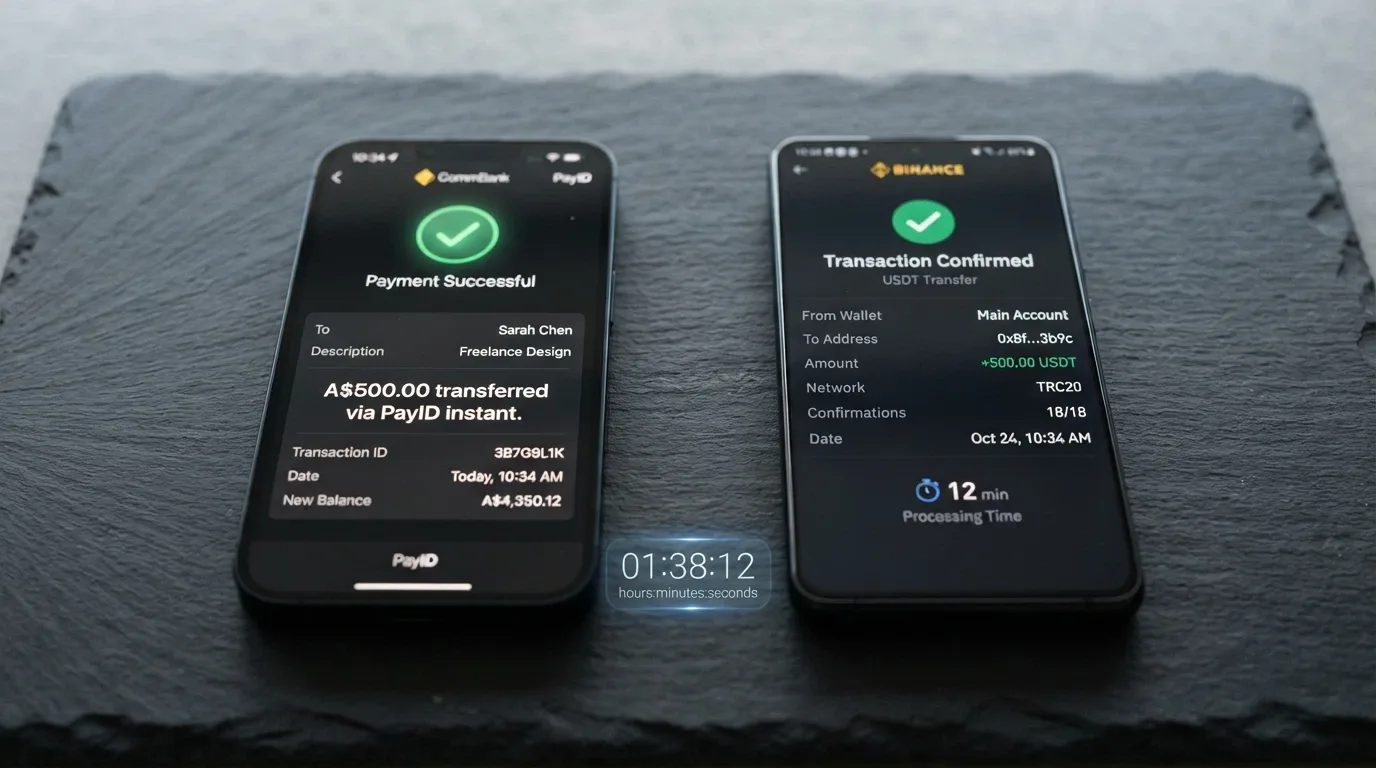
What PayID does not bring is any of the licensed-market overlay. PayID itself is a payments rail, not a consumer-protection framework. The bank transfer moves, the money arrives, and the protections Australian players associate with a domestic wagering transaction — dispute rights, chargeback options, the ACMA complaints body — are not in the loop. A punter who PayID-deposits A$500 to an offshore casino and then has a withdrawal dispute has paid via a payment method that works fast and offers no recourse. That is the standard offshore trade-off, sitting behind a familiar logo.
BPAY is the slower fallback. Same legal route as PayID, but settlement is overnight rather than instant, and the offshore operators who still accept it tend to treat it as a deposit-only path. For a punter who wants to fund an account from a bank account without giving a card number, BPAY remains viable; it is just not fast.
Crypto and Digital Wallets at Offshore Casinos
Crypto is the fastest withdrawal route at AU-facing offshore casinos, and the reason is structural rather than coincidental. USDT TRC-20 withdrawals clear in 8 to 18 minutes at most sites that accept them, because the settlement is on-chain and there is no intermediary to wait on. PayPal sits in the middle: deposits post in under 60 seconds, withdrawals clear to a PayPal balance in 2 to 8 hours once KYC is complete, against 1 to 3 business days for a PayID bank transfer.
Both routes are unavailable on the licensed Australian side by design. Credit cards, credit-related products and digital currency are banned as payment for online wagering in Australia since 11 June 2024; an operator that fails to enforce the ban faces penalties of up to A$247,500. An Australian player asked for a credit-card deposit or a crypto deposit is being served by someone outside the Australian rules, and that is the offshore route’s clearest signature.
The trade-off is speed against recourse. Crypto has no chargeback. Once a USDT transfer is broadcast and confirmed, it is settled, and a casino that refuses to pay out a winning is holding crypto the player cannot claw back through a card network. PayPal terms exclude gambling transactions in most jurisdictions; the practical effect is that a PayPal withdrawal that an offshore operator refuses is as hard to reverse as a crypto withdrawal. Speed of arrival and absence of recourse are two sides of the same coin.
Deposit Minimums, Withdrawal Caps and Payout Timelines
Deposits are easy. Withdrawals are where the asymmetry lives, and it is asymmetric by design. A$10 or A$20 is enough to fund an account at most AU-facing offshore sites; PayPal clears inside a minute; PayID is seconds; crypto is whatever the network confirms. A withdrawal, by contrast, requires KYC verification — a driver licence, a proof of address, sometimes a source-of-funds check — before the operator will release funds. The 15 to 60 minute PayID window is the post-KYC figure; the actual end-to-end timeline from first withdrawal request to bank balance is usually a day for a first withdrawal and faster thereafter.
The caps are tighter on the way out than the way in. A PayID deposit cap of A$1,500 to A$5,000 per transaction sounds high until it is compared with a A$9,000 per-day withdrawal cap at the same operator. A punter who has run a balance to A$30,000 is looking at three to four business days of PayID withdrawals to clear it, assuming no operator-imposed weekly cap on top. Crypto removes the per-day cap but adds its own friction: a wallet address to whitelist, a network fee to absorb, and the absence of any Australian bank intermediation if something goes wrong.
Pay-by-mobile-bill and pay-by-phone options exist at some offshore casinos, though specifics for AU-relevant operators were not confirmed in this run. The general shape is a deposit charged to a phone bill or deducted from prepaid credit, typically capped at small amounts per day. Useful for a low-stakes player; not a path for a serious bankroll.
Why Your 2026 Offshore Bonus Isn’t the Free Money It Looks Like
Free Spins and No-Deposit Offers Off the Register
Only one operator in the confirmed set runs a genuine no-deposit offer. FairGO’s 30 free spins on Fu Long Treasures, with a A$180 cashout cap and a validity running to August 2026, are the only confirmed no-deposit free spins in the table. Every other “free spins” bundle in the set — the 400 at Skycrown, the 100 at RocketPlay, the 550 at FatFruit, the 300 at Neospin — is tied to a deposit. The trigger is the deposit; the spins are a sweetener, not a freebie.
The distinction matters because the cashout caps on the genuine freebies are tight. A$180 is the most a player can withdraw from FairGO’s no-deposit spins, regardless of what the spins return. A 50x multiplier on a small win still produces a small win, and the cap is the ceiling either way. The marketing page says “free”; the terms page says A$180. Both are true; only one is what the player actually gets.
The scarcity is itself informative. Most offshore operators can offer no-deposit free spins when they want to; the fact that only one in this lineup does is a sign that the rest prefer the deposit-triggered structure, because a deposit unlocks the wagering requirement, which is where the real money is made.
Deposit-Match Welcome Packages and Low-Deposit Entry
The welcome packages range from FairGO’s modest 100% up to A$200 to Neospin’s headline A$11,000 multi-deposit package. The minimum deposits start at A$10 (FairGO) and run through A$20 (FatFruit), A$25 (RocketPlay) and A$30 (Skycrown). The match percentages cluster around 100% on the single-deposit offers and step higher on the multi-stage packages, with Skycrown’s first stage at 120%.
The size of the headline and the value of the offer are two different things. A A$200 match at 30x wagering costs A$6,000 of turnover; a A$1,000 match at 40x costs A$40,000; a A$1,200 match at 40x costs A$48,000. The headline values vary by a factor of fifty-five across the set; the turnover obligations vary by a factor of eight. That gap is the difference between the marketing claim and the real cost.
The minimum-deposit entry point matters because it sets the floor on what a punter can test the bonus with. A$10 at FairGO is the lowest in the set; A$30 at Skycrown is still low enough to be a single session’s stake for a casual player. The deposit-trigger structure means the bonus is gated on a deposit the player has to make anyway, so the real question is what the wagering cost is relative to the deposit, not whether the deposit is large.
Stake is the one operator that has chosen to opt out of this comparison entirely. Its model is promo-based rather than fixed-package, which means the value to a player shifts week to week rather than being captured in a single headline figure. The table reads n/a on Stake’s bonus column for that reason, and that is honest rather than evasive.
Wagering, Rollover and the Small Print That Shrinks Your Bonus
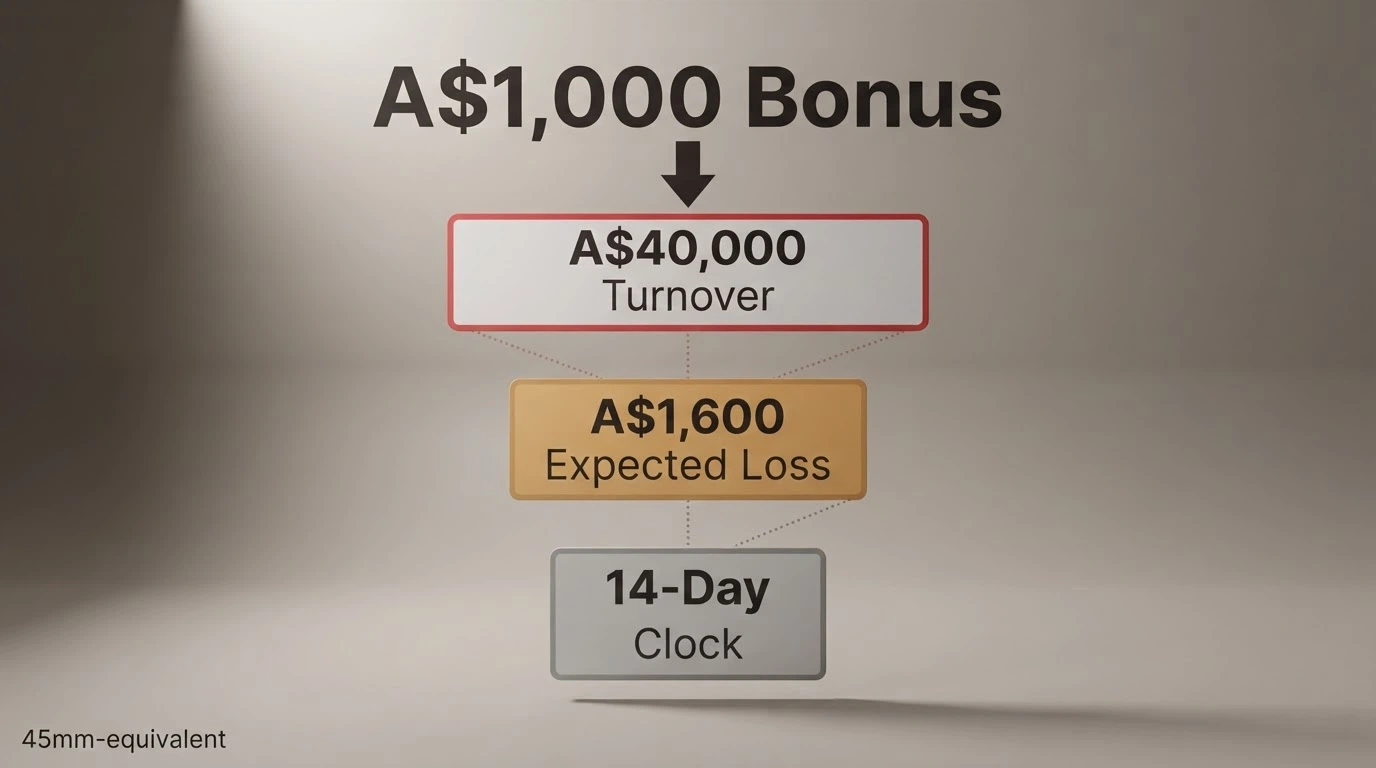
A 40x wagering requirement on a A$1,000 bonus means A$40,000 of bets must be turned over before any of the bonus converts to withdrawable cash. That is the deal at Skycrown and RocketPlay; FairGO sits lower at 30x; FatFruit at 35x. The offshore AU market broadly operates in the 30x to 50x range. A punter seeing a A$8,000 headline and not reading the 40x is reading the marketing page rather than the terms page.
The arithmetic of an expected loss makes this concrete. Take a A$1,000 bonus at 40x wagering, played on online pokies with a theoretical RTP of 96% — the midpoint of the 94% to 97% range that major developer pokies typically run at, and a conservative middle for the catalogue. The required turnover is A$40,000. The expected loss on that turnover, given a 96% return, is roughly A$1,600. That is the statistical cost of clearing the bonus: A$1,000 is being given, and A$1,600 of expected loss is the price of converting it into withdrawable cash.
The figure is a statistical estimate, not a promise. A specific session can return more than its expected loss; another can return less. The estimate is the average over many spins under the stated assumptions; it does not predict any individual outcome, and it does not guarantee a return.
What the math does is puncture the marketing. The headline says “A$1,000 bonus”. The terms say 40x. The arithmetic says the player is paying roughly A$1,600 in expectation to claim it. The bonus is not the casino giving the player A$1,000; it is the player paying the casino A$600 in expectation for the chance to keep the A$1,000. That is the cost, hidden in plain sight across the wagering requirement and the house edge, and it is the reason the headline is never the real number.
The small print layers more on top. The 14-day validity at Skycrown and RocketPlay is a hard deadline — the bonus expires if it has not been cleared in time, and A$48,000 of turnover in 14 days is approximately A$3,400 a day, or A$240 an hour at 70 spins an hour. The A$7.50 max bet while wagering is active is the rule that prevents a player from clearing the requirement in a single large spin. The A$5,000 cashout cap per bonus stage at Skycrown is the ceiling on what a winning session can extract from the bonus, regardless of how the run goes. Each of these is a term the player will only meet by reading the small print.
The Pokies You Can Actually Play — and What Their RTPs Really Mean
Pokies and Their Real RTPs
The highest confirmed RTPs at offshore casinos sit with NetEnt and Thunderkick. Mega Joker runs at 99.00% — the highest among widely available titles. Blood Suckers (NetEnt) sits at 98.00%, and 1429 Uncharted Seas (Thunderkick) at 98.60%. Sweet Bonanza (Pragmatic Play) ships in up to four RTP configurations — 96.51%, 95.45%, 94.51% and 91.51% — and the casino chooses which version to deploy. The same branded pokie can pay 5% less on one site than another; that is the structural feature of the offshore market, not an accident.
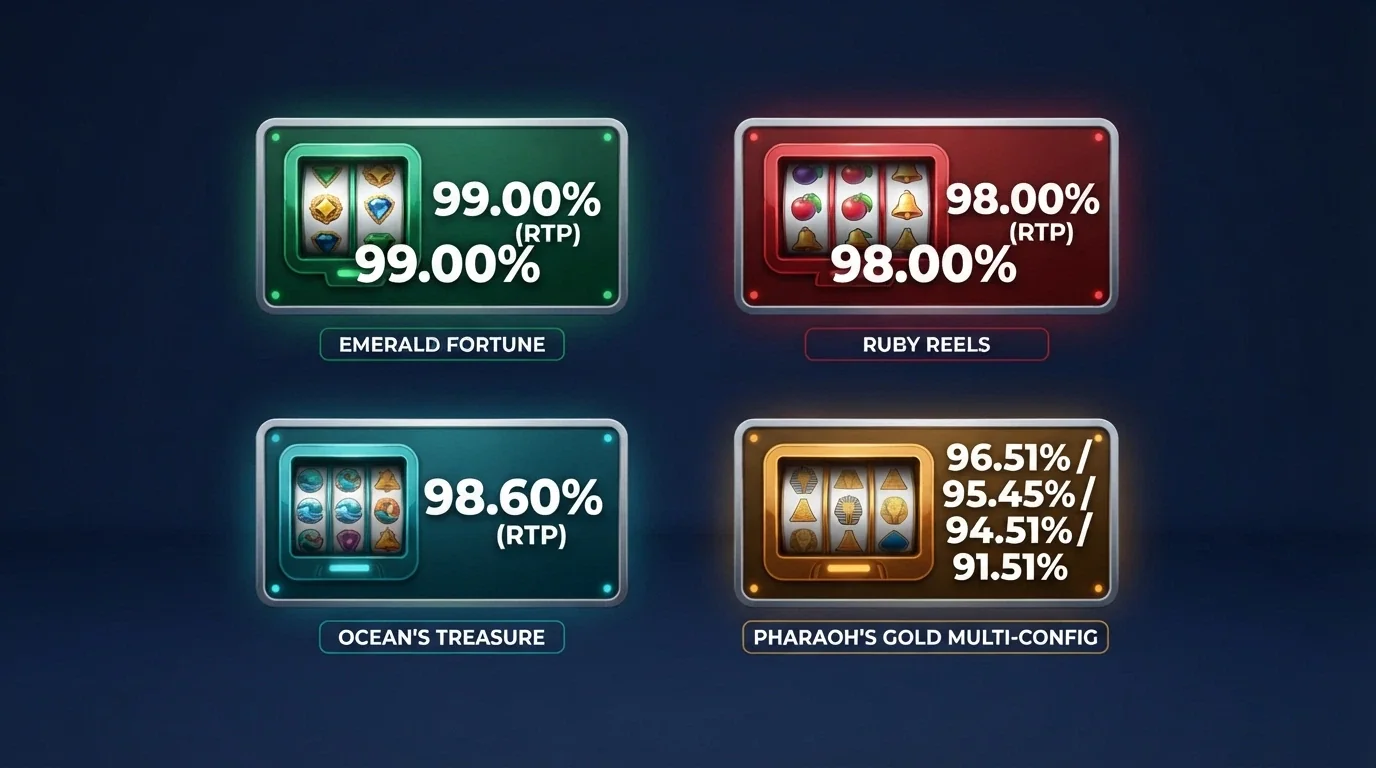
| Pokie | Provider | RTP |
|---|---|---|
| Mega Joker | NetEnt | 99.00% |
| Blood Suckers | NetEnt | 98.00% |
| 1429 Uncharted Seas | Thunderkick | 98.60% |
| Sweet Bonanza | Pragmatic Play | 96.51% / 95.45% / 94.51% / 91.51% |
For comparison, land-based pokies in NSW must return at least 85% and in Victoria at least 87%. Most major-developer online pokies sit between 94% and 97%, with the few listed above exceeding 98%. Offshore sites do not follow state-level RTP thresholds, which is why the same Pragmatic Play title can be set at the 96.51% configuration on one site and the 91.51% configuration on another. A punter who cares about which version is being run needs to ask the operator, or to check a third-party RTP tracker where one exists.
The theoretical return is a long-run average across many spins, not a guarantee for any single session. A player can lose at a 99% RTP pokie; they can win at a 91% one. The RTP matters as a property of the game being played, not as a prediction of the next hour. Choosing a 98% title over a 92% one is a real edge, but only over the kind of volume most recreational players will never reach.
Table Games, Card Games and Live Dealer
Beyond the pokies, the offshore catalogues carry blackjack, roulette, baccarat and live-dealer studios. The live-dealer providers named in the featured set are Pragmatic Play Live and Evolution Gaming — Stake carries both, which is why it sits at the live-dealer end of the spectrum rather than the pokies end. Wild Tokyo and FatFruit are catalogue-heavy without confirmed live-dealer specifics; Skycrown’s confirmed mix is IGTech, BGaming, Pragmatic Play and Play’n GO, the latter two of which run live-dealer tables as well as pokies.
RTP transparency is the gap on table games. Pokies publish RTPs at the title level; blackjack and roulette variants rarely do at the operator level, and what a player usually sees is a generic figure for “blackjack” rather than per-title returns. The structural reason is that table games ship in many rule variants — number of decks, dealer stands/hits on soft 17, surrender availability — and an RTP figure tied to a generic “blackjack” label conceals as much as it reveals. A punter who wants to know what return they are playing against on a live-dealer blackjack table should ask the operator, and treat the absence of an answer as information.
Playing on Mobile: Apps, Browsers and What Changes
Most offshore casinos run browser-based mobile play rather than native apps, because the Apple App Store and Google Play Store both restrict real-money gambling apps to licensed operators in regulated jurisdictions. The browser experience is smooth on the modern mobile providers — Pragmatic Play, Play’n GO and Evolution Gaming titles are mobile-first by design — and a player on a recent phone sees essentially the same catalogue they would see on desktop.
What mobile changes is the protection stack. A native app sits behind Apple or Google’s payment mediation and review process; a mobile browser does not. The deposit flow on a mobile browser is the same PayID, PayPal or crypto flow as on desktop, with none of the app-store safeguards. Demo-mode availability — playing for fun rather than real money — varies by operator and was not confirmed per brand in this run, which is the honest answer rather than a guess.
Staying Safe When the Safety Net Isn’t There
What Self-Exclusion Looks Like Offshore
An offshore casino may offer a self-exclusion button. Where it does, the exclusion applies to that brand only — there is no cross-operator blocking, no Australian register, no regulator to enforce the exclusion if the operator ignores it. A BetStop-registered player who walks into an offshore casino is walking into a venue that is under no obligation to recognise the registration and no incentive to turn them away.
The 2026 reform touches this from the other direction. From 1 January 2027, licensed operators are banned from direct marketing of inducements for three months after a person deregisters from BetStop. That is a measure aimed at the licensed side; it does not extend to offshore operators, who do not market under the licensed rules and are not subject to the licensed rules. A deregistered player who receives marketing from an offshore casino is being marketed to by someone outside the perimeter, as they were before the reform.
The practical answer for a player who has self-excluded and now wants to stop is the Australian help infrastructure. The next section names it. The offshore self-exclusion button is a tool, but it is a tool the operator chooses to honour, and the absence of a regulator behind it makes it a softer commitment than the BetStop registration the player came from.
Where to Get Help in Australia
The licensed market’s safety net is still there regardless of where a player plays. The National Gambling Helpline — 1800 858 858 — is free, confidential and staffed 24 hours a day, with online chat and counselling available through Gambling Help Online at gamblinghelponline.org.au. Lifeline (13 11 14) is the broader crisis-support line. The National Debt Helpline (1800 007 007) handles the financial fallout that often arrives alongside gambling harm.
The figures behind the help lines make the case for using them. Australians lose approximately A$25 billion on legal gambling each year. Roy Morgan’s March 2026 survey found 13.0% of the Australian population — around 2,857,000 people — were experiencing some form of gambling harm from their own gambling; 5.4% (about 1,177,000 people) were experiencing harm from someone else’s gambling. Roy Morgan’s August 2025 reading put the problem-gambling rate at 2.9% of adults, up from 1.9% in 2022-23 and 2.4% in 2023-24. ANU’s POLIS centre found risky gambling rose from 13.7% in 2024 to 19.4% in 2025. The NSW Gambling Survey 2024 reported 14.5% of gamblers and 7.8% of all NSW residents had experienced at least one gambling harm in the previous year.
These numbers are why the section exists, and why it sits between the operator reviews and the verdict. The page is built for readers weighing a decision. For readers who have already made the decision and want to undo it, the lines above are the next step.
How We Selected and Ranked These Casinos
The shortlist of ten came from cross-referencing Australian-facing affiliate rankings and the terms pages of the operators those rankings cite. The order reflects a combination of confirmed bonus value in AUD, payment-method support for Australian deposits (PayID, PayPal, crypto), game-provider transparency (Pragmatic Play, Play’n GO, Evolution Gaming, BGaming, IGTech, RTG) and licence jurisdiction where verifiable against the Curaçao Gaming Authority register or Antillephone. Operators with confirmed bonus terms and a verifiable Curaçao licence rank above those where either was missing.
What the page does not claim: completeness. The ACMA has had 1,564 illegal gambling websites blocked since 2019, and more than 225 services have withdrawn from the Australian market since 2017. The number of offshore operators that have ever served Australian players is materially larger than ten, and the ten on this page are the ones the cross-reference surfaced consistently. No AU-licensed casino operator is on this list because no such licence exists; the licensed anchor for online wagering in Australia is the Northern Territory Racing and Wagering Commission, and its licence covers pre-event sports and racing wagering, not online casino games.
Several operators in the ranking — Royal Reels, GoldenCrown, Bizzo, Neospin, Wild Tokyo on the bonus side — have open cells where terms could not be confirmed. The page transcribes the gaps rather than papering over them, on the principle that an em dash is more useful to a reader than a guessed figure. A punter using this page as a starting point should treat the confirmed entries as the verified shortlist and the gap entries as the names to investigate before committing money.
The Verdict on Offshore Casinos in 2026: What the Trade-Off Really Costs You
The trade-off is real and it is asymmetric. The access is real: pokies from Pragmatic Play, Play’n GO and NetEnt at high RTPs; live-dealer tables from Evolution Gaming; bonuses from A$200 to A$11,000 in headline value; PayID deposits that clear in seconds; USDT withdrawals in under 20 minutes. None of this is available inside the Australian licensed perimeter, and the licensed perimeter is the perimeter the IGA has drawn.

What the player leaves behind is also real. No ACMA complaints body, no Australian consumer law recourse, no BetStop coverage, no equivalent of the credit-card and crypto ban that protects licensed-wagering punters. A site can be blocked at the DNS level with player balances still on it. The 2026 reform, commencing on 1 January 2027, gives banks and payment providers express authority to block transactions to illegal gambling operators, which adds friction to the deposit and withdrawal paths rather than removing them. None of this changes the legal position of the player, who is not prosecuted under the IGA — that remains a provider-targeted statute — but it tightens the practical envelope around the offshore route.
The bonus arithmetic is the clearest way to see what the trade-off costs. A A$1,000 match at 40x wagering, played at a 96% RTP pokie, carries an expected loss of roughly A$1,600 in statistical terms — the player is paying about A$600 in expectation for the privilege of clearing the bonus. The headline of A$1,000 is the marketing number; the A$1,600 is the real one. The same arithmetic applies at every bonus in the table: the wagering multiplier and the house edge between them decide what the bonus costs, not the figure at the top of the page.
The page is not a recommendation to play or not to play. It is the information a player needs to make the call with eyes open: the bonuses cost what they cost, the payment methods behave the way they behave, the protections are what they are, and the access is what it is. The one thing the page has shown is that the headline figure is never the real deal. A reader who walks away knowing that has what they came for.
Frequently Asked Questions
Is it legal to play at an online casino not on BetStop in Australia?
The Interactive Gambling Act 2001 prohibits providing online casino games to a person in Australia; the prohibition targets the operator, not the player. No Australian online casino licence exists, federally or in any state or territory. Accessing an offshore casino is not an offence for you as the player, but you cannot recover money from the operator through any Australian consumer protection body.
Which payment methods can I use at casinos not on BetStop — does PayID work?
Yes. PayID and Osko deposits clear in seconds at most AU-facing offshore casinos, typically with A$10 to A$20 minimums and A$1,500 to A$5,000 per-transaction caps. Withdrawals clear in 15 to 60 minutes after KYC verification, with a A$50 minimum and a A$9,000 per-day cap. PayPal and USDT TRC-20 are also common; credit cards and crypto are banned on the licensed side.
Do casinos not on BetStop offer no-deposit bonuses or free spins for Australian players?
FairGO is the only operator in the featured set with a confirmed no-deposit offer — 30 free spins on Fu Long Treasures with a maximum cashout of A$180, valid through August 2026. Every other “free spins” bundle in the lineup is triggered by a deposit, and the spins are a sweetener on top of the deposit match rather than a standalone offer.
What happens to my money if an offshore casino refuses my withdrawal?
There is no Australian regulator who can recover it. ACMA enforces the prohibition on the operator but cannot act as a complaints body for individual players. Disputes fall under whatever the operator’s terms say — typically Curaçao jurisdiction — and the practical outcome is that the player has no domestic recourse. This is the clearest cost of the offshore route.
Are online pokies at non-BetStop casinos fair and what RTPs do they have?
The RTPs published by the developers hold — Mega Joker at 99.00%, Blood Suckers at 98.00%, 1429 Uncharted Seas at 98.60% — but the casino chooses which configuration of a title to deploy. Sweet Bonanza ships in versions ranging from 96.51% down to 91.51%, and an offshore site can run any of them. There is no Australian minimum-RTP floor offshore, which is why the same branded pokie can pay 5% less on one site than another.
What licence do most casinos not on BetStop hold and what does that mean for my protection?
The dominant jurisdiction in the featured set is Curaçao — Skycrown, Stake and FatFruit carry Curaçao-licence markers, and RocketPlay holds an Antillephone Curaçao sub-licence (8048/JAZ2020-13). These licences do not give an Australian player any Australian consumer protection. They give the operator a permission to operate from Curaçao; they do not give the player a route to Australian courts, ACMA complaints or BetStop coverage.
Published by the POLi Casinos AU team.