Australian Online Casino Payment Methods in 2026: What Works, What Costs, and What Each Method Tells You About the Operator
 Available in AU
Online casino is prohibited in Australia under the Interactive Gambling Act 2001. No Australian operator holds an Australian casino licence because none exists, and every site accepting Australian players is therefore offshore — operating outside every layer of Australian consumer protection. The payment method an operator accepts is the fastest compliance check a player can run: PayID settles in under sixty seconds with zero fees; crypto withdrawals clear in under two hours at best operators; credit cards and Bitcoin have been banned for licensed wagering since 11 June 2024. The line between an honest offshore operator and a reckless one starts with which button the deposit page asks you to press.
Data current as of 18 October 2026 and verified against the ACMA register, AUSTRAC reporting thresholds and operator payment pages.
Table of Contents
- What “Best” Casino Payment Method Actually Means for Australians
- Every Deposit and Withdrawal Method Australian Players Can Actually Use in 2026
- Which Offshore Casinos Accept the Payment Methods Australians Actually Want
- Why a Crypto Deposit Button Is a Warning Sign for Australian Players
- Paying From Your Phone — the Methods That Actually Work for Aussie Casino Players
- What Your Deposit Method Tells You About an Operator’s Legal Status
- How the Right Payment Choices Can Keep Your Gambling Safe
- How We Evaluated and Ranked These Casino Payment Methods
- What Australian Casino Players Should Actually Do About Payment Methods Right Now
- Frequently Asked Questions
What “Best” Casino Payment Method Actually Means for Australians
Speed is the metric every comparison page leads with, and it is the metric that tells you the least. A method that takes sixty seconds to deposit and three days to withdraw is slow. A method that takes sixty seconds to deposit and never pays out at all is not slow — it is a closed door. Australians searching for the best casino payment method are usually searching for the wrong thing. The right question is which method balances four filters at once: legal signal, speed, cost and accessibility.
Those four filters are not interchangeable. A method can clear instantly and cost nothing and still leave the player exposed, because the operator accepting it is unlicensed and the consumer protection that would have helped never engaged. The fastest method available at an offshore casino is crypto; the cheapest is PayID; the most popular is also PayID; and the strongest legal signal is whichever method an offshore operator cannot legally accept from a licensed Australian wagering account — the methods the regulator has banned since June 2024. Sorting payment methods by one filter and calling it “best” is the easiest mistake a comparison page can make.
The legal angle is the one no AU-facing affiliate page leads with. A site that asks for a credit card or a Bitcoin wallet deposit is telling you, before the first chip is placed, that it operates outside Australian rules. That signal is worth more than a fee comparison, because no fee structure survives an operator that declines to pay out at all. The “best” method is the one that lets the player walk away with their money and tells them, on the way in, which kind of operator they are dealing with.
Beyond Speed — the Real Criteria for Judging a Casino Payment Method
Deposit speed and withdrawal speed are two different metrics, and most comparison tables conflate them. PayID deposits settle in under sixty seconds with zero fees; PayID withdrawals take one to four hours at best-in-class operators and longer elsewhere. E-wallet deposits are similarly instant, but withdrawals settle in seventeen to twenty-six hours. Crypto deposits confirm after a few blockchain blocks, and crypto withdrawals can clear in under two hours, with around forty-five minutes tested at Stake. Bank wires run ten to fifty Australian dollars per transaction and can take up to five business days. The method that is fastest to put money in is rarely the fastest to take money out.
Fee transparency is the second filter. PayID is fee-free at the Australian banking end; e-wallets charge percentage fees plus fixed components; crypto carries the network fee and an exchange spread. PayPal’s published rate is 3.49% plus A$0.59 per transaction. Neteller’s deposit fee is 2.5%, plus sum-dependent withdrawal charges. Skrill and Neteller convert on deposit, applying a 3.99% exchange margin that is not advertised on the banking page. The hidden spread is the one to watch — an unadvertised 3.99% is more than the entire advertised fee on most rival rails.
The third filter is accessibility. A method that the casino accepts but the bank will not honour is unusable. PayID transfers under A$2,000 typically clear without flagging. Above that, banks apply their own risk controls well before the AUSTRAC reporting threshold kicks in. ANZ applied a twenty-four-hour delay to a single A$3,000 transfer to Binance Australia in February 2026, citing fraud prevention review. Two of three A$5,000 test transfers to Binance Australia via PayID were declined outright in March 2026. A method that the bank quietly refuses is not really a method at all.
The fourth filter is regulatory signal. The methods banned under the Interactive Gambling Amendment (Credit and Other Measures) Act 2023 — credit cards, credit-related products and digital currency — have been prohibited for licensed wagering since 11 June 2024, with penalties reaching A$247,500 for non-compliant operators. An offshore operator that accepts one of those methods from an Australian player has already chosen not to comply with Australian rules. That choice tells you something about every other choice the operator makes, including the one about whether to honour a withdrawal on a Friday night.
Popular Isn’t Always Best — What the Data Actually Shows
PayID is the most popular fiat banking method at Australian-facing casinos by a wide margin. Over 42% of Australian players now use PayID, drawn by instant settlement and zero transfer fees. The numbers explain why PayID leads the comparison: zero fees beats 3.49% plus A$0.59; under sixty seconds beats two to five business days; one to four hours beats three to seven days. PayID wins on three of the four filters by a margin that closes the question for most readers.
The trap is assuming popularity implies safety. The 42% adoption figure is a count of who uses what, not a count of who got paid. POLi was shut down and ceased operations in 2023 and is no longer available at any Australian casino; any site still advertising “POLi deposits” is running outdated information and the rail simply does not work anymore. A method that is popular in search results is not the same as a method that is popular in actual use, and the gap between the two is where the hidden costs live.
What popularity actually reveals is the path of least resistance. PayID wins because it is built on Australia’s own New Payments Platform, the same rail that moves money between bank accounts in under a minute for free. Crypto wins in search because it promises anonymity; that same anonymity is what strips away the Australian financial ombudsman, the chargeback mechanism and the bank statement record. A method that is popular at offshore casinos tells you what most players are doing, not what most players should be doing.
Every Deposit and Withdrawal Method Australian Players Can Actually Use in 2026
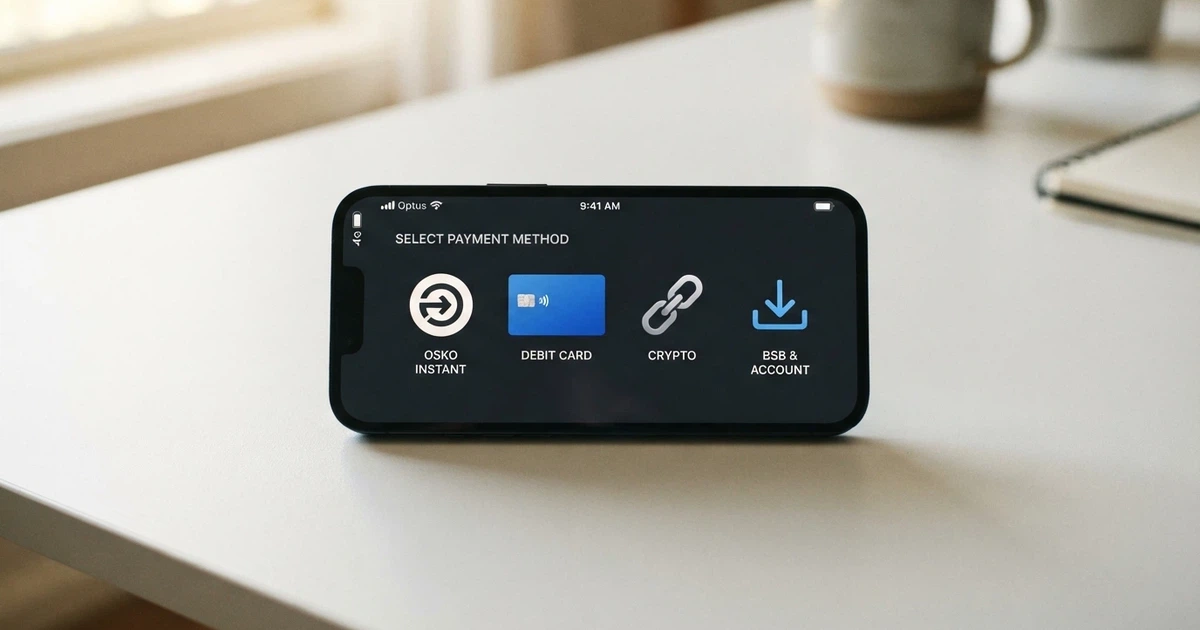
The full menu of methods available at offshore casinos that Australian players actually access is shorter than the search results suggest. POLi shut down in 2023 and is not coming back. Apple Pay and Google Pay are accepted at almost no offshore casino. Credit cards are banned. The methods still working are PayID and Osko, debit cards, e-wallets, prepaid vouchers, bank transfer and BPAY, and crypto at the operators that run outside the 2024 ban. Some of these move money in two directions; some move it in one direction only. Knowing which is which is the difference between a deposited dollar and a withdrawn dollar.
The split between deposit-only and two-way methods is the most important distinction a player can make. A Neosurf voucher can fund an account in under a minute, but the same voucher cannot withdraw a cent. A Paysafecard works the same way. BPAY deposits clear in two to five business days and have a single direction of travel. Bank transfer moves money in either direction, slowly and expensively. PayID moves in both directions and is the only Australian-built rail that clears in both under a day. The deposit method is what gets a player in; the withdrawal method is what gets them out, and the player who picked deposit-only for the convenience finds out later that convenience does not extend to cashing out.
Several methods that worked five years ago have vanished. POLi is the obvious example; the service shut down in 2023 and is no longer available. Other methods have narrowed rather than disappeared. BPAY remains listed at some operators but with minimum deposits of A$20 to A$50 and maximum deposits of A$5,000 to A$10,000 — best-in-class operators reach A$20,000. The rail is still there; the limits have moved. A player returning to a familiar method after a year or two is well advised to check the current schedule before assuming the same numbers still apply.
PayID & Osko — the Instant Aussie Standard
PayID is the standout payment method for Australian casino players. PayID runs on the New Payments Platform, the real-time settlement infrastructure that Australia’s banks use to clear transfers between accounts. The Osko product sits on top of NPP and is what most banking apps label when a transfer clears in seconds. A PayID transfer between two Australian bank accounts settles in under sixty seconds, seven days a week, twenty-four hours a day, with no transfer fee charged by the sending or receiving bank. The casino that accepts PayID is using the same rail a player already uses to send money to a friend.
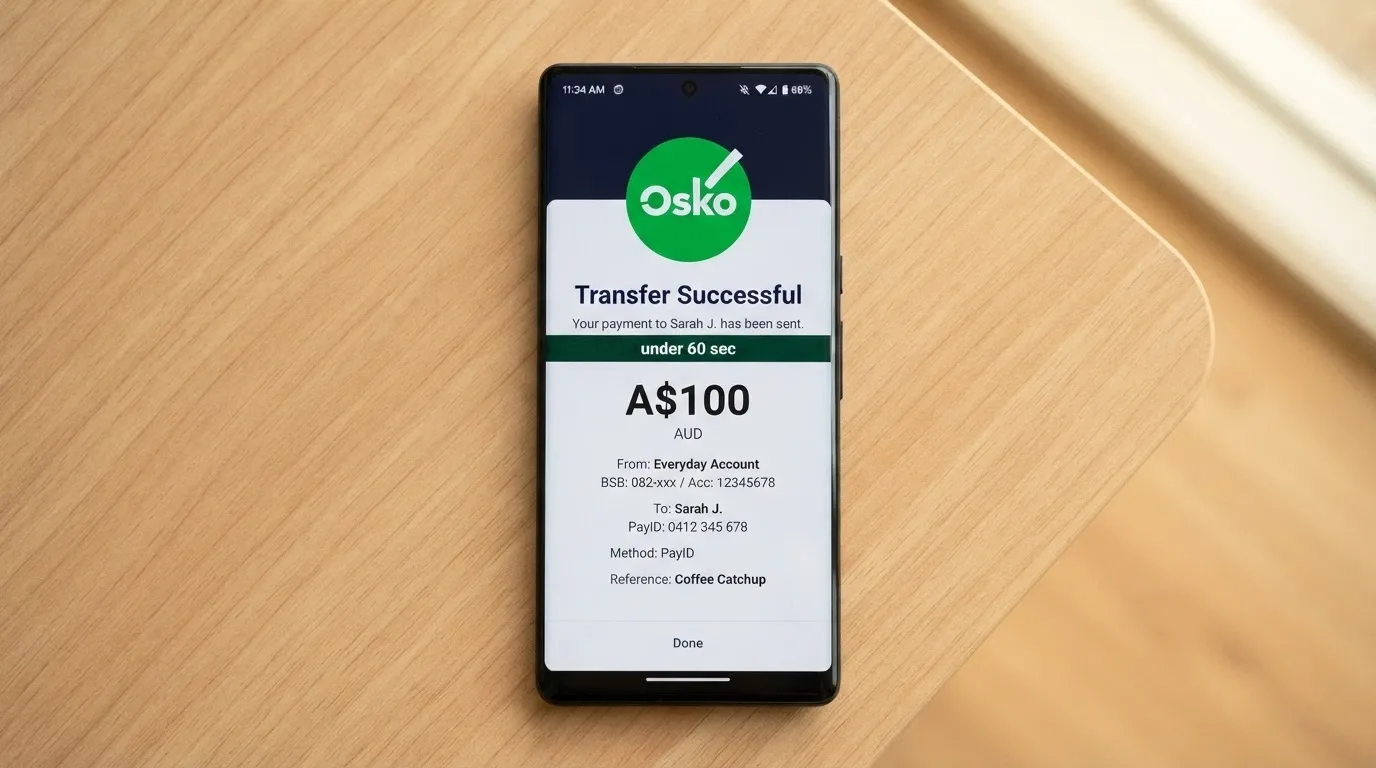
Deposits clear in under sixty seconds and cost the player nothing. Withdrawals at best-in-class operators settle in one to four hours; at average operators, the same withdrawal takes longer and the time taken is rarely published. The asymmetry — sixty seconds in, four hours out — reflects the casino’s processing queue rather than the rail itself. PayID transfer mechanics do not slow a withdrawal down; the casino’s finance team does.
The A$2,000 threshold matters more than most comparison pages admit. PayID transfers under A$2,000 typically clear without flagging at Australian banks, which means the deposit does not trigger an internal review or a fraud hold. Above A$2,000 the bank may apply its own risk controls; above A$5,000 two of three recent test transfers to Binance Australia were declined outright. For a player making regular deposits under A$2,000, PayID is frictionless; for a player moving larger amounts, the same rail becomes unpredictable.
PayID also has the strongest regulatory signal among the AUD-native methods. PayID is not banned, it is not flagged and it is the rail the Australian banks themselves use. An offshore casino accepting PayID is using a method the regulator has not restricted; an offshore casino accepting credit card or crypto is using a method the regulator has actively banned. The PayID deposit button is the deposit button an honest operator is least likely to refuse.
Debit Cards, Credit Cards and the Cash-Advance Trap
Debit cards are legal for licensed wagering in Australia and remain the most universally accepted card rail at offshore casinos. Visa deposits at Australian-facing casinos carry a minimum of A$20 and a maximum of A$5,000, with withdrawal times of three to five business days. The minimum is set by the operator; the maximum is set by the issuer; the timeline is set by the card network. The same Visa debit card that took the deposit is the card the withdrawal must return to, which is why the rail works in two directions at all.
Credit cards are banned. The Interactive Gambling Amendment (Credit and Other Measures) Act 2023 made credit cards and credit-related products prohibited as payment for online wagering in Australia from 11 June 2024, with penalties reaching A$247,500. An offshore casino that still displays a credit card deposit button is not licensed in Australia, because no Australian-licensed operator can accept one. The credit card button is the clearest single signal on a deposit page that the operator sits outside the Australian framework. Offshore casinos may process credit card transactions via overseas acquirers; the Australian issuer, if it classifies the transaction correctly, will decline it, but the issuing bank may also treat it as a cash advance.
The cash-advance treatment is the part players miss. Credit card issuers may classify gambling transactions as cash advances rather than purchases, which adds a separate cash-advance interest rate from the transaction date and a processing charge on top. The result is a higher effective cost than the casino fee schedule shows, plus interest compounding daily until the balance is paid. The ban exists because the cash-advance treatment turned credit-funded wagering into the most expensive way to lose money the regulator had seen. The ban closes that door at the operator end; for the offshore casino that still accepts the card, the door is open and the cost compounds at the issuing bank’s discretion.
The distinction between debit and credit is the practical question. Debit cards at licensed wagering operators are legal, slow on withdrawal, and free of cash-advance interest. Credit cards at offshore casinos are illegal at the operator end, often declined at the issuer end, and expensive if they clear. The Visa or Mastercard logo on a deposit page does not tell the player which type of card the operator will accept. The player’s own bank will, and that answer usually arrives in the decline message.
E-wallets — PayPal, Skrill & Neteller Side by Side
E-wallets sit between the bank and the casino, holding a balance in their own system that the casino can credit or debit. The separation is the appeal: a player can fund the wallet from a bank account or card and then move money to the casino without exposing the underlying card number to the merchant. The separation is also the cost: every e-wallet charges a fee for the privilege of sitting in the middle.
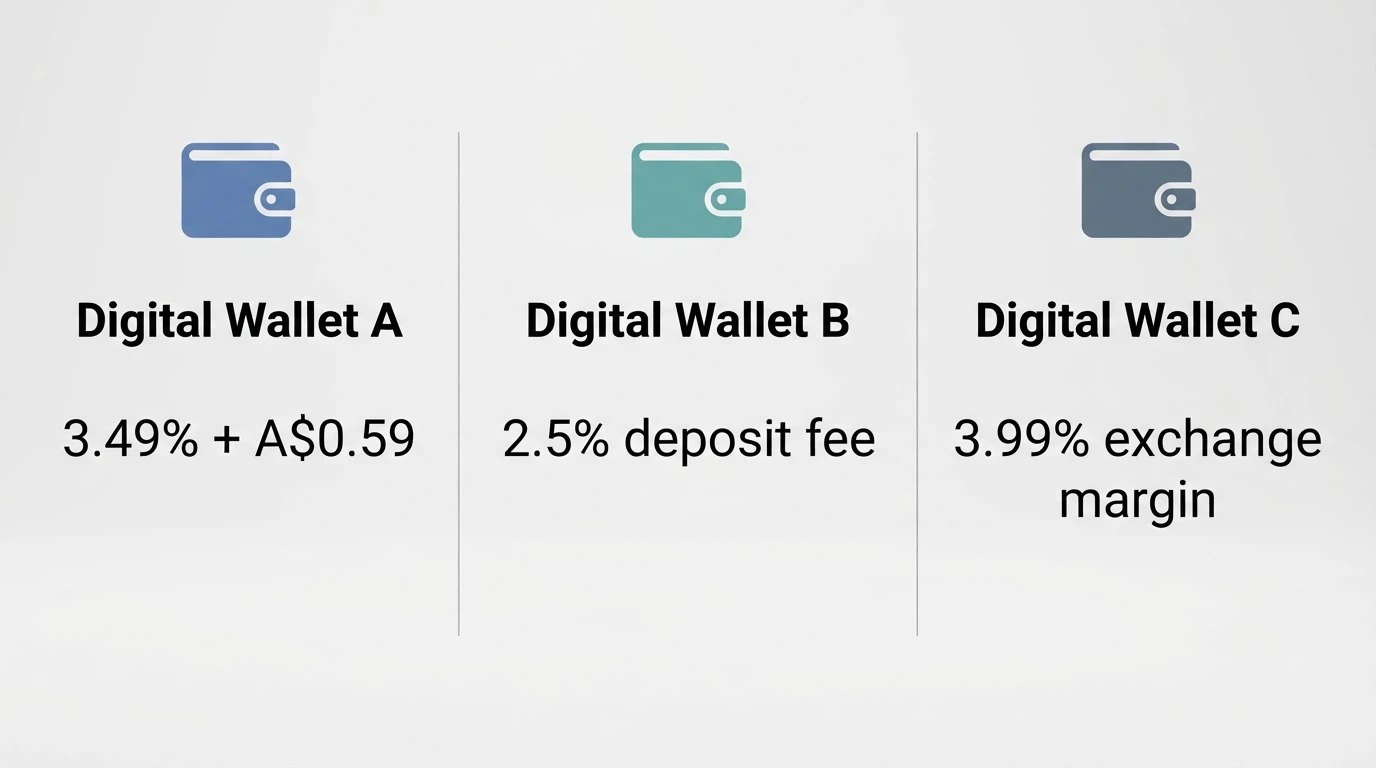
PayPal’s published rate is 3.49% plus A$0.59 fixed per transaction. The fee is charged on the deposit, not the withdrawal, and is collected by PayPal at the time of the transfer. A A$100 deposit costs the player A$4.08 in PayPal fees; a A$1,000 deposit costs A$35.49. PayPal does not always appear on AU-facing offshore casino deposit pages; where it does, the fee is rarely advertised on the casino’s own banking screen. PayPal withdrawals, where available, settle to the player’s PayPal balance and then to a linked bank account.
Skrill and Neteller charge differently and less transparently. Neteller’s deposit fee is 2.5%, with sum-dependent withdrawal fees on top. Skrill and Neteller convert on deposit, applying a 3.99% exchange margin that is not advertised on the banking page. The exchange margin is the hidden cost: a player depositing in Australian dollars has the deposit converted to a currency the wallet uses, then back to AUD when withdrawing, with the spread absorbed both ways. Two conversions at 3.99% each is more than seven per cent, before the operator’s published fees. The total cost of funding a casino account through Skrill and withdrawing back is consistently higher than PayPal on a per-transaction basis, despite Skrill and Neteller being positioned as the cheaper e-wallets.
E-wallet withdrawals at best operators take seventeen to twenty-six hours; most settle within twenty-four hours. The speed is competitive with PayID and faster than cards. The cost is higher than PayID. The trade-off is straightforward: a player paying 3.49% plus A$0.59 on a PayPal deposit is paying for the convenience of a buffer between the bank and the casino; a player paying 2.5% plus an unadvertised 3.99% on a Skrill deposit is paying more, in exchange for a rail most AU-facing offshore casinos actually accept. The convenience is real. So is the bill.
Prepaid Vouchers — Neosurf, Paysafecard and the Deposit-Only Trade-Off
Neosurf is the prepaid voucher most commonly listed at AU-facing offshore casinos. The vouchers come in fixed denominations of A$10, A$50 and A$100, are sold online and at retail outlets, and convert to a casino balance on entry of a PIN. The deposit is instant. The voucher carries no bank account, no card number and no name; the only identifier is the PIN. For a player who does not want a casino deposit showing on a bank statement, Neosurf is the cleanest separation available.
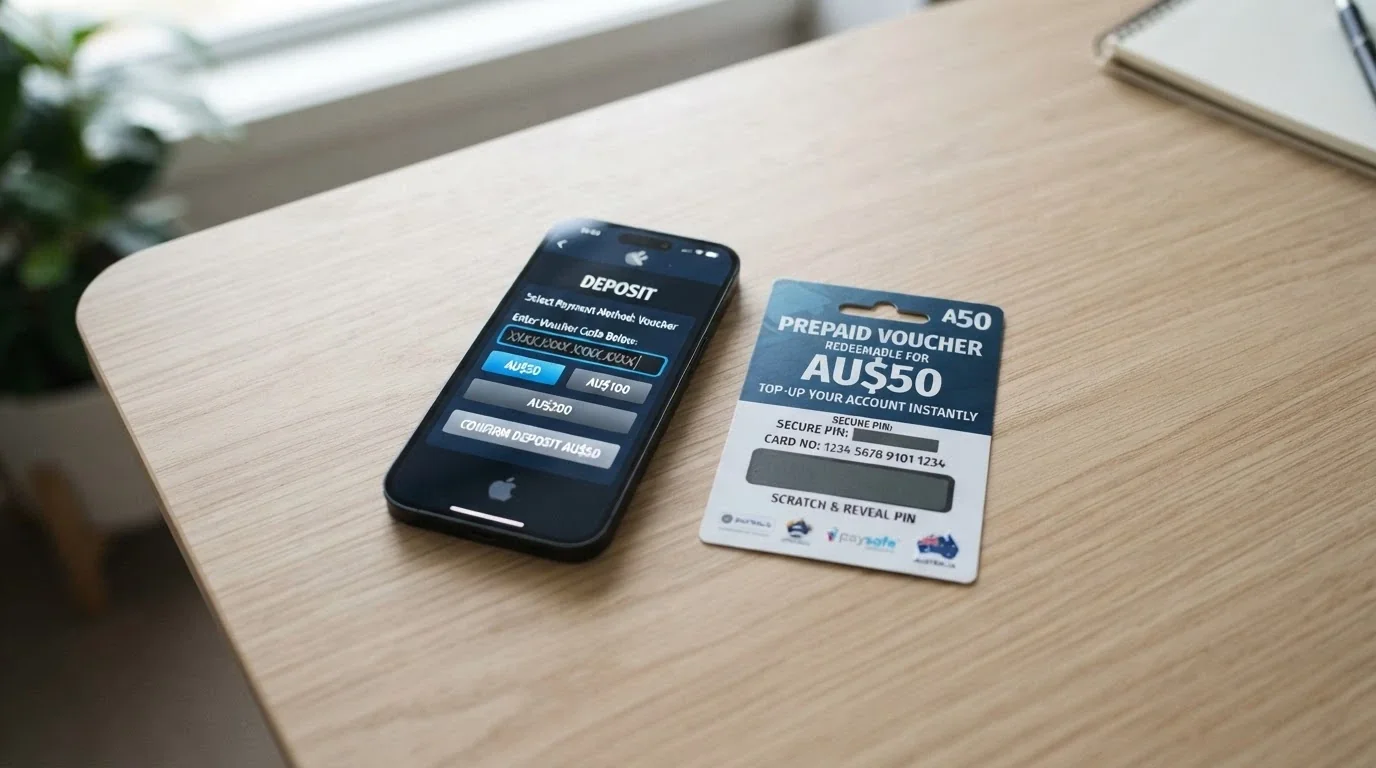
The deposit is one-way. Neosurf is deposit-only; withdrawals cannot return to a voucher because the voucher has no account to return to. The withdrawal must go through bank transfer, PayID, crypto or another method, which means the player funding an account with a Neosurf voucher has committed in advance to providing a second payment rail before the first withdrawal. Roughly seven in ten AU-facing casinos list Neosurf in their banking index under withdrawals, but the listing refers to Neosurf-branded payout methods that route through partner systems; the voucher itself remains a deposit instrument.
Paysafecard is the older prepaid brand and operates on the same model: fixed-denomination vouchers, PIN-based redemption, deposit-only. Paysafecard is less commonly listed at AU-facing offshore casinos than Neosurf; where it is listed, the deposit mechanics are identical. A player who has used Paysafecard elsewhere can transfer the same habit to a casino deposit page with no learning curve. The same one-way limitation applies: the voucher is a way in, not a way out.
The trade-off is anonymity against convenience. A Neosurf deposit leaves no card number, no bank account and no name on the casino’s records. It also leaves no path back. The player who values privacy above convenience, and who has a second rail ready for withdrawals, can use Neosurf as a deliberate buffer. The player who deposits A$100 in Neosurf expecting to withdraw A$120 in Neosurf will find the withdrawal option a route through a partner system rather than a voucher refund. The denomination caps also limit how much can be moved in one transaction: A$100 is the maximum per voucher, so high-roller play requires multiple vouchers or a different method.
How Fast Your Money Actually Arrives — Withdrawal Speed Compared
Deposit speed is instant almost everywhere. Withdrawal speed is where the real differences live, and the gap between methods is measured in days. The table below summarises the published settlement windows for each method at best-in-class operators.
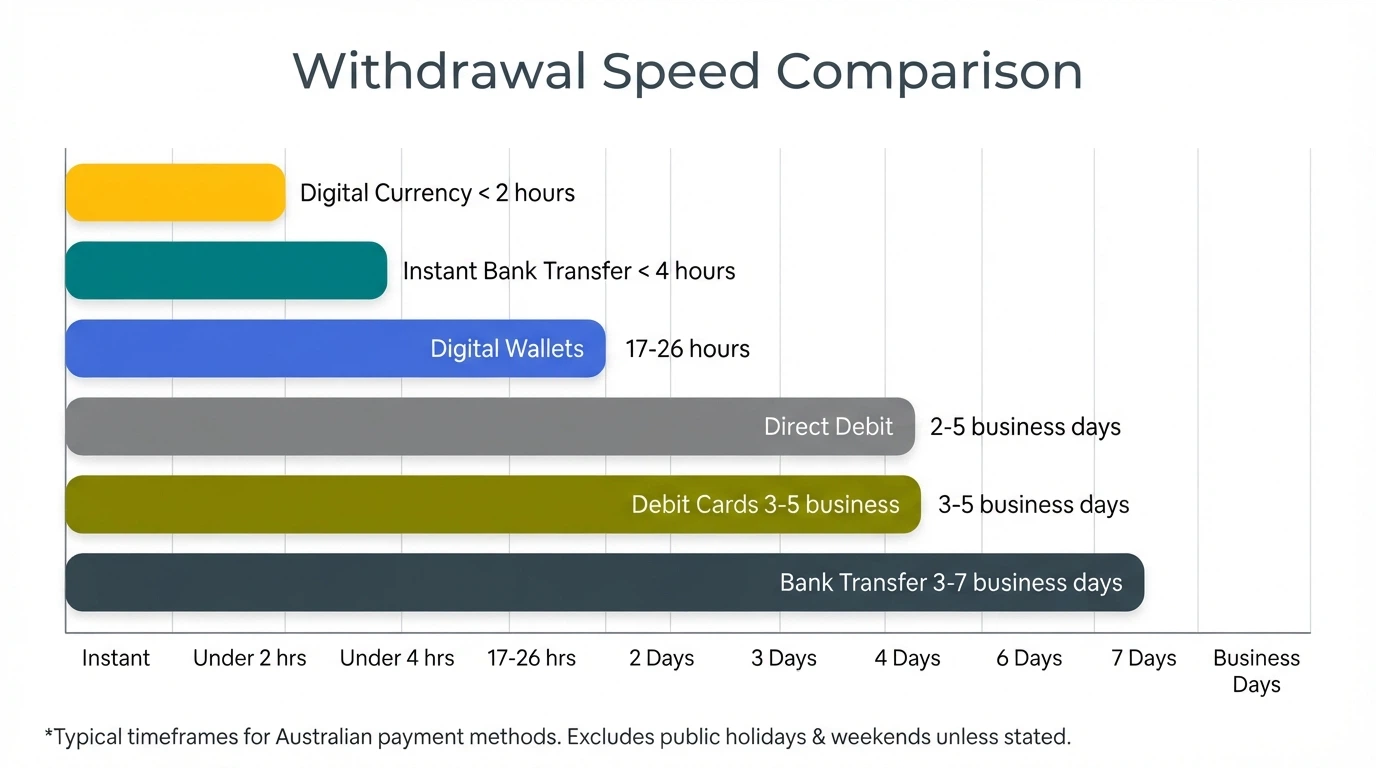
| Method | Withdrawal Speed | Fees | Key Limitation |
|---|---|---|---|
| PayID | 1–4 hours | Zero transfer fees | Up to operator’s processing queue; banks apply own controls above A$2,000 |
| Crypto (BTC/ETH) | Under 2 hours (~45 minutes tested) | Network fee + exchange spread | Banned for licensed AU wagering since 11 June 2024 |
| E-wallet (Skrill/Neteller) | 17–26 hours | 2.5% deposit + up to 3.99% exchange margin | Hidden conversion cost; not all operators accept |
| Visa / Mastercard (debit) | 3–5 business days | Zero at bank end | Must return to the same card that funded the deposit |
| Bank transfer | 3–7 business days | A$10–A$50 per transaction | Slowest rail; minimums and maximums vary |
| BPAY | 2–5 business days (deposit only) | A$20–A$50 minimum | Deposit-only rail; max A$5,000–A$10,000 typical |
PayID wins on settlement time at best-in-class operators and on cost. Crypto wins on settlement time at the operator level, with the ~45-minute figure tested at Stake, but loses on the regulatory signal. E-wallets split the difference on speed, charge more on cost, and accept the same Australian dollars anyone else does. Cards and bank transfer are the rails a player falls back on when faster methods are not available, and the wait shows. The rail that wins the speed race is rarely the rail that wins every other race.
Payment Infrastructure and Security — What Happens Behind the Deposit Button
The deposit button is the last step in a chain, not the first. The chain runs from the player’s bank to a payment gateway, from the gateway to a payment processor, from the processor to the acquiring bank, from the acquiring bank to the casino’s merchant account. Each step in the chain can block, delay or report the transaction. The player sees only the last step. The infrastructure that decides whether the deposit lands is the infrastructure the player never sees.
AUSTRAC sits at the far end of the chain. International funds transfer instructions of AU$10,000 or more trigger mandatory reporting to AUSTRAC under the AML/CTF Act 2006. A deposit of A$10,000 to an offshore casino, structured as an international transfer, generates a report the casino’s bank files; the player is not named in the report, but the transaction is on file. Most Australian casino deposits are below this threshold; high-roller play at an offshore operator is not.
Australian banks apply their own controls well below the AUSTRAC line. CommBank has had a public policy since mid-2023 declining or limiting payments to high-risk crypto exchanges, with daily caps around A$10,000. ANZ applied a twenty-four-hour delay to a single A$3,000 transfer to Binance Australia in February 2026, citing fraud prevention review. Two of three A$5,000 test transfers to Binance Australia via PayID were declined outright in March 2026. The pattern is consistent: large or unusual transfers to high-risk counterparties attract bank-level controls, and the casino deposit may or may not be the kind of transfer the bank treats as high-risk.
The 2027 reform reshapes the chain’s downstream end. From 1 January 2027, Australian banks and payment providers gain express authority to block transactions to illegal gambling operators. The Interactive Gambling Amendment (Gambling Reform) Bill 2026 passed Parliament on 19 August 2026; the bank-blocking provisions commence 1 January 2027. The same reform package includes advertising restrictions and inducement prohibitions that expand specialised financial counselling services for gambling-related financial difficulty, announced 2 April 2026. A deposit that clears today may be declined in 2027, and the operator on the other end may not be reachable at all.
Which Offshore Casinos Accept the Payment Methods Australians Actually Want
Every operator below is an offshore casino unlicensed in Australia. Online casino is prohibited in Australia; no Australian operator holds an Australian casino licence because no such licence exists. The operators on this list accept Australian players, accept Australian dollars at varying rates, and operate under the rules of their offshore jurisdiction rather than Australian consumer protection. The table below shows the payment methods each one accepts.
| Operator | Payment Methods Accepted |
|---|---|
| Rocket Play | PayID, Neosurf, crypto (BTC/ETH), Visa/Mastercard, bank transfer |
| Skycrown | PayID, Neosurf, crypto, Visa/Mastercard |
| Royal Reels | PayID, Neosurf, crypto |
| Stake | Crypto-primary (BTC/ETH/LTC/USDT), PayID |
| WinSpirit | PayID, Neosurf, crypto, Visa/Mastercard |
| Rainbet | Crypto-primary |
| Scream Casino | PayID, Neosurf, crypto |
| FairGO | PayID, Neosurf, Visa/Mastercard, crypto |
| Bizzo Casino | PayID, Neosurf, crypto, Visa/Mastercard |
| Rocket Casino | PayID, Neosurf, crypto |
The table reads as a spread: a player picking from this set can find a PayID rail almost everywhere, a crypto rail almost everywhere, a Neosurf rail at most, and a card rail at roughly half. The crypto-only operator is the loudest single signal on the table. The five-rail operator is the most flexible. The choice between them is a choice about what kind of player the operator expects.
Rocket Play — Broadest Payment Mix of the Featured Set
Rocket Play accepts PayID, Neosurf, crypto (Bitcoin and Ethereum), Visa and Mastercard, and bank transfer — five payment rails, the widest spread of any operator on the table. A player depositing by PayID can withdraw to the same method; a player funding with Neosurf needs a second rail ready; a player using a Visa debit card can return funds to the same card. The breadth is the asset: a player who is unsure which rail they will use at the point of deposit has more options here than anywhere else in the featured set.
The breadth also means the operator is not optimised for any single rail. Crypto-only operators tend to clear crypto faster than multi-rail operators do, because their finance queues are built around one method. Rocket Play’s bank transfer option exists alongside the PayID option, which suggests the bank transfer is the legacy rail and PayID is the recommended one. A player depositing by bank transfer is paying for a slower rail because the operator still offers it; a player depositing by PayID is paying nothing and clearing in seconds. The breadth is convenience, but a method is only as good as the operator accepting it.
For a player who has not yet decided which rail they will use, Rocket Play’s five-rail spread is the answer. For everyone else, four of those rails are decoration. The breadth is the asset and the limitation in the same breath.
Skycrown — Four-Rail Coverage With PayID at the Centre
Skycrown offers PayID, Neosurf, crypto and Visa/Mastercard — four payment rails, missing only bank transfer from the broadest spread on the table. The PayID rail is the primary AUD route; Neosurf covers the prepaid option; crypto covers speed; Visa and Mastercard cover the card route. The setup is the most common configuration in the featured set: PayID at the centre, three methods branching from it.
The missing rail is bank transfer, which is the rail a player falls back on for very large deposits. With no bank transfer, a player depositing more than the Visa A$5,000 maximum has PayID or crypto as the only options; PayID above A$2,000 begins to attract bank-level review, so the practical high-deposit rail is crypto. The four-rail setup is the everyday configuration; the missing fifth rail is the high-roller configuration. A casual player does not miss bank transfer. A high-roller does.
Skycrown is the everyday PayID casino. The missing bank transfer is not a gap for casual players and is the only reason a high-roller would look elsewhere.
Royal Reels — PayID, Neosurf and Crypto, No Card Rail
Royal Reels runs a three-rail setup: PayID, Neosurf and crypto. There is no card rail and no bank transfer. The omission is unusual within the featured set — most operators that skip one rail still keep cards, because cards are the rail most players default to before they read any comparison guide. Royal Reels has decided that the card rail is not worth offering, or that the operator’s banking arrangements make it impractical.
What a no-card operator means for a player is no fallback to the most familiar rail. A player who arrived at the deposit page with a Visa debit card in hand cannot use it. A player who set up a PayID in advance can. A player with a Neosurf voucher can. A player with a crypto wallet can. The omitted rail cuts the choice down to three, and three is enough for a player who prepared for it.
Three rails is enough for a player who has prepared for three rails. Royal Reels does not accommodate a player who plans to choose at the deposit page.
Stake — Crypto-First Operator With PayID as the Sole Fiat Bridge
Stake is built for crypto. Bitcoin, Ethereum, Litecoin and USDT are the primary rails; PayID is the only fiat on-ramp. The deposit page leads with crypto and treats PayID as the alternative. The asymmetry is deliberate: the operator’s customer base is overwhelmingly crypto-funded, and the fiat option exists to bring in players who do not yet hold crypto.
Crypto withdrawals at Stake have been tested at around forty-five minutes, faster than any other rail in the comparison. The operator’s finance queue is built around crypto, so crypto clears faster than it does at a multi-rail operator. The speed is real. The regulatory signal is the loudest on the table: a crypto-primary operator is the operator that has most decisively chosen to sit outside the 2024 ban. An Australian player funding a Stake account in Bitcoin is making the most expensive statement about regulatory status that the deposit page allows.
Stake’s ~45-minute crypto withdrawal is the fastest in the comparison. That speed is also the operator’s loudest statement about its relationship with Australian rules.
WinSpirit — Full Five-Rail Spread Matching the Broadest Mix
WinSpirit matches Rocket Play’s five-rail coverage: PayID, Neosurf, crypto, Visa/Mastercard, and the implied fifth rail that brings it to five. The configuration is the same as the table leader, with PayID at the centre, crypto and cards branching from it, and Neosurf covering the prepaid buffer. A player choosing between Rocket Play and WinSpirit is choosing between two operators with effectively identical payment rails.
The question is which operator runs the rails better. The rails themselves are common to both: PayID works the same way at WinSpirit as at Rocket Play because both use the same Australian NPP infrastructure; crypto clears in roughly the same window at both. The differences live in the operator’s finance queue, the limits on each rail and the consistency of withdrawal times. A player who has not tested both cannot tell from the payment-methods page which one pays out faster.
WinSpirit matches Rocket Play rail for rail. The difference between them is the difference between two operators whose finance queues a player has not yet tested.
Rainbet — Crypto-Only, No Fiat Payment Rails
Rainbet is the only operator in the featured set that accepts no fiat method at all. Deposits and withdrawals are crypto-only. There is no PayID, no Neosurf, no card. A player arriving at the deposit page without a crypto wallet cannot deposit. A player without a wallet cannot play. The constraint is total.
The regulatory signal is the loudest on the table. A crypto-only operator is the clearest possible statement that the operator sits outside the June 2024 ban on digital currency as a payment method for licensed wagering. Rainbet is not licensed for Australian wagering — no operator is, for online casino — and the crypto-only design reflects that. A player funding a Rainbet account in Australian dollars would need to convert to crypto first, which adds an exchange step and a conversion spread before the deposit clears. The simplest route is to arrive with crypto already in hand.
Rainbet serves players who arrive with crypto. For everyone else, the deposit page is a closed door.
Scream Casino — PayID, Neosurf and Crypto, Three-Rail Setup
Scream Casino offers PayID, Neosurf and crypto — a compact three-rail mix that covers instant AUD, prepaid AUD, and crypto. The setup is similar to Royal Reels, with PayID as the instant fiat backbone, Neosurf as the prepaid option, and crypto as the speed-focused alternative. There is no card rail.
The compact mix is what it sounds like: a smaller surface area, fewer rails to maintain, fewer options for the player. A three-rail setup is enough for a player who has decided which rail to use; it is not enough for a player who likes to switch. The crypto rail is competitive on speed, the PayID rail is competitive on cost, and the Neosurf rail is competitive on anonymity.
Three rails, three routes in, three routes out. Scream Casino is the smaller surface area; the smaller surface area is also the trade-off.
FairGO — Four Rails Including Debit/Credit Cards
FairGO is one of the few featured operators that still lists Visa and Mastercard alongside PayID, Neosurf and crypto. The four-rail spread includes cards, which most comparison pages do not flag because the card rail is so familiar. The familiarity is the problem. Credit cards have been banned for licensed Australian wagering since 11 June 2024, subject to the same A$247,500 penalties. FairGO is not licensed for Australian wagering; it is an offshore operator. The card rail is therefore available, but the player should know what they are funding.
A player depositing with a debit card is funding legally, in the sense that the ban applies to credit cards and credit-related products rather than debit cards. A player depositing with a credit card is funding through an operator that has chosen to accept a method the regulator has banned. The card rail is the rail with the most split meaning on the table: debit is a different legal category from credit, and the deposit page does not distinguish.
FairGO accepts cards in a market where credit cards are banned. The card rail is the rail to read carefully before using — debit is fine, credit is the risk.
Bizzo Casino — Full Four-Rail Coverage With Cards
Bizzo Casino runs PayID, Neosurf, crypto and Visa/Mastercard — four payment rails with card acceptance alongside the instant and prepaid options. The configuration is the everyday setup with cards added: PayID at the centre, Neosurf for the prepaid buffer, crypto for speed, and cards for the familiar default. A player arriving at the deposit page without a strong preference has the four most common rails to choose from.
The four-rail spread is the standard configuration in the featured set, with FairGO offering the same four and WinSpirit and Rocket Play extending to five with the addition of bank transfer. Bizzo sits in the middle: more than the three-rail operators, less than the five-rail operators, with cards included. The configuration does not stand out, which is sometimes the point.
Bizzo sits in the middle of the spread. The middle is a fine place to be for a player who does not need the broadest or the narrowest setup.
Rocket Casino — Three Rails, No Card or Bank Transfer
Rocket Casino accepts PayID, Neosurf and crypto — a three-rail setup with no card rail and no bank transfer. The configuration is similar to Royal Reels and Scream Casino: instant AUD, prepaid AUD, and crypto, with the card rail omitted. A player who defaults to card deposits cannot use this operator.
The omitted rails cut the choice down to three. PayID is the everyday AUD deposit; Neosurf is the prepaid option; crypto is the speed rail. A player who wants card or bank transfer has to look elsewhere. A player who does not need them has three rails to work with, and three is the smallest configuration on the table that still covers the main use cases.
Rocket Casino is the three-rail setup without cards. The setup is what it is — choose the rail before the deposit page and the rest follows.
Why a Crypto Deposit Button Is a Warning Sign for Australian Players
Crypto is banned as a payment method for licensed Australian wagering since 11 June 2024 under the Interactive Gambling Amendment (Credit and Other Measures) Act 2023. The ban sits alongside the credit card ban in the same amendment, with penalties of up to A$247,500 for an operator that fails to enforce it. The reason the ban exists is consumer protection: crypto’s anonymity cuts both ways, and the player who benefits from it also loses the chargeback mechanism, the bank statement record, and the Australian financial ombudsman when something goes wrong. A casino that asks for a Bitcoin deposit is, by definition, not licensed in Australia, because no licensed Australian operator can accept one.

The ban is enforced at the licensed-operator end. The offshore operator is not subject to Australian jurisdiction. The crypto deposit button is therefore not a regulatory mistake but a regulatory choice: the operator has decided to serve Australian players using a method the Australian regulator has banned, because serving Australian players at all is something the Australian regulator has banned. The crypto button is the operator’s way of saying so out loud. An Australian player clicking it is consenting to a transaction outside every Australian protection.
The penalty for an Australian-licensed operator that accepts crypto is up to A$247,500. The penalty for an operator that provides a prohibited interactive gambling service is up to A$2,475,000 per day for an individual and A$12,375,000 per day for a corporation under section 15 of the Interactive Gambling Act 2001. The penalties are aimed at the operator. The player is not prosecuted. But the player pays the cost in the absence of Australian recourse when the operator declines a withdrawal, voids a win or closes the account.
Bitcoin, Ethereum and the Rest — How Crypto Casino Payments Work
A crypto casino deposit works from the player’s wallet to the casino’s wallet — no bank, no card, no merchant account in the conventional sense. The player scans a QR code or copies a wallet address from the deposit page, sets the amount in the cryptocurrency they hold, and confirms the transaction from their wallet. The blockchain confirms the transfer after a number of blocks; for Bitcoin this is typically ten minutes to an hour depending on network congestion; for Ethereum and Litecoin it is minutes; for USDT it depends on the network. Once the casino’s system sees the confirmations, the player’s casino balance updates in their account. The deposit is irreversible once the blockchain confirms it.
Crypto withdrawals at best operators clear in under two hours, with around forty-five minutes tested at Stake. The operator sends the funds from its wallet to the player’s wallet; the player sees the funds in their wallet after blockchain confirmation. The speed is faster than any fiat rail because no bank is in the loop. There is no processing queue in the conventional sense; there is the operator’s manual approval step and the blockchain confirmation.
The volatility risk is the part that the comparison pages skip. Crypto balances held in a casino account are denominated in crypto. The dollar value of the balance moves with the market. A player who deposits the AUD equivalent of A$1,000 in Bitcoin and leaves the balance unconverted for a week may find the balance is worth A$850 or A$1,150 when they log back in. Casinos that hold balances in fiat-equivalent terms do exist; the deposit page should specify which model the operator runs. A player who treats the casino balance as AUD and the operator treats it as BTC is exposed to a market neither party planned.
Crypto vs Fiat — What You Gain in Speed You Lose in Protection
Crypto withdrawals clear faster than PayID (one to four hours), faster than e-wallets (seventeen to twenty-six hours), faster than cards (three to five business days) and faster than bank transfer (three to seven business days). The speed advantage is real and consistent. The advantage is the reason crypto deposits appear on the comparison pages at all: the speed metric is the one where crypto wins and the one where every other rail loses.
The protection gap is what the speed metric hides. Crypto deposits leave no bank statement, no card record, and no name on a financial ombudsman’s complaint file. There is no chargeback mechanism because there is no card. There is no Australian financial ombudsman because the operator is offshore. There is no BetStop coverage because BetStop does not reach offshore casinos. The privacy that crypto offers the player also offers the operator; an operator that declines to pay out a withdrawal has no Australian body to answer to, and the player has no Australian record to point at in a complaint. The transaction is private both ways.
The June 2024 ban reads as a consumer-protection measure rather than a prohibition. The ban is aimed at the operator; the player is the protected party. A player who would otherwise have deposited in crypto, lost, and found no recourse, is the player the ban exists for. The offshore casino accepting the crypto deposit is not bound by the ban, but the ban tells the player what the regulator thinks of the rail. A regulator that bans a method has weighed its costs; the player’s choice to use the method anyway is a choice to accept those costs.
Paying From Your Phone — the Methods That Actually Work for Aussie Casino Players
Mobile casino payments in Australia fall into two camps. The first is the mobile-optimised version of the methods above: PayID through a banking app, Neosurf through the voucher PIN entry on a phone, crypto through a wallet app. The second is carrier billing and SMS deposits, a separate category with hard caps and almost no withdrawal path. The first camp is mobile-friendly versions of rails the player would use on a desktop; the second is a rail that exists primarily for mobile.
The PayID route through a banking app is the closest thing to a default mobile deposit. A player opens their banking app, picks PayID, enters the casino’s PayID identifier, sets the amount and confirms with biometrics. The deposit lands in the casino balance in under a minute. The banking app is already on the phone; the PayID rail is already on the app; the casino’s deposit page is a browser tab. No new app is needed. The combination is the strongest mobile deposit flow available to an Australian player today.
Neosurf works on mobile through the same PIN entry as on desktop. The voucher is physical; the entry is on the phone. The crypto wallet app is a separate application that signs the transaction and sends it to the casino’s wallet address. The wallet app is the rail’s mobile equivalent. Apple Pay and Google Pay are accepted at almost no offshore casino, so the wallet app gap is the gap the player encounters if they assume their phone’s built-in wallet will work at the deposit page.
Carrier billing is the third category. The casino charges the deposit to the player’s phone bill or prepaid balance; the player confirms by SMS. The deposit caps are low — typically A$10 to A$50 per transaction, with weekly caps that keep the total spend small. Carrier billing is convenient for a small first deposit and almost never available for withdrawals. A player using carrier billing at an AU-facing offshore casino is committing to a separate withdrawal rail before the deposit lands.
Mobile Wallets and Banking Apps — the Same Rails, a Smaller Screen
Apple Pay and Google Pay are rare at offshore casinos because the operators that accept them are usually subject to card-network rules that exclude gambling merchants. The card networks have historically declined to process gambling transactions through the wallet rails because the chargeback and dispute mechanisms on those rails are stricter than the operator wants. An offshore casino that accepts Apple Pay or Google Pay is unusual; the average AU-facing offshore casino does not.
The deposit route that does work is the banking app with PayID. CommBank, Westpac, NAB and ANZ all support PayID through their mobile apps, with biometrics for confirmation and the Osko real-time settlement badge on completion. A player depositing A$100 by PayID through their banking app sees the transfer in their transaction history within seconds and the casino balance update within a minute. The mobile flow is faster than the desktop flow because the biometrics step is faster than typing a password. The rail is the same; the screen is smaller.
Crypto wallet apps do the same job for crypto deposits. The player opens the wallet app, picks the cryptocurrency, scans the casino’s QR code or pastes the address, sets the amount, and confirms. The deposit confirms on the blockchain in minutes; the casino balance updates after the operator’s confirmation threshold. The mobile flow is faster than opening a desktop wallet extension because the app is already open.
The gap between mobile wallets and banking apps is real. The wallet app works for crypto; the banking app works for PayID. A player using Neosurf needs neither — just the voucher PIN and a phone. A player using cards needs the card details typed into the mobile browser, which is the desktop flow moved to a smaller screen.
SMS and Carrier Billing — Small Deposits, Big Convenience, Hard Caps
SMS and carrier-billing deposits work by charging the deposit to the player’s mobile phone account. The casino asks for a phone number; the player receives an SMS with a confirmation code; the deposit is added to the next phone bill or deducted from the prepaid balance. The transaction is confirmed in seconds. No card, no bank account, no crypto wallet. The phone is the payment method.
The caps are the limit. Most carrier-billing casino deposits are capped at A$10 to A$50 per transaction, with weekly caps of A$100 to A$300. The caps exist because the carrier is on the hook for the transaction if the player disputes it; a high cap exposes the carrier to losses it does not want. The result is that carrier billing suits a small first deposit, a low-stakes session or a verification transaction — not a regular deposit flow for a player with a real bankroll.
The withdrawal path is almost non-existent. Carrier billing is one-way: the carrier can charge the player, but it cannot refund to a phone number. A player depositing A$30 by SMS to test a casino finds no SMS-based withdrawal route and must set up a second rail — PayID, bank transfer or crypto — before any winnings can be cashed out. The convenience of a phone-only deposit is the trap of a phone-only withdrawal. The player who picked carrier billing for the simplicity is committed to a second rail anyway.
Availability at Australian-facing offshore casinos is patchy. The AU-facing operator set is dominated by PayID, Neosurf and crypto; carrier billing is the rail that appears at smaller operators and disappears at the larger ones. A player searching for a specific carrier-billing deposit option may find it at a smaller operator that other comparison pages do not feature.
What Your Deposit Method Tells You About an Operator’s Legal Status
In Australia, the payment method an operator asks for is a regulatory litmus test. The Interactive Gambling Act 2001 makes it an offence to provide an online casino, online pokies or in-play sports betting to a person in Australia. There is no licence for it anywhere in the country. Every operator accepting Australian players is therefore offshore, and the methods they accept tell the player what kind of operation they are running.
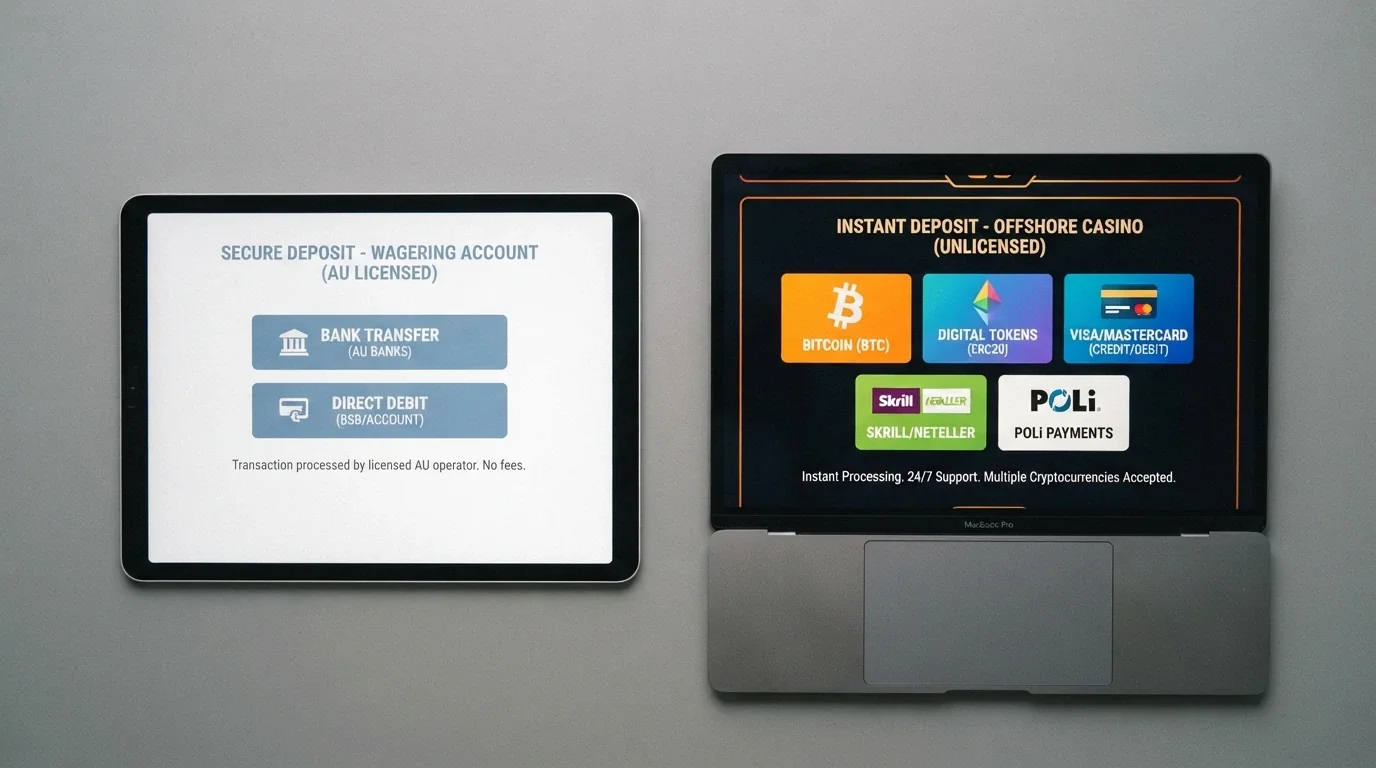
The June 2024 ban on credit cards and crypto for licensed wagering drew a hard line. From 11 June 2024, an Australian-licensed wagering operator cannot accept credit cards, credit-related products or digital currency. Penalties for non-compliance reach A$247,500 per operator. An offshore casino accepting those methods from an Australian player is therefore not subject to the ban — but the choice to accept them tells the player what the operator’s relationship with Australian rules is. The credit card button and the Bitcoin button are the buttons a licensed operator cannot legally display.
ACMA has enforced the prohibition by blocking illegal gambling and affiliate websites at the ISP level. Since November 2019, 1,751 illegal gambling and affiliate websites have been blocked, and more than 230 illegal services have withdrawn from the Australian market since enforcement began in 2017. Civil penalties for providing prohibited interactive gambling services reach A$2,475,000 per day for an individual and A$12,375,000 per day for a corporation. The penalties are aimed at the provider. The player is not prosecuted, but the player’s recourse when the offshore operator acts badly is also aimed at someone the player cannot reach.
AUSTRAC and Your Deposit — When a Casino Transfer Triggers a Report
AUSTRAC, the Australian Transaction Reports and Analysis Centre, sits underneath the deposit chain. International funds transfer instructions of AU$10,000 or more trigger mandatory reporting to AUSTRAC under the AML/CTF Act 2006. The casino’s bank, not the player’s, files the report. The threshold is set deliberately high so that ordinary consumer transactions do not generate reports. A player moving A$10,000 to an offshore casino will see the report filed, but not in their own name; the casino’s bank handles the obligation.
The more common friction is below the AUSTRAC line. Australian banks apply their own risk-based controls to international transfers well before the A$10,000 threshold. CommBank has had a public policy since mid-2023 declining or limiting payments to high-risk crypto exchanges, with daily caps around A$10,000. ANZ applied a twenty-four-hour delay to a single A$3,000 transfer to Binance Australia in February 2026, citing fraud prevention review. Two of three A$5,000 test transfers to Binance Australia via PayID were declined outright in March 2026. The pattern is that the bank’s risk model treats the casino as high-risk, and the bank’s controls kick in long before AUSTRAC’s reporting threshold does.
PayID transfers under A$2,000 typically clear without flagging at Australian banks. The threshold is the practical one for an Australian casino player: deposits up to A$2,000 by PayID are routine, deposits above that begin to attract attention, and deposits of A$5,000 or more may be declined outright. A player who wants frictionless deposits should keep them under A$2,000. A player who needs larger deposits should expect bank-level delays or declines.
The 2027 Reform — What Changes When Banks Can Block Gambling Transactions
From 1 January 2027, Australian banks and payment providers can now block transactions to unlicensed gambling services. The Interactive Gambling Amendment (Gambling Reform) Bill 2026 passed Parliament on 19 August 2026; the bank-blocking provisions commence 1 January 2027. The same reform package includes advertising restrictions, inducement bans and the expansion of specialised financial counselling services for gambling-related financial difficulty, announced 2 April 2026. The reform is the most significant change to the Australian gambling-payment infrastructure since the 2024 ban.
What changes for a player is that a deposit which clears today may be declined in 2027, and the operator on the other end may not be reachable at all. The bank’s authority to block is not a discretionary power the bank chooses to use; the reform grants the authority, and the bank’s risk model decides which operators to block. An offshore casino that has been processed without incident through PayID today may find that the same transfer is declined next year once the bank’s blocking system is in place. The deposit page’s payment methods are not the deposit chain’s only failure mode; the bank itself is a new point of failure.
The reform does not change what is licensed. Online casino remains prohibited; licensed Australian wagering operators remain the only licensed gambling services; offshore casinos remain unlicensed. The reform changes the practical enforcement, by giving banks the authority they did not previously have to block the flow of funds. The bank blocking the transaction is faster than the regulator blocking the website; the deposit does not arrive, the casino does not see the player, and the player is told by their banking app that the transfer was declined.
Offshore vs Licensed — What You Lose When the Operator Sits Outside Australia
Playing at an offshore casino means losing every layer of Australian consumer protection. There is no Australian complaints body. There is no Australian financial ombudsman. There is no withdrawal guarantee, no dispute resolution mechanism, no code of conduct the operator has signed. The Interactive Gambling Act 2001 prohibits the operator from providing the service at all; the operator is therefore not licensed by any Australian regulator and not bound by any Australian regulator’s standards.
BetStop is the clearest gap. BetStop — the National Self-Exclusion Register — covers approximately 150 licensed wagering providers in Australia, and excludes the player from those providers for a minimum of three months up to a lifetime. An offshore casino is not connected to the register. A player who has self-excluded through BetStop can still deposit at an offshore casino. The self-exclusion does not reach offshore operators because the operators are not part of the system BetStop covers. The player who needs the protection BetStop offers does not get it at an offshore casino.
The deposit method cannot fill the gap. PayID, Neosurf, crypto, cards and bank transfer all move money between the player and the operator; none of them reverses the operator’s decision to refuse a withdrawal, void a win or close an account. The offshore operator’s terms govern the relationship, and the offshore operator’s terms can change at any time. The player accepts those terms by depositing.
The site can also be blocked at any time. ACMA has blocked 1,751 illegal gambling and affiliate websites since November 2019. A player with a balance at a blocked site has the balance on the operator’s books but no working URL to access it. The balance is not protected by Australian insolvency law, not protected by Australian consumer law, and not reachable through any Australian complaints mechanism. The deposit that landed instantly can be lost to a regulator action the player did not see coming.
How the Right Payment Choices Can Keep Your Gambling Safe
Payment methods are not just pipes for money. They are also the place where deposit limits, transaction visibility and self-exclusion either engage or do not. Choosing the right payment method is partly a responsible-gambling decision, because the method that leaves a paper trail is the method that gives the player a record they can show themselves, their bank or a counsellor. The method that hides the trail hides it from everyone, including the player.
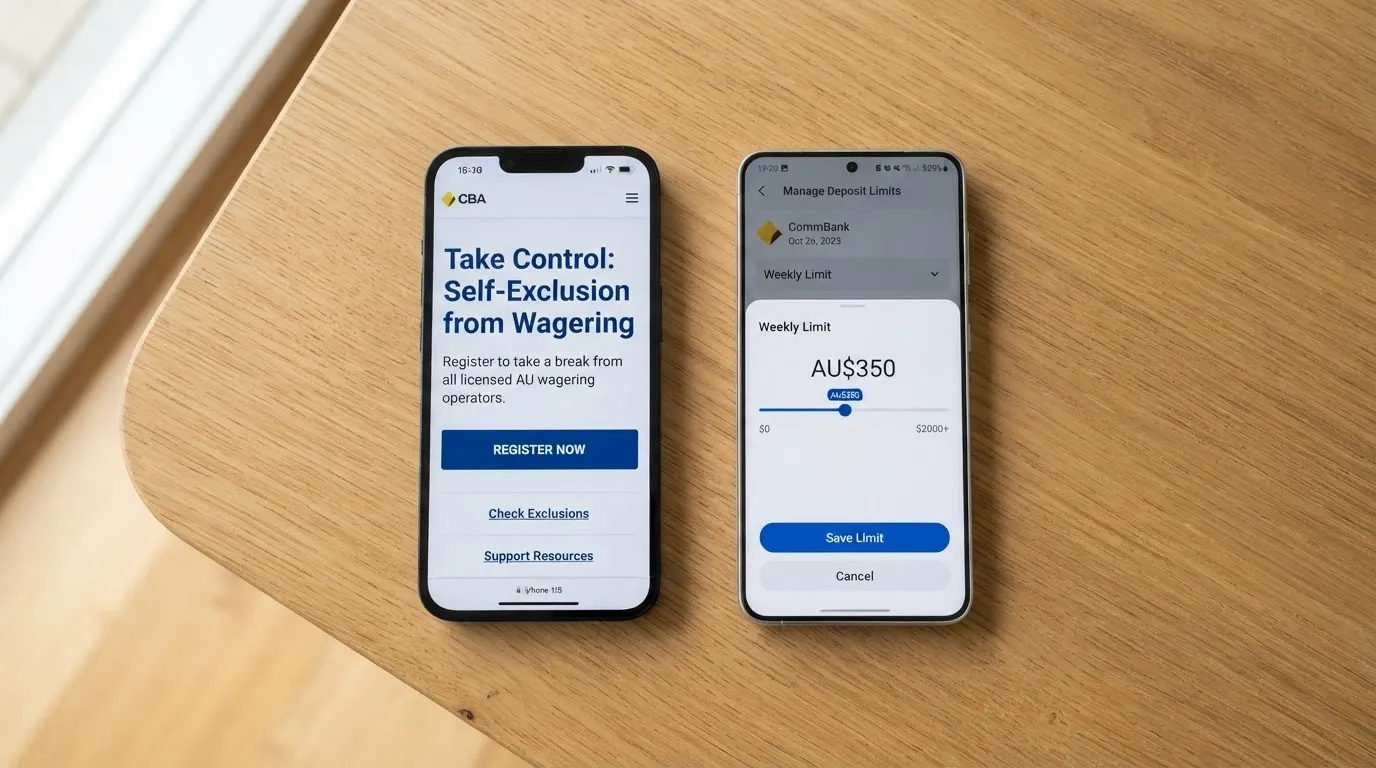
BetStop is the formal version of the same idea. BetStop’s National Self-Exclusion Register has 67,480 registrations as at 31 July 2026, of which 41,290 exclusions were still active. Seventy-eight per cent of registrants were under 40, and thirty-eight per cent chose lifetime exclusion. The register covers approximately 150 licensed wagering providers in Australia. The register does not cover offshore casinos. A player who has self-excluded through BetStop can still deposit at an offshore casino, because the offshore casino is not connected to the system.
About 2.1% of Australian adults — roughly 430,000 people — experience problem gambling. The National Gambling Helpline — 1800 858 858 — is free, confidential and staffed twenty-four hours a day, seven days a week, with online chat and counselling through Gambling Help Online. The helpline and the counselling are the response infrastructure for those players. Payment methods are not a substitute for the helpline. They are, however, the part of the system the player interacts with most often.
Deposit Limits, Session Caps and the Tools Built Into Your Payment Method
There is no federal deposit, loss or stake ceiling for online gambling in Australia. The product those ceilings would govern is banned outright. Australia caps the payment method, not the deposit amount. Licensed wagering operators offer customer-set deposit limits under their state or territory conditions; offshore casinos may offer deposit limits too, but the enforcement is voluntary and there is no Australian regulator to appeal to if the operator overrides the player’s setting.
What that means in practice is that the limit a player can set at an offshore casino is the limit the casino chooses to honour. The limit is not binding on the operator. A player who sets a weekly deposit limit of A$200 and finds the operator has not enforced it has recourse through the casino’s own complaints process, which is the casino’s own complaints process. The player who values the limit values the operator’s commitment to it. The player who picks the operator with the most generous published limits has chosen the operator most likely to let them down.
The deposit limit a player can set is the deposit limit the player can afford to set. The rule of thumb at licensed wagering operators is that a player should be able to lose the deposit without affecting their weekly budget. The rule of thumb at offshore casinos is the same. The difference is whether the operator enforces the rule when the player tries to exceed it.
BetStop and Your Casino Deposits — What Self-Exclusion Actually Blocks
BetStop blocks the player from depositing at the approximately 150 licensed wagering providers in Australia that are connected to the register. The exclusion lasts for a minimum of three months up to a lifetime; a person cannot apply to be removed in the first three months. The exclusion is the strongest formal protection available to an Australian player who has decided they need help.
What BetStop does not block is the offshore casino. The register does not reach offshore operators because the offshore operators are not part of the Australian licensing system. A player who has self-excluded through BetStop can still deposit at the operators featured on this page, because none of them hold an Australian licence. The self-exclusion is real at licensed wagering operators and a non-event at offshore casinos.
The payment method that bypasses the register is the same payment method that accepts the deposit at the offshore casino. PayID, Neosurf, crypto, cards and bank transfer do not check BetStop before processing a transaction. The check happens at the licensed wagering provider’s account-opening step; offshore operators do not run the check. A player who has self-excluded and is choosing to deposit at an offshore casino is choosing to bypass the system they enrolled in.
How We Evaluated and Ranked These Casino Payment Methods
The page ranks payment methods by four criteria: speed, cost, accessibility to Australians and regulatory signal. Speed is the published deposit and withdrawal time at best-in-class operators, sourced from operator payment pages and independent testing. Cost is the published fee schedule from each method’s operator (PayPal’s 3.49% plus A$0.59, Neteller’s 2.5%, Skrill/Neteller’s 3.99% exchange margin), plus the bank wire fees of A$10 to A$50 per transaction. Accessibility is whether the method works at the AU-facing offshore casinos Australians actually access, and whether the bank will honour the transfer. Regulatory signal is whether the method is banned for licensed wagering and what that tells the player about the operator.
Sources include the ACMA register and ACMA enforcement reports — 1,751 sites blocked since November 2019, more than 230 services withdrawn since 2017 — operator payment pages from each of the ten featured offshore casinos, published fee schedules from PayPal, Neteller and Skrill, AUSTRAC reporting thresholds under the AML/CTF Act 2006, and bank policy disclosures from CommBank and ANZ. BetStop statistics are from ACMA’s published figures as at 31 July 2026. The H2 Gambling Capital 2025 report figures are from Responsible Wagering Australia’s commissioned research.
The operator set checked is ten offshore casinos that Australian players actually access: Rocket Play, Skycrown, Royal Reels, Stake, WinSpirit, Rainbet, Scream Casino, FairGO, Bizzo Casino and Rocket Casino. None holds an Australian online casino licence because no such licence exists. Licensed Australian wagering operators — SportsBet, TAB, bet365 AU, Ladbrokes, TABtouch, Neds, PointsBet, Betr, Picklebet, Betfair — offer wagering only, not casino games, and are not included in this comparison. The page does not measure bonus terms, game libraries or customer support; the focus is the payment-method mix.
What Australian Casino Players Should Actually Do About Payment Methods Right Now
Three rules cover most of what an Australian player should know. First, pick a method the banned operators cannot touch. PayID is the strongest default choice for most players: it is built on Australia’s own NPP rail, costs nothing, settles in under a minute on deposits and one to four hours on withdrawals, and is not banned. Crypto is faster on withdrawals but banned for licensed wagering since 11 June 2024, which means any operator accepting it is offshore and unlicensed. The credit card button is a closed door at licensed operators and a regulatory signal at offshore ones.
Second, check what the method costs before depositing. PayID is fee-free. PayPal is 3.49% plus A$0.59. Neteller is 2.5% on deposit plus a 3.99% exchange margin. Skrill applies the same 3.99% margin. Bank wire is A$10 to A$50 per transaction. A player depositing A$1,000 a week through PayPal pays A$35.49 in fees; the same deposit through PayID pays nothing. The fee comparison over a year of regular play is a five-figure difference.
Third, never deposit more than the player can afford to lose at an operator with no Australian complaints body. The offshore casino’s terms govern the relationship; the offshore casino’s terms can change at any time; the player has no recourse through any Australian mechanism if the operator refuses a withdrawal, voids a win or closes the account. The deposit limit a player should set is the deposit limit they can afford to lose. The National Gambling Helpline — 1800 858 858 — is the response if that limit is being exceeded.
The 2027 reform changes the practical picture. From 1 January 2027, banks and payment providers gain express authority to block transactions to illegal gambling operators. A deposit that clears today may be declined in 2027. A player choosing where to deposit in 2026 is choosing with a one-year horizon before the bank-blocking authority arrives. The method that works at an offshore casino today is not guaranteed to work at the same casino in 2027.
Frequently Asked Questions
What are the safest payment methods for Australian online casino players?
PayID is the strongest default: zero fees, deposits in under sixty seconds, withdrawals in one to four hours at best operators, and not banned for licensed wagering. Crypto is faster on withdrawals but banned since 11 June 2024. An operator accepting crypto is offshore and outside every Australian consumer protection.
Is Neosurf a good option for online casino deposits in Australia?
Neosurf suits privacy-focused players. Vouchers come in A$10, A$50 and A$100 denominations; the deposit is instant and no bank account is linked. The catch is that Neosurf is deposit-only — winnings must return through PayID, crypto or bank transfer. A player who expects to withdraw by voucher will find no refund route exists.
What is the minimum deposit amount for Australian online casinos?
Minimums vary by method and operator. Visa deposits have a minimum of A$20 and a maximum of A$5,000. Neosurf is fixed at A$10, A$50 and A$100. BPAY starts at A$20 to A$50. PayID has no rail-level minimum, though most operators set A$10 to A$30. Crypto minimums depend on the coin, often around A$20.
How does BetStop affect my ability to deposit at online casinos?
BetStop blocks deposits at the approximately 150 licensed wagering providers for the duration of the exclusion — minimum three months, maximum lifetime. The exclusion does not reach offshore casinos because they are not part of the Australian licensing system. A self-excluded player can still deposit at offshore operators because none of them hold an Australian licence.
What happens if my bank blocks a casino transaction?
Below the A$10,000 AUSTRAC reporting threshold, Australian banks apply their own risk controls. CommBank caps crypto-exchange payments around A$10,000 daily; ANZ delayed a A$3,000 transfer to Binance in February 2026 and declined A$5,000 PayID transfers in March 2026. From 1 January 2027, banks can block payments to such operators outright.
Are there fees for using e-wallets at Australian online casinos?
Yes, and the fees are higher than most players expect. PayPal charges 3.49% plus A$0.59 fixed per casino deposit. Neteller charges 2.5% on deposits. Skrill and Neteller also apply a 3.99% exchange margin on deposit that is not advertised. A A$1,000 deposit through PayPal costs A$35.49 in fees; through PayID, nothing.
Published by the POLi Casinos AU team.