
Bitcoin Pokies in Australia: A Real-World Guide to Offshore Crypto Casinos
 Available in AU
18 October 2026 — checked against the ACMA BetStop licensed-wagering register and the Australian Communications and Media Authority’s online prohibition framework.

Australian players who want to spin pokies with bitcoin in 2026 are not choosing between a licensed option and an offshore one. There is no licensed option. Online casino games, online pokies and in-play betting are prohibited to people in Australia under the Interactive Gambling Act 2001, and the Australian Communications and Media Authority (ACMA) enforces that prohibition by directing internet service providers to block illegal sites. The ten brands ranked below are the offshore, AU-unlicensed operators that actually accept Australian players and bitcoin deposits. They sit on the other side of a line drawn by statute, and that is the first fact a reader of this page needs to carry forward.
The ten operators on this page are not the only offshore crypto casinos an Australian could find. They are the ten whose bonus terms, wagering multipliers, free-spin mechanics and licence transparency the research for this article was able to verify from primary or near-primary sources. The order is not a recommendation to play; it is a comparison of what each one offers on the strength of what each one actually publishes. Where a brand’s licence jurisdiction, game providers, or bonus validity period could not be confirmed in this research pass, the article says so rather than fill the gap with a confident guess.
A reader looking for offshore online pokies has three real reasons to read a comparison rather than pick the first brand that takes their deposit. The first is that the headline bonus figure is almost never the figure that reaches a player’s withdrawal balance, because turnover requirements, bonus-only wagering, max-cashout caps and free-spin win caps eat most of the headline. The second is that offshore operators do not provide Australian consumer protection, which means a dispute over a withheld withdrawal is not one the regulator will mediate. The third is that BetStop, the National Self-Exclusion Register, binds licensed Australian wagering services — and does not bind any of the operators in this ranking. Each of these reasons is developed in the sections that follow, in that order.
Table of Contents
- What Bitcoin Pokies Are, and Why Australian Players Use Them
- From Wallets to Reels: How a Bitcoin Pokie Spin Actually Happens
- Choosing a Network: TRC-20, ERC-20 and BEP-20 for an Australian Player
- Why Australian Players Choose Bitcoin Over a Bank Transfer
- Best Bitcoin Pokies Sites for Australian Players in 2026
- How the Ranking Was Built
- What Separates the Top Sites from the Rest
- BitStarz
- BC.Game
- Wild Fortune
- Bitcasino.io
- mBit
- BetPanda
- CoinCasino
- Cryptorino
- HyperLucky
- Vave
- Why the Bonus Figure Is Smaller Than It Looks
- How a Bitcoin Welcome Package Is Actually Structured
- What Free Spins Are Actually Worth
- Wagering Requirements and the Fine Print That Eats the Bonus
- The Legal Reality of Bitcoin Pokies in Australia
- What the Interactive Gambling Act Actually Bans
- The Licensed Wagering Ecosystem and What It Actually Permits
- The 2026 Gambling Reform and What Changes from 2027
- Payment Methods: What Is Banned, What Is Legal, and What the Offshore Market Uses
- Staying Safe When Playing Bitcoin Pokies
- Setting Deposit and Session Limits at Offshore Sites
- Where Australians Can Get Help
- What BetStop Covers and Where It Falls Short
- How the Ranking Was Evaluated
- Making the Choice: A Practical Path for an Australian Player
- Frequently Asked Questions
What Bitcoin Pokies Are, and Why Australian Players Use Them
A bitcoin pokie is an online slot machine played at an offshore crypto casino using bitcoin, or a stablecoin pegged to the US dollar such as USDT, as the deposit and withdrawal currency. The game itself is the same kind of reel-and-payline game Australians have played in pubs and clubs for decades; the difference is the rails the money runs on. An Australian player opens an account at an offshore casino, sends bitcoin from a self-custody wallet or an exchange account, plays the same kind of pokies that are banned online at home, and can withdraw winnings back to a wallet in minutes rather than days.
The vast majority of these offshore operators run under an offshore licence. Curaçao is the jurisdiction most commonly cited for the category, though a handful — Wild Fortune among the ten in this ranking — publish a Tobique licence that is at least nominally verifiable. None of them provides Australian consumer protection. A player who has a dispute with a Curaçao-licensed brand has recourse to that brand’s complaint process and, in some cases, the licensing authority. They do not have recourse to ACMA, the Australian Competition and Consumer Commission, or any state-based dispute resolution body.
Crypto deposits at these sites usually land in a player account within ten to thirty minutes for bitcoin on the base layer, and within a few minutes for USDT or BTC on faster networks. Withdrawals in the same direction are similarly fast once the casino’s internal processing completes. A test suite cited by the security research site Casipto reports that tested bitcoin casinos store 90–95% of user funds in offline (cold) wallets, use TLS 1.3 with 256-bit keys for transport security, and that operators including BitStarz and mBit apply a 2-of-3 multisignature setup for large withdrawals. None of that removes the offshore-protection problem; it does mean the rails themselves are not the soft part of the operation.
The practical reason an Australian player chooses crypto over the deposit methods available at licensed Australian bookmakers is friction. Licensed online wagering in Australia cannot legally accept credit cards, credit-related products or digital currency as a payment method. The legal deposit routes that remain are debit card, bank transfer, PayID/Osko and BPAY. Each of those carries a visible “gambling” merchant code on the bank statement, takes a working day or more to clear in the case of BPAY and some bank transfers, and ties the player’s gambling activity to a personal bank account in a way that some people would rather not have on a record they cannot easily redact. Crypto, used carefully, separates the gambling activity from the bank statement entirely. It also bypasses the credit and crypto ban that applies to licensed wagering — because the ban applies to licensed wagering, not to offshore operators, and the offshore operators are the only ones who are not banned from offering online pokies in the first place.
USDT plays a particular role in the choice. Bitcoin’s price can move ten per cent in a day. A player who deposits 0.1 BTC worth $6,500, plays for a week, and then finds 0.1 BTC now worth $5,800 has lost money on the gambling and on the currency. USDT, pegged to the US dollar, holds roughly the same dollar value across a session, which makes the gambling itself — the only thing a player can actually affect — easier to read. Some players split their balance between the two, holding a stablecoin core and a smaller bitcoin float for the chance of appreciation. The mechanics of the play are identical between the two; the difference is the volatility the player is willing to wear outside the game.
From Wallets to Reels: How a Bitcoin Pokie Spin Actually Happens
The mechanics of a crypto-funded slot play are simple at the player level, even though the systems on either side are not. A player holds bitcoin or USDT in a wallet — either a self-custody wallet whose private keys the player controls, or an account at a cryptocurrency exchange that holds the keys on the player’s behalf. To play, the player copies a deposit address the casino displays inside its cashier, sends the chosen amount to that address over the appropriate network, and waits for a number of network confirmations. Most casinos credit the deposit after one to three confirmations, which on the Bitcoin base layer is roughly ten to thirty minutes. On TRC-20, ERC-20 or BEP-20 networks carrying USDT, the credit is often faster.

Once the casino credits the account, the funds appear in the player’s balance and play begins. The games are the same kind of reel-and-payline pokies that licensed land-based venues in Australia offer, and they are produced by the same third-party studios — Pragmatic Play, Nolimit City, Booming Games, Betsoft, NetEnt, Play’n GO and Spinomenal are all named as providers in the BitStarz game library, for example. The outcome of each spin is determined by a random number generator, the same way a physical pokie’s outcome is determined by a random number generator. The crypto part of the transaction ends at the deposit.
A growing number of offshore casinos also publish provably fair verification, a cryptographic method that lets a player check after the fact that a game’s result was not altered by the casino. Provably fair works by combining a server seed the casino publishes in advance, a client seed the player can change, and a nonce that increments per bet; the resulting hash determines the outcome. A player can recompute the hash with the disclosed values and confirm the result was not tampered with. Not every operator offers this on every game, and not every player checks it, but for those who do, it closes a verification gap that no third-party audit fully closes.
A withdrawal reverses the deposit path. The player requests a payout to a wallet address they control, the casino processes the request through its internal compliance and anti-fraud checks, and the funds are sent. Identity verification is still required at most offshore operators before the first withdrawal — the licence requirement binds even when the regulator is not ACMA — and that step is where many players hit the only real wait in the system. Once verification is complete, subsequent withdrawals in the same operator typically clear in minutes. Two of the operators in this ranking, BitStarz and mBit, use 2-of-3 multisignature cold-storage setups for large withdrawals, which means the player sees a signed transaction that requires two private keys out of three to authorise. This is industry-standard custody practice and the player experiences it as a brief delay rather than a visible ceremony.
Choosing a Network: TRC-20, ERC-20 and BEP-20 for an Australian Player
For a player depositing USDT specifically, the network choice is the part most likely to lose funds. USDT exists on several blockchains. The Tron network (TRC-20) typically has the lowest transaction fees, often under one Australian dollar, and confirmation times in the one-to-three-minute band. Ethereum (ERC-20) carries higher fees, particularly when the network is busy, and confirmation times of a few minutes to over an hour depending on gas. Binance Smart Chain (BEP-20) sits in between on cost and confirmation speed. Bitcoin itself only exists on the Bitcoin network, so the address is the address and the network choice is fixed.
The trap is sending USDT on TRC-20 to a casino address that expects ERC-20, or vice versa. The tokens will not appear in the casino account because the casino is only watching the network it instructed the player to use. A player who has sent funds to a wrong-network address has, in nearly every case, lost them. The fix is straightforward and worth carrying into every deposit: copy the deposit address from the casino cashier, confirm the network label the casino displays beside the address, and send only that token on that network. Most casino cashiers will show the network name explicitly next to the address or as a QR-code metadata field. Match it. Do not assume.
Bitcoin deposits do not have this problem in the same form, but they do have a slow-block problem. The Bitcoin base layer processes a block roughly every ten minutes, and most casinos credit after one to three confirmations. A player in a hurry can pay a higher fee to push the transaction into the next block, but cannot do better than the network itself. Lightning Network deposits and withdrawals, where supported, settle in seconds and at much lower cost, but Lightning support is not universal at the operators in this ranking.
The exchange on-ramp matters as well. An Australian player who buys bitcoin on a local exchange that pairs BTC against the Australian dollar — exchanges that take PayID or bank transfer as funding rails — will pay an A-to-BTC spread and a network fee, and the resulting bitcoin can be sent directly to the casino wallet. The chain is exchange to wallet to casino, and each step has a fee. The alternative is to buy USDT, which is a dollar-pegged token that does not move with bitcoin’s price, and the dollar value of the player’s balance stays roughly stable across the time it takes to deposit. Both routes are legal in Australia at the exchange level; the illegality sits with the licensed wagering side, which is banned from accepting the deposit that the offshore casino is not licensed to receive.
Why Australian Players Choose Bitcoin Over a Bank Transfer
The reason an Australian player chooses bitcoin for offshore pokies is not ideology. It is that the legal alternative is built to be slow and visible. A PayID or Osko deposit to a licensed Australian bookmaker settles in under a minute but lands at a bookmaker, not at a pokie site, because Australian-licensed operators cannot offer online pokies. A BPAY deposit to a licensed operator takes a working day. A debit card deposit carries a gambling merchant code on the bank statement. None of those options lets a player reach a pokie in the first place.
The practical wins for a player using crypto are three. The first is speed: deposits clear in minutes and withdrawals clear in minutes once verification is complete. The second is privacy: a crypto withdrawal does not show up on a bank statement at all, and a crypto deposit leaves no merchant code trail between the player’s bank and the casino. The third is access: the licensed Australian ecosystem simply does not contain online pokies, so anyone who wants to play online pokies from Australia is, by definition, looking at an offshore operator, and crypto is the cleanest way to fund and withdraw from one.
USDT plays a specific role in hedging that volatility. A player who deposits bitcoin and leaves it in bitcoin between deposits and withdrawals is taking a currency position in addition to a gambling position. The gambling position is the only one the player can affect; the currency position is something the bitcoin market does on its own. Stablecoins remove the second position and let the player play only the first. Some operators in the offshore market settle bets and bonuses in USDT by default, which closes the gap further. The risk that remains is the credit risk of the operator itself, which is not hedged by any token choice.
The legal status is not hidden by the choice of payment rail. The Interactive Gambling Act 2001 prohibits the supply of prohibited interactive gambling services to people in Australia, and an offshore casino offering online pokies to an Australian player is the entity the Act targets, not the player. Payoutverdict (2026) states: ‘Australian players are not criminalised for using offshore crypto casinos — the Interactive Gambling Act 2001, Section 8AA, prohibits operators from providing services to AU residents, not residents from playing.’ Players are not prosecuted for using offshore crypto casinos.
Best Bitcoin Pokies Sites for Australian Players in 2026
The table below ranks the ten offshore crypto casinos that accept Australian players and bitcoin deposits and that the research for this article was able to verify against published bonus terms. Wagering type refers to whether the multiplier applies to the bonus alone or to bonus plus deposit together; bonus-only wagering is the industry norm at offshore operators, and it is the type the audit checks against. Where a column is empty, the research did not surface the figure from a primary or near-primary source in this pass, and the no-data marker is honest.
| Operator | Welcome Bonus (% and cap) | Free Spins | Wagering (bonus) | Wagering Type |
|---|---|---|---|---|
| BitStarz | Up to $500 or 5 BTC across four deposits | 180 (first deposit) | 40x | Bonus-only |
| BC.Game | Up to $1,600 + 400 free spins across four deposits | 400 (across four deposits) | 40x | Bonus-only |
| Wild Fortune | 225% up to CA$7,500 | 250 | 40x | Bonus-only |
| Bitcasino.io | 100% up to approximately €1,200 | — | 40x | Bonus-only |
| mBit | 175% up to 2 BTC | 300 | 40x | Bonus-only |
| BetPanda | 200% up to $10,000 | 50 | 60x | Bonus-only |
| CoinCasino | 200% up to $30,000 | 50 | 60x | Bonus-only |
| Cryptorino | 100% up to 1 BTC | — | 60x | Bonus-only |
| HyperLucky | 100% up to $1,000 | 100 | 80x | Bonus-only |
| Vave | Up to 4 BTC across four deposits | 100 | 50x | Bonus-only |
The table is a snapshot of what each operator publishes as its welcome offer. It is not a forecast of which one pays out best, because the headline figure is only the first input into the calculation. A $500 bonus with 40x bonus-only wagering carries a turnover obligation of $20,000. A $1,000 bonus with 80x bonus-only wagering carries an obligation of $80,000. The relationship between the headline figure and the real cost is not proportional; it is a function of the wagering multiplier and the cap, which is why the wagering column is the one the next section treats as the decision driver.
The top four by wagering multiplier are BitStarz, BC.Game, Wild Fortune, Bitcasino.io and mBit, all at 40x. The next two, Vave, sit at 50x. BetPanda, CoinCasino and Cryptorino sit at 60x. HyperLucky sits at 80x, the top of the range. Wagering type is bonus-only across every operator the research verified, which means the multiplier applies to the bonus amount alone, not to bonus plus deposit, and is the more favourable reading for the player. The two operators whose welcome bonus structure clearly differentiates them on terms rather than multiplier are Wild Fortune, which carries 0x wagering on its free-spin winnings, and BitStarz, which carries no formal maximum cashout limit on deposit-bonus winnings.
How the Ranking Was Built
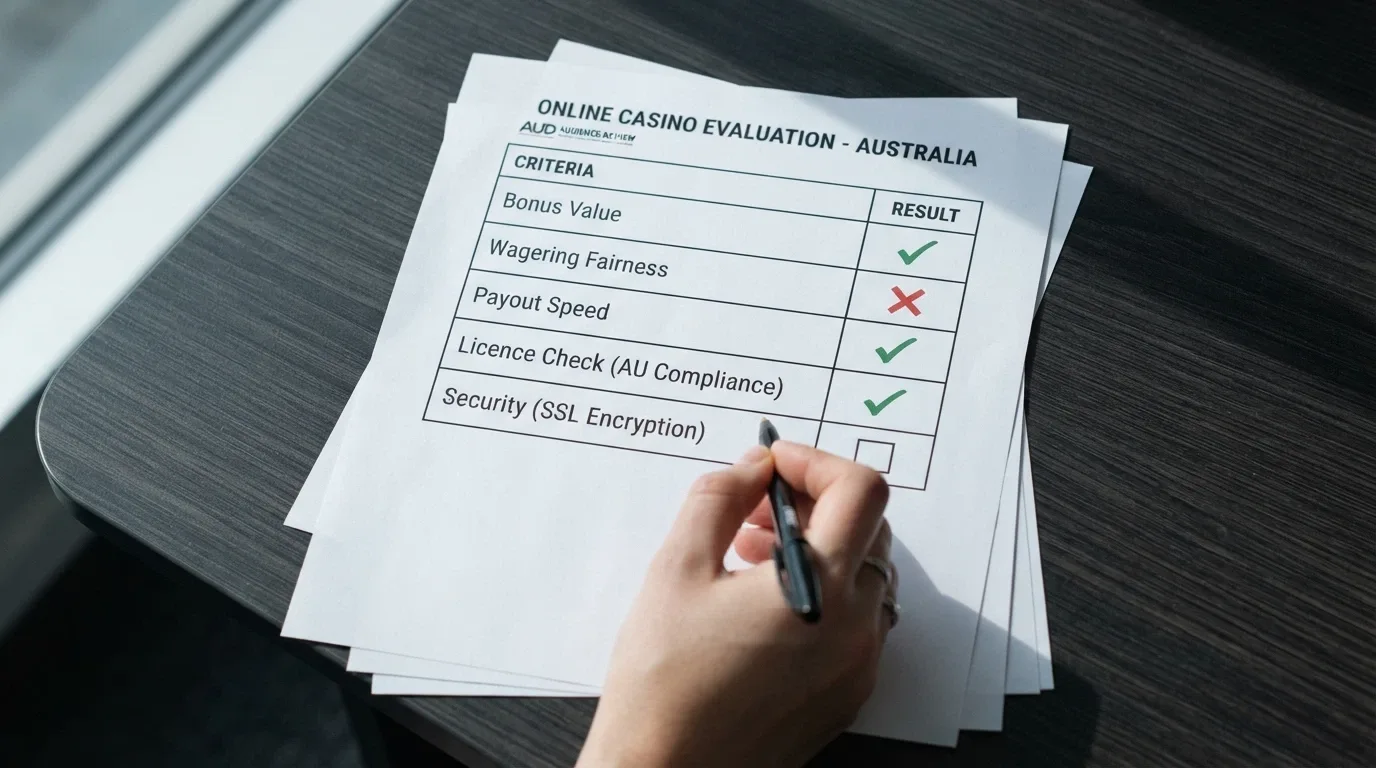
Five criteria determined the order. Bonus value, by which the comparison means the package as a whole — match percentage, cap, free-spin count, and whether the wagering multiplier and validity window leave the bonus withdrawable in practice. Wagering fairness, by which the comparison means the wagering multiplier and the wagering type, with bonus-only treated as the favourable case and bonus-plus-deposit as the unfavourable case. Payout speed and reliability, meaning how fast the operator processes crypto withdrawals once verification is complete, and whether the operator publishes any cap on cashouts. Game library breadth and provider quality, judged by the number and recognisability of the third-party studios the operator carries. Licence and security checks, meaning whether the operator publishes a verifiable licence jurisdiction and whether the security practices (cold storage, multisig, transport encryption) are documented.
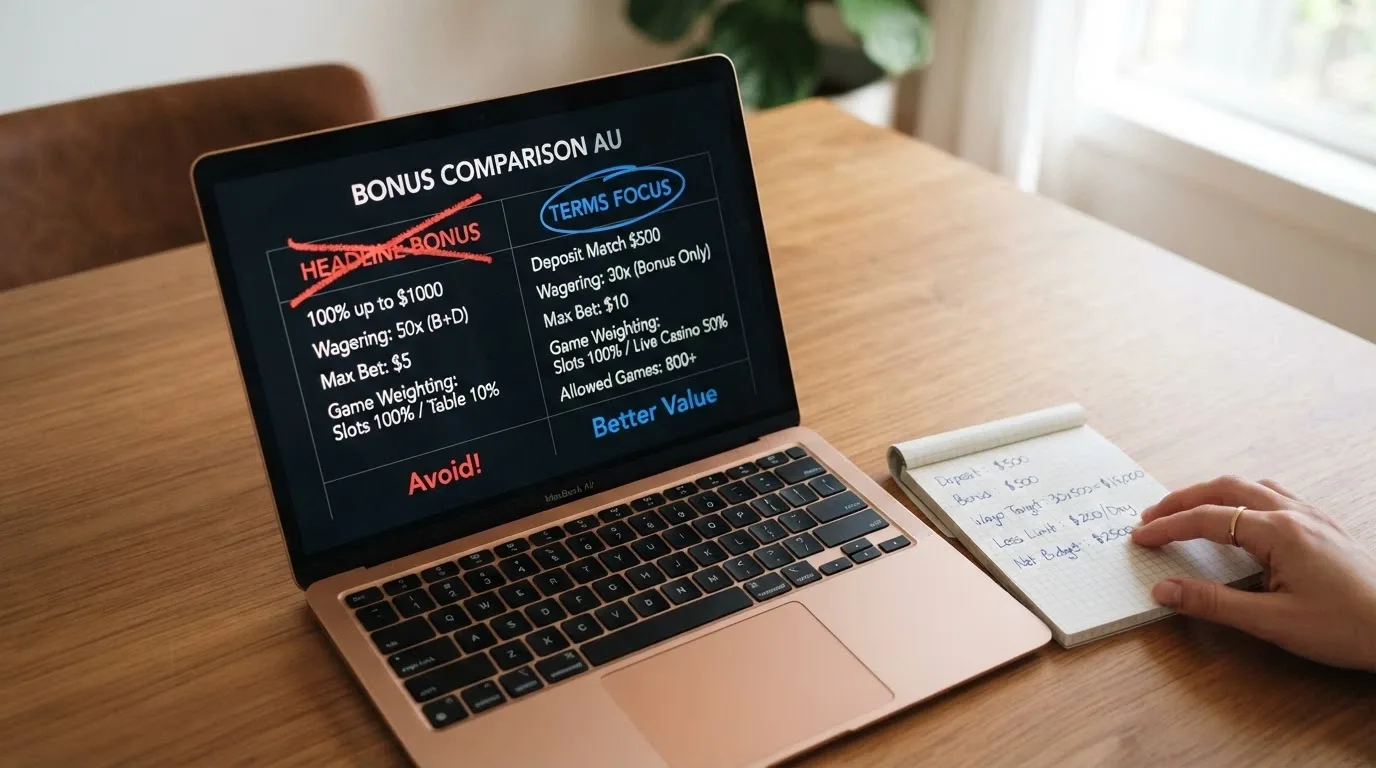
40x wagering is the benchmark the comparison treats as the floor of reasonable for a crypto welcome bonus in the offshore market. Wild Fortune’s verifiable Tobique licence, with the licence number checkable against the Tobique Gaming Commission register, is the example of a checkable offshore licence the ranking rewards. Operators whose published terms show a multiplier above 60x, or whose bonus validity window is short enough to put the bonus at risk of expiring before wagering completes, are ranked lower regardless of headline cap. The ranking is qualitative: no weightings, no black-box scores, no invented rankings. The numbers in the table come from the operator’s own published terms or from the secondary sources cited in the research; the order is the editor’s read of those terms against the five criteria.
What Separates the Top Sites from the Rest
Four markers distinguish the top handful of operators in this ranking from the lower band, and all four are visible in the published terms rather than in the marketing.
The first marker is transparent bonus terms with a reasonable wagering multiplier. A player who can read the terms and know, to the dollar, what turnover is required to clear a bonus is in a different position from a player who has to guess. Reasonable, in this market, means 40x on the bonus or below. Wild Fortune, BitStarz, BC.Game, Bitcasino.io and mBit sit at 40x. HyperLucky’s 80x is not reasonable; it is the kind of figure that turns a 100% match into a liability.
The second marker is fast crypto payouts without internal stalling. Crypto payouts that clear in minutes rather than days are the entire reason an Australian player chose crypto in the first place. Operators that hold withdrawals in a “pending” status for 24 to 72 hours before processing have, in practice, taken the speed advantage off the table. The ten operators in this ranking all process crypto, but the speed at which they release funds once verification is complete is not uniform, and the research did not surface a verified payout-time figure for every brand.
The third marker is provably fair or independently audited games. Provably fair verification, where the operator publishes server seeds and lets the player check each result against the disclosed inputs, is the strongest evidence the games have not been altered. Independent third-party audits, where a lab like iTech Labs or GLI tests the random number generator, are the next-strongest. Not every operator in this ranking publishes both, and a player who values verifiability should check the footer of the operator’s homepage or the help section for the relevant disclosure before depositing.
The fourth marker is the absence of hidden maximum cashout caps on deposit-bonus winnings. BC.Game’s offer, for example, caps maximum win from the bonus at 200% of the bonus amount, and caps maximum win from free spins at $5 . A player who cleared BC.Game’s full $1,600 welcome bonus and triggered a $10,000 slot jackpot would walk away with $3,200 — the cap — not the jackpot. BitStarz, by contrast, has no formal maximum cashout limit on deposit-bonus winnings, which means a cleared bonus does not have a ceiling pinned over the result. This is the single largest gap between operators at the same headline wagering multiplier, and the comparison makes it explicit because it is the gap a player feels last.
BitStarz
BitStarz is a top crypto-first operator, offering a four-deposit package up to $500 or 5 BTC plus 180 free spins. Key terms include 40x wagering on cash and free-spin winnings, a $5 max bet during wagering, and no formal maximum cashout limit. It is an offshore, unlicensed brand; players should exercise self-discipline as it falls outside Australian consumer protections.
BC.Game
BC.Game runs a four-deposit welcome package totalling up to $1,600 plus 400 free spins, with 40x bonus-only wagering on the bonus and 40x on free-spin winnings. The first deposit alone is 120% up to $1,000, which is one of the larger single-deposit matches in the set. The bonus validity is 30 days; free spins must be claimed within 24 hours of being credited and used within 24 hours of being claimed. The 24-hour claim-and-use window for the free spins is unusually tight and worth noting before claiming.
The terms feature that pulls BC.Game down the ranking is the cap structure. The maximum win from the bonus is capped at 200% of the bonus amount, and the maximum win from free spins is capped at $5 . A player who deposits $1,000 and clears the bonus has, in the best case, $2,000 to withdraw from the bonus side before the cap kicks in. A player who wins anything substantial on a free spin walks away with $5. The 40x multiplier is at the benchmark, but the cap structure is the reason the bonus headline is the smallest figure on the page that matters.
BC.Game offers a four-deposit welcome package totalling up to $1,600 plus 400 free spins, with 40x bonus-only wagering. The offer is capped at 200% of the bonus amount, and free-spin wins are capped at $5. Like other offshore, unlicensed sites, it operates outside Australian consumer protection frameworks.
Wild Fortune
Wild Fortune provides a 225% match up to CA$7,500 plus 250 free spins, featuring a notable 0x wagering requirement on free-spin winnings. It publishes a verifiable Tobique licence. This offshore, unlicensed brand offers strong free-spin terms, though the 7-day validity requires faster turnover.
Bitcasino.io
Bitcasino.io delivers a 100% match up to approximately €1,200 with 40x wagering. It is a clean, single-deposit offer but lacks differentiation in the competitive offshore market. As with other unlicensed sites, users must navigate the lack of local Australian protection.
mBit
mBit offers a 175% match up to 2 BTC plus 300 free spins at 40x wagering. While it lacks confirmed bonus validity and official cashout caps, its multisig custody practice aligns with industry standards for this offshore, unlicensed segment.
BetPanda
The 200% match up to $10,000 comes with 60x bonus-only wagering, turning the headline cap into a $600,000 turnover obligation. The high multiplier makes the headline bonus less accessible. This unlicensed operator provides no Australian consumer protection.
CoinCasino
The 200% match up to $30,000 plus 50 Super Spins comes with 60x bonus-only wagering, making the large headline cap difficult to clear. The large headline cap is difficult to clear given the 60x wagering requirement. This unlicensed operator operates without Australian regulatory oversight.
Cryptorino
This 100% match up to 1 BTC plus 10% cashback comes with 60x bonus-only wagering. Like other unlicensed offshore sites, it lacks Australian regulatory safeguards for players.
HyperLucky
HyperLucky offers 100% up to $1,000 plus 100 free spins, with 80x bonus-only wagering. The 80x multiplier is the highest in the ranking. At 80x on a $1,000 bonus — the maximum — a player needs to turn over $80,000 before any winnings are withdrawable. The 100 free spins is a reasonable free-spin count, but no research surfaced the wagering on free-spin winnings or any cashout cap, which means a player cannot tell from the published terms alone what a cleared free spin is worth.
The trade-off is the 80x wagering multiplier, full stop. A 100% match at 80x bonus-only is, in turnover terms, the worst deal in the ranking. The 100 free spins are not large enough to make up for a multiplier that turns a $1,000 bonus into an $80,000 turnover obligation. A player who values the absolute figure of the bonus and can clear that volume in 7 or 30 days is in a position to use the offer; a player who reads the headline as a withdrawal is reading it wrong.
HyperLucky is an offshore operator and does not hold an Australian online casino licence. The licence jurisdiction was not confirmed in this pass. For a player who explicitly wants a 100% match with 100 free spins at 80x, HyperLucky is the only option in the ranking. For most players, the 40x operators deliver more of the bonus in practice.
Vave
This up to 4 BTC plus 100 free spins package is split across four deposits, with 50x wagering. As with other unlicensed sites, players should be aware of the lack of local Australian protection.
The trade-off is the 50x wagering on a four-deposit package. A player claiming all four deposits at Vave needs to clear 50x on each bonus, which compounds the turnover obligation across the package. The 4 BTC cap is large in absolute terms, but at 50x it is also a large absolute turnover. The 100 free spins with no surfaced wagering or cap is an additional unknown.
Vave is an offshore operator and does not hold an Australian online casino licence. The licence jurisdiction was not confirmed in this pass. For a player who values a large BTC-denominated four-deposit package at 50x, Vave is a reasonable pick. The 40x operators offer the same package size at a lower multiplier, and the 50x sits between the benchmark and the lower band.
Why the Bonus Figure Is Smaller Than It Looks
The headline figure on a welcome bonus is the figure the casino wants a player to read. The figure that actually matters is the product of the bonus, the wagering multiplier, and the cashout cap. A worked example makes the gap visible.
BitStarz’s welcome bonus is up to $500. The wagering is 40x on the bonus, which means a player who claims the full $500 bonus needs to turn over $20,000 — 40 multiplied by 500 — before any of the bonus-derived winnings are withdrawable. The expected loss on that turnover, assuming the player plays a representative online pokie with a return-to-player of 96.25% (the figure Spinhunter reports for Lightning Link, used here as illustrative because the actual RTP varies by title and by casino), is $20,000 multiplied by 1 minus 0.9625, which is $750. The player is mathematically expected to lose $750 of the $20,000 turned over to clear a $500 bonus. The bonus is, on its own terms, a worse deal than depositing the $500 and playing without claiming it, and the player is paying roughly $250 of “bonus value” to clear it. The expected loss is an average over many spins under the stated assumptions; it is not a guaranteed outcome for any single session.
The multiplier does most of the work. A player at HyperLucky, where the wagering is 80x, faces an $80,000 turnover on a $1,000 bonus, and the expected loss on that turnover at 96.25% RTP is $3,000 — three times the bonus, before any winnings are counted. The 40x operator is the better deal by a factor of two on the expected loss at the same bonus size. The 60x operators sit between, and the difference between 40x and 60x is the difference between a tight bonus and a punishing one.
The cashout cap compounds the multiplier’s effect. BC.Game’s 200% bonus-amount cap means a player who clears the full $1,600 welcome bonus can withdraw, at most, $3,200 from the bonus side — even if the wagering produced a $10,000 slot win. The expected loss on the $64,000 turnover at 40x is $2,400, and the maximum withdrawable from the bonus is $3,200, leaving a maximum net gain of $800 against an expected loss of $2,400. A player who understands the cap reads the offer differently from a player who reads the headline.
The bonus-validity window is the third variable, and it is the one that does not have a clean formula. A player who does not clear the turnover before the bonus expires loses the bonus and any winnings tied to it. Wild Fortune’s 7-day validity at 40x on a CA$7,500 match is short; BC.Game’s 30-day validity is long; HyperLucky’s was not surfaced. A player who claims a bonus they cannot clear in the validity window is paying the wagering cost without the bonus benefit.
The free-spin side of the offer carries its own small print. BitStarz’s 180 first-deposit spins release as 20 on deposit plus 20 per day for eight days, tied to a designated slot. BC.Game’s 400 spins must be claimed within 24 hours and used within 24 hours. Wild Fortune’s 250 spins are 0x wagering, which is the exception rather than the rule. BC.Game’s free-spin winnings are capped at $5. The free-spin component looks like a clean addition to the bonus; in practice, the wagering and the cap on those winnings often mean the player would have done as well with the cash bonus alone.
The arithmetic reads the same way across the ranking. The 40x operators deliver more of the bonus to the player in practice than the 60x and 80x operators do. The operators with no formal cashout cap deliver more of a large win than the capped operators do. The operators with 0x wagering on free spins deliver the free-spin component as cash. A player who reads the wagering column and the cap clause before the headline figure is reading the offer as it is.
How a Bitcoin Welcome Package Is Actually Structured
A welcome package is the bundle of deposit matches and free spins a new player claims on the first few deposits. Most of the operators in this ranking structure the welcome package across four deposits rather than as a single lump, and the structure of the package affects how a player should think about claiming it.
A 100% match is the simplest structure: the casino matches the player’s deposit dollar for dollar up to a cap. A player depositing $200 at a 100% match up to $1,000 receives a $200 bonus; a player depositing $1,000 receives a $1,000 bonus; a player depositing $2,000 receives a $1,000 bonus and is capped. A 200% match is the casino matching at two-to-one: a $200 deposit receives a $400 bonus. A 225% match at Wild Fortune is the casino matching at two-and-a-quarter-to-one. Higher match percentages look like better deals, but they are bounded by the cap and the wagering, and a 225% match at 40x is not necessarily a better deal than a 100% match at 40x if the cap forces the player to deposit more to reach it.
A four-deposit package splits the total match across four separate deposits, with each deposit triggering its own bonus. BitStarz’s “up to $500 or 5 BTC across four deposits” means the cap applies to the total across all four deposits, and the player can choose to claim a smaller portion by making smaller deposits or by skipping deposits. BC.Game’s “up to $1,600 + 400 free spins across four deposits” is the same structure with a larger total. mBit’s 175% up to 2 BTC and Vave’s up to 4 BTC are also four-deposit packages. A player who makes the first deposit and does not return for the second, third or fourth forfeits the remaining matches.
Bitcoin-denominated caps versus fiat-denominated caps are a second structural difference. A 5 BTC cap moves with the BTC price. At $50,000 BTC, 5 BTC is $250,000; at $30,000 BTC, 5 BTC is $150,000. A $500 cap is $500. A player depositing in BTC is taking a currency position in the cap itself, and the volatility that makes USDT attractive as a play currency applies to the bonus cap too. Some operators in the offshore market settle bonuses in USDT by default; others settle in BTC. The terms the casino publishes answer which it is.
Minimum qualifying deposits are a third structural difference. Wild Fortune’s AU$30 minimum is below the others in the set. mBit’s 30 USDT minimum is comparable. Bitcasino.io’s approximately €45 minimum is higher. A higher minimum means a player needs a larger first deposit to claim the bonus at all, which is a hidden condition on the offer.
What Free Spins Are Actually Worth
Free-spin offers at offshore bitcoin pokies sites fall into two structural groups. The first is a daily-release tranche, where a fixed number of spins is credited per day over a fixed number of days, tied to a designated slot. BitStarz’s 180 spins released as 20 on deposit plus 20 per day for eight days is the standard pattern. The second is a lump-sum credit, where all spins appear in the account at once, often with a tight claim and use window. BC.Game’s 400 spins with a 24-hour claim window and a 24-hour use window is the tightest version of this pattern in the ranking.
The wagering on free-spin winnings is the second variable. Wild Fortune’s 0x wagering on free-spin winnings is the rare case where the winnings are credited as cash. BitStarz’s 40x on free-spin winnings is the benchmark. BC.Game’s 40x on free-spin winnings is at the benchmark. HyperLucky’s wagering on free-spin winnings was not surfaced. A player who clears 0x wagering on free spins has the winnings in their cash balance; a player who clears 40x has the winnings in their bonus balance until the turnover completes.
The free-spin win cap is the third variable, and it is the one that most often goes unmentioned in marketing. BC.Game’s $5 free-spin max-win cap is the tightest cap in the ranking. A player who wins $50 on a single free spin at BC.Game walks away with $5. The cap matters because it is the operator’s answer to “what is the most a free spin can pay out”. A player who reads the cap before claiming knows what the spins are worth in the worst-case-best-case; a player who reads it after winning has already lost the difference.
The value of one free spin is the product of the spin’s payout rate and the slot’s RTP, minus any wagering and any cap. The research for this article did not surface the value of one spin for any of the ten operators; the figure varies by slot, by casino, and by whether the wagering has been cleared. The honest statement is that free spins are a small additional return on the welcome package, not a primary reason to claim it, and a player who values the free-spin component over the cash bonus is, in most cases, valuing the smaller part of the offer.
Wagering Requirements and the Fine Print That Eats the Bonus
Wagering requirements are the turnover a player must produce before a bonus and any bonus-derived winnings become withdrawable. The wagering multiplier is the number of times the bonus must be turned over, and the wagering type is whether the multiplier applies to the bonus alone or to bonus plus deposit. All ten operators in the ranking apply bonus-only wagering, which is the more favourable case for the player.
A 40x bonus-only multiplier on a $500 bonus is $20,000 of required turnover. The player is not paying $20,000; the player is producing $20,000 of bets across the wagering period, and the house edge on each bet is what costs the player. At 96.25% RTP, that $20,000 of bets carries an expected loss of $750. The player who wins nothing during wagering loses $750 of the $20,000 turned over and gets the bonus back, less the wagering cost. The player who wins more than the bonus during wagering keeps the bonus and the winnings, less the wagering cost. The player who wins less than the bonus during wagering loses the difference. The expected loss is a statistical average, not a guaranteed outcome, and the actual result for any single player depends on the variance of the games played.
A 60x multiplier is the same arithmetic at 1.5x the cost. An 80x multiplier is 2x. The 40x-to-60x gap is the gap between a benchmark offer and a punishing one; the 60x-to-80x gap is the gap between a punishing offer and a near-impossible one. HyperLucky’s 80x is the top of the range and the reason the offer sits at the bottom of the ranking despite a competitive 100% match and 100 free spins.
Bonus-only wagering versus bonus-plus-deposit wagering is the structural difference. A 40x bonus-only multiplier on a $500 bonus is $20,000 of turnover. A 40x bonus-plus-deposit multiplier on the same $500 deposit is $40,000 of turnover, because the multiplier acts on the $500 bonus plus the $500 deposit. The published wagering type is, in practice, more important than the published multiplier: a 50x bonus-only is half the turnover of a 50x bonus-plus-deposit at the same bonus size. Every operator in this ranking applies bonus-only wagering, which is the better case; operators that apply bonus-plus-deposit are typically one tier worse on a like-for-like multiplier comparison.
The maximum bet during wagering is the third variable. BitStarz’s $5 maximum bet during wagering limits the rate at which a player can produce turnover, which extends the time to clear the bonus and therefore the exposure to variance. A player betting the maximum $5 on a slot at 96.25% RTP needs to produce 4,000 spins to clear $20,000 of turnover; at the standard 5-second spin interval, that is roughly 5.5 hours of play. A player at a higher bet ceiling clears faster and finishes wagering sooner, with less variance exposure.
The bonus-validity window is the fourth variable. BC.Game’s 30-day bonus validity is long; Wild Fortune’s 7-day bonus validity is short. A player who does not clear the wagering within the window forfeits the bonus and any bonus-derived winnings. A 7-day window at 40x on a CA$7,500 match at Wild Fortune is tight, and a player who plans to claim the full match should plan the wagering session before claiming.
A player reading the wagering terms is reading the part of the offer that determines whether the bonus is withdrawable in practice. The headline figure, the free-spin count, and the cap are visible in the marketing. The multiplier, the wagering type, the max-bet rule, and the validity window are visible only in the terms. The terms are the part that matters.
The Legal Reality of Bitcoin Pokies in Australia
The Interactive Gambling Act 2001 prohibits the supply of prohibited interactive gambling services to people in Australia, and online casino games, online pokies and in-play betting are the products the Act prohibits. ACMA is the federal regulator that enforces the online prohibition. ACMA can investigate alleged breaches, issue warnings, seek civil penalties, and direct internet service providers to block illegal sites. ACMA’s blocking program has had 1,564 illegal gambling and affiliate websites blocked since the first blocking request in November 2019, and more than 225 illegal services have withdrawn from the Australian market since 2017.
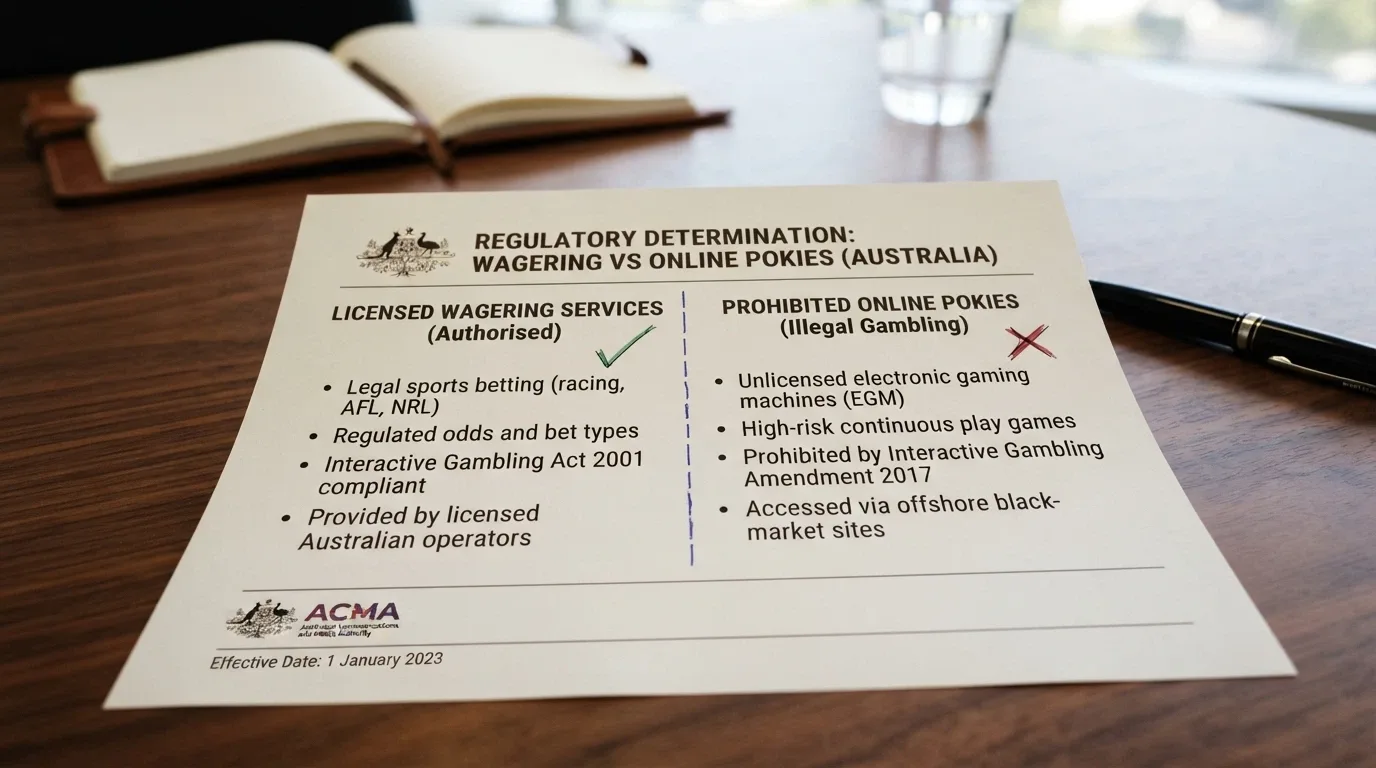
The Act targets operators, not residents. The penalty provisions apply to entities that provide prohibited interactive gambling services to people in Australia. Payoutverdict (2026) states: ‘Australian players are not criminalised for using offshore crypto casinos — the Interactive Gambling Act 2001, Section 8AA, prohibits operators from providing services to AU residents, not residents from playing.’ The offshore casino that accepts an Australian player is the entity the Act is written to reach, and the Australian player using one is on the side of the line the Act does not pursue. This is the part of the law that the offshore industry leans on, and it is the part that is true: the IGA does not criminalise the player.
The part the offshore industry does not lean on is what the player loses by sitting outside the licensed system. Australian consumer protection does not apply to an offshore casino. The Australian Competition and Consumer Commission cannot mediate a dispute between a player and a Curaçao-licensed operator. The Australian Financial Complaints Authority cannot order a Curaçao-licensed operator to release a withheld withdrawal. The state and territory gambling regulators have no jurisdiction. A player who has a complaint about a withheld withdrawal, a voided bonus, a changed term, or a closed account has recourse to the operator’s own complaint process and, in some cases, to the offshore licensing authority — and that is the end of the list. The protections that come with a licensed Australian operator do not transfer to an offshore one.
BetStop, the National Self-Exclusion Register, is the second protection gap. BetStop lets a person self-exclude from all Australian-licensed online and phone wagering services in a single step, and approximately 150 licensed wagering providers are bound by the register. The protection is real for a player who bets with a licensed Australian bookmaker. The protection does not extend to offshore bitcoin casinos. Self-exclusion at an offshore casino is a request a player can make, though the operator is not obliged to honour it. The self-discipline a player can apply at an offshore site is the only self-discipline that applies at an offshore site.
A player who reads the IGA, ACMA’s enforcement, and the offshore status together reaches the same conclusion: the law is on the side of the operator, not the player, and the gap between “not criminalised” and “protected” is the gap a player needs to understand before depositing. The offshore bitcoin pokies market in Australia is the result of prohibition plus unblocked payment rails plus an audience that wants to play. The law does not make the player a criminal. The law also does not give the player a regulator to call.
What the Interactive Gambling Act Actually Bans
The IGA’s prohibition is product-specific. Online casino games, online pokies and in-play betting are prohibited to people in Australia. Pre-event wagering on racing and sport, lotteries, and keno are permitted products, licensed by state and territory regulators and concentrated in practice with the Northern Territory Racing and Wagering Commission . The licensed Australian ecosystem is racing, sport, lotteries and keno; it is not online pokies and not online casino.
ACMA’s enforcement powers include formal warnings, infringement notices, civil penalties, and the direction to ISPs to block illegal sites. The blocking program is the most visible tool. Since November 2019, ACMA has had 1,564 illegal gambling and affiliate websites blocked, and more than 225 illegal services have withdrawn from the Australian market since 2017. The blocks affect access: an Australian player whose ISP has received a blocking direction cannot reach the blocked site without a workaround. The blocks do not affect every offshore operator, and the operators that accept Australian players in 2026 are the operators who have, so far, not been the subject of a successful blocking action.
The IGA targets operators through Section 8AA and related provisions. Payoutverdict (2026) states: ‘Australian players are not criminalised for using offshore crypto casinos — the Interactive Gambling Act 2001, Section 8AA, prohibits operators from providing services to AU residents, not residents from playing.’ The penalty provisions apply to entities that provide prohibited interactive gambling services to people in Australia. The Act does not contain a parallel penalty provision for the person who uses the service. This is the legal basis for the player-not-criminalised framing, and it is accurate as a matter of statute. It is not the same as a regulatory framework that protects the player who uses the service. The two are different questions, and a player who reads only the first is missing the second.
The Licensed Wagering Ecosystem and What It Actually Permits
The licensed Australian wagering market is real and substantial, and it sits on the other side of the IGA line from online pokies. The licensed products are pre-event wagering on racing and sport, lotteries, and keno. Online wagering licensing is state and territory business; in practice, the Northern Territory Racing and Wagering Commission is the de facto national licensor for many online bookmakers. The minimum age to open an account is 18. Identity verification is required to open an account with a licensed operator. The customer-set deposit limits and activity statements that licensed operators offer are part of the licensed product, not the offshore product.
BetStop is the player-protection system for the licensed ecosystem. A single registration excludes a person from every Australian-licensed online and phone wagering service, and there are approximately 150 licensed wagering providers bound by the register . Self-exclusion is available for a minimum of three months and up to a lifetime. ACMA’s 31 July 2026 figures record 67,480 registrations, 41,290 active exclusions, 78% under the age of 40, and 38% of registrants choosing a lifetime exclusion. The protection is meaningful for a player who bets with licensed operators. It is not meaningful for a player who bets with offshore bitcoin casinos, because offshore operators are not bound by BetStop.
A player looking for online pokies does not find them in the licensed ecosystem and is not the audience for BetStop. The licensed ecosystem is the right place for a player who wants to bet on a horse race or a football match with a regulated, accountable operator; it is not the right place for a player who wants to spin an online pokie, because the product is banned.
The 2026 Gambling Reform and What Changes from 2027
The Interactive Gambling Amendment (Gambling Reform) Bill 2026 passed the House on 18 August 2026 and the Senate on 19 August 2026. The reform measures commence on 1 January 2027. The reform does not change the prohibition on online pokies. It changes the advertising and payment framework around licensed wagering, and it gives banks and payment providers new authority to block transactions to illegal gambling operators.
The advertising measures include a maximum of three wagering ads per hour on television between 6:00 am and 8:30 pm, a prohibition on wagering advertising during live sport within those hours, and a prohibition on direct marketing of inducements for 14 days after a customer signs up with a licensed operator and for three months after a person deregisters from BetStop. The inducement rule is the part that touches the bonus discussion directly: a licensed Australian operator cannot send a “deposit and get 100% extra” email to a customer who signed up last week. The rule binds licensed operators, not offshore ones.
The payment-blocking authority is the part that touches offshore operators most directly. From 1 January 2027, banks and payment providers gain express authority to block transactions to illegal gambling operators. The authority is held by the banks and exercised at the bank’s discretion; a bank that suspects a customer’s transaction is going to an illegal gambling operator can decline the transaction. The authority does not apply to crypto transactions on the blockchain, which are not bank-mediated; it applies to bank transfers, debit card transactions, and any other rail that passes through a regulated payment provider. An Australian player using bitcoin to fund an offshore casino is using a rail the bank cannot see, and the new authority does not reach that rail.
The reform does not change the IGA prohibition on online pokies. The reform does not legalise offshore bitcoin casinos. The reform does not give ACMA new power to prosecute players. The reform does tighten the licensed ecosystem and gives the banking system a new tool, and the tool is most relevant to the licensed wagering market, not to the offshore crypto market.
Payment Methods: What Is Banned, What Is Legal, and What the Offshore Market Uses
The IGA’s payment-side restriction came into effect on 11 June 2024, and it is the rule that brought crypto into the licensed-wagering conversation in the first place. Credit cards, credit-related products and digital currency (crypto) are banned as payment for online wagering in Australia . The penalty for non-enforcement is up to A$247,500 per breach. The legal deposit routes for licensed wagering are debit card, bank transfer, PayID/Osko and BPAY. The table below shows the four legal deposit routes, what each one is, and the practical implication for an Australian player who uses it.
| Activity | Legal Status in Australia | What This Means for Bitcoin Pokies Players |
|---|---|---|
| Using a credit card to fund online wagering | Banned (since 11 June 2024) | Not available at any licensed wagering operator; the ban does not bind offshore operators, but the same ban does not reach crypto at the deposit stage either |
| Using crypto (BTC, ETH, USDT and other digital currency) to fund online wagering | Banned (since 11 June 2024) | Not available at any licensed wagering operator; available at the offshore operators in this ranking, because the ban binds licensed operators, not offshore ones |
| Debit card, bank transfer, PayID/Osko, BPAY to a licensed wagering operator | Permitted | Funds land at a licensed Australian wagering operator (racing, sport, lotteries, keno). Online pokies are not on the licensed product list, so the funds cannot reach an online pokie through this route |
| Crypto deposit to an offshore casino | Outside the Australian framework | Funds land at an offshore operator; no Australian consumer protection applies; AUSTRAC reporting triggers at A$10,000 for the on-ramp transaction |
The practical implication is that an Australian player who wants to play online pokies online has two choices: a licensed wagering product that does not include online pokies, or an offshore casino that does. Crypto is the rail that connects the player to the offshore casino because the bank rails do not. The crypto ban is the rule that explains why crypto is the only practical rail to the offshore market; the offshore market is the only market that contains the product. The two facts together produce the situation an Australian player faces.
AUSTRAC’s reporting threshold of A$10,000 is the regulatory touch on the on-ramp. A transaction at or above A$10,000 from an Australian bank to a cryptocurrency exchange triggers a reporting obligation on the exchange and on the reporting entity. The threshold does not make the transaction illegal; it makes it regulator-readable. A player making regular sub-threshold deposits is below the AUSTRAC line; a player making a single large deposit is on the record. The threshold is part of the practical picture an Australian player should know before funding the first deposit.
Staying Safe When Playing Bitcoin Pokies
The licensed Australian ecosystem has BetStop, customer-set deposit limits and licensed-operator complaint processes. The offshore bitcoin pokies market has none of those by default. The protection a player has at an offshore casino is the protection the player sets up themselves, plus the small set of responsible-gambling tools the offshore operator chooses to publish.
The first safe-play step is the same at any operator: set a deposit limit and a session limit before the first deposit, and keep the limits to an amount the player can afford to lose in full. A player who cannot afford to lose the deposit should not deposit. The second step is to recognise the harm signs: chasing losses, playing for longer than planned, lying about gambling activity, gambling instead of working or sleeping, borrowing to fund deposits. The Roy Morgan 2026 figures record that 13.0% of the Australian adult population — approximately 2,857,000 people — were experiencing some form of harm from their own gambling in March 2026, and 15.1% — approximately 3.32 million people — were experiencing some form of gambling harm including from others’ gambling. The harm is not hypothetical. The figures are the context against which a personal limit is set.
The third step is to know where to get help. Gambling Help Online and the national gambling helpline offer free, confidential support 24/7 across Australia on 1800 858 858. Online chat counselling is available, and referrals to face-to-face, phone and telehealth counselling are part of the service. The Gambling Harm Scales framework that Roy Morgan uses was developed by Central Queensland University and is the framework behind the prevalence figures. The helpline and the chat are the routes in. The helpline is also the place a person close to a player can call for advice on how to support someone they are concerned about.
The fourth step is to know what BetStop does and does not cover. BetStop self-exclusion covers Australian-licensed online and phone wagering services. The protection does not extend to offshore online casinos. A player who registers with BetStop and then opens an account at one of the ten operators in this ranking is not stopped by BetStop from doing so, and the offshore operator is not bound to honour the BetStop registration. The protection gap is real and worth knowing before relying on it.
The licensed bookmakers an Australian player uses for racing or sport do not provide online pokies. The offshore operators an Australian player uses for online pokies do not provide BetStop coverage. The two ecosystems do not overlap, and a player who wants both protections has to play in neither, which is not a useful answer. The useful answer is to know which protections apply where, set personal limits accordingly, and call the helpline if the limits stop holding.
Setting Deposit and Session Limits at Offshore Sites
Offshore bitcoin casinos vary in the responsible-gambling tools they offer. The most common tools are deposit limits (daily, weekly, monthly), session-time reminders, and self-exclusion requests made directly to the operator. The least common tools are reality checks (a pop-up at fixed intervals reminding the player how long they have been playing) and loss limits (a hard cap on net loss over a period). The licensed Australian requirement of customer-set deposit limits and activity statements does not apply to offshore operators, and the operator is not obliged to provide a tool the player has not asked for.
A player who wants a deposit limit at an offshore operator typically sets it through the account settings or by contacting customer support. The operator may or may not enforce the limit; reputable operators enforce it, and the player can confirm enforcement by attempting to deposit above the limit. A player who wants a session limit can use a phone alarm, a browser extension, or a third-party app; the offshore operator does not provide it by default. A player who wants a loss limit can set a personal figure and stop playing when the figure is reached; again, the operator does not enforce it by default.
The gap between licensed-operator protections and offshore-operator protections is wide. A licensed Australian bookmaker is required to offer customer-set deposit limits, to honour BetStop self-exclusion, to provide activity statements, and to allow the customer to withdraw funds without delay. An offshore bitcoin casino is required by its own licence jurisdiction, which is typically Curaçao, and the requirements vary. The player who values the protections should know which protections they have, and which ones they have to set up themselves.
Where Australians Can Get Help
Free, confidential support is available to every Australian player, every day of the year, and the routes in are short.
- Gambling Help Online — chat counselling, self-assessment tools, and referrals to face-to-face, phone or telehealth counselling. The service is free, confidential, and available 24/7. The site is the place a player can start a chat session at any hour.
- The national gambling helpline — 1800 858 858 — is a free, confidential phone line staffed 24/7. The same number routes to Gambling Help Online. A player who prefers to talk to a person rather than type can call.
- BetStop — at betstop.gov.au — is the National Self-Exclusion Register. A single registration excludes the person from all Australian-licensed online and phone wagering services. The minimum exclusion is three months; the maximum is a lifetime. The protection is real for licensed wagering and does not extend to offshore online casinos.
- A player’s GP can also help. A GP can refer a player to a psychologist, a psychiatrist, or a specialist gambling counsellor, and the referral is part of standard practice for patients presenting with gambling-related harm.
The Roy Morgan 2026 figures record that 13.0% of the Australian adult population — approximately 2,857,000 people — were experiencing harm from their own gambling in March 2026, and 15.1% — approximately 3.32 million people — were experiencing harm including from others’ gambling . The figures are large because the harm is widespread. The figures do not say the player is one of them. They say the player is in a population where 1 in 8 adults is currently in some form of gambling harm, and the player who is concerned is in a population where the help is free, the helpline is staffed, and the chat is open.
What BetStop Covers and Where It Falls Short
BetStop is the strongest self-exclusion tool in the Australian wagering ecosystem. A single registration excludes the registrant from approximately 150 Australian-licensed online and phone wagering services, and the exclusion is available for a minimum of three months and up to a lifetime. The 31 July 2026 figures record 67,480 registrations, 41,290 active exclusions, 78% of registrants under the age of 40, and 38% of registrants choosing a lifetime exclusion. The exclusion is a hard wall between the registrant and the licensed wagering market.
The wall does not extend to offshore online casinos. A BetStop-registered player can open an account at any of the ten operators in this ranking and play online pokies there, and BetStop will not stop them. The offshore operator is not bound by the BetStop registration. Self-exclusion at an offshore casino is a request a player can make to the operator, which the operator is not obliged to honour.
A player who wants the strongest self-exclusion available in the Australian context should register with BetStop and accept that the offshore market is not covered. A player who wants the strongest self-exclusion available at an offshore casino should contact the operator directly and ask for self-exclusion, and the request is honoured at the operator’s discretion. A player who wants both protections has to set them up at both kinds of operator, and the offshore protection is the weaker of the two by design.
The right way to read BetStop is as a tool that is strong where it applies and silent where it does not. The licensed wagering market is approximately 150 operators. The offshore bitcoin pokies market is the ten operators in this ranking, plus the many offshore brands that did not make the ranking. BetStop is the right tool for the licensed market and the wrong tool for the offshore market, and a player who is choosing between the two should know which tool applies to which.
How the Ranking Was Evaluated
The ranking in this article was built from public bonus terms, secondary-source verification where primary terms were not accessible, and ACMA’s regulatory framework as the Australian reference point. The operator set is the ten offshore crypto casinos whose welcome packages the research was able to verify against published terms or near-primary secondary sources. The ranking criteria are bonus value, wagering fairness, term transparency, security practices, and payout reliability — five criteria, applied qualitatively, with no weightings and no black-box scores.
The sources consulted are the secondary operators and aggregators that publish verified bonus terms for the offshore crypto market — CryptoSlate, Tokenist, Bitranked, Payoutverdict, TSAS.ca, and BonusOracle for the operator data; ACMA and the AU regulation skill backbone for the regulatory context; Roy Morgan Research for the harm-prevalence figures; and the Gambling Help Online service description for the responsible-gambling infrastructure. Where a primary operator-page source was not accessible in this research pass, the article reports the gap rather than filling it with a confident guess. The licence jurisdiction, the game providers, the bonus validity and the cashout cap are the fields most often missing; the article marks them as the no-data marker where they are.
The ranking is not a recommendation to play. The article is a comparison of what each operator offers on the strength of what each operator publishes. A player who reads the comparison and decides to claim a bonus is making a decision the article supports with the published terms and the cost analysis; the article does not endorse the play itself. The offshore market is the only market that contains online pokies for Australian players, and the choice to enter it is the player’s choice.
Making the Choice: A Practical Path for an Australian Player
The figure that matters is not the bonus cap. The figure that matters is the wagering multiplier and the cashout cap, because those are the figures that determine how much of the bonus reaches a withdrawal balance. The 40x operators are the benchmark; the 80x operator is the extreme; the 60x operators sit between. A player who values the bonus as a real return should pick a 40x operator first, and should read the cashout cap before claiming. Wild Fortune’s verifiable Tobique licence and 0x wagering on free spins are the standout terms; BitStarz’s no formal cashout cap on deposit-bonus winnings is the standout cap absence.
The licence is the second check. Wild Fortune’s Tobique licence is checkable against the Tobique Gaming Commission register, and the licence number is published. The other operators in the ranking publish licence jurisdictions that are verifiable in principle (Curaçao is the most common) but were not confirmed against a primary register source in this research pass. A player who values a checkable licence should pick Wild Fortune first. A player who does not have a strong licence preference should still know which licence they are playing under, because the licence determines the dispute-resolution path.
The payout speed and the cashout cap are the third check. Crypto payouts that clear in minutes are the reason an Australian player chose crypto in the first place. A cap that turns a cleared bonus into a smaller withdrawal is the operator’s way of collecting the wagering cost without paying the headline. A player who wants the full headline should pick an operator with no formal cap; a player who does not have a strong cap preference should still know the cap before claiming.
The personal limit is the fourth check, and it is the only one the player controls fully. Set a deposit limit, a session limit, and a loss limit before the first deposit. The licensed-operator protections do not apply offshore, and the offshore operator’s own tools are inconsistent. The limit a player sets themselves is the limit that holds.
If gambling stops feeling like a choice, the next step is the helpline. The national gambling helpline is 1800 858 858, free, confidential, 24/7. Gambling Help Online offers chat counselling and referrals. The harm-prevalence figures record that 13.0% of Australian adults are currently experiencing some form of gambling harm, which means the help line is staffed for a population the player is in. The call is the right move at the right time, and the right time is whenever the player thinks it might be.
Frequently Asked Questions
How do I deposit bitcoin at an Australian-facing online casino without losing funds to wrong networks or addresses?
Copy the deposit address from the casino cashier, confirm the network label (TRC-20, ERC-20, BEP-20, or Bitcoin mainnet) the casino displays, and send only that token on that network. Sending USDT on TRC-20 to an ERC-20 address — or vice versa — will not credit the casino account and the funds are usually unrecoverable. Bitcoin itself only exists on the Bitcoin network, so the address is the address, but confirmation takes ten to thirty minutes per block.
Are bitcoin pokies safe, and what should I check about offshore licences, audits and fairness?
The games at offshore casinos run on random number generators from third-party studios like Pragmatic Play, NetEnt, and Play’n GO, and some operators publish provably fair verification that lets a player check each result. The licence is the harder check: most operators in the offshore market run under a Curaçao licence, and Wild Fortune in this ranking publishes a checkable Tobique licence. The figure to look for is a licence number that resolves against a register, not a marketing claim that does not. Offshore operators do not provide Australian consumer protection, and a dispute over a withheld withdrawal is not one ACMA can mediate.
Does BetStop self-exclusion cover offshore bitcoin casinos?
No. BetStop covers Australian-licensed online and phone wagering services — approximately 150 operators — and does not cover offshore online casinos. A BetStop-registered player can open an account at an offshore bitcoin pokies site, and BetStop will not stop them. The offshore operator is not bound by the BetStop registration. Self-exclusion at an offshore casino is a request a player can make to the operator, which the operator is not obliged to honour. BetStop is the right tool for the licensed wagering market; it is the wrong tool for the offshore market.
What new gambling advertising and inducement rules apply from 2027 in Australia, and how do they affect offers?
The Interactive Gambling Amendment (Gambling Reform) Bill 2026 passed in August 2026 and commences on 1 January 2027. It caps wagering advertising on TV at three ads per hour between 6:00 am and 8:30 pm, bans wagering advertising during live sport within those hours, and prohibits direct marketing of inducements for 14 days after a customer signs up and for three months after a person deregisters from BetStop. It also gives banks and payment providers express authority to block transactions to illegal gambling operators. The rules bind licensed Australian operators. The rules do not bind offshore bitcoin pokies sites, because the offshore operators are not licensed in Australia and are not subject to the IGA’s inducement or advertising provisions.
Do Australian banks restrict transfers to crypto exchanges or offshore casinos, and what reporting thresholds apply?
Australian banks do not have a standing block on transfers to cryptocurrency exchanges. AUSTRAC’s reporting threshold of A$10,000 applies to relevant transactions, and a transfer at or above that figure to an exchange triggers a reporting obligation on the reporting entity. From 1 January 2027, banks gain express authority to block transactions to illegal gambling operators, and a bank that suspects a transaction is going to an illegal operator can decline the transaction. The new authority applies to bank-mediated rails — bank transfers, debit card transactions — and does not apply to crypto transactions on the blockchain, which are not bank-mediated. A player funding an offshore casino with crypto is on a rail the bank cannot see, and the new authority does not reach that rail.
Created by the ”POLi Casinos AU” editorial team.