
What an offshore crypto casino actually looks like for an Australian player in 2026
 Available in AU
Roughly a third of Australian adults hold cryptocurrency now, and a growing share of them are using it to play casino games offshore — into a market where no Australian online casino licence exists at all. The pages ranking “the best crypto casinos Australia” all carry the same ten to fifteen brand names, the same welcome bonuses, and very little about what it actually costs to play there. This one is built around the numbers research could verify: where the licences sit (outside Australia), what “no KYC” really means once a withdrawal triggers it, how many minutes a payout actually takes, and the legal frame around all of it.

Data current as of 18 October 2026, checked against the ACMA register of blocked services, AUSTRAC’s published Travel Rule guidance, and the terms pages of every operator named below.
Table of Contents
- Crypto casinos and the Australian punter: what 2026 looks like
- The real price of “no KYC” at a crypto casino
- 10 offshore crypto casinos Australians are using in 2026
- Crypto casino withdrawals: how many minutes you’re actually waiting
- Why your 2026 crypto casino bonus is smaller than it looks
- Crypto pokies: what Australians are spinning in 2026
- New crypto casinos in 2026: fresh paint or real change?
- No Australian casino licence exists for online crypto play
- Staying safe when the Australian safety net cannot reach
- How we evaluated every crypto casino on this page
- What you actually do about crypto casinos as an Australian player
- Frequently asked questions
Crypto casinos and the Australian punter: what 2026 looks like
Online casino play is prohibited in Australia by the Interactive Gambling Act 2001 — there is no licence a foreign operator can apply for and obtain — and the licensed wagering market that does exist (sports and racing, run mostly through Northern Territory-licensed bookmakers) banned credit cards and cryptocurrencies as payment methods on 11 June 2024. The supply that Australians who want to spin a pokie or hit a blackjack table had was always going to be offshore. Crypto simply turned out to be the payment rail those operators could still run.
The other side of that is a population already comfortable with crypto. Around a third of Australian adults hold some form of cryptocurrency, and the legal framework treats it as property you can own and trade freely. The same goes for using it on the offshore casino market in practical terms — the law’s teeth are on the supply side, not the player side. No Australian has been prosecuted for playing at an offshore casino. What does exist is an enforcement regime that blocks sites rather than pursuing players: the ACMA has had 1,564 illegal gambling and affiliate websites blocked by Australian ISPs since November 2019, and more than 225 illegal services have withdrawn from the Australian market since 2017.
What “Australian crypto casino” actually means — and what it doesn’t
The word “Australian” in the term does a lot of work that the operator list does not. It does not mean “licensed in Australia” — no casino on this page holds such a licence, because none exists for online casino play. It does not mean “based in Australia.” Every brand reviewed below runs from Curaçao, Anjouan, Costa Rica or similar offshore jurisdictions. What “Australian” actually signals is accessible from Australia: the site accepts Australian sign-ups, processes Australian-dollar-equivalent deposits, and runs no IP block that prevents a Sydney or Perth player from registering.
That distinction is the entire market. Section 8AA of the Interactive Gambling Act 2001 prohibits operators from offering online casino games to people who are physically in Australia — and the prohibition runs against the operator, not the player. The practical effect is that the ACMA’s enforcement is block-based, not account-based. Whether the site accepts an Australian driver licence at the cashier is the practical tell, not a marketing claim.
A “.com.au” domain does not change any of this. Domain extensions are cheap and meaningless to the legal status of the operator. AUD as a cashier option only signals that the operator has bothered to localise its payment page. What does matter is whether the Terms page excludes Australia — most of the operators on this list do — because the IGA makes the supply side illegal and the operator wants the protection of having written the warning.
The coins that matter: crypto the casino actually takes
Bitcoin and Ethereum are universal. USDT is where the Australian player actually lives, because the cleanest deposit route is AU bank → CoinSpot or Independent Reserve → USDT on the TRC20 network → offshore casino, then reverse to cash out. Stablecoins sidestep the volatility that turns a 0.1 BTC win into a smaller number of dollars by Friday morning.
Litecoin and a handful of altcoins appear in most crypto casino cashier pages. They rarely matter to an Australian player: AUD on-ramps to anything beyond BTC, ETH and USDT are thinner, the spreads are wider, and the practical question is whether your exchange supports the network the casino actually credits. TRC20 USDT is the cheapest path by a margin, because Tron fees sit at fractions of a cent where Ethereum’s can swallow a meaningful slice of a small deposit on a congested day. BTC’s confirmation times have shortened, but six blocks is still an hour when a player wants to play now.
The Australian angle on this is mostly a rail question. Crypto is legal to own and trade here, and roughly a third of adults hold some. That is the supply side the offshore casino industry leans on, and it is the reason these sites compete for Australian traffic at all.
Trust without a local licence: how to read the signs
Without an Australian regulator, the trust signals an Australian player has to fall back on are foreign and uneven. Curaçao and Anjouan licences are the most common. Both are cheaper to obtain than a state-level wagering licence and offer weaker dispute resolution. Provably fair is a crypto-native trust mechanism worth understanding: the casino publishes a hash of the next result before the bet, the player sees the unhashed result after the spin, and a third-party verifier can confirm the two match. Real cryptography, and it removes the “is the house actually using a random result” question. It does not remove the “is the house going to pay me” question.
Longevity is a proxy. An operator that has paid Australian players for three years is, on priors, more likely to keep paying than one launched last month. Community reputation on the major affiliate forums is a weaker version of the same signal. Red flags that should stop a deposit cold include no licence number anywhere on the site, no provably fair mechanism on the games the casino promotes, withdrawal terms that let the operator void winnings at its discretion, and — universally — a Terms page that quietly excludes Australia.
The Terms-of-Service exclusion matters because every operator that takes Australian sign-ups while writing “not available to residents of Australia” into its own rules is signalling what its legal department already knows. The IGA makes the supply side illegal, and the operator wants the legal protection of having told you not to play.
The real price of “no KYC” at a crypto casino
Soft KYC is the model most of the offshore crypto casinos actually run, and the gap between that and the marketing claim is where the cost sits. The marketing version: open an account, deposit crypto, play, withdraw crypto, no passport scan, no proof of address, no selfie with your driver’s licence. The production version: do exactly that, until your cumulative withdrawals cross a threshold set somewhere between A$2,000 and A$5,000, at which point the operator requests the documents and you wait.
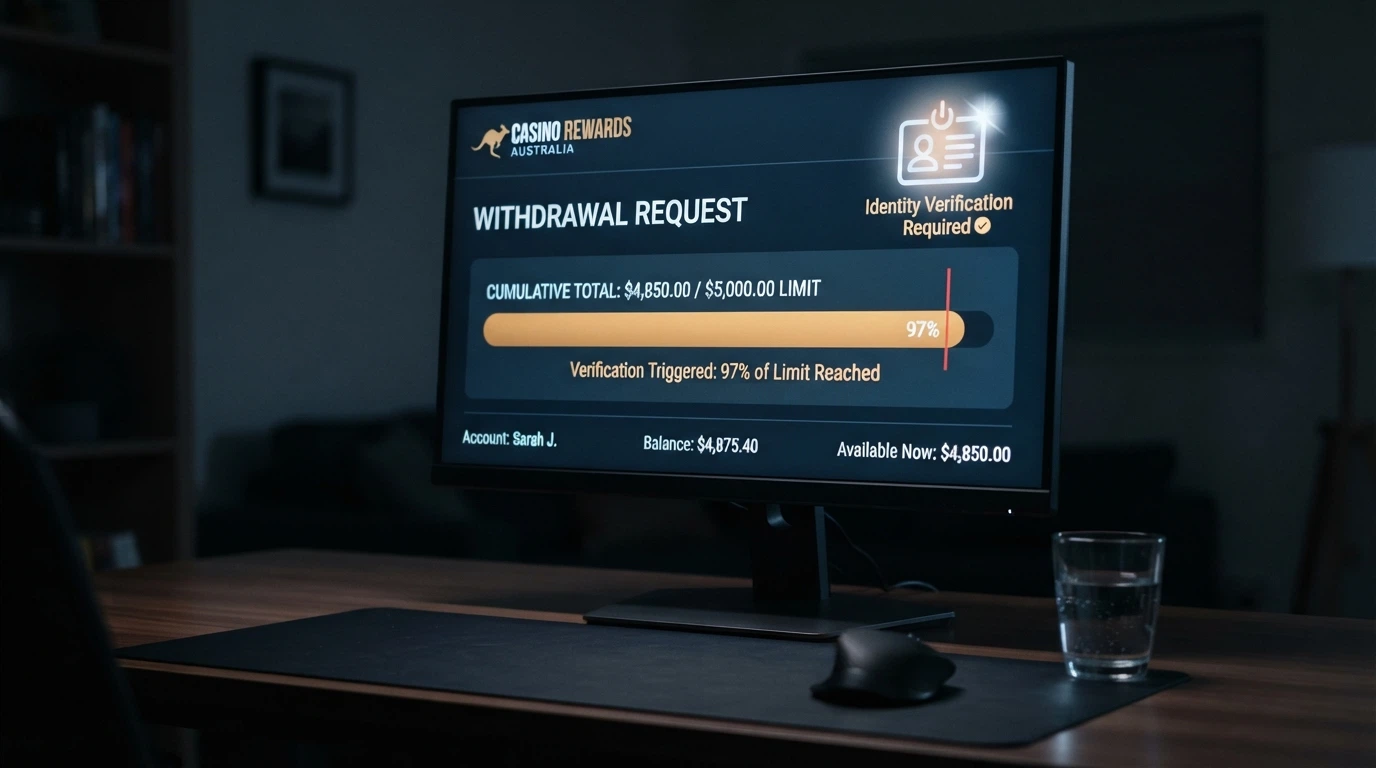
It is worth being precise about what “no KYC” means at the crypto casinos serving Australian players. The dominant model is soft KYC — the operator reserves the right to verify identity, but only enforces it past a threshold. “No KYC does not always mean never KYC,” as the roundups themselves note. Soft KYC thresholds sit in the A$2,000–A$5,000 cumulative withdrawal band; below that, withdrawals process automatically; above it, verification is requested. The threshold is per player, per casino, and reset if you win big and walk away.
The trigger point: how much you can pull out before they ask
The cumulative withdrawal threshold is the number every AU player needs to know — and it is lower than most players expect. The lowest reported for the featured set is BC.Game at approximately A$1,000 cumulative; Stake sits at approximately A$1,500 with a median eight-hour verification time once triggered; Shuffle runs highest at approximately A$2,000.
What crossing the trigger gets you, in operator-specific terms: BC.Game scores a 2.5/10 KYC severity for Australian players — the lowest in the featured set. Stake scores 3.0/10 with that eight-hour median verification window. Shuffle scores 3.5/10 with the higher A$2,000 ceiling. None of these are zero. The verification itself is typical: photo of a government ID, a recent utility bill or bank statement, sometimes a selfie holding the ID. The wait varies — median eight hours at Stake is a tight middle; BC.Game’s processing was less consistent in the data the roundups collected.
Anonymity that holds: Monero, no-account play, and the privacy ceiling
The few operators that have actually committed to no-KYC are notable. Jackbit reserves verification for genuine fraud and AML flags rather than normal withdrawals, and supports Monero for on-chain privacy across more than 7,000 games. That is the genuine version of the no-KYC pitch, and the rest of the market sits somewhere below it.
The privacy ceiling sits inside the Australian banking system, not at the casino cashier. AUSTRAC’s Travel Rule kicks in at A$10,000, triggering enhanced reporting for transfers to and from crypto exchanges. Below that threshold, the operator’s own rules are what determine what you can move without paperwork. Above it, the on-ramp itself is reporting-grade, regardless of how private the casino on the other side pretends to be.
The other piece is the bank rail. CommBank and Westpac silently restrict outbound transfers to crypto exchanges; ANZ and NAB flag without fully blocking; ING and Macquarie are the most permissive. A player who needs to move A$5,000 from their bank account to CoinSpot to fund an anonymous casino session may find the bank has already said no before the casino ever gets to ask for ID. That is the practical ceiling on anonymity in the Australian market, and no operator, however committed to Monero, can move money past it.
VPN usage to access geo-blocked casinos is commonly discussed on competitor pages. It carries additional risk — it may violate the operator’s terms and provides no recourse if the account is closed — and the anonymity it adds is largely cosmetic, since the bank rail still has to happen somewhere.
Where no-KYC sits in the Australian market — and where it doesn’t
The licensed AU market requires full identity verification to open an account. BetStop — the National Self-Exclusion Register — only works against Australian-licensed services. The crypto-payment ban that took effect on 11 June 2024 applied to licensed wagering operators only. So the licensed market is full-KYC, crypto-free, and entirely closed to online casino play. No-KYC crypto play is an exclusively offshore proposition in Australia, and the consumer-protection gap that opens up when you cross to the offshore side is the real cost of “no KYC.”
What that gap looks like in practice: no Australian consumer protection, no ACMA complaints body to recover money, no BetStop coverage, no recourse if the operator refuses a withdrawal, and the site can be blocked at any time with no obligation to return funds. The casino gets to keep its no-KYC branding; the player keeps whatever risk that branding actually removed.
10 offshore crypto casinos Australians are using in 2026
Every brand below is offshore. None holds an Australian licence, because no Australian online casino licence exists. The table is the operator set research was able to verify at the depth the comparison actually works at; rows where the licence or bonus details were not confirmable against the operator’s own site or a third-party review read as dashes. The ranking reflects what the AU-facing market actually shows — crypto-native brands sit alongside fiat casinos that added a crypto rail — and is not weighted by any single criterion.

| Operator | Offshore Licence | Welcome Offer | Wagering |
|---|---|---|---|
| Stake | Curaçao (unconfirmed this run) | No traditional welcome bonus; rakeback system | N/A |
| Rocket Play | Curaçao (unconfirmed this run) | 100% up to A$500 + 100 FS (1st dep); 200% up to A$500 (2nd dep) | 40x bonus amount |
| SkyCrown | Curaçao (unconfirmed this run) | 450% up to A$8,000 + 400 FS across 4 deposits | 40x bonus + FS winnings |
| BC.Game | Anjouan (unconfirmed this run) | 180% up to 20,000 BCD | 500x |
| Royal Reels | — | — | — |
| WinSpirit | — | — | — |
| BitStarz | Curaçao (unconfirmed this run) | Up to 5 BTC + 180 FS across 4 deposits | 40x |
| Lucky Block | Curaçao (unconfirmed this run) | 200% first deposit + 50 FS | 35x |
| FairGO | Curaçao (unconfirmed this run) | — | — |
| Rainbet | — | — | — |
The four rows of dashes are real. Royal Reels, WinSpirit, FairGO and Rainbet show measurable Australian market share (2.51%, 1.55%, 0.8% and 1.28% respectively), but the licence, welcome offer and wagering terms were not confirmable against the operators’ own sites or third-party reviews this round. Where the data is missing, the cells say so — and the deeper operator write-ups below explain what that absence means in practical terms.
Stake: rakeback over welcome bonus, and the AU numbers behind it
Stake is the crypto-native giant of the list, and the easiest brand to read once you stop looking for a welcome bonus — there isn’t one. Stake runs a rakeback system instead of a deposit match, which is why the wagering column reads N/A and the welcome-offer column is empty. A player who comes looking for a 100%-up-to headline number is going to find nothing of the sort.
What Stake does offer, in measurable terms, is a 3.0/10 KYC severity for Australian players with a soft trigger at approximately A$1,500 cumulative withdrawals. The median verification time once triggered runs to about eight hours. The other measurable claim is the withdrawal clock: 95% of withdrawals reportedly process inside 30 hours. Against the wider Australian market that is fast, and against the under-15-minute leaders it is not.
The verdict, in a flat line: Stake is the brand for a player who values low-friction withdrawals and a low-friction bonus model over a headline-grabbing first-deposit match, and who understands that a rakeback system rewards volume rather than the first deposit.
Rocket Play: a two-tier welcome with a A$7.50 bet ceiling
Rocket Play runs a conventional two-tier welcome: 100% up to A$500 plus 100 free spins on the first deposit, then 200% up to A$500 on the second. Wagering is 40x the bonus amount, with a A$7.50 maximum bet during wagering. That ceiling is the part the marketing tends to skip past.
The A$7.50 cap matters because it sets the pace at which the bonus clears. A player grinding the A$500 bonus at the maximum allowable bet spends A$7.50 per spin and needs to clear A$20,000 in wagering to convert any of the bonus to cash. At a five-second spin and the A$7.50 ceiling, that runs to nearly 2,700 spins, or about three and three-quarter hours of continuous play. Rocket Play also excludes some high-RTP titles from the wagering contribution, which lengthens the clearing time further.
The verdict, by number: the package looks generous on the way in, but the A$7.50 bet cap, the 40x multiple and the title exclusions mean a player is grinding harder than the headline suggests.
SkyCrown: the A$8,000 package that crypto depositors cannot claim
SkyCrown runs the largest welcome package on the list — 450% up to A$8,000 plus 400 free spins across four deposits — and applies a sharp restriction to it. Bonuses are not available to crypto depositors. A player funding with USDT, BTC or ETH sees no welcome offer at all, even though SkyCrown itself is reachable from Australia and processes crypto deposits cleanly.
If a player were eligible, the package carries 40x wagering on bonus and free-spin winnings, a A$7.50 maximum bet during wagering, a 14-day validity (five days for the high-roller tier), a A$5,000 maximum bonus-to-cash conversion per welcome part, and a A$30 minimum deposit. The first deposit alone runs to 120% up to A$1,200 plus 125 free spins on Wolf Treasure by IGTech. The fine print cuts both ways.
The verdict, as a caveat: the package is real and large, but the crypto-depositor exclusion makes it irrelevant to the player this page is for. The A$8,000 number is a fixture of the comparison tables rather than something an Australian crypto player can actually reach.
BC.Game: the lowest KYC bar and a 500x wagering mountain
BC.Game runs the lowest KYC severity for Australian players at 2.5/10, with a soft trigger at approximately A$1,000 cumulative. That is the threshold a player can withdraw up to before identity documents start getting requested. The offer — 180% deposit match up to 20,000 BCD — looks competitive on the way in.
The wagering multiple is the catch. 500x the bonus amount is the highest on the list by a margin. A player who claims the equivalent of a A$500 bonus needs to put A$250,000 through the games before any of it converts to withdrawable cash. At a A$7.50 maximum bet (where applicable) and a five-second spin, that is roughly 33,000 spins and well over 45 hours of continuous play. The bonus is one thing; the wagering attached to it is another, and the gap is what the marketing tends not to discuss.
The verdict, as comparison: BC.Game is the most anonymous brand in the featured set, and it asks the most turnover of any of them in return. The trade is real.
Royal Reels: 2.51% of the AU crypto market and not much else confirmed
Royal Reels shows up on the AU-facing market-share rankings at 2.51% — a measurable presence in this market — but the rest of the verifiable detail is thin. The licence attribution, the welcome offer, the wagering terms, the bonus validity, the maximum cashout: research could not confirm any of them against the operator’s own site or a third-party review this round. The brand is offshore-confirmed; everything else reads as a gap.
That gap matters. A player depositing at Royal Reels has nothing to verify against — no licence number on a public register, no provably fair audit on the games, no published withdrawal ceiling — and the only signal in the data is that other Australian players have used it.
The verdict, framed against the data: Royal Reels sits at 2.51% AU market share and the rest is a gap — no verifiable licence, no welcome terms, no wagering data. A player who deposits at Royal Reels is choosing to be the verification themselves.
WinSpirit: 1.55% market share, light on the public record
WinSpirit sits at 1.55% AU market share, and the public detail behind that share is similarly thin. The licence, the welcome terms, the wagering multiple, the maximum bet during wagering — all of it reads as “not confirmed this run” against the operator’s own page or any third-party review the research consulted. Offshore status is confirmed; the rest is a gap.
The shape of the gap is the same as Royal Reels’: measurable traffic, unverified everything else. What a player should check before depositing is the same short list — licence number on the site, provably fair on the games, withdrawal terms in the small print, community reputation on the affiliate forums, and the Australia exclusion clause in the Terms.
The verdict, in one line: WinSpirit is on this list because Australian players use it; the 1.55% market share is a fact about use, not a fact about safety. A player looking for an operator with verifiable licence and terms is not yet looking at WinSpirit.
BitStarz: the 5-BTC welcome and the A$100 no-deposit cap
BitStarz runs the multi-currency veteran offer on the list: up to 5 BTC plus 180 free spins across four deposits, with 100% up to 1 BTC plus 180 free spins on the first deposit, wagering 40x. The headline is the size of the welcome package; the fine print is a separate document.
BitStarz also runs the only confirmed active no-deposit bonus in the featured set: 30 free spins, 40x wagering on winnings, A$100 maximum withdrawal from the no-deposit spins, A$0.20 per spin, 24-hour validity. That is the closest thing to a free offer an Australian crypto player can claim from the names on this page. Caswino, outside the featured set, runs a comparable 20 no-deposit spins with 50x wagering and 24-hour validity. Beyond that, none of the featured operators currently runs a no-deposit bonus for Australian players.
The verdict, by number: the 5-BTC welcome is the largest headline figure on the list, the no-deposit spins are the only active offer of their type in the featured set, and the A$100 cap on the no-deposit winnings is the number that says what the operator thinks the offer is worth.
Lucky Block: 200% match, 35x turnover, no code required
Lucky Block runs the simplest welcome maths on the list: 200% first-deposit match plus 50 free spins, 35x wagering, no bonus code needed. The 35x is the lowest wagering multiple anywhere in the featured set, which is the number that actually decides how much work the bonus takes to clear.
A player depositing A$100 to claim the full 200% match sees A$200 in bonus funds plus 50 free spins. At 35x, the required turnover runs to A$7,000 — half of what BC.Game’s 500x would demand on a comparable bonus. The lack of a code requirement is a small convenience that compounds across a welcome sequence. The bonus terms beyond the multiple — validity, maximum bet, eligible games — were not fully confirmable against the operator’s site this round.
The verdict, as a caveat: Lucky Block is the lowest-wagering welcome in the featured set, but the unconfirmed bonus terms beyond the 35x — the validity, the maximum bet, the eligible games — leave the picture half-drawn. A player choosing Lucky Block on the multiple alone is buying half an offer.
FairGO: RTG-exclusive with 0.8% of the AU crypto market
FairGO runs RealTime Gaming exclusively. The provider list is a single name; the games lobby is whatever RTG is currently shipping. RTG has a long history with Australian-facing online casinos and a stable library of pokies, but the breadth is narrower than what a multi-provider casino offers. The brand holds 0.8% of the AU crypto market — a small but measurable share — and runs under a Curaçao licence that was not confirmable this round.
What an RTG-exclusive library means in practical terms: the pokie range is what it is, the RTP range is what RTG publishes, and there is no Hacksaw or Pragmatic Play to widen the menu. For a player who already knows the RTG catalogue, this is a feature. For a player who wants the breadth of the wider crypto-casino market, it is the limit.
The verdict, in one line: a niche brand for a player who already knows what they want from RTG and does not need anyone else’s catalogue to get there.
Rainbet: 1.28% market share with an empty paper trail
Rainbet sits at 1.28% AU market share and is the highest-risk row on the list. The licence attribution, the welcome offer, the wagering terms, the bonus validity, the maximum cashout — none of it was confirmable against the operator’s own site or any third-party review the research consulted. Offshore status is confirmed; everything else reads as a gap.
The due-diligence gap is the load-bearing piece. A player depositing at Rainbet is depositing at an operator with measurable traffic but no verifiable licence, no published withdrawal terms, and no community reputation the research could reach. The 1.28% market share is a fact about other Australians using the site; it is not a fact about whether the site is safe to use.
The verdict, as comparison: against every other row on this list, the data gap on Rainbet is the widest and the public record is the thinnest. A player choosing Rainbet is choosing to deposit at an operator the verification has not yet reached.
Crypto casino withdrawals: how many minutes you’re actually waiting
Crypto withdrawal speed is the metric the marketing uses hardest, and the one where the gap between claim and clock is widest. The under-60-minute claim from operator marketing is real for some brands and not for others. The cleanest data point in the roundups is Wild Fortune Casino, whose crypto withdrawals averaged 5 hours 24 minutes from request to confirmation across five test cycles in early 2026, with a range of 3h 50m to 7h 58m. That is an honest median; the marketing claim that “most withdrawals process in under an hour” runs ahead of it.
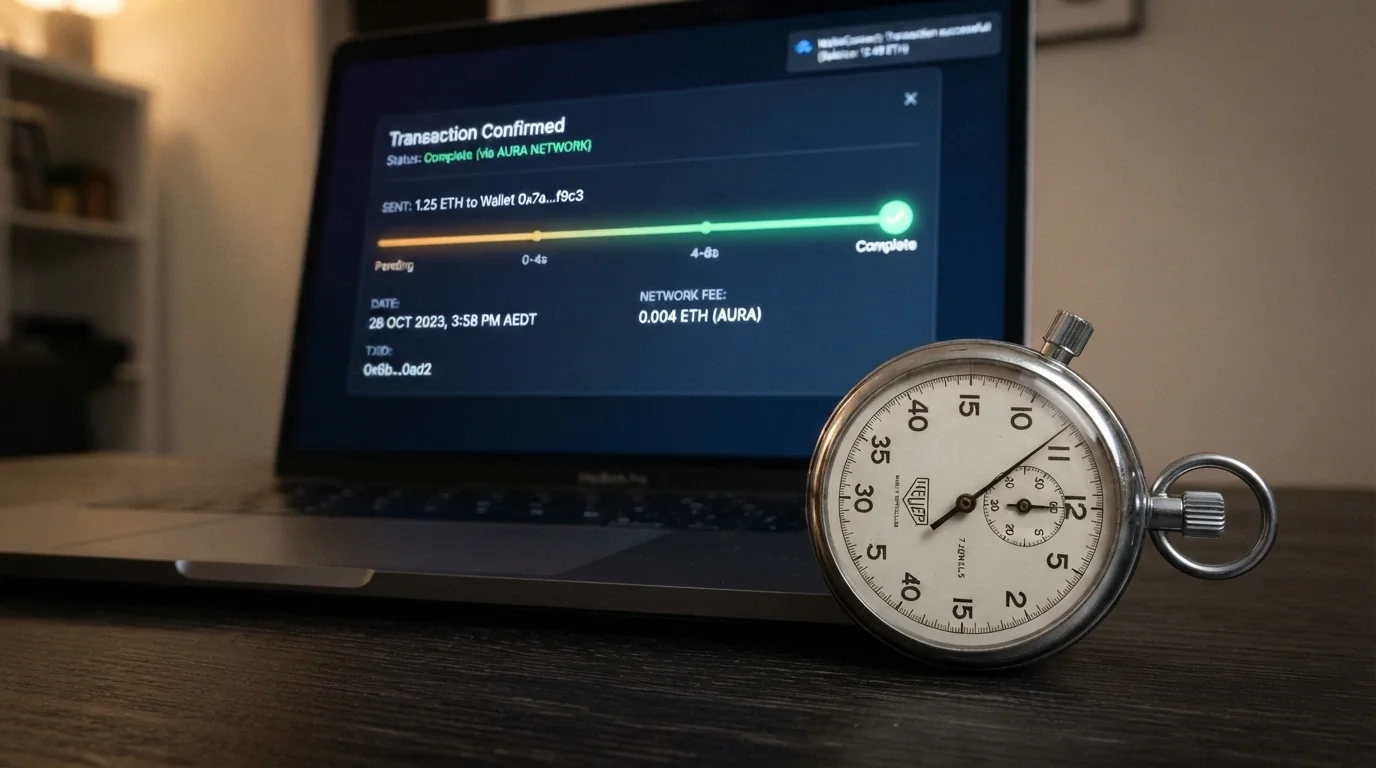
The faster end of the tested set is sharper. LuckyDreams processes USDT withdrawals in under 15 minutes; NeoSpin in under 20; VegasNow in under 15; LuckyOnes in under 20; Wild Tokyo in under 25. Those numbers are the floor of the AU-facing market in the current data, not the ceiling of what is possible.
Across a wider sample of 50-plus casinos, the data shows crypto deposits typically reflecting within 3 minutes, withdrawals approved instantly or up to 24 hours if verification is needed, and funds arriving in wallets in 10–60 minutes once approved. The bottleneck is rarely the casino’s approval step; it is the time the verification takes when it is requested, and the time the wallet takes to show the credit after the casino has signed off. The fastest path is no-KYC under threshold, USDT TRC20, approval instant, wallet arrival minutes — and most players will not hit that path on every withdrawal.
The bank rail friction nobody talks about
| Bank | Stance on Crypto Exchange Transfers | Practical Impact for Casino Deposits |
|---|---|---|
| CommBank | Silently restricts | Direct AUD → exchange often blocked; players routed via alternative banks or P2P |
| Westpac | Silently restricts | Same as CommBank; transfers to CoinSpot or Independent Reserve frequently declined |
| ANZ | Flags without fully blocking | Transfers may trigger review; most complete with delay |
| NAB | Flags without fully blocking | Same as ANZ; some transfers held for manual review |
| ING | Permissive | Transfers to major exchanges generally process without friction |
| Macquarie | Permissive | Same as ING; the cleanest retail-bank route in the current data |
The cleanest deposit route research verified is AU bank → CoinSpot or Independent Reserve → USDT TRC20 → offshore casino, then reverse to cash out. A player banking with CommBank or Westpac may find that step one already says no. A player banking with ING or Macquarie will rarely hit friction at step one at all.
The other piece is that the bank rail friction is invisible to the casino. The casino cannot tell whether a player’s AUD cleared CoinSpot on the first try or the fifth; it just sees the USDT land. The friction is borne entirely by the player, which is why it tends not to appear in operator-side marketing.
Why your 2026 crypto casino bonus is smaller than it looks
A welcome bonus looks like a gift; the wagering multiple is the cost of unwrapping it. A 40x wagering multiple on a A$500 bonus means A$20,000 in turnover before any of the bonus converts to withdrawable cash. The bonus’s headline value and what a player actually walks away with are usually two different numbers.

BitStarz’s first-deposit bonus illustrates the maths cleanly. The bonus is 100% up to 1 BTC at 40x wagering on the bonus amount. For a player claiming the full 1 BTC bonus (assuming only the bonus amount is wagered), the required turnover is 40 BTC. The cost of the bonus, before any of it converts to cash, is therefore forty times the headline. Even using BitStarz’s own A$0.20 free-spin value as a working per-spin stake, the spin count runs into the millions of spins and continuous play at five seconds per spin would take years. That is what 40x wagering on a 1 BTC bonus looks like once the maths is done.
Time limits compress the same maths into a shorter window. SkyCrown’s bonus validity runs 14 days (5 days for the high-roller tier); BitStarz’s no-deposit free spins expire in 24 hours. A player who clears 40x in 14 days at A$7.50 a spin is playing about 27 hours a day, which is not a real-world pace. Most bonuses expire before the maths is finished, and the bonus balance is what gets forfeited at expiry, not the deposit. The cashout cap is the final compression. SkyCrown’s A$5,000 maximum bonus-to-cash conversion per welcome part is a ceiling that runs ahead of most players’ actual winnings from the bonus, but the cap is real and binding when a player does run past it.
No-deposit offers: free spins, tight caps, and a 24-hour clock
The no-deposit bonus is the offer every Australian player searches for. In the featured set, BitStarz runs the only currently active one: 30 free spins, 40x wagering on winnings, A$100 maximum withdrawal from the no-deposit spins, A$0.20 per spin, 24-hour validity. That is the full shape of the offer. Beyond BitStarz, none of the ten operators on the featured list currently runs a dedicated no-deposit bonus for Australian players.
Outside the featured set, Caswino runs a comparable offer — 20 free spins with no deposit required (10 on phone plus 10 on email verification), 50x wagering, 24-hour validity. The 50x is steeper than BitStarz’s 40x, and the spin count is lower. The honest statement is that the no-deposit market for Australian crypto players in 2026 is small, the offers that exist are tight, and the A$100 maximum withdrawal on BitStarz’s is the cap that decides what the offer is actually worth.
Welcome packages compared: match rates, free spins, and the wagering you actually face
The welcome terms that matter are the wagering multiple and the bet ceiling, not the match rate. A 450% match at 40x wagering (SkyCrown) is a bigger headline than a 200% match at 35x (Lucky Block), but the per-dollar cost is comparable once the multiple and the eligible games are priced in. The 180% at 500x on BC.Game is the highest match on cost-per-dollar cleared.
Free-spin counts and the titles they lock a player into are the second layer. SkyCrown’s 125 first-deposit free spins run on Wolf Treasure by IGTech, which sets the game menu during the wagering window. BitStarz’s 180 first-deposit free spins run on an undisclosed title. The minimum deposit runs from A$30 (SkyCrown, Wazamba) to 20 USDT (Vave) to “unconfirmed” across most of the rest. The headline numbers tend to anchor the comparison; the wagering multiples decide what the comparison is actually worth.
Crypto pokies: what Australians are spinning in 2026
“Pokies” is the Australian word for slot machines, and the crypto casino lobbies serving Australian players in 2026 are overwhelmingly pokie lobbies. Pragmatic Play, Evolution, Hacksaw, IGTech, Booongo, Voltent and RealTime Gaming are the names that appear across the featured operators; Pragmatic Play and Hacksaw dominate the crypto-native casino lobbies; Evolution appears in the live-dealer vertical; IGTech is the home of Wolf Treasure, the title SkyCrown pins its first-deposit free spins to. RealTime Gaming is what FairGO runs exclusively.
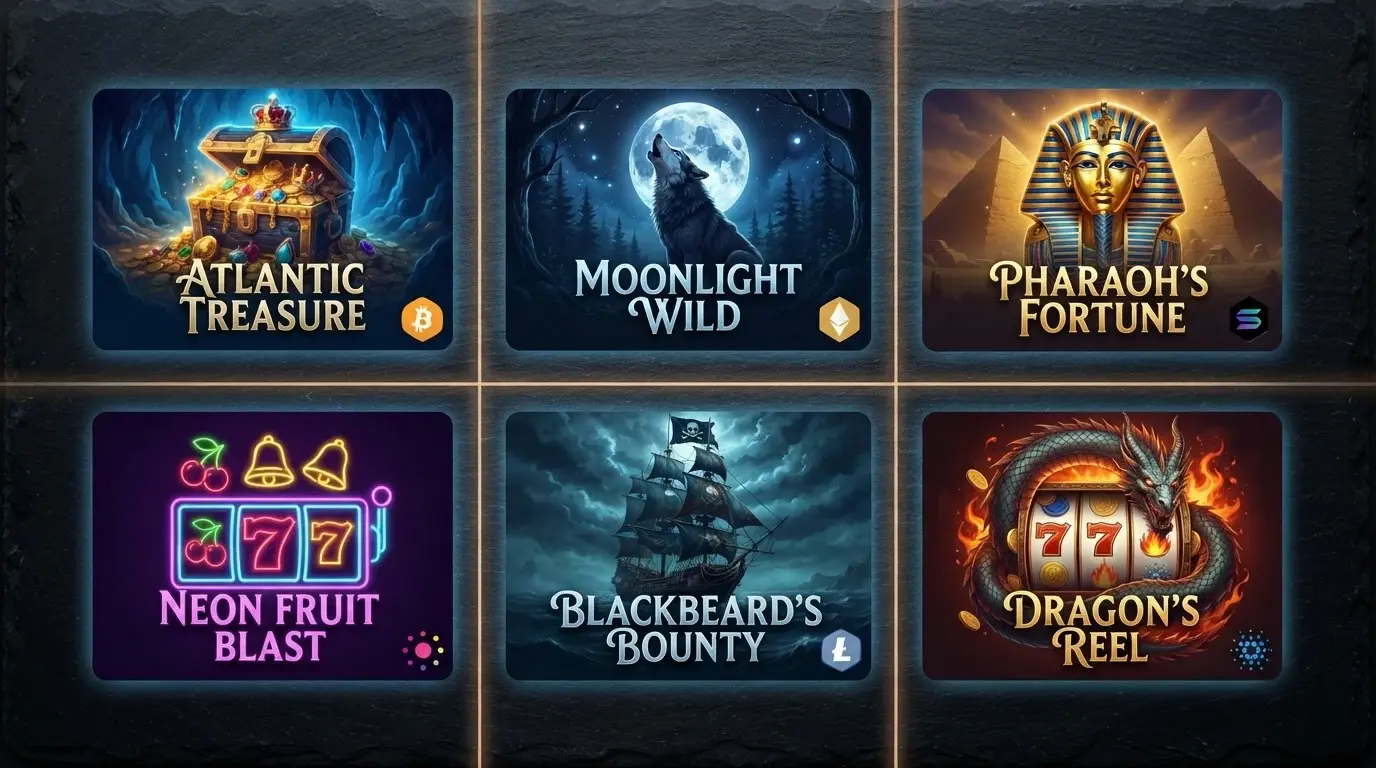
Provably fair is the trust mechanism that distinguishes a crypto-native pokie from a traditional RNG-based one. The casino publishes a hash of the next result before the spin, the player sees the unhashed result after the spin, and a third-party verifier can confirm the two match. Real cryptography, and it removes the “is the house actually using a random result” question — the same question a state regulator answers in the licensed market. It does not remove the “is the house going to pay me” question. That is still on the player.
Real-money crypto spins vs free-spin pokies: what the offer actually delivers
There are two ways an Australian player spins with crypto, and they behave differently. Real-money crypto pokie play is the default: deposit, play, withdraw. No turnover requirement, no bonus balance to forfeit, no expiry clock. The terms the casino applies are the terms of the cashier — minimum withdrawal, maximum withdrawal, processing time. Free-spin bundles are a different instrument: the spins run on a fixed set of titles at a fixed per-spin value, the winnings are bonus money until the wagering multiple clears, and the bonus balance expires on the operator’s clock.
BitStarz’s 30 no-deposit free spins are the shape of a free-spin offer: A$0.20 per spin, 40x wagering on winnings, A$100 maximum withdrawal, 24-hour validity. SkyCrown’s 125 first-deposit free spins are the larger shape: fixed on Wolf Treasure by IGTech, 40x wagering on winnings, 14-day validity. The A$7.50 maximum bet during bonus wagering is the bet ceiling that runs across most of the featured set — SkyCrown and Rocket Play both cap at A$7.50 — and it sets the pace at which the wagering clears.
The practical difference between the two paths: real-money play converts a win into withdrawable cash at whatever pace the casino’s cashier runs. Free-spin winnings convert only after the multiple clears, and the cashout cap (where one exists) sets the ceiling on what the player walks away with. Both are legitimate products; the terms decide which one is worth taking.
New crypto casinos in 2026: fresh paint or real change?
A new crypto casino launches every week. Most affiliate roundups test 30 to 60 sites in a given cycle and surface the ones with current sign-up bonuses; the rotation is rapid. A “new” casino in 2026 typically offers a bigger welcome bonus, fewer player reviews, and an unproven payout record. The trade-off is real: a fresh bonus in exchange for a thinner trail of evidence that the operator will pay out.
What “new” rarely delivers is structural change. The licence is usually Curaçao or Anjouan; the providers are the same handful; the KYC model is the same soft-threshold architecture; the Terms page usually excludes Australia under IGA enforcement risk. The marketing is louder; the operator underneath is rarely meaningfully different from the older set.
The new-casino checklist: five things to verify before you deposit
The sequence is short, and the order matters. First: check the licence register and regulator. A Curaçao or Anjouan licence number should be verifiable against the issuing authority’s own register; if it is not, the licence attribution is unconfirmed and the operator’s claim of being licensed is a claim, not a fact. Second: verify the game providers are named and licensed in their own right — Pragmatic Play, Evolution and Hacksaw all publish which operators carry their games, and a casino claiming a provider that does not list the casino is a red flag. Third: test withdrawal minimums and caps before depositing, because the published terms are the ones that will apply if you win. Fourth: search player forums for unresolved complaints — a brand with months of unresolved withdrawal disputes is a brand that will likely have one more. Fifth: read the Terms page for the Australia exclusion clause, because every operator that excludes Australia in writing is signalling the legal risk it knows it is taking.
No Australian casino licence exists for online crypto play
The Interactive Gambling Act 2001 makes it illegal for providers to offer online casino games, online pokies and in-play sports betting to people in Australia. There is no licence for it anywhere in the country — not federally, not in any state or territory. A page about “the best licensed online casinos in Australia” is describing something that does not exist.
The law’s prohibition runs against the operator, not the player. No Australian has been prosecuted for using an offshore casino. What the ACMA does is direct Australian ISPs to block the sites; 1,564 illegal gambling and affiliate websites have been blocked since the first blocking request in November 2019, and more than 225 illegal services have withdrawn from the Australian market since enforcement was strengthened in 2017. The enforcement is supply-side, and it is persistent.
The 2026 reform is the next chapter. The Interactive Gambling Amendment (Gambling Reform) Bill 2026 passed Parliament on 19 August 2026, with measures commencing 1 January 2027. The headline changes are the wagering-advertising restrictions during live sporting events (15 minutes before to 5 minutes after, between 5am and 8:30pm), a ban on athletes and celebrities promoting wagering, and the new power for banks and payment providers to block transactions to illegal gambling operators. From 1 January 2027, the bank-rail friction that has been informal (covered in the withdrawals section) becomes a regulated power.
What the credit and crypto payment ban actually changed
Since 11 June 2024, licensed Australian wagering operators have been banned from accepting credit cards, credit-linked products and digital currencies as payment. The ban is the Interactive Gambling Amendment (Credit and Other Measures) Act 2023, and the fines for breach run to A$247,500 per operator. The ban does not change the legal status of offshore casinos — they were already illegal under the IGA regardless of payment method — but it changes the practical market. The regulated Australian market is now crypto-free; the crypto gambling that exists for Australians is entirely on unlicensed offshore platforms.
The other piece of the same reform wave is the Corporations Amendment (Digital Assets Framework) Bill 2025, which took effect on 1 April 2026 and requires crypto exchanges and custody providers operating in Australia to hold an Australian Financial Services Licence. That brings the on-ramp side of crypto gambling inside the AFSL regime; it does not bring the offshore casino side anywhere near it.
What you give up playing at an unregulated offshore operator
The Australian-licensed operator must provide deposit limits, activity statements, complaint pathways through state gambling authorities, and BetStop coverage. None of those obligations apply offshore. The practical meaning: no Australian consumer protection, no ACMA complaints body to recover money, no BetStop coverage, no recourse if the operator refuses a withdrawal. The site can also be blocked by the ACMA at any time, with no obligation to return funds. A player who wins A$20,000 at an offshore casino and then has the site blocked by their ISP has no Australian body to complain to.
BetStop is the clearest single illustration of what is missing. Its offshore blind spot (covered in the next section) is a structural gap in the harm-minimisation infrastructure that does not exist on the offshore side at all. A self-excluded Australian who registers with BetStop and then opens an offshore crypto account will not be stopped by BetStop — the operator is not connected to the register, and will keep accepting deposits.
The AUSTRAC Travel Rule and the A$10,000 threshold
AUSTRAC’s Travel Rule kicks in at A$10,000, triggering enhanced reporting for transfers to and from crypto exchanges. Below that threshold, the on-ramp is invisible to AUSTRAC; above it, the exchange files the report and the transaction is recorded against the player’s identity. That is the legal ceiling on anonymous volume in the Australian crypto market.
The bank rail compounds the threshold well before it arrives. CommBank and Westpac restrict crypto exchange transfers silently and below the A$10,000 mark; ANZ and NAB flag transfers without fully blocking; ING and Macquarie are permissive. A player moving money through CoinSpot or Independent Reserve from a CommBank account may find the transfer blocked at A$500; from ING or Macquarie, the same transfer usually clears. The cleanest deposit route in the current data is AU bank → CoinSpot or Independent Reserve → USDT TRC20 → offshore casino — and that route works for players whose bank is not actively blocking it.
Staying safe when the Australian safety net cannot reach
The Australian safety net for gambling harm is built around the licensed market. BetStop — the National Self-Exclusion Register — has recorded 67,480 registrations since going live in August 2023, with 41,290 exclusions still active as at 31 July 2026. 78% of registrants are under 40 and 38% chose lifetime exclusion. The register binds every Australian-licensed online and phone wagering service, and from 1 January 2027 it gains the additional protection of a ban on direct marketing of inducements for three months after deregistration.
What BetStop does not cover is the offshore casino. An offshore operator is not connected to the register, and a self-excluded Australian who opens an offshore crypto account will not be stopped by BetStop’s registration. The operator has no obligation to check, and the deposit will land. That is the structural gap the harm-minimisation infrastructure does not yet reach.
The services that do reach every Australian player are the support services. The National Gambling Helpline (1800 858 858) is free, confidential, staffed 24/7. Gambling Help Online (gamblinghelponline.org.au) provides online chat and counselling. Lifeline (13 11 14) is the broader crisis-support line. These are not harm-prevention tools; they are harm-response tools, and they are the one safety rail every Australian player can reach regardless of where they play.
How big the problem is: the numbers behind Australian problem gambling
About 2.1% of Australian adults — roughly 430,000 people — experience problem gambling, with the Australian Institute of Health and Welfare putting high-risk gambling at 1.8% in 2022. The numbers are large enough that the offshore environment’s gap in the Australian safety net is a real concern for a meaningful slice of the population. The players who are most vulnerable to harm from offshore play are the players the licensed market’s harm-minimisation tools were built for — and the offshore market is the one those tools do not reach.
The correlation is not a claim about causation. What is true is that an offshore casino with no deposit limit enforcement, no BetStop coverage, no activity statement and 24-hour access from a phone is a higher-risk environment than a licensed Australian wagering account with the full suite of harm-minimisation obligations. The licensed product is sports and racing only; the casino product does not exist in the licensed market. The player who wants casino play in Australia has to cross to the offshore side, and the harm-minimisation tools do not cross with them.
Practical limits you can set — even without an Australian regulator
The practical limits a player can set are exchange-side and self-enforced. CoinSpot and Independent Reserve both allow daily and weekly transfer limits on the player’s account, set by the player, that cap how much can move to a casino wallet in any given period. The casino’s own deposit limit (where one exists) can be set conservatively on day one. Session-time tracking is a player-side tool — a phone timer or a dedicated gambling app that logs session length and stake volume.
BetStop is partial coverage only; it binds licensed wagering services and does not reach the offshore crypto casinos on this list. From 1 January 2027, the bank-blocking power (covered in the legality section) gives banks and payment providers the express authority to block transactions to illegal gambling operators — a tool that does not exist in the current legal frame and that the 2026 reform makes available. The National Gambling Helpline and Gambling Help Online remain the standing adjunct support, regardless of where the player chooses to play.
How we evaluated every crypto casino on this page
The operator set on this page was assembled against the official AU licence landscape — which is to say, the absence of one. Every brand here is offshore; the column reads “Curaçao (unconfirmed this run)” or “Anjouan (unconfirmed this run)” where research was able to attribute a licence, and a dash where it was not. No regulator’s register was successfully queried for licence dates this round; all licence attributions are inferred from the operator’s own site or third-party reviews, not confirmed against an official register.
The criteria applied were licence verifiability (where possible), bonus terms clarity, KYC thresholds (where published), withdrawal-speed data (where independent tests were available), and AU market-share signals from the affiliate-tracker data the research consulted. The ranking reflects what the AU-facing market actually shows rather than any weighted score across those criteria; a heavier welcome bonus did not move an operator up the list if the wagering multiple made the headline number meaningless, and a thinner offer did not move an operator down if the underlying licence and KYC architecture were stronger.
What the ranking does not measure is the player experience over months of play. Payout reliability, complaint-handling quality, the speed of live chat and the depth of the live-dealer lobby are not in the data this round. The page describes what an offer is worth and what the licence and verification picture looks like; it does not describe what playing there feels like over time.
What you actually do about crypto casinos as an Australian player
The trade-offs the data shows are sharper than the marketing lets on. Faster withdrawals and bigger bonuses sit on one side; no Australian consumer protection, no BetStop coverage, no recourse if the operator refuses a withdrawal on the other. The offshore reality is not a temporary loophole — it is the permanent structural condition of the Australian crypto casino market, because the IGA prohibits the licensed product from existing and the 2026 reform does not change that. From 1 January 2027 the bank-blocking power adds a new tool to the enforcement side; it does not legalise the supply.
If a player chooses to play, the practical takeaways from this page are few. The cleanest deposit route is AU bank → CoinSpot or Independent Reserve → USDT TRC20 → offshore casino, and that route works for players whose bank is not actively blocking transfers to crypto exchanges. The soft KYC thresholds sit in the A$2,000–A$5,000 cumulative withdrawal band; crossing them triggers verification that varies from operator to operator. The wagering multiples on welcome bonuses sit between 35x and 500x, and the per-bonus cost is the multiple, not the headline match. The bank rail friction, the AUSTRAC Travel Rule at A$10,000, and the Australia exclusion clause in every Terms page are the structural conditions the marketing does not mention.
What the page does not do is pick an operator for the reader. The decision sits with the person whose money is at stake, and the data on this page is built to make that decision an informed one. The safety rail every Australian player can reach regardless of where they play is the National Gambling Helpline (1800 858 858) and Gambling Help Online (gamblinghelponline.org.au) — free, confidential, 24/7.
Frequently asked questions
Can I deposit with Bitcoin at an Australian online casino?
There is no Australian-licensed online casino to deposit at, because the Interactive Gambling Act 2001 prohibits the supply. The casinos that accept Bitcoin and serve Australian players are offshore — Curaçao, Anjouan, Costa Rica — and they accept AUD-equivalent crypto deposits via CoinSpot or Independent Reserve. USDT on the TRC20 network is the cheapest path.
Are crypto casino winnings taxed in Australia?
No Australian case has held ordinary punter winnings assessable. Section 6-5 of the ITAA 1997 taxes gambling winnings only when the person carries on a business of betting. A recreational crypto casino player does not meet that test, and the ATO’s IT 2655 treats ordinary winnings as non-assessable. Crypto is property for CGT purposes, but a one-off punter’s winnings typically do not trigger a CGT event.
What happens if an offshore crypto casino blocks my account or refuses a withdrawal?
There is no Australian regulator to complain to. The ACMA enforces the IGA by blocking sites, not by mediating player disputes. Practical remedies are chargeback through the original funding source (where the route allows), the casino’s own dispute process, and — where the licence is verifiable — a complaint to the issuing regulator. None of these guarantees a payout.
Does BetStop cover crypto casinos?
No. BetStop binds Australian-licensed online and phone wagering services only. Offshore crypto casinos are not connected to the register, and a self-excluded Australian who opens an offshore crypto account will not be stopped. The operator has no obligation to check, and the deposit will land. BetStop is the strongest single harm-minimisation tool for Australian players — and its offshore blind spot is a real gap.
What responsible gambling tools are available for Australian crypto casino players?
BetStop covers the licensed market only and does not reach offshore crypto casinos. Tools that reach every Australian player are the National Gambling Helpline (1800 858 858, free, confidential, 24/7), Gambling Help Online (gamblinghelponline.org.au) and Lifeline (13 11 14). Player-side limits include exchange transfer caps (CoinSpot and Independent Reserve allow these), conservative casino deposit limits set on day one, and session-time tracking.
Published by the POLi Casinos AU team.