
25 free spins no deposit in Australia: the offer, the odds, and the offshore catch
Twenty-five free spins, no deposit asked, sounds like a free lunch. For an Australian player it is closer to a free sample at a shop that has no Australian shopfront and no Australian shopkeeper to chase if the sample turns out to cost more than the lunch.

Data current as of 17 October 2026; licence claims verified against the Australian Communications and Media Authority register and the Curacao Gaming Control Board public records.
Table of Contents
- How 25 free spins no deposit actually reach Australian players
- Why your no-deposit free spins are never really free
- The offshore casinos Australians use for free spins — and what they actually offer
- The pokies your 25 free spins unlock — and which titles pay the best
- Claiming free spins on mobile: what works and what the fine print hides
- New casinos dangling 25 free spins: higher risk, familiar promise
- The legal reality: every 25-spin offer reaching Australia comes from an offshore operator
- How to protect yourself when the Australian safety net is gone
- How we evaluated these 25 free spins casinos
- What your 25 free spins are actually worth — and whether they are worth claiming
- Frequently asked questions
How 25 free spins no deposit actually reach Australian players
A “25 free spins no deposit” offer is a marketing term for a small bundle of slot spins credited to a new account without a qualifying deposit. The bundle is small — usually worth between A$2.50 and A$5 at a typical A$0.10 to A$0.20 per spin — and the spins are tied to a specific pokie or a short list. Anything the spins return lands in a bonus balance, not a cash balance, and almost never reaches a bank account without first passing through a wagering requirement, a cashout cap and, more often than the marketing lets on, a real-money deposit.
No Australian-licensed operator offers this product. The reason is plain: online casino games, online pokies and in-play sports betting are prohibited under the Interactive Gambling Act 2001. The Act makes it illegal for a provider to offer those services to people physically in Australia. Permitted and licensable are wagering on races and sport placed before the event begins, lotteries and keno, through operators licensed by a state or territory. Online pokies are not on that list. There is no licence for them, anywhere in Australia, at any level of government.
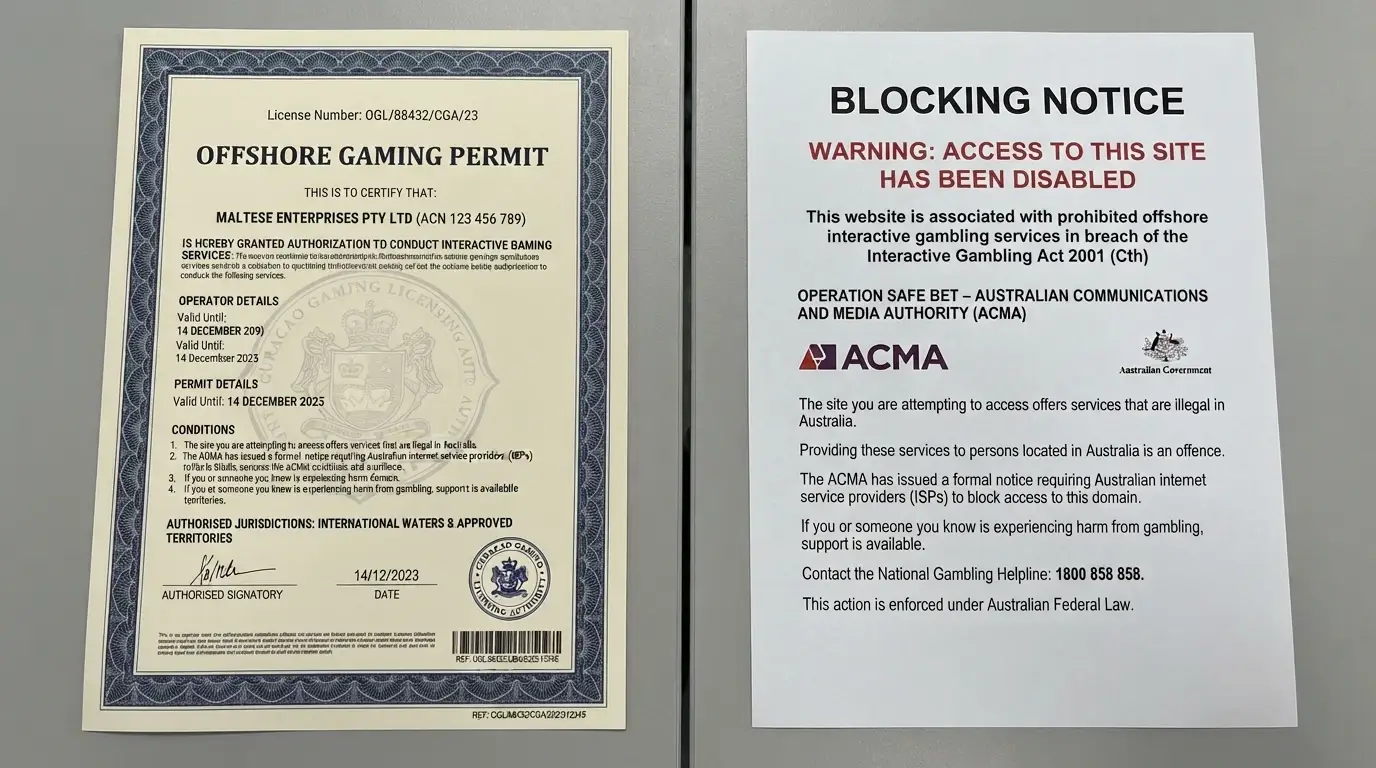
So when an Australian sees a 25-spin no-deposit offer, the operator behind it is offshore. Every time. The licence on the footer is almost always a Curacao Gaming Control Board permit, occasionally an Anjouan or Kahnawake one, and never an Australian one — because none exists to issue.
The offshore reality: every spin comes from outside Australia
Operating offshore is not the same as operating illegally, but the difference matters less than it sounds to the player at the keyboard. The IGA targets operators, not players — the Act names the provider, the hosting service and the advertising affiliate, not the punter. An Australian who opens an account at a Curacao-licensed casino is not committing an offence. What they are giving up is the entire Australian safety net that surrounds any locally licensed wagering service.
BetStop — the National Self-Exclusion Register — binds Australian-licensed wagering services only. One registration excludes a person from every licensed online and phone bookmaker in the country, but a Curacao casino is not connected to the register and will keep accepting that person’s deposits. ACMA enforcement is real, but it operates on the supply side, not the demand side: the regulator investigates, finds breaches, refers offending domains to Australian ISPs for blocking and moves on. A player whose favourite offshore casino has just been blocked by their ISP loses access to their balance with no complaint body to escalate to. The money is held by an entity that does not fall under Australian consumer law.
This is what offshore looks like in practice. The regulator has no jurisdiction. The ombudsman has no operator to compel. The self-exclusion register has no flag to honour. The bank has no avenue to claw back a disputed transaction.
What 25 free spins no deposit actually means — and what it does not
Spin values at offshore casinos running this offer cluster between A$0.10 and A$0.20 per spin. Twenty-five spins at A$0.10 is A$2.50 of nominal action; at A$0.20 it is A$5. Either figure is small, but the bonus is rarely about the spin value. It is about the slot the spins are tied to, the wagering requirement that follows the win, the cashout cap that limits the upside, and the seven-day expiry that compresses the play window.
Winnings are bonus-capped, not withdrawable. A player who hits a 100x line combination during a 25-spin session does not have A$200 in cash. They have A$200 in a bonus balance that must be wagered, usually at 30x to 60x on the winnings, before a cent can leave. The bonus is tied to specific pokies — almost always the slot the offer advertised — and those pokies count 100% toward wagering. Table games count around 10%. Live dealer is usually excluded entirely.
The seven-day expiry matters. A player who treats the bonus as something to come back to next week returns to find the spins gone and the bonus balance zeroed. The compressed window is not an accident; it is how the operator makes the wagering requirement achievable only by players who play fast and stake high.
Why your no-deposit free spins are never really free
The marketing on a no-deposit free-spin offer is built around the word “free”. The arithmetic is built around everything else. A typical package combines three mechanisms — wagering on winnings, a maximum cashout cap, and a withdrawal trigger that converts the bonus into a paid grind before a dollar can be cashed out.
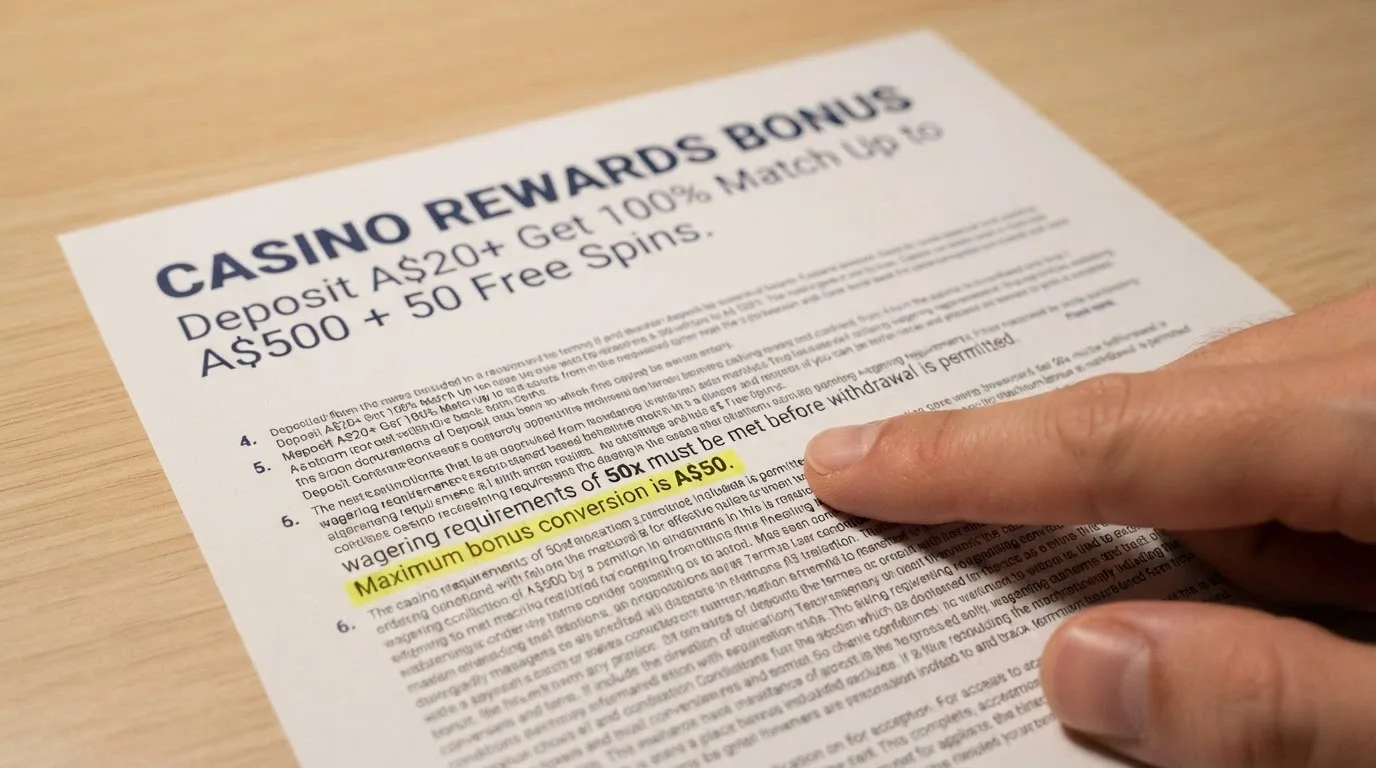
Wagering requirements at AU-facing offshore casinos running this offer range from 30x to 60x on the winnings from the bonus spins. Maximum cashout caps most commonly sit between A$50 and A$100, with the wider tested range running from A$20 at the low end to A$150 at the high end. The withdrawal trigger deposit — the requirement to fund the account with real money before a no-deposit win can be withdrawn — is the third leg of the stool, and the most often hidden. None of these terms appear on the offer banner. They appear on a linked terms page, in a font a touch smaller than the headline.
Wagering explained: why 50x on winnings costs more than it sounds
The wagering requirement is a multiplier applied to winnings, not to the bonus. A player who wins A$5 from twenty-five spins at a 50x requirement must generate A$250 of qualifying turnover before the bonus balance converts to withdrawable cash. Pokies contribute 100% toward that turnover. Table games contribute about 10%, so a player who tries to grind through the requirement at blackjack is generating a tenth of the qualifying volume per dollar staked — the same A$250 of real turnover might count only A$25 against the requirement, and the seven-day expiry clock does not slow down.
A A$5 win from the 25 spins, with 50x wagering on the winnings and a 96.71% RTP on Big Bass Bonanza, requires A$250 of qualifying turnover. The expected loss over that turnover, assuming the wagering is cleared on the same eligible pokie, is A$8.23. The expected cost of clearing the bonus exceeds the win that produced it.
That is the median case. A player who wins A$10 faces A$500 of turnover and an expected loss of A$16.45; the bonus pays them to lose more. A player who wins A$2 faces A$100 of turnover and an expected loss of A$3.29 — the rare case where the math comes out ahead. The expected cost exceeds the win at every realistic win size.
Cashout caps: why your winnings shrink before you touch them
The maximum cashout cap is applied after wagering is complete. A player who has cleared A$250 of qualifying turnover on a A$5 win, with a A$100 cap, withdraws A$100; the rest is voided. The cap is not negotiable and does not scale with the wagering — a player who grinds harder does not earn a higher ceiling.
The cap range is wide. A$20 is the floor at the cheapest end of the market — operators use it to limit exposure on offers that draw high bonus-chasing volume. A$50 to A$100 is where most AU-facing offshore casinos cluster. A$150 is the ceiling at the more generous end, and A$180 appears at Fair Go on its A$10 free-chip variant. The cap is a percentage of the wagering in the roughest possible sense: at A$50 on a A$5 win with 50x wagering, the player has done A$250 of turnover and walks away with A$50, a fifth of the volume.
The cap matters most when the math goes right. A long-shot bonus hit during the 25 spins — a 50x or 100x line combination on the pokie — produces a balance well above the cap. The cap converts the upside from a windfall into a small payout and voids the rest. The screen showed a number. The terms page showed a smaller one. The terms page governs.
Promo codes: when you need one and when the spins land automatically
The 25-spin offer reaches a new account by one of two routes. Some operators auto-credit the spins once email or phone verification is complete; no code, no cashier visit, no opt-in. Other operators require a code, entered either at registration or in the cashier, and the offer does not appear until the code is in. The auto-credit model is easier to verify because the bonus appears the moment the registration checks clear. The code-gated model is harder because codes rotate, expire and silently change at the operator’s discretion.
From the player’s perspective, the two routes have one practical difference: the code-gated offer can disappear overnight. A code that worked yesterday can be dead by morning. A player who waits two days to register on the strength of a code they read somewhere is registering for an offer that may no longer exist.
Operators do not announce code changes. The affiliate databases that collect these codes refresh on a delay, and the offer pages of the casinos themselves often hide the most recent code behind an email opt-in. The reliable move is to register and check the cashier or promotions page directly at the operator rather than relying on a code copied from a third-party list.
Bitcoin casinos and the 25-spin offer: crypto changes the terms
Crypto-focused offshore casinos carry the same Curacao licence architecture as their fiat counterparts, but they denominate their offers differently. A 25-spin package at a crypto casino is usually priced in USDT or in BTC rather than in AUD, and the bonus terms are written against that denomination. Wagering requirements, cashout caps and eligible-game lists transfer across, but the FX exposure does not — a player who wins 50 USDT in bonus balance faces a BTC or USDT withdrawal, and the AUD value of that withdrawal moves with the crypto market in the time it takes to clear wagering.
Crypto also changes the payment-method side. The credit-card and crypto ban that took effect on 11 June 2024 under the Interactive Gambling Amendment (Credit and Other Measures) Act 2023 applies to wagering services licensed in Australia. It does not reach the deposit rails of an offshore casino, because the offshore casino is not licensed in Australia and is not subject to the Act. An Australian player funding an offshore casino account with USDT is not committing an offence, but they are also outside the small protection the Australian bank-debit system offers — there is no chargeback route, no bank complaint escalation, and no path through the Australian Financial Complaints Authority if the operator refuses a withdrawal.
Stake is the crypto-focused operator in the featured set. It carries a Curacao licence, runs a multi-provider catalogue and accepts BTC, ETH, LTC and USDT. Its promotional offer to AU players is not the traditional AUD-denominated free-spin bundle. The bonus language is crypto-native, the value of any free-spin equivalent moves with the market, and the player comparing offers on an apples-to-apples basis needs to translate the crypto bonus into AUD before ranking.
How to claim 25 free spins step by step — and what to check before you do
- Register at the casino using an email address and password; some operators also require a phone number at this stage.
- Verify the email address or phone number; the bonus either auto-credits here (the auto-credited model) or requires a code entered at the cashier or on the registration form (the code-gated model).
- Open the eligible pokie — almost always the title named in the offer terms — and run the 25 spins. Spins typically expire within seven days of crediting; some offers give 24 hours.
- Winnings land in a bonus balance. Wagering of 30x to 60x on those winnings must be cleared before any cashout is possible, and only eligible games — almost always pokies, sometimes a named list — contribute 100% toward the requirement.
- Clear the wagering on the same pokie or another eligible title, watching for the A$5 or so max bet limit several operators impose during wagering.
- Request the withdrawal. At this point the operator may require a real-money deposit before processing the no-deposit win — the withdrawal trigger deposit. Skipping it forfeits the bonus.
- Complete the operator’s identity check, which usually requires a photo of a government ID and a proof of address. Withdrawals can take several business days and may stall at this stage.
The offshore casinos Australians use for free spins — and what they actually offer
A note before the table: most operators in the featured set do not carry a pure 25 free spins no deposit bonus. The headline offer most of them run is a deposit-match welcome, a free chip on first deposit, or a deposit-gated spin bundle. The ranking weights transparency of bonus terms, game-provider breadth and clarity of the licence disclosure over the headline free-spin claim.
| Operator | Wagering on Bonus | Game Providers |
|---|---|---|
| Royal Reels | 30x (bonus amount) | Pokies (2,200+ titles), live dealer |
| Fair Go Casino | 60x (no-deposit chips); 30x on deposit + bonus (welcome) | RTG only |
| WinSpirit | 40x | Multiple providers |
| Skycrown | 40x (advertised) | Multiple studios, Evolution live tables |
| Rocket Play | — | Multiple providers |
| Stake | — | Multiple providers, crypto-focused |
| Rainbet | 35x (bonus); 30x (FS winnings) | Multiple providers |
| Bizzo Casino | — | Multiple providers (high RTP transparency noted) |
| Rocket Casino | 45x standard; 50x on deposits above A$100 | Multiple providers |
| Scream Casino | — | Multiple providers |
Royal Reels: deposit match, not no-deposit spins
Royal Reels runs on a Curacao licence held by Digibrite S.R.L. and offers Australian players a 100% first-deposit match up to A$500, with 30x wagering applied to the bonus amount and a A$10 minimum qualifying deposit. The headline offer is not a no-deposit spin bundle — it is a deposit-match welcome — but the casino pairs it with a A$10 no-deposit free chip on registration, which functions as the entry point. The chip carries its own terms, separate from the deposit match.
The catalogue runs to more than 2,200 pokies plus a live dealer section, which is broader than most operators at this licence tier. For an Australian player comparing on game variety alone, Royal Reels sits at the wide end of the featured set. The 30x bonus wagering is at the lower end of the AU-facing range, which is the only term-side advantage it offers over the 40x and 45x operators below. Verdict: a broad catalogue and a low multiplier; the no-deposit entry is a chip, not a spin bundle.
Fair Go Casino: the RTG specialist with a no-deposit free chip
Fair Go is the closest thing in the featured set to a no-deposit offer. The casino runs an A$10 free chip on registration, code-gated at the cashier, with 60x wagering on the chip and a A$180 maximum cashout. The chip is restricted to RTG (RealTime Gaming) pokies, which is the entire catalogue — Fair Go is a single-provider casino. The deposit welcome is a separate product: 100% up to A$200 on each of the first five deposits, with 30x wagering on deposit plus bonus and no maximum cashout on the deposit welcome.
The bonus split is the honest version of a “free” offer. The 60x on the chip is heavy, but the A$180 ceiling is the highest cashout cap in the featured set. A player who grinds a A$10 free-chip win into a A$180 payout has done more turnover than a player at any other operator, but the ceiling is real. Verdict: for the player comparing no-deposit entries across the featured set, Fair Go is the only confirmed one — heavy on the wagering, generous on the ceiling, single-provider on the catalogue.
WinSpirit: the A$1,000 match with 100 free spins — but no confirmed no-deposit entry
WinSpirit is operated by Complete Technologies N.V. under a Curacao Antillephone N.V. licence, number 8048/JAZ2014-053. The welcome is a 100% deposit match up to A$1,000 plus 100 free spins, credited at 20 per day over five days. Wagering is 40x on the bonus, and a A$3,000 win limit caps the welcome package. The minimum qualifying deposit is A$30.
The A$3,000 win limit is the structural feature. A welcome package that pairs a five-figure ceiling on the bonus with a three-figure ceiling on the winnings is shaped to contain upside — a player who hits a long-shot line combination during the 100 free spins gets the spin value but is capped at A$3,000 on the whole welcome. The package reads as generous on the bonus side and tight on the win side, which is a familiar offshore shape. Verdict: a large bonus ceiling paired with a smaller win cap — built for high-deposit play, not the 25-spin no-deposit reader.
Skycrown: multi-provider catalogue with Hollycorn backing
Skycrown runs under a Curacao licence held by Hollycorn N.V. The casino carries multiple studios, including Evolution live tables, and advertises a welcome bonus spread across the first deposits, with 40x wagering. Specific bonus figures vary between affiliate sources and were not confirmed in a single authoritative form this run.
The multi-provider catalogue is the strongest pitch: an Australian player who wants Evolution live tables alongside pokies has a short list of featured operators and Skycrown is on it. Verdict: the catalogue breadth is real; the bonus terms need a second look at the cashier before funding.
Rocket Play: lean data, standard Curacao structure
Rocket Play runs under a Curacao licence and carries a multi-provider catalogue. The current AU-facing welcome bonus was not confirmed in a single verified form this run. The casino appears on aggregator lists but the bonus terms vary between sources.
A player evaluating Rocket Play should treat the licence as the only confirmed fact and treat any bonus figure on an affiliate page as unverified until they see it on the operator’s own cashier. Verdict: standard offshore structure with a thin verified-data profile — the catalogue is the answer, the bonus is a gap.
Stake: crypto-first, light on the traditional free-spin offer
Stake runs under a Curacao licence and operates a crypto-native platform, accepting BTC, ETH, LTC, USDT and other digital assets. The catalogue spans multiple providers. The promotional model is fundamentally different from a fiat-currency casino — bonuses are denominated in crypto, the offer language is built around rakeback and reloads rather than traditional welcome packages, and the AUD-denominated 25-spin no-deposit bundle does not appear in the AU-facing offer set.
For an Australian player who already holds crypto and is comfortable transacting in USDT, Stake is a familiar brand and a deep catalogue. For a player whose comparison point is the 25-spin no-deposit offer in AUD, Stake does not offer that product. The credit-card and crypto ban that commenced on 11 June 2024 applies to Australian-licensed wagering services, not to offshore deposits, but the AUD on-ramp is missing and the AUD value of any bonus moves with the crypto market. Verdict: a different product from the AUD free-spin reader; a familiar platform for the crypto-comfortable.
Rainbet: deposit-gated spins with dual wagering tiers
Rainbet operates under a Curacao eGaming licence and runs a welcome package of a 100% deposit match up to A$500 plus 50 free spins on selected slots. The wagering structure is dual: 35x on the bonus amount, 30x on free spin winnings. The split is unusual and is the point of the offer — a player who reads it carefully can plan a playthrough that addresses the two requirements separately.
The package is deposit-gated. There is no no-deposit entry point in the Rainbet welcome; the spins are unlocked by the qualifying deposit. Verdict: a clean dual-tier wagering structure, but no no-deposit entry — useful for a player who is willing to deposit and wants the wagering split clearly stated.
Bizzo Casino: high-RTP transparency, bonus details unconfirmed
Bizzo runs under a Curacao licence and carries a multi-provider catalogue noted for its RTP transparency — the operator publishes per-game return-to-player figures in the game info panel, which is more than most offshore casinos do. Specific bonus terms for AU players were not confirmed in a single verified form this run.
RTP transparency is the structural feature here. A player who cares about the RTP-variant issue — where operators can silently load lower-payout versions of the same title — has one defensive move, and Bizzo is the operator in the featured set that makes the move easiest. Verdict: RTP transparency is the pitch and the bonus gap is the cost — confirm the terms on the cashier before committing to a deposit.
Rocket Casino: variable wagering that climbs with deposit size
Rocket Casino operates under a Curacao licence and runs a 45x standard wagering requirement, rising to 50x on deposits above A$100 as of 2026. The casino imposes a A$5 maximum bet limit during wagering — a player who places a A$6 spin during the playthrough risks the bonus being voided.
The variable wagering is the structural feature. A player who deposits A$99 qualifies for the lower multiplier; a player who deposits A$101 pays the higher one. The A$5 cap is the other structural feature and it limits the speed at which a player can clear a large bonus. Verdict: 45x standard and 50x above A$100 — the wagering tier is the headline.
Scream Casino: newest face, least confirmed detail
Scream Casino runs under a Curacao licence and carries a multi-provider catalogue. The casino appears on aggregator lists but bonus terms, wagering requirements and eligible-game details were not confirmed this run. A player evaluating Scream should treat the licence as the only verified fact and confirm bonus terms directly with the operator before depositing.
The thinnest verified-data profile in the featured set is itself a fact. Newer offshore casinos use aggressive no-deposit offers to drive registrations; a casino that does not publish terms clearly enough for a third party to verify is a casino a player should approach on minimum exposure. Verdict: multi-provider catalogue, freshest licence, no confirmed bonus — the data gap is the answer.
The pokies your 25 free spins unlock — and which titles pay the best
The 25-spin offer almost always names a specific pokie, or a small list of pokies, on which the spins must be played. The four titles below are the ones that appear most frequently across the AU-facing offer set, and they are also the four whose per-game data research has confirmed.
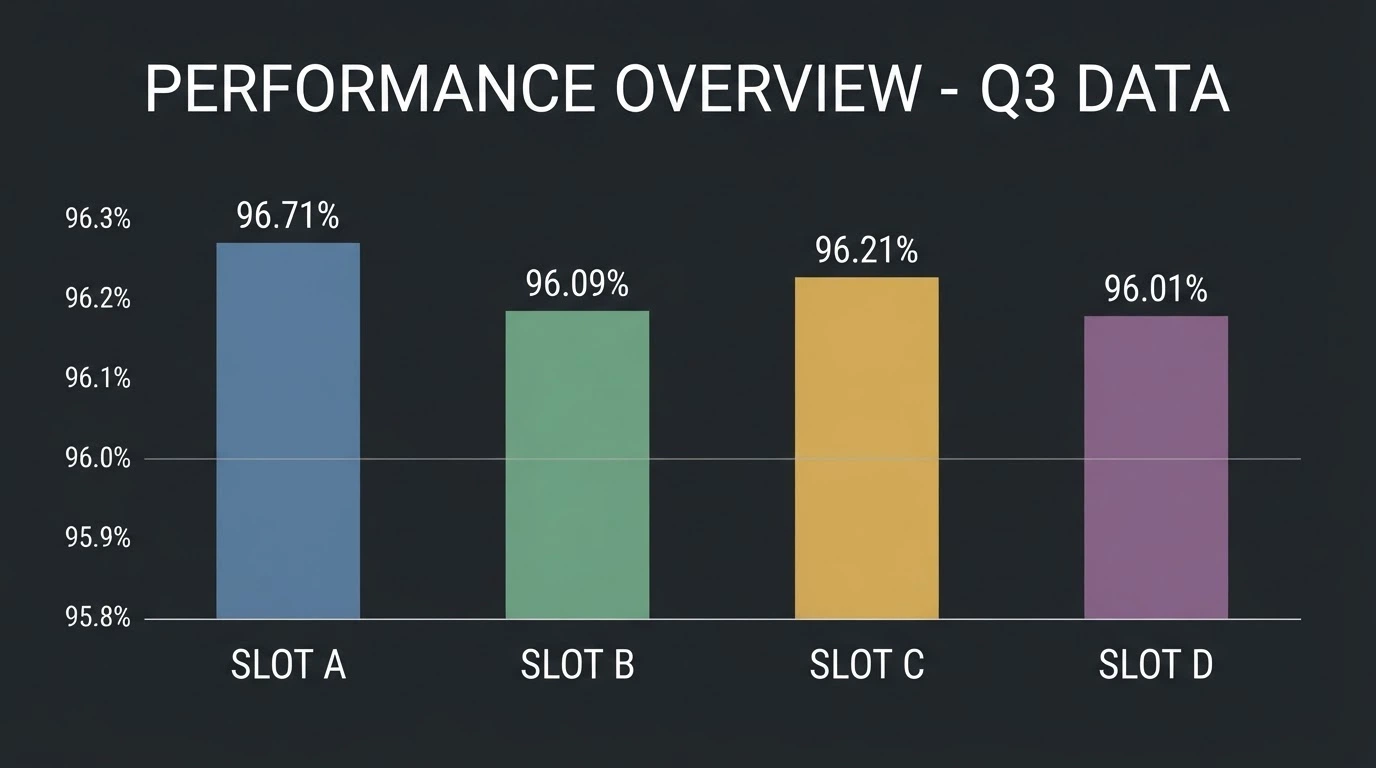
| Slot Title | Provider | RTP | Volatility | Max Win |
|---|---|---|---|---|
| Big Bass Bonanza | Pragmatic Play | 96.71% | Medium-high | 2,100x stake |
| Wolf Gold | Pragmatic Play | 96.01% | Medium | 2,500x stake |
| Starburst | NetEnt | 96.09% | Low | 500x bet |
| Book of Dead | Play’n GO | 96.21% | High | 5,000x bet |
The RTP spread across these four titles runs from 96.01% to 96.71% — a 0.70 percentage-point range that looks small on paper and compounds meaningfully across the hundreds of turnover spins a player needs to clear a 25-spin bonus. A 96.71% return on A$250 of turnover retains A$241.78 of the A$250 wagered; a 96.01% return retains A$240.03. The difference between the top and bottom RTP in the eligible-titles list, on the wagering alone, is A$1.75. Across the full session — and across the wagering requirement that follows a 25-spin win — the RTP of the chosen title is the single most important number a player can check.
Pragmatic Play, NetEnt and Play’n GO: which provider dominates the free-spin lobby
Three studios account for most of the 25-spin offers in the AU-facing market. Pragmatic Play contributes Big Bass Bonanza and Wolf Gold — both medium-to-high volatility, both above 96% RTP, both with a maximum win in the thousands of times stake. NetEnt contributes Starburst — low volatility, the shortest path through the wagering requirement because small wins accumulate faster than rare large ones, but with a 500x ceiling that limits upside on the bonus itself. Play’n GO contributes Book of Dead — high volatility, the largest ceiling in the eligible list at 5,000x, and the longest path through the wagering requirement because the slot pays less often.
The house style difference matters. A player clearing a 50x wagering requirement on Starburst is grinding through small, frequent returns and the balance moves in small steps. The same player on Book of Dead is waiting for a line combination that may or may not arrive in the seven-day window. Pragmatic Play’s two flagship titles sit between the two — medium volatility, mid-range ceiling, a session that feels neither grinding nor starving.
The RTP-variant warning applies across providers. Starburst in particular ships in 92%, 94%, 96.09% and (rarely) 99% return-to-player variants, and operators can load any of them without announcing which version is live. The player at the keyboard sees the same title; the math behind it differs by up to seven percentage points. The defensive move is to check the in-game info panel for the published RTP before starting the wagering — most operators do not show it.
No-wagering free spins on pokies: the offer that almost never appears
No-wagering free spins would convert any bonus win directly into withdrawable cash, with no turnover required. No operator in the featured set confirms a no-wagering 25-spin offer for AU players this run. The economic reason is straightforward: an operator gives away the spins at no cost to the player, then sits the player down at a pokie with a 96% return-to-player and asks them to walk away with whatever they have won. On a A$5 nominal bonus, the expected cost to the operator is the same as the bonus value, with no deposit to offset it and no chance to recoup the cost through subsequent play the player is now unlikely to undertake.
The no-deposit free spin, with no wagering attached, is a market where the operator pays retail. Few operators run it. The offers that do appear are short-window, low-spin, small-stake — closer to a free demo than a bonus. For a player who wants the offer to exist at all, wagering is the price of admission. For a player who refuses to pay that price, the offer is unavailable in the AU-facing market.
Claiming free spins on mobile: what works and what the fine print hides
Most Australian players claim these offers on a phone. The path works almost identically to desktop, but the surrounding plumbing is different. Native casino apps are rare for offshore AU-facing operators because the App Store and Google Play restrict real-money gambling apps, especially in jurisdictions where the product is prohibited. The offshore casino’s mobile path is almost always a responsive web app — the same site, reflowed for the screen.

The browser path means no app permissions, no biometric lock and no automatic updates. A player who leaves the browser tab open on a shared phone does not have the same device-level protection that a banking app or a licensed wagering app would offer. Sessions persist on the operator’s server, but the device-side security is whatever the browser and operating system provide by default. For most readers that is acceptable; for a player logging in from a phone that also holds work email, it is a setting worth tightening before claiming.
Game compatibility on smaller screens is broadly good for the major studios. Pragmatic Play, NetEnt and Play’n GO all ship mobile-first HTML5 builds, and the four pokies in the eligible-titles table play on a phone without feature loss. The volatility and RTP figures do not change with screen size; the math is the same on a 6.1-inch display as on a 27-inch monitor.
Casino app vs mobile browser: which path keeps your spins safer
The browser path is the only path on offer at most offshore AU-facing casinos. A native app from one of these operators would mean a Curacao-licensed casino in the App Store or on Google Play — a category Apple and Google do not host in jurisdictions where the product is restricted. The absence of a native app is a structural feature of the offshore market, not a missing feature of any one operator.
The trade-off is real but small. A browser session offers no biometric lock; a player who steps away from the phone leaves the session open. A licensed wagering app, by contrast, ships with Face ID, fingerprint unlock, and a forced timeout on inactivity. The offshore player is choosing between catalogue breadth and device-side hardening. The defensive move is to use the phone’s own screen-lock, to avoid saving the casino password in the browser, and to log out at the end of each session rather than relying on session persistence.
New casinos dangling 25 free spins: higher risk, familiar promise
A 25-spin no-deposit offer is a customer-acquisition tool. New offshore casinos use it harder than established ones because they need registrations, not because they are more generous. The promise is the same as the established operator’s promise; the licence on the footer is a Curacao permit, freshly issued; the catalogue is the same multi-provider library aggregated from the same studios. The newness is in the marketing, not the math.

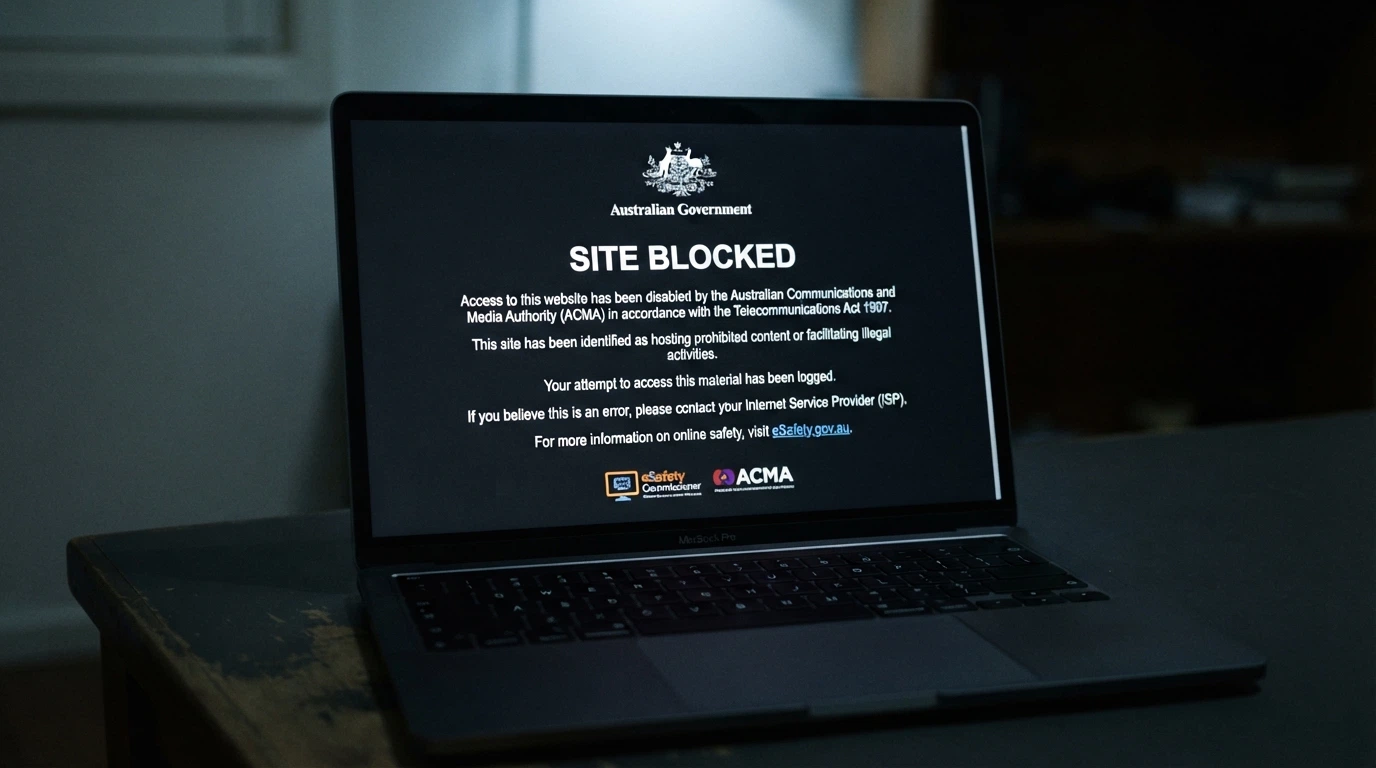
The legal status of a new domain is also identical to an established one. ACMA enforcement does not age-discriminate — the regulator blocks new sites and old ones at the same tempo. As of 2026, 1,788 illegal gambling and affiliate websites have been blocked by Australian ISPs since the ACMA made its first blocking request in November 2019, and 133 of those referrals came in Q4 2025 alone. Over 230 illegal services have withdrawn from the Australian market since enforcement strengthened in 2017. A new domain on a new Curacao permit is no safer than a six-year-old one, and it is as vulnerable to blocking as soon as it draws the regulator’s attention.
The defensive read on a brand-new 25-spin offer is to assume the worst on every term that is not explicitly published. If the wagering requirement, the cashout cap, the eligible games and the bonus expiry are not stated on the landing page, they are not guaranteed. The casino has not earned the trust that an established operator’s reputation partially confers.
The legal reality: every 25-spin offer reaching Australia comes from an offshore operator
The Interactive Gambling Act 2001 makes it illegal to offer online casino games, online pokies and in-play sports betting to people in Australia. The Act was strengthened by the Interactive Gambling Amendment Act 2017, and the prohibition has been enforced continuously since. Online casino is not a grey area; it is a prohibited interactive gambling service. There is no licence to apply for, in any state or territory, because no level of government has decided to issue one.
What is licensable is wagering on races and sport placed before the event begins, lotteries and keno, through operators licensed by a state or territory. The Northern Territory Racing and Wagering Commission, administered through Licensing NT, is the de facto national licensor for large online bookmakers, with terms running up to 20 years. Sportsbet, bet365, Ladbrokes and the rest of the licensed AU wagering market sit on NT licences. None of them offer online pokies. None of them offer a 25-spin no-deposit bundle. None of them are on this page, because none of them offer the product the page is about.
The “operators not players” line is true and incomplete. The IGA targets operators, and an Australian player is not prosecuted for using an offshore casino. What the player gives up is the Australian consumer protection that surrounds any locally licensed service: ACMA complaint escalation, AFCA route through the bank, BetStop self-exclusion, and the simple recourse of a regulator who can compel a withdrawal. None of that reaches across to a Curacao permit.
ACMA enforcement in numbers: how aggressively Australia blocks offshore casinos
The tempo of ACMA enforcement is the supply-side counterweight to the offshore market. In Q4 2025, the ACMA completed 23 investigations into 45 gambling sites and found 69 breaches of the IGA — 38 for providing a prohibited interactive gambling service, 26 for providing an unlicensed regulated interactive gambling service, and 5 for advertising a prohibited or unlicensed service. The regulator referred 133 websites to Australian ISPs for blocking in the same quarter.
The cumulative figure tells the longer story. Since the ACMA made its first blocking request in November 2019, 1,788 illegal gambling and affiliate websites have been blocked. Over 230 illegal services have withdrawn from the Australian market since 2017. The pattern is not that offshore operators are tolerated; it is that they are pushed out, one blocking round at a time, with the pace accelerating rather than slowing.
The consequence for an Australian player is that the balance sitting in an offshore casino account is not stable. The site can be blocked at any time, with the player’s funds held by an entity outside Australian jurisdiction. The DNS-level block is not a confiscation, but it does sever the player’s access to the operator’s cashier, and the operator has no obligation to push the balance back through an alternative route.
Payment bans and the 2026 reform: what changes for Australian players from January 2027
The payment-method side of the prohibition was sharpened in 2024. Credit cards, credit-related products and digital currency (crypto) are banned as payment for online wagering in Australia under the Interactive Gambling Amendment (Credit and Other Measures) Act 2023, which commenced on 11 June 2024. The ban applies to wagering services licensed in Australia — not to offshore casinos, which sit outside the Act’s reach — but it shapes the legal landscape the offshore player is operating in. The licensed alternative, the route the Australian government has authorised, does not accept the payment methods the offshore casino does accept.
The 2026 reform sits behind that 2024 measure. The Interactive Gambling Amendment (Gambling Reform) Bill 2026 passed Parliament on 19 August 2026 and its measures commence on 1 January 2027. From that date, banks and payment providers gain express authority to block transactions to illegal gambling operators. The same reform restricts wagering advertising: no ads during live sporting events (15 minutes before to 5 minutes after, between 5 am and 8:30 pm), no more than three wagering ads per hour on TV between 5 am and 8:30 pm, no wagering ads in sports venues or on players’ and officials’ uniforms, and no athletes, celebrities or influencers promoting wagering products. Direct marketing of inducements is prohibited for 14 days after a customer signs up, for three months after a person deregisters from BetStop, and indefinitely for customers identified as at risk of gambling-related harm.
The bank-blocking authority is the structural change that lands hardest on the offshore market. A 25-spin offer at a Curacao casino today is reachable through any Australian bank account; a 25-spin offer at a Curacao casino on 2 January 2027 is reachable only through a bank that has decided not to use the new blocking power. The economic effect on the offshore market will be measured in the next quarterly ACMA enforcement report.
How to protect yourself when the Australian safety net is gone
The Australian safety net is the suite of consumer-protection, harm-prevention and self-exclusion tools that surrounds every locally licensed wagering service. None of those tools reach the offshore casino on this page. BetStop, the National Self-Exclusion Register, binds Australian-licensed wagering services only. One registration excludes a person from every licensed online and phone bookmaker in the country — Sportsbet, bet365, Ladbrokes, TAB and the rest — but it does not reach a Curacao casino. As of 31 March 2026, BetStop had 59,830 registrations, of which 37,247 were active exclusions. Seventy-eight per cent of registrants were under 40; thirty-eight per cent chose lifetime exclusion. None of those registrations protect a player from depositing at any operator in the featured set.
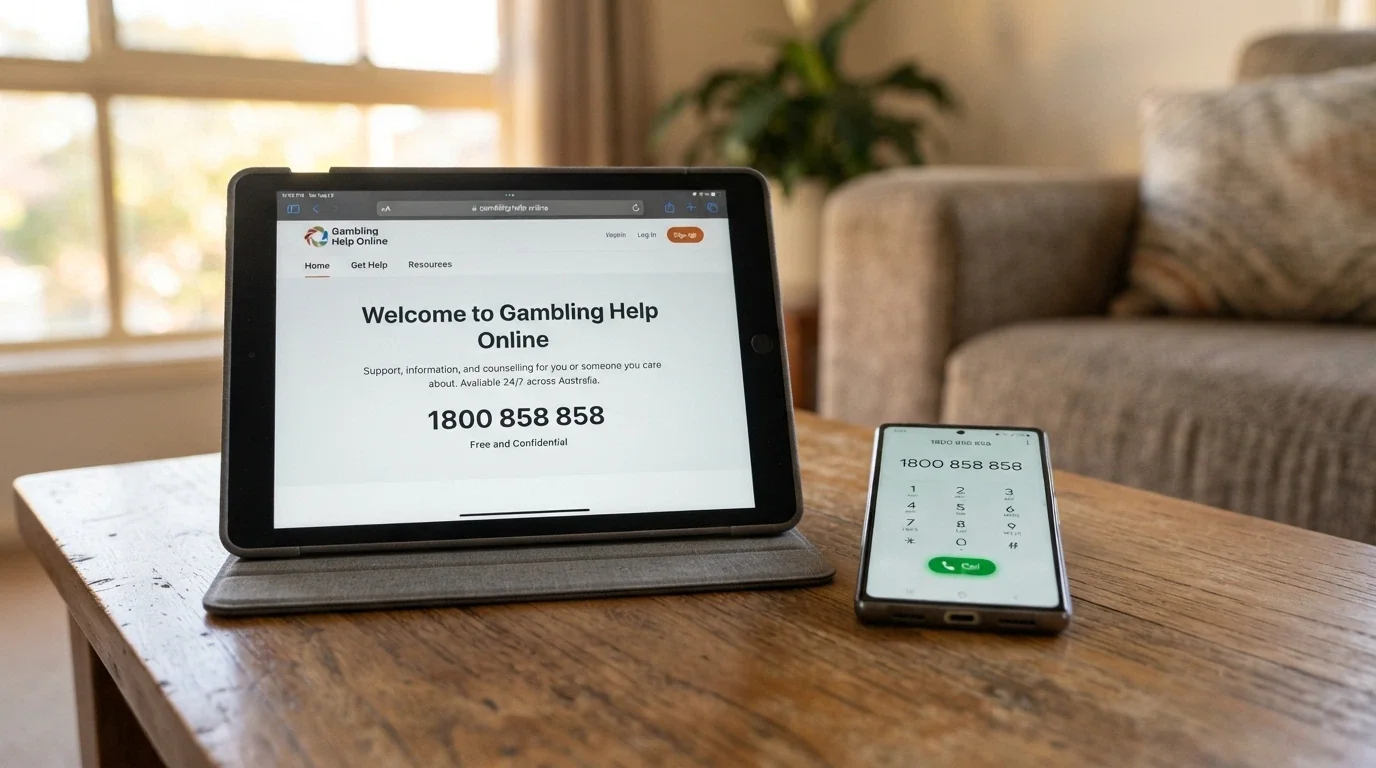
The harm-prevention context is the wider frame. Between March 2025 and March 2026, Australians lost A$36.0 billion to gambling, and losses have increased every year since the COVID-19 pandemic. Overall gambling participation declined to 58.8% in 2025, but risky gambling — measured by the Problem Gambling Severity Index — increased to 19.4%, up from 13.7% the year before. About 2.1% of Australian adults — roughly 430,000 people — experience problem gambling. Approximately 3.29 million Australians aged five and over are affected annually by their own or another person’s gambling, including about 1.38 million adult affected others. On a per-person basis, Australians lose more money to gambling than any other country.
The help infrastructure is real, free, confidential and outside the offshore market. The National Gambling Helpline is 1800 858 858 — a free call from anywhere in Australia, staffed 24 hours a day, with online chat and professional counselling through Gambling Help Online. The two channels are the safety net the offshore casinos do not connect to. A player concerned about their own play, or about the play of someone close to them, can reach help without going through the offshore casino’s customer service.
The BetStop gap: why self-exclusion does not reach the casinos on this page
BetStop is a structural feature of the licensed market. One registration, one form, one confirmation, and a person is excluded from every Australian-licensed online and phone wagering service for a period of their choice — from three months to lifetime. The register is administered by the ACMA, which publishes quarterly statistics. The active exclusion count has grown steadily since the register launched on 21 August 2023.
The gap is the offshore market. A Curacao casino is not required to honour a BetStop registration and does not connect to the register. A person who has self-excluded from licensed AU wagering can still deposit at any of the ten operators on this page, and the operator has no obligation to refuse the deposit. The only self-exclusion that works at an offshore casino is the one the player sets with that specific casino, which is per-operator and revocable.
The asymmetry is the point. The Australian safety net is built for the licensed market. The licensed market does not offer the product on this page. A player reading this page is operating outside the safety net, and the tools that work for licensed wagering do not reach the casino they are reading about.
How we evaluated these 25 free spins casinos
The ranking was built from three sources: the operators’ own published terms, the ACMA register and Curacao licence records where available, and a cross-section of affiliate databases — Betzoid, PokiesRoo, Casinoshub, VegasPokie, Casipto, TheRxReview, WatchMynumbers, Ausslots and PayoutVerdict — that aggregate no-deposit offers for AU-facing players. Where two sources disagreed on a bonus figure or a wagering multiple, the operator’s own cashier page was treated as the tiebreaker. Where the operator’s own page was silent, the cell in the ranking table is a gap rather than a guess.
The ranking order was weighted by four criteria. First, transparency of terms: operators that publish clear, current wagering requirements, cashout caps and eligible-game lists ranked ahead of operators that publish partial terms. Second, confirmed offer shape: operators with a verified no-deposit or near-no-deposit entry ranked ahead of operators with a deposit-gated welcome only. Third, game-provider breadth: multi-provider catalogues ranked ahead of single-provider catalogues where the rest of the profile was comparable. Fourth, wagering fairness: operators at 30x ranked ahead of operators at 40x, 45x or 50x, and operators at flat 45x ranked ahead of operators with a 50x tier above a deposit threshold.
Two things the ranking does not do. It does not invent numerical weightings for criteria research did not back, and it does not pretend an unconfirmed bonus is confirmed. Several featured operators carry a Curacao licence, a multi-provider catalogue, and a bonus that varies between sources. The table presents those operators honestly; the prose names the data gap; the ranking does not promote an unconfirmed offer above a confirmed one.
What your 25 free spins are actually worth — and whether they are worth claiming
The arithmetic on a 25-spin no-deposit offer runs against the player at every stage. The bonus value is small — A$2.50 to A$5 in nominal spins. The wagering requirement multiplies that figure by 30 to 60, demanding A$75 to A$300 of qualifying turnover on a typical win. The cashout cap, most commonly A$50 to A$100, voids anything above the ceiling. The withdrawal trigger deposit, common at AU-facing offshore casinos, demands a real-money payment before a no-deposit win can leave. The seven-day expiry compresses the play window. The expected loss over the required turnover exceeds the expected value of the win at every realistic win size — a A$5 win at 50x wagering with a 96.71% RTP carries an expected loss of A$8.23 against the A$5 win that produced it.
The arithmetic is not the only cost. The product is prohibited in Australia. The operator is offshore. BetStop does not reach it. ACMA blocks the site at any time, and the player’s balance goes with the block. The regulator that protects the licensed AU punter has no jurisdiction over the operator that takes the no-deposit claim. The harm-prevention context is wide: A$36.0 billion lost in the past twelve months, 19.4% of Australian gamblers in the risky-gambling band, about 430,000 people in problem-gambling territory.
The offer is worth claiming if the player reads it as a paid entry to a session they would otherwise have paid for in full, treats the cap as the ceiling rather than a floor, declines the withdrawal-trigger deposit when it surfaces, and walks away at the bonus-balance threshold that matches the cap rather than the wagering-multiplied win. It is not worth claiming if the player reads “free” as “free”, assumes the casino’s regulator will adjudicate a dispute, or treats the offer as a route around the safety net they have already chosen to use.
The right call is the one the player can defend after the spins have run. The arithmetic, the legal reality and the harm context are on the page; the decision belongs to the player at the keyboard.
Frequently asked questions
What wagering requirements apply to 25 free spins no deposit winnings?
Wagering on 25 free spins no deposit winnings at AU-facing offshore casinos runs from 30x to 60x. A 50x requirement on a A$5 win means A$250 of qualifying turnover before cashout; only eligible pokies count 100% toward it. The expected loss at the typical 96.71% RTP exceeds the A$5 win that produced it.
How much real money can I withdraw from 25 free spins no deposit?
Maximum cashout caps at AU-facing offshore casinos most commonly run from A$50 to A$100, with the wider tested range from A$20 to A$180 at Fair Go’s free-chip variant. The cap is applied after wagering is complete. A player who clears the wagering and lands above the cap withdraws the cap; the surplus is voided.
Do I need a bonus code to claim 25 free spins no deposit in Australia?
Some operators auto-credit the bonus once email or phone verification is complete; no code, no cashier visit required. Other operators require a code, entered at registration or in the cashier, and the offer does not appear until the code is in. Code-gated offers are harder to verify because codes rotate and expire silently without notice.
What happens if an offshore casino blocks my account or refuses a withdrawal?
No Australian regulator has jurisdiction to compel a withdrawal from a Curacao casino. BetStop does not reach the operator; ACMA escalation does not apply; AFCA does not bind offshore entities. A player whose withdrawal is refused must pursue the dispute through the operator’s customer service or the Curacao authority, neither of which has Australian compulsion.
Is it safe to give my ID to an offshore casino for verification?
Identity verification is standard at every casino in this market, with the same documents a licensed AU operator would request: government photo ID, proof of address, sometimes a payment-method screenshot. The structural risk is storage — offshore operators are not bound by Australian Privacy Principles, and a data breach there bypasses the Notifiable Data Breaches scheme.